News & Events

white plant

NEWS

On June 30, InnovPlantProtect (InPP) was present at the meeting “7 years of CoLABs: impacts and perspectives”, which brought together political decision-makers, experts from the Portuguese innovation ecosystem, leaders from different sectors, representatives of public and private entities and the representatives of the 41 Collaborative Laboratories (CoLAB), at the Pavilhão do Conhecimento in Lisbon.

The meeting, organized by the Forum of Collaborative Laboratories (FCoLAB), aimed to reflect on the impact of the work carried out by the different CoLABs over the last seven years, as well as to address future prospects and identify strategies to boost the contribution of scientific research and innovation to the economy and society.

This initiative was an opportunity to showcase the products, services and solutions developed by CoLAB over the last seven years, highlighting its contribution to innovation, competitiveness and sustainability in various sectors of the economy. The application recently launched by InPP, iCountPests, which allows pests to be counted automatically using images from traps, reducing the time invested in monitoring and making it possible to create a pest history, was also highlighted.

The event was attended by the Minister of Education, Science and Innovation, Fernando Alexandre, the Secretary of State for the Economy, João Rui Ferreira, Manuel Heitor, from the IN+ Center for Innovation, Technology and Policy Research and former Minister of Science and Innovation, António Grilo, President of ANI, among others.

In his speech, the Minister for Education, Science and Innovation, Fernando Alexandre, highlighted the purpose of science at national level: “We hope that the science created in Portugal will generate innovation. More than technology, innovation is the answer to society's problems. You are the agents of change!”.

During the session, the main activity indicators and proven impact of the first seven years of CoLABs' activity were also presented, and multisectoral perspectives on their role in the national science and innovation ecosystem were debated, focusing on topics such as socio-economic impact, internationalization, business competitiveness, technological innovation and sustainability.

The activity indicators and the impact of the 7 years of activity are as follows:

  • More than 260 projects approved
  • More than 1,300 qualified jobs created
  • 19M€ in tax revenue generated
  • More than 900 interactions with companies
  • 33 patent applications (10 granted)
  • 680 scientific articles published

The two afternoon panels were attended by companies, partners and management entities, who reflected on the impact generated so far and presented proposals for maximizing CoLAB's long-term contribution to both the economy and Portuguese society.

At a time when the basic funding options for CoLABs are being discussed, this event is of the utmost importance. The area of crop protection, in particular, needs more investment in innovation. Holding this event was important for bringing this urgent and strategically important issue to the debate.

The InPP was also present in the exhibition area, receiving important visitors, including the Minister of Education, Science and Innovation, Fernando Alexandre, the Secretary of State for the Economy, João Rui Ferreira, the Secretary of State for Science and Innovation, Helena Canhão, the President of the FCT, Madalena Alves, the President of the National Innovation Agency, António Grilo, the President of the National Monitoring Committee for the RRP, Pedro Dominguinhos and the Executive Director of Ciência Viva, Ana Noronha.

Image credits: InnovPlantProtect - Inês Ferreira


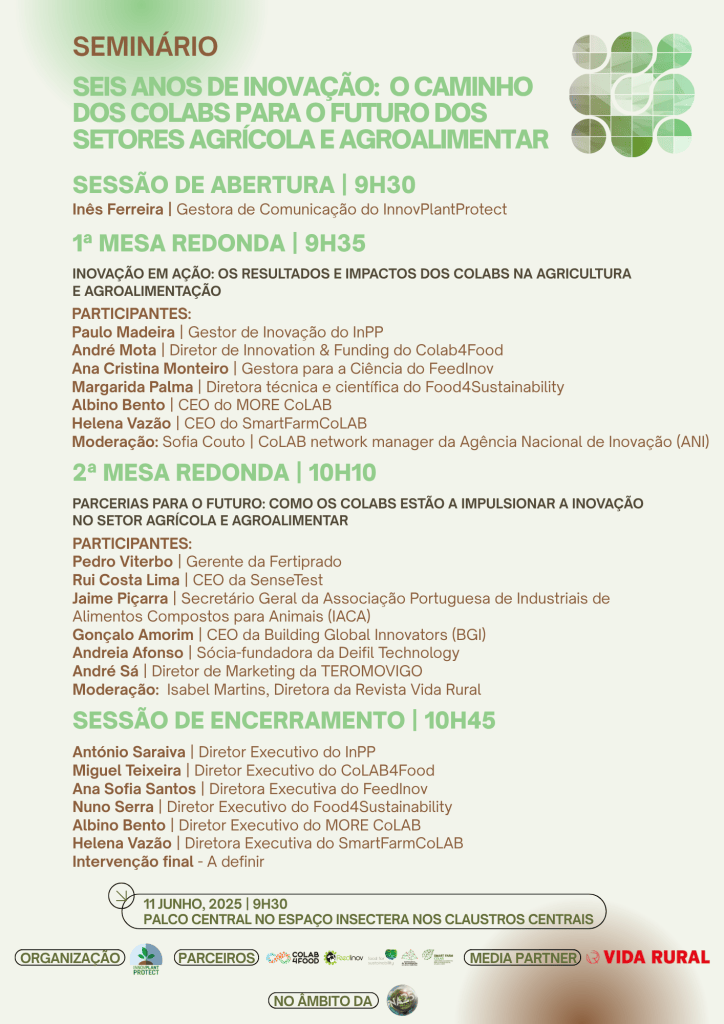
On June 11th, InnovPlantProtect (InPP) held a seminar on “Six years of innovation: CoLABs” path to the future of the agricultural and agri-food sectors", at the National Agriculture Fair (FNA) in Santarém.

The event brought together, for the first time, six Collaborative Laboratories (CoLABs) with direct involvement in the agricultural and agri-food sectors: InnovPlantProtect, CoLAB4Food, FeedInov CoLAB, Food4Sustainability, MORE CoLAB and SmartFarmCoLAB.

The program included two round tables. The first, dedicated to “Innovation in Action: The Results and Impacts of CoLABs in Agriculture and Agrifood”, representatives from each CoLAB took part, presenting success stories and projects developed, with emphasis on the intervention of the innovation manager at InnovPlantProtect, Paulo Madeira, He shared InPP's achievements in developing solutions for more sustainable agriculture.

The second round table, under the theme “Partnerships for the Future: How CoLABs are Driving Innovation in the Agricultural and Agri-Food Sector”, The event was attended by partner companies and associations, who stressed the importance of collaborating with the CoLABs. Among the speakers were Pedro Viterbo, manager of Fertiprado, InnovPlantProtect's partner, accompanied by representatives of the following organizations Sense Test, Associação Portuguesa Dos Industriais De Alimentos Compostos Para Animais (IACA), Building Global Innovators (BGI), DEIFIL Technology and TeroMovigo.

The seminar ended with a moment of joint reflection, with speeches from all the executive directors of the CoLABs present, including the executive director of InnovPlantProtect, António Saraiva, The meeting was organized by the European Commission, which stressed the importance of cooperation and strategic coordination between the Collaborative Laboratories, reinforcing their collective commitment to innovation and sustainable development in the agricultural and agri-food sectors.

Throughout the seminar, the importance of synergies between science, innovation and the market became clear, as did the need to strengthen funding and guarantee conditions for the continuity and growth of these Collaborative Laboratories, whose impacts are already visible in the national agricultural and agri-food ecosystem.

This meeting was an important moment for sharing experiences and strengthening collaborative work, charting a joint path towards a more competitive, sustainable and innovative future for agriculture and agri-food in Portugal.

O InnovPlantProtect (InPP) promotes the seminar “Six years of innovation: The path of CoLABs for the future of the agricultural and agri-food sectors”, on the next day June 11thfrom 09h30 until 11h00, in center stage at Espaço InsectERA, located in the Central Cloisters of the National Center for Agricultural Exhibitions and Markets (CNEMA) in Santarém.

The seminar aims to present the practical results and real impact of six Collaborative Laboratories (CoLABs) in Portugal - InnovPlantProtect, Colab4Food, FeedInov, Food4Sustainability, MORE and SmartFarmCoLAB. These interface infrastructures are essential pillars of the National Innovation System (SNI) and play a growing and essential role in the dynamics of innovation for agriculture and agri-food.

The event will be attended by members of the teams and partners of each of the CoLABs, who will talk about their vision of the added value of these interface and innovation entities, from the point of view of those who collaborate directly with them.

The initiative, which is part of the National Agriculture Fair (FNA) 2025, which this year has the theme “Biosolutions” and will be the stage for exploring the innovations that are shaping the future of the sector, brings together different representatives of the innovation ecosystem to show the role of CoLABs in stimulating the transfer of knowledge and making innovation available to agriculture and agri-food in Portugal, creating value and attracting highly qualified human resources to the country.

See the full program in the image below.

The registration for the event is free, but mandatory due to the limited capacity of the space. Guarantee your presence by filling in the available form here.

We look forward to welcoming you for a morning of sharing and debate on the future of innovation in the agricultural and agri-food sectors!

EVENTS

Nature Plants highlights the advantages of new genome editing techniques but warns of three crucial aspects that still need to be addressed.

“The rapid development of plant biotechnologies is profoundly shaping crop improvement and catalyzing the next revolution in agriculture,” writes an editorial recently published by Nature Plants, entitled Next-generation crop engineering (Next-generation crop engineering).

Crop improvement no longer has to depend on naturally occurring mutations and artificially generated variations can be the raw material for further improvement, the text argues. “A much broader spectrum of phenotypic space is ready for exploration, allowing the development of ideal phenotypes adapted to the heterogeneous environments of Earth, or even Space,” argue the authors of the paper. article, He concluded that “a new agricultural revolution driven by biotechnology could be just around the corner”.

Image: Francesco Gallarotti/ Unsplash

The editorial refers to the promise and advantages of the new genome editing techniques, particularly compared to classical breeding, but not only. And it warns of three crucial factors that are still missing in order to achieve high levels of variation through gene editing: 1) a better understanding of the key regulators for genes that are important from an evolutionary or developmental point of view; 2) being able to dissect networks of genes that control phenotypes of interest and regulatory networks in cis that affect gene expression; 3) to establish stable and efficient transformation and regeneration procedures for most species.

Unless genetic editing in planta is developed quickly, breeding based on gene editing will be unable to benefit recalcitrant species. It is also recalled that there are alternative strategies for engineering new generation crops, such as the transfection of viral RNA in sprays, which allows for the temporary adjustment of agronomic characteristics without modifying the genetic material.

The DGAV has announced new requirements for citrus production and marketing, due to the African citrus psyllid plague.

The technical requirements for the production and marketing of citrus fruits and other rutaceous plants in a place free from Trioza erytreae, the insect vector of the disease citrus greening, were recently updated and published by the Directorate-General for Food and Veterinary (DGAV).

The rutaceae are a family of trees in which the genus Citrus is imperative from the point of view of economic value. O citrus greening, greening citrus greening, Huanglongbing disease or citrus greening is caused by the African citrus psyllid (Trioza erytreae), an insect vector that also causes direct damage to citrus fruits.

“In view of the detection of Trioza erytreae in some regions of the country and given the expansion that has already occurred in the area infested by this insect, we have tried to ensure a set of conditions to ensure the continuity of production and marketing of citrus propagating material in regions where the pest is present,” explain the DGAV officials in a press release. document. The update was motivated by “experience gained in the meantime” and by the new legislation in force: Annex VIII of Implementing Regulation (EU) 2019/2072 and Ordinance no. 142/2020.

A Trioza erytreae is a quarantine pest on national territory. 

In the T. erytreae, In addition to the obligatory declaration of mother or nursery plants, citrus and other rutaceous plants must be produced “in a place with complete physical protection against this insect” and have been subject to two official inspections in the last growing season without showing any symptoms of the pest.

For marketing, the plants must also be kept in a place with complete physical protection against this insect “and come from exempt areas (outside infested zones and buffer zones) or from nurseries located in demarcated zones”, among other requirements, which aim to guarantee that no infestation occurs.

InPP has a cooperation project with the DGAV to take part in the task force phytosanitary measures and to support the biological control plan with a view to controlling the Trioza erytreae.

Feature image: mac231/ Pixabay

Researchers at InPP are developing machine learning methods for predicting phenotypic traits from genetic information of key crops. The project is led by Manisha Sirsat, from the Data Management and Risk Analysis Department, which is headed by Ricardo Ramiro, in collaboration with the Protection of Specific Crops Department, headed by Paula Oblessuc.

Over the last decade, machine learning has become part of our everyday lives, when it suggests the next song you should listen to or the restaurant you should go to. This branch of artificial intelligence is focused on building models and applications that can learn from data, in order to predict a particular outcome. For this to be possible, large amounts of data are necessary which, until recently, would preclude its application in most fields of biology. However, in the last 20 years, biology has become a data-intensive discipline, due to the revolution brought by high-throughput systems for fields as disparate as genomics and microscopy. Thus, machine learning methods are now being applied to a wide range of biological questions.

At InPP, the team is taking advantage of the availability of high-throughput genomic and phenotypic data for key phenotypes of important crops (e.g. wheat genomes and yield) and using this data to develop machine learning models that can predict the phenotype from the genotype. This approach is termed Genomic Prediction. “The aim is to develop an advanced genomic prediction tool which uses genome-wide genetic markers to predict complex traits,” states Manisha Sirsat. “This will allow us to identify genetic markers that can increase agricultural productivity and that can accelerate plant breeding programs,” adds Ricardo Ramiro.

© 2021 InnovPlantProtect, All rights reserved