News & Events

white plant

NEWS

“We're here to listen to the sector's problems and find solutions together”. This was said by António Saraiva, executive director of InnovPlantProtect (InPP), who attended the eighth edition of the National Olive Oil Congress, held in Campo Maior and featured in the July edition of Voz do Campo magazine.

In the interview, António Saraiva highlighted the importance of olive growing, one of the most representative crops in the Mediterranean, and pointed out some of the major challenges currently facing the sector:

  • A growing shortage of phytosanitary solutions: many tools are disappearing and effective alternatives are not always emerging.

  • The long road between research and application in the field: the process of bringing a scientific solution to farmers can take around 10 years.
  • Impacts of climate change and emerging pests, which make farming even more difficult.

Faced with these challenges, InPP is committed to developing new innovative solutions that are environmentally friendly and sustainable for farmers. CoLAB is looking for agents such as active substances and microorganisms capable of controlling diseases and boosting biostimulants, as well as investing in digital technologies that allow producers to detect crop problems early and increase the effectiveness of interventions.

Another point highlighted by the executive director is the need to speed up the transfer of knowledge to the field, through partnerships and commercial agreements that ensure that innovations actually reach farmers.

“We're here to listen to the sector's problems and find solutions together. We want to be close to farmers, associations and companies, because that's the only way we can develop effective and sustainable tools,” António Saraiva stressed.

The full interview is available in the July issue of Voz do Campo magazine, on newsstands now, and in the image below.

It's called PROSPER and it's a new European project that aims to transform European agriculture through the valorization of “orphan” legumes - resistant crops, little exploited, but with great potential to face the challenges of climate and food in the future.

The consortium, with total funding of around 5 million euros, brings together 27 partners from 13 European countries and Tunisia, including universities, research centers, companies and non-profit organizations in the agricultural sector. Among them are countries from the Mediterranean (Italy, Spain, Greece, Portugal and France), Central Europe (Germany, Belgium, Poland, Bulgaria and Romania), Northern Europe (Denmark, Sweden and Finland).

The aim of PROSPER is to test and validate new agricultural diversification strategies, adapted to different climates and social and economic contexts, promoting more sustainable, innovative practices that are adjusted to the needs of different agricultural realities.

InPP, PROSPER's partner, will be responsible for analyzing:

  • Soil health and environmental impact
  • Energy efficiency and waste management
  • Nutritional quality of crops
  • Fair valuation along the production chain

To do this, the InPP team will use advanced technologies, such as real-time sensors and geospatial analysis, which will help study soil health, carbon sequestration captured by crops, water management and biodiversity, among others.

PROSPER is co-created with the main players in the agricultural sector, ensuring that the solutions developed do not remain on paper: they will be practical, useful and transformative.

The project starts in September 2025. We are ready to embark on this journey towards a greener, fairer and more resilient agriculture.

Stay tuned for more news!

InnovPlantProtect (InPP) was present at the Science 2025 Meeting in Lisbon, at the Nova SBE Campus, to take part in the parallel session “Crop Protection for One Health, and Food and Environmental Sustainability”.

The Encontro Ciência took place from July 9 to 11 at the NOVA SBE Campus in Carcavelos, with the motto “Science, Innovation and Society”. Portugal's largest science and technology meeting was the stage for promoting and discussing the scientific, social, cultural and economic impact of research in Portugal, exploring the intersection between science, innovation and society, to inspire new ideas and foster transformative collaborations.

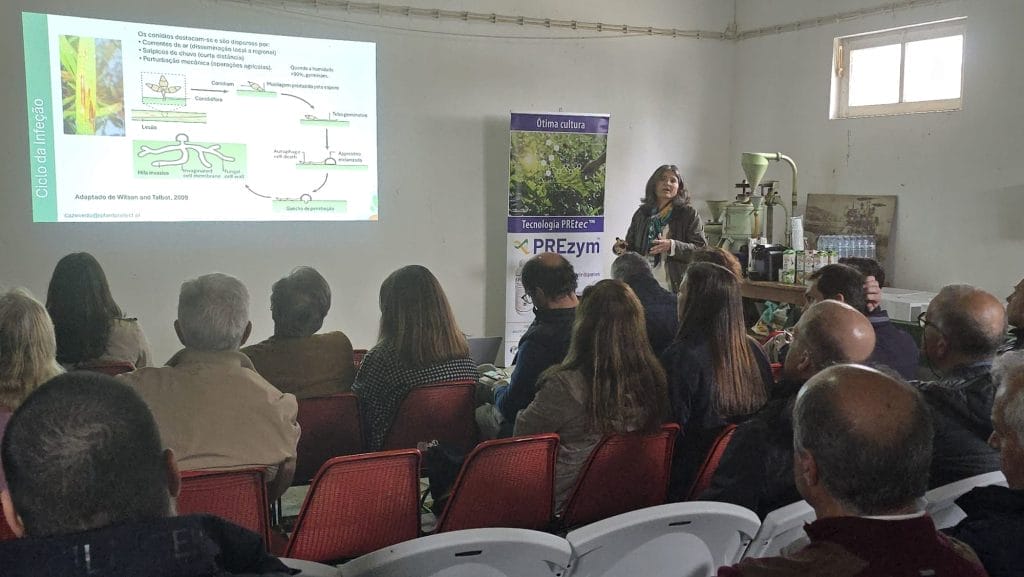
The director of the Data Management and Risk Analysis Department, Ricardo Ramiro, and the director of the New Biopesticides Department, Cristina Azevedo, presented some of the results of their work in this session co-moderated by the executive director, António Saraiva.

During the session, two important solutions for the agricultural sector, developed by our team, were presented:

  • iCountPests - an innovative app that uses AI to detect and count pests accurately and quickly in photos of chromotropic traps.
  • InPP 2 - a broad-spectrum biofungicide capable of fighting Botrytis cinerea, the fungus responsible for gray rot in tomatoes.

CoLAB MORE Colab - Collaborative Mountain Research Laboratory and Sfcolab - Collaborative Laboratory for Digital Innovation in Agriculture, were also present at the parallel session, as well as GREEN-IT, to discuss how science and innovation can tackle the challenges of climate change and promote more sustainable agricultural systems.

EVENTS

We are very pleased to announce the recent visit and knowledge-sharing session with our associate Antonio Villalobos, Agronomic Solutions Manager at Bayer Crop Science Portugal.

During the meeting, António Villalobos gave a comprehensive overview of the radical transformation that the crop protection sector is going through, highlighting two crucial vectors of innovation for the Sustainable Agriculture of the future: the growth of Biological Solutions and the advance of Digital Tools.

Trends and Key Messages

The presentation highlighted the new paradigm guiding agricultural strategy, driven by the need for greater sustainability and efficiency:

  • European leadership in reducing inputs: Europe has been at the forefront of the sharp reduction in available conventional protective active ingredients, which requires an unavoidable commitment to the constant innovation in the search for safer and more effective alternatives.
  • The Rise of the Biological: The future of crop protection undeniably lies in biological solutions. These compounds - which include biopesticides, biostimulants e biofertilizers - represent around 20% of the global Crop Protection market by 2030.
    • Functions of Biological Compounds: These products are used as biocontrol (against pests and diseases), biostimulants (improving tolerance to stress and nutrition) and biofertilizers (increasing the efficiency of nutrient absorption).
  • The Essential Role of Digital Tools: Digital technologies are the cornerstones of modern and precise agricultural management. Examples include risk forecasting (weather, pests), waste calculation and management and optimization of water management.
  • Paradigm Shift: From Products to Integrated Solutions: The sector is witnessing an evolution in companies“ portfolios, which are migrating from offering isolated ”products" to Integrated Solutions. These solutions strategically combine quality seeds, conventional synthetic products (in optimized and reduced doses), biological compounds and digital tools for more robust, efficient pest and disease control in line with sustainability objectives.

Recognition

Special thanks to Antonio Villalobos and Bayer Crop Science for the continuous collaboration and inspiring sharing of knowledge in a field that is proving to be fundamental for the competitiveness and sustainability of Portuguese agriculture.

Image credits: InnovPlantProtect - Inês Ferreira

On November 12, InnovPlantProtect (InPP) had the pleasure of welcoming researchers from iBET - Institute of Experimental Biology and Technology, for a session dedicated to valorization of wine production by-products as sustainable biopesticides.

The session was attended by Naiara Fernández, Senior Scientist and Leader of the iBET Technology Platform, and of João Baixinho, D. student on the same platform. The researchers shared the center's mission and main lines of research, with particular emphasis on the development of new biopesticides with high potential for agricultural application.

Innovation and the Circular Bioeconomy

The focus of the presentation was on the exploitation of wine-growing by-products, transforming waste into high value-added solutions for crop protection.

  • Potential Biopesticides: The compounds under study showed promising properties, being able to inhibit disease-causing microorganisms in crops and to exercise effective mite control, It represents a sustainable alternative to conventional phytopharmaceuticals.

  • The Tec4Green Project: The role of the project was highlighted Tec4Green, This is a mobilizing agenda co-funded by the Recovery and Resilience Plan (PRR). This ambitious project brings together 18 strategic partners with the aim of developing a new generation of products for crop protection and nutrition, in line with the principles of the circular bioeconomy and sustainability.

Thank you

InPP would like to thank iBET for the visit and the inspiring sharing of knowledge in an area that is crucial for the future of crop protection and the advancement of sustainable agriculture in Portugal.

Image credits: InnovPlantProtect - Inês Ferreira

InnovPlantProtect (InPP) was honored to receive, on October 15th, the Hubel Verde, our newest associate. The visit provided a sharing session on the innovative solutions that the company provides for the management and protection of agricultural crops.

During the meeting, João Caço, Executive Director of Hubel Verde, and Margarida Mota, Innovation Coordinator, presented the company, its mission and its vast portfolio of products. innovative and sustainable solutions. These solutions are designed to respond effectively to the diverse needs and realities of the field in Portuguese agriculture.

Spotlight on Technology and Efficiency

The presentation focused on technologies aimed at increasing efficiency and sustainability in the sector:

  • Low Volume Electrostatic Nebulizers: Special attention was paid to this cutting-edge technology, which allows for a more precise, economical and efficient application of crop protection products, minimizing waste and environmental impact.
  • Integrated Services and Solutions: Hubel Verde highlighted its scientific know-how in integrated services and solutions which cover various aspects of crop management. These holistic approaches are crucial to ensuring the greatest success and profitability of agricultural activity.

Recognition and Collaboration

InPP would like to thank Hubel Verde for the visit and the valuable sharing of knowledge and technologies. Your experience is fundamental to the development and modernization of crop protection and agriculture in Portugal.

Image credits: InnovPlantProtect - Inês Ferreira