News & Events

white plant

NEWS

On June 30, InnovPlantProtect (InPP) was present at the meeting “7 years of CoLABs: impacts and perspectives”, which brought together political decision-makers, experts from the Portuguese innovation ecosystem, leaders from different sectors, representatives of public and private entities and the representatives of the 41 Collaborative Laboratories (CoLAB), at the Pavilhão do Conhecimento in Lisbon.

The meeting, organized by the Forum of Collaborative Laboratories (FCoLAB), aimed to reflect on the impact of the work carried out by the different CoLABs over the last seven years, as well as to address future prospects and identify strategies to boost the contribution of scientific research and innovation to the economy and society.

This initiative was an opportunity to showcase the products, services and solutions developed by CoLAB over the last seven years, highlighting its contribution to innovation, competitiveness and sustainability in various sectors of the economy. The application recently launched by InPP, iCountPests, which allows pests to be counted automatically using images from traps, reducing the time invested in monitoring and making it possible to create a pest history, was also highlighted.

The event was attended by the Minister of Education, Science and Innovation, Fernando Alexandre, the Secretary of State for the Economy, João Rui Ferreira, Manuel Heitor, from the IN+ Center for Innovation, Technology and Policy Research and former Minister of Science and Innovation, António Grilo, President of ANI, among others.

In his speech, the Minister for Education, Science and Innovation, Fernando Alexandre, highlighted the purpose of science at national level: “We hope that the science created in Portugal will generate innovation. More than technology, innovation is the answer to society's problems. You are the agents of change!”.

During the session, the main activity indicators and proven impact of the first seven years of CoLABs' activity were also presented, and multisectoral perspectives on their role in the national science and innovation ecosystem were debated, focusing on topics such as socio-economic impact, internationalization, business competitiveness, technological innovation and sustainability.

The activity indicators and the impact of the 7 years of activity are as follows:

  • More than 260 projects approved
  • More than 1,300 qualified jobs created
  • 19M€ in tax revenue generated
  • More than 900 interactions with companies
  • 33 patent applications (10 granted)
  • 680 scientific articles published

The two afternoon panels were attended by companies, partners and management entities, who reflected on the impact generated so far and presented proposals for maximizing CoLAB's long-term contribution to both the economy and Portuguese society.

At a time when the basic funding options for CoLABs are being discussed, this event is of the utmost importance. The area of crop protection, in particular, needs more investment in innovation. Holding this event was important for bringing this urgent and strategically important issue to the debate.

The InPP was also present in the exhibition area, receiving important visitors, including the Minister of Education, Science and Innovation, Fernando Alexandre, the Secretary of State for the Economy, João Rui Ferreira, the Secretary of State for Science and Innovation, Helena Canhão, the President of the FCT, Madalena Alves, the President of the National Innovation Agency, António Grilo, the President of the National Monitoring Committee for the RRP, Pedro Dominguinhos and the Executive Director of Ciência Viva, Ana Noronha.

Image credits: InnovPlantProtect - Inês Ferreira


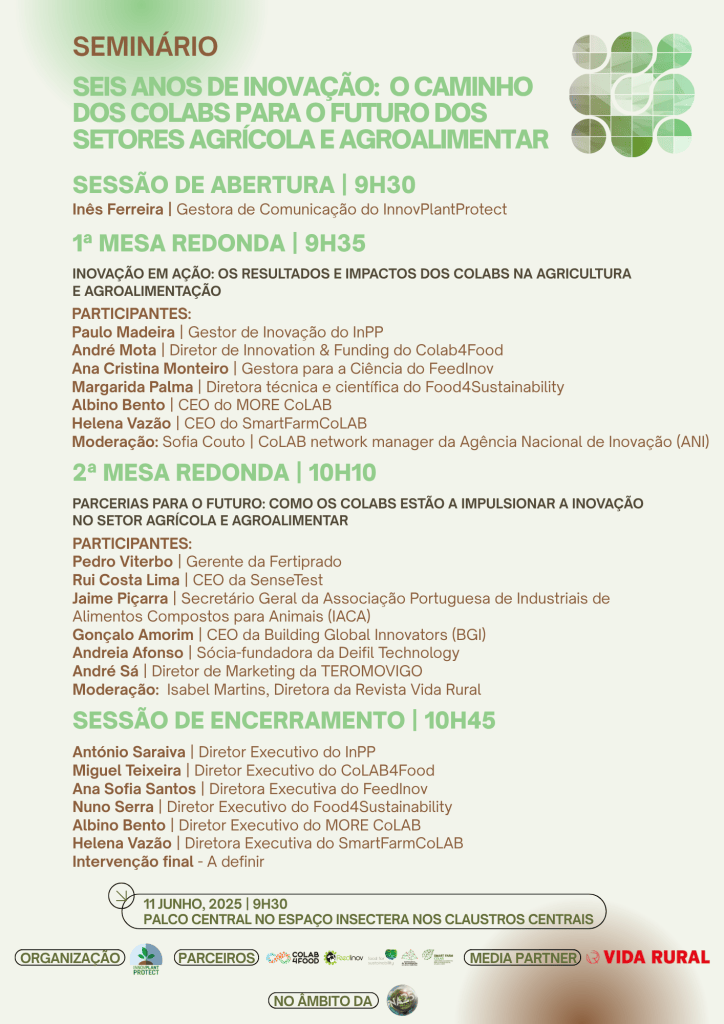
On June 11th, InnovPlantProtect (InPP) held a seminar on “Six years of innovation: CoLABs” path to the future of the agricultural and agri-food sectors", at the National Agriculture Fair (FNA) in Santarém.

The event brought together, for the first time, six Collaborative Laboratories (CoLABs) with direct involvement in the agricultural and agri-food sectors: InnovPlantProtect, CoLAB4Food, FeedInov CoLAB, Food4Sustainability, MORE CoLAB and SmartFarmCoLAB.

The program included two round tables. The first, dedicated to “Innovation in Action: The Results and Impacts of CoLABs in Agriculture and Agrifood”, representatives from each CoLAB took part, presenting success stories and projects developed, with emphasis on the intervention of the innovation manager at InnovPlantProtect, Paulo Madeira, He shared InPP's achievements in developing solutions for more sustainable agriculture.

The second round table, under the theme “Partnerships for the Future: How CoLABs are Driving Innovation in the Agricultural and Agri-Food Sector”, The event was attended by partner companies and associations, who stressed the importance of collaborating with the CoLABs. Among the speakers were Pedro Viterbo, manager of Fertiprado, InnovPlantProtect's partner, accompanied by representatives of the following organizations Sense Test, Associação Portuguesa Dos Industriais De Alimentos Compostos Para Animais (IACA), Building Global Innovators (BGI), DEIFIL Technology and TeroMovigo.

The seminar ended with a moment of joint reflection, with speeches from all the executive directors of the CoLABs present, including the executive director of InnovPlantProtect, António Saraiva, The meeting was organized by the European Commission, which stressed the importance of cooperation and strategic coordination between the Collaborative Laboratories, reinforcing their collective commitment to innovation and sustainable development in the agricultural and agri-food sectors.

Throughout the seminar, the importance of synergies between science, innovation and the market became clear, as did the need to strengthen funding and guarantee conditions for the continuity and growth of these Collaborative Laboratories, whose impacts are already visible in the national agricultural and agri-food ecosystem.

This meeting was an important moment for sharing experiences and strengthening collaborative work, charting a joint path towards a more competitive, sustainable and innovative future for agriculture and agri-food in Portugal.

O InnovPlantProtect (InPP) promotes the seminar “Six years of innovation: The path of CoLABs for the future of the agricultural and agri-food sectors”, on the next day June 11thfrom 09h30 until 11h00, in center stage at Espaço InsectERA, located in the Central Cloisters of the National Center for Agricultural Exhibitions and Markets (CNEMA) in Santarém.

The seminar aims to present the practical results and real impact of six Collaborative Laboratories (CoLABs) in Portugal - InnovPlantProtect, Colab4Food, FeedInov, Food4Sustainability, MORE and SmartFarmCoLAB. These interface infrastructures are essential pillars of the National Innovation System (SNI) and play a growing and essential role in the dynamics of innovation for agriculture and agri-food.

The event will be attended by members of the teams and partners of each of the CoLABs, who will talk about their vision of the added value of these interface and innovation entities, from the point of view of those who collaborate directly with them.

The initiative, which is part of the National Agriculture Fair (FNA) 2025, which this year has the theme “Biosolutions” and will be the stage for exploring the innovations that are shaping the future of the sector, brings together different representatives of the innovation ecosystem to show the role of CoLABs in stimulating the transfer of knowledge and making innovation available to agriculture and agri-food in Portugal, creating value and attracting highly qualified human resources to the country.

See the full program in the image below.

The registration for the event is free, but mandatory due to the limited capacity of the space. Guarantee your presence by filling in the available form here.

We look forward to welcoming you for a morning of sharing and debate on the future of innovation in the agricultural and agri-food sectors!

EVENTS

On March 18th, InnovPlantProtect (InPP) took part in the Ucanorte XXI Field Day, organized by our associate Fertiprado.

The morning kicked off with an auditorium session featuring InPP. António Saraiva, executive director of CoLAB, introduced InPP and the different innovative solutions and technologies that are being developed to protect crops. Ricardo Ramiro, director of the Data Management and Risk Analysis department, was another speaker who presented the services that can be of use to corn silage producers.

Samira Andrade, a researcher at Fertiprado, shared the promising results of her collaboration with the InPP team on seed coating.

Many thanks to Fertiprado for the invitation and the opportunity to strengthen our partnership!

Image credits: Fertiprado

Photos from left to right: António Saraiva, executive director of InPP; Ricardo Ramiro, director of the Data Management and Risk Analysis department and Samira Andrade, Fertiprado researcher collaborating with CoLAB.

InPP is the leader of a project that aims to develop sustainable and effective biopesticides to control two of the most important diseases of the olive grove, gafa and tuberculosis. This biopesticide, obtained from the plant biomass left over from the production of cannabis for medicinal purposes, will innovate and boost sustainability in this booming industry in Portugal. With an investment of 150,000 euros from the “la Caixa” Foundation, ValorCannBio promises to revolutionize the sector, positioning it as an important player in the circular economy and in reducing waste.

You have to travel to the heart of the Mediterranean, one of the regions most vulnerable to climate change, to get to the olive grove, an ancient crop and economic engine, and understand the uphill battle it faces. Gafa and tuberculosis, two of the most important olive diseases, threaten the production of olive oil, one of Portugal's most valuable export products, especially in the Alentejo, where 75% of national production is concentrated.

Gafa, caused by the fungus Colletotrichum sp., can decimate up to 80% of production, representing losses of more than 50 million euros and threatening traditional Portuguese varieties such as Galega. Tuberculosis, caused by the bacterium Pseudomonas savastanoi pv. savastanoi (Pss), compromises the quality of olive oil, and current copper-based control methods are ineffective and harmful to the environment.

Left photo: Olive grove, agricultural crop in focus of the ValorCannBio project; Center photo: Olive infected with the fungus Colletotrichum, The bacterium, which causes gafa, one of the most important diseases of the olive grove; Photo on the right: Olive tree infected with the bacterium Pseudomonas savastanoi, which causes tuberculosis, one of the most important diseases of the olive grove.

Cannabis: A New Hope for the Olive Grove

In a promising turnaround, the production of medical cannabis (with the scientific name Cannabis sativa) flourishes in Portugal, including in the Alentejo, with the country on its way to becoming one of the world's largest producers. However, the flower, rich in valuable compounds such as THC and CBD, is the only part of the plant that is used, while the remaining biomass legally has to be incinerated, a process with high economic and environmental costs.

What if this biomass, with its more than 500 chemical compounds, some of which have proven antibacterial and antifungal properties that are already known and others that have yet to be discovered, could be transformed into a solution to the challenges facing the olive grove? This is where the ValorCannBio: Valorization of medicinal cannabis by-products as a biopesticide for olive groves, a beacon of innovation and sustainability.

ValorCannBio: Science and Sustainability in Action

Led by InPP, in partnership with NOVA FCT's Associated Laboratory for Green Chemistry (LAQV requimte) and the companies GreenBePharma (GBP) and AGR Global, ValorCannBio is transforming surplus biomass from medical cannabis into effective and sustainable biopesticides against Gafa and Tuberculosis.

This is the first time that InPP has joined projects related to innovation and sustainability in the cannabis production industry and it wants to play a decisive role in the value chain. “Our team of researchers is developing sustainable biofungicides and biobactericides, using new extraction methods with environmentally friendly solvents. We are creating solutions that increase the efficiency and sustainability of this industry,” says Tatiana Gil, an InPP researcher involved in the project.

But the team of researchers isn't stopping there. “We are still unraveling the secrets of endophytic cannabis bacteria, microorganisms that live in symbiosis with the plant, as biological control agents,” he adds.

And how do you turn a cannabis leaf into a shield for the olive grove? Tatiana Gil explains the process step by step: “First, we test the effectiveness of the extracts in the laboratory, like detectives looking for clues. Then we formulate the biopesticide and assess its impact in a greenhouse, in a controlled environment. Finally, we take the solution to the field for the final test.”.

Tatiana Gil, InnovPlantProtect researcher, analyzes samples of cannabis leaf extracts as part of the ValorCannBio project.

An Impact that extends across the Territory

Cristina Azevedo, InPP researcher and project leader, anticipates the impact of ValorCannBio: “All of these impacts will be felt in the municipality of Elvas, where the project will take place, but it is expected that they will extend to the entire olive-growing region from Trás-os-Montes to the Algarve, where production losses due to gafa and tuberculosis are increasing, and eventually to Mediterranean countries where these diseases are equally prevalent.”.

ValorCannBio not only aims to offer a sustainable alternative to chemical pesticides, but also opens up a new way of valorizing the remaining biomass of the cannabis plant that is not used for medicinal purposes, transforming it from a waste product into a valuable resource.

“We want to create a parallel and complementary industry to the production of medicinal cannabis, involving the production of biopesticides,” reveals Cristina Azevedo, “which will pave the way for other innovations,” she adds.

A Sustainable Future for the Olive Grove

The ValorCannBio project is an example of how innovation and sustainability can go hand in hand, offering solutions to the challenges of modern agriculture. By harnessing the potential of medicinal cannabis, ValorCannBio is helping to build a greener, more prosperous future for olive groves and the planet.

With the support of the “la Caixa” Foundation, in partnership with Banco BPI and the Foundation for Science and Technology (FCT), ValorCannBio, which began in October 2024, promises to be a success story until November 2027.

By the end of spring, the National Vector Insect Monitoring System project team will be working on the Xylella fastidiosa (SNM_XylellaVt), funded by the PRR, challenges citizens to keep an eye on plant foams: by detecting foams on plants, recording the data in the app and filling in the online form, it helps them to create an up-to-date map of the temporal and spatial distribution of the appearance of the juvenile stage of 4 species of leafhoppers in Portugal, which, once adult, are responsible for carrying the quarantine bacterium Xylella fastidiosa from one plant to another.

The presence of the bacteria has already been detected in Portugal Xylella fastidiosa in four species of leafhoppers in mainland Portugal, but little is known about the current temporal and spatial distribution of these insects in our country. With this in mind, the project team SNM_XylellaVt, challenges citizens to be on the lookout for foams, located mainly on the stems of plants, in their daily lives, on vacation in Portugal, or when walking in natural spaces, olive groves, vineyards, pastures, orchards or in the montado. Foams are signs of the presence of these insect species that are vectors for the transmission of the bacteria Xylella fastidiosa.

Left and center photos: Examples of foams found in plants; Right photo: foam leafhopper, an insect that transmits the bacteria. Xylella fastidiosa

“With the help of all citizens, we will be able to understand the population dynamics of insect vectors and their relationship with plants, which could help us plan measures to combat Xylella fastidiosa, preventing the spread of this bacterium. This is very relevant given that we don't have a direct curative treatment for this bacterium, which makes its control extremely difficult,” explains Ilaria Marengo, a partner in the SNM_XylellaVt project and researcher at InPP. “Destroying infected plants and controlling insect vectors are currently the main measures to prevent the spread of the bacterium,” she adds.

Everyone can contribute to the “Help us save your plants!” campaign that is currently underway: all you have to do is, when you spot the leafhopper foams, take photos of the foams, located on the stems of the plants, and of the plant where you found them, record the data in the ODK Collect 2024 application available for your cell phone (see image below), record the date and geographical location - if possible with GPS coordinates - or alternatively, submit this data using a online form on the project platform. Once you have submitted your data, you will be able to view it on the available map aqui.

Steps on how to install and use the ODK Collect 2024 application on your cell phone or tablet. To install, go to the guide on the DGAV website here.

The “Help us save your plants!” campaign is being developed as part of the SNM_XylellaVt project, which is currently underway. SNM_XylellaVt, led by the Centro Regional Coordination and Development Commission (CCDR CENTRO), and in which InPP is a partner, aims to contain the disease to the areas identified so far and to stop it spreading to the rest of Portugal. To this end, it is creating a network for monitoring the X. fastidiosa and its vector insect(s), in particular the foam leafhoppers, with the scientific name Philaenus spumarius, Philaenus tesselatus, Neophilaenus lineatus e Cicadella viridis, This will enable the development of new tools, such as risk forecasting models that will allow the National Agricultural Warning Service (SNAA) to warn in real time about the economic attack levels (NEA) for these insects, and prevent the spread of infection to crops that are relevant to national agriculture.

In 2019, the bacterium Xylella fastidiosa was first detected in Portugal, in the metropolitan area of Porto, and has since been detected in other areas of mainland Portugal. This bacterium attacks a wide range of plants, posing a risk to agricultural and forestry crops of significant economic importance.

For more information on the bacteria Xylella fastidiosa access the website of the Directorate-General for Food and Veterinary (DGAV) here.