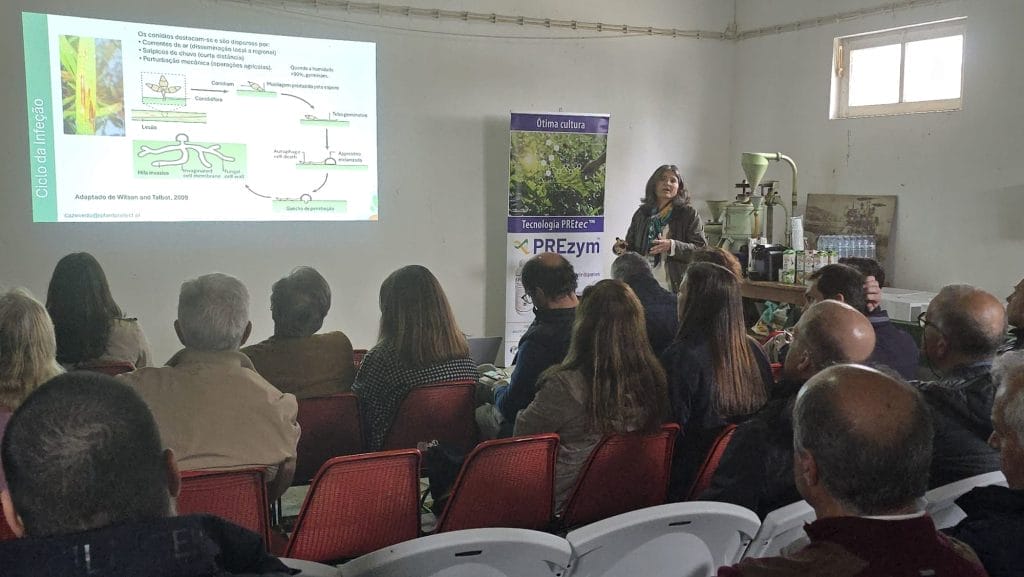
O InPP marcou presença no Encontro com orizicultores e técnicos(as) em Portugal, promovido pela EDAF, que decorreu no dia 5 de março, no Pólo de Inovação de Salvaterra de Magos, em Santarém.
A Diretora de Biosoluções do InPP, Cristina Azevedo, integrou o painel de oradores convidados, tendo apresentado a comunicação intitulada “A problemática da Pyricularia na cultura do arroz”. A apresentação incidiu sobre os principais desafios fitossanitários associados a esta doença, que continua a constituir uma das maiores ameaças à produção de arroz a nível mundial e também em Portugal.
O encontro reuniu produtores, técnicos e especialistas da fileira do arroz, proporcionando um espaço de partilha de conhecimento e debate sobre soluções atuais e em desenvolvimento para o controlo da piriculariose. Foram igualmente abordados outros temas relevantes para a sustentabilidade e produtividade da cultura, nomeadamente a gestão da fertilização.
A participação do InPP neste tipo de iniciativas reforça o compromisso da instituição com a inovação, a transferência de conhecimento e o desenvolvimento de soluções sustentáveis para a agricultura nacional.
O InPP agradece à EDAF e ao COTArroz o convite e a organização deste importante encontro, esperando que esta colaboração continue a fortalecer-se no futuro.
The project TomaBioTec started in January with the aim of developing and validating innovative solutions that contribute to a more sustainable and efficient production of tomatoes in the industry, in line with the current challenges of the agri-food sector, by integrating biotechnology and digital technologies.
The initiative aims to evaluate, under real field conditions, the effectiveness and efficiency of a biosolution with bioprotective and/or biostimulant properties, developed by InnovPlantProtect (InPP), This could help improve the quality and productivity of industrial tomato crops.
The rehearsals take place at Alentejo and Spanish Extremadura and combine traditional agronomic methods with advanced technologies, such as drones, multispectral sensors and artificial intelligence models. This approach allows detailed monitoring of the health of the crop, the presence of pests and diseases and the impact of the bioproduct throughout the production cycle.
The project “TomaBioTec: New biological and digital solutions for tomato crop protection and fertilization” is led by the InPP, in collaboration with the Centro Tecnológico Nacional Agroalimentario Extremadura (CTAEX) and Cordeiro Group, and was selected as one of the winners of the 7th edition of the Promove Program, The prize was awarded by the “la Caixa” Foundation, in partnership with Banco BPI and the Foundation for Science and Technology (FCT), in the category of innovative pilot projects.
This project reinforces the commitment to biological and digital solutions as drivers of more sustainable, competitive agriculture based on scientific evidence, with a direct impact on producers and industry.
InnovPlantProtect (InPP) was present at the XVI National Maize Congress, which also included the 2nd Meeting of Cereal Crops, organized by ANPROMIS, in collaboration with ANPOC and AOP. The event took place on February 11 and 12 at CNEMA in Santarém, bringing together national and international experts to discuss the sector's main challenges.
António Saraiva, Executive Director of InPP, took part in the panel “Cereal Production: What technical challenges are we facing?”, where he highlighted the decisive role of research in responding to the emerging challenges of cereal production, in a context of growing demographic, environmental and economic pressure.
“I'm proud that today, after seven years, we have 28 researchers working full-time on this topic, 12 of whom have PhDs, with experience in crops such as rice, which has been central to our work,” he said, emphasizing the multifunctional and international nature of InPP's teams.
He also pointed out that the work being done extends beyond rice to include maize, through ongoing projects and new operational groups focused on emerging crop problems. Among the initiatives in the spotlight is an application to Horizon Europe focused on developing improved and more resilient varieties.
For António Saraiva, anticipation is the key to success: “These challenges can't wait too long to be discussed or resolved. The sooner we anticipate the issues, the easier, more effective and more economical the solutions will be.”
In a debate that also marked the 40th anniversary of Portugal's integration into Europe and the role of the Common Agricultural Policy in the cohesion of the European Union, one message was clear across the board: “Climate change is the biggest threat we have.”
InPP thus reaffirms its commitment to innovation, science and the development of sustainable solutions for the future of cereal crops.
Farming is considered by many to be a traditional activity, carried out by hand and managed according to the dictates of the Borda d'Água. But is that really the case? Or is it an activity guided by scientific knowledge and which shows leaps in quality, sustainability and productivity when science is applied judiciously in agricultural fields?
This is the theme of the debate, organized by InnovPlantProtect (InPP), which will take place on National Scientific Culture Day, November 24, at 6pm, in the InPP Auditorium, in Elvas, and which brings together a CEO, António Serrano, a scientist, Rosário Félix, a science communicator, Cristina Nobre Soares, and an agricultural producer, Paulo Maria, at the same table to answer the question: “Does agriculture need Scientific Culture?”.
The debate will be moderated by Pedro Fevereiro, executive director of InPP.
Participation is open to all interested parties, subject to prior registration here.
Celebrate this day with us and come and enrich this debate by asking your questions.
The initiative is part of Science and Technology Week 2022, promoted by Ciência Viva, which runs from November 19 to 27 and celebrates science and technology at national level, with the aim of bringing science closer to society and promoting scientific and technological culture in Portugal.
On November 7, the executive director of InPP, Pedro February, took part in the first session of EDE-X - Entrepreneurial Discovery Spaces, a cycle of participatory events dedicated to technology transfer, R&D and innovation, promoted by National Innovation Agency (ANI), which took place in Évora, at the Alentejo Science and Technology Park.
The main objective of the initiative was the collaborative mapping of technology transfer, R&D and innovation models and processes in the context of smart specialization in Portugal.
This session was an opportunity to involve the entire innovation community in the construction of an operational governance model for the National Strategy for Intelligent Specialization (ENEI 2030), made up of multiregional thematic platforms, and a system for monitoring the dynamics of technology transfer in the areas of intelligent specialization.
ENEI 2030, approved in June, served as the motto for the discussion, in which participants were invited to contribute, through co-creation methodologies, to the definition of the lines of action that give shape to its six major priority areas: Digital Transition; Materials, Systems and Information Technologies; Green Transition; Society, Creativity and Heritage; Health, Biotechnology and Food; Major Natural Assets: Forest, Sea and Space.
(Re)watch the best moments of this session in the video available on ANI's YouTube channel here.
The EDE-X series of events was promoted within the framework of the Support System for Collective Actions - Transfer of Scientific and Technological Knowledge, TECH4INNOV, co-financed by the European Union through the European Regional Development Fund, under the Competitiveness and Internationalization Operational Programme (COMPETE 2020) of Portugal 2020.
AlViGen, coordinated by InnovPlantProtect, was one of the innovative pilot projects recently selected and funded under the 4th edition of the Promove Program.
The project “AlViGen: Creation of a hub in ALentejo for the GENomic VIgilance of diseases in agriculture”, led by InnovPlantProtect (InPP) in partnership with the University of Évora (WOW), is one of the winners of the 4th edition of the Promove Program (in the category of innovative pilot projects), financed by the La Caixa Foundation, BPI and the Foundation for Science and Technology (FCT). This project will enable the InPP to create the capacity for early detection of multiple crop diseases, using molecular methods that make it possible to identify important characteristics of pathogens, such as virulence, susceptible varieties and resistance to phytopharmaceuticals, benefiting producers and government authorities.
AlViGen aims to create the first genomic surveillance center in the Alentejo, applied to important agricultural crop diseases, a unique structure at local and national level, with state-of-the-art equipment. Genomic surveillance, a methodology widely applied to the SARS-CoV2 virus (which causes COVID-19), makes it possible to characterize pathogens in detail down to the strain level, enabling the agricultural sector to obtain better information on crop pests and diseases, and to manage the means of control (e.g. pesticides) based on data, in order to reduce possible economic, social and environmental impacts.
Ricardo Ramiro, The InPP researcher responsible for the project explains that “the AlViGen project is important to us so that we can establish the conditions for applying genomic surveillance. Once these conditions are established, we will apply genomic surveillance to fungi in olive groves and wheat fields. We will identify which species of fungi are circulating in the air and also characterize the strains of two key fungi in these crops: Pucciniastriiformis f.sp. tritici (yellow rust on wheat) and Colletotrichum spp. (olive galls). This will allow early and rapid detection of strains of these fungi and some of their characteristics, including virulence and resistance to fungicides or pesticides.”.
“The information obtained could be used to prevent sharp losses in the production of these essential crops for the Alentejo region, which is the main producer at national level,” adds Rosário Félix, a UÉ professor also involved in the project.
In addition to bringing benefits to producers in crop management, the service provided by the AlViGen hub will also be of great interest to government entities or non-governmental organizations focused on protecting agricultural crops or biodiversity, since the genomic information produced makes it possible to identify pathways and routes of pest transmission, allowing authorities to implement policies that minimize the risks of transmission.
The AlViGen project is the result of an international collaboration with institutions in Portugal, Spain and the United Kingdom, bringing together research centers, companies, producer associations and public administration institutions. In addition to InPP and UÉ, the project includes the British research center John Innes Center, the National Institute for Agricultural and Veterinary Research (INIAV), Spanish companies De Prado and Roma/Roma-Bio, the Agrupamento de Produtores de Cereais do Sul (CERSUL) and the General Directorate of Food and Veterinary (DGAV).
The fourth edition of the Promove 2022 competition received 29 proposals divided into three categories, with funding of over 3.6 million euros awarded to just 13 pilot projects across the Iberian Peninsula. The Promove Program aims to support innovative initiatives in strategic areas to boost the sustainable development of Portugal's inland and border regions and which can be replicated in other regions with similar characteristics.






 Português
  English