News & Events

white plant

NEWS

Imagine a future where drones and artificial intelligence work together to protect your vineyards. That's what the AI4Leafhopper project is making a reality!

Manisha Sirsat, a researcher on the AI4Leafhopper team, has developed two artificial intelligence models that analyze the aerial images captured by our latest generation drone... and these models make it possible:

  • geolocation of each vine
  • to know if there are vine failures
  • quickly identify “sick” vines”
  • optimize the application of treatments

The result? Growers can have a detailed view of the health of their vineyards, detect problems early and make more informed decisions.

Find out all about it here.

AI4Leafhopper is a project led by InPP and funded by the ICAERUS Horizon Europe program, which began in April 2024 and ended on April 30 with a final meeting involving the six European projects approved in the 1st edition of the ICAERUS program's PULL applications. The project team presented the AI-based models for detecting and monitoring the impact of the green leafhopper on vineyards.
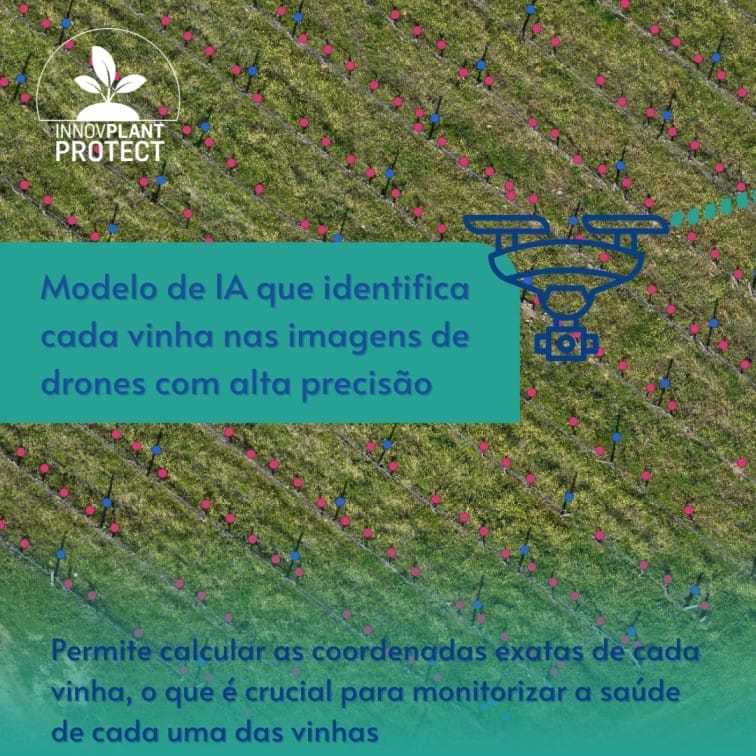
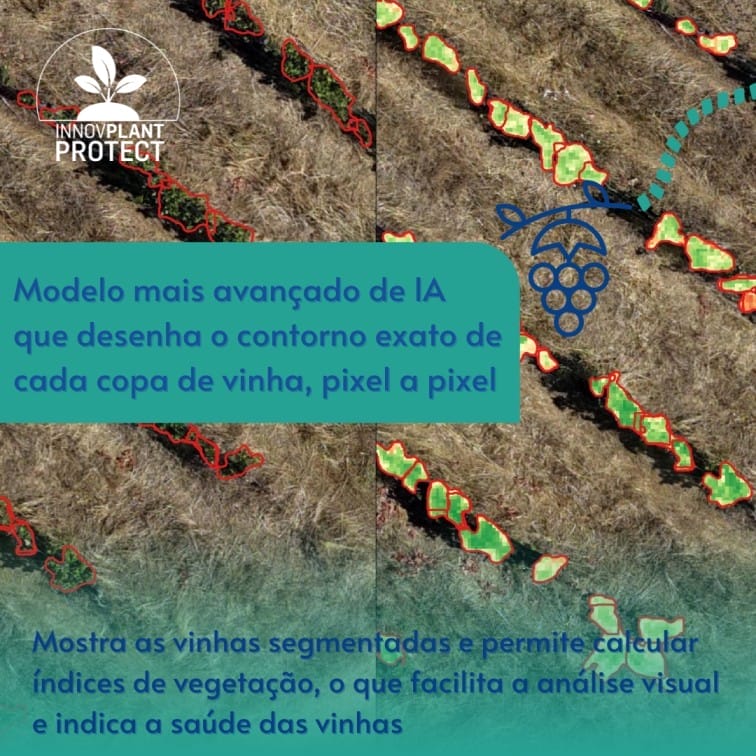
The AI4Leafhopper project, InnovPlantProtect used a state-of-the-art drone to monitor the impact of the green leafhopper in the vineyards of our partners Reynolds Wine Growers and João Portugal Ramos. Although the results show that this advanced technology is more effective at detecting attacks at advanced stages, we are excited about the potential of this tool to provide valuable data for the management of this harmful insect.

We believe that with more research, we can refine our solution to detect early attacks and prevent significant damage to vineyards. Transforming the monitoring of this pest is where we want to go, always with the aim of protecting vineyards and guaranteeing the quality of production for winegrowers.

Over the next few days we'll be revealing everything that the AI4Leafhopper project is making a reality and how drones and artificial intelligence are working together to create a more sustainable future for viticulture. Stay tuned!

Find out all about it here.

AI4Leafhopper, funded by the ICAERUS Horizon Europe program, which began in April 2024, is now in its final stages. The development phase of the project, which took place in the field, is now over and the final stage is to present the solutions developed by our team on Portuguese soil to the market.

EVENTS

Sometimes, if you're inside a building, it's hard to tell whether or not it's raining outside. However, you will easily conclude that it is raining if you see people with open umbrellas. The umbrella is an accessory that helps human beings deal with their environment.

Bacteria can also use “accessories” to better cope with their environments. These accessories, however, have much more profound effects on the lives of microbes, as they take the form of genes that can be integrated into their own genomes. These “accessory” genes are obtained from other microbes or from the environment, and can play various roles, from allowing bacteria to resist antibiotics to enabling symbiotic associations with plants.

Image: Adrianna Calvo/ Pexels

At InPP, the Data Management and Risk Analysis Department is comparing bacterial genomes to identify those that have “accessory” genes that can help plants defend themselves better against pathogens. On the other hand, these analyses also allow us to rule out bacterial strains that could have adverse effects. This information will be crucial for identifying microbes and microbial characteristics that are important for plant protection.

Tobacco whitefly uses a stolen gene to avoid the host's defenses. The discovery is highly relevant to pest control.

The first known case of a natural gene transfer from a plant to an insect has been identified by an international team of researchers. The insect is a whitefly and the discovery could pave the way for new pest control strategies, according to a report published in the newspaper Nature.

Scientists have discovered that Bemisia tabaci appropriated a gene from a host plant millions of years ago, reveals a article published in Cell. The gene allows this pest to neutralize a toxin produced by certain plants to defend themselves against insects.

Some whiteflies use plant genes to render toxins harmless. Image: Gaucho/ Wiki

This aleirodid, also known as the bean or sweet potato whitefly, although it attacks many other vegetable crops, is a worldwide pest and one of the most destructive we know of. A Bemisia tabaci ingests the sugary sap of hundreds of types of plants, excreting a sweet, sticky substance, honeydew, which then serves as a medium for fungi to grow. Whiteflies are also vectors for more than a hundred viruses that are pathogenic to plants.

“It's a remarkable example of how the study of evolution can underpin new approaches to applications such as crop protection,” says Andrew Gloss, who studies plant-pest interactions at the University of Chicago in the USA. The study suggests that inhibiting the gene identified could make this whitefly vulnerable to the toxin, opening up a new way of combating this pest.

Protecting plants from pathogens without genetically modifying crops? A team of Chinese researchers suggests an alternative strategy in the latest issue of Plant Communications.

The biotechnological methods that currently exist to create crops that are resistant to pests and diseases are limited in their applicability, mainly because they are based on transgenics or surface application (which does not allow access to the inner areas of the plant). A scientists' proposal involves the use of small RNA produced by beneficial microbes for crop protection, guaranteeing the stability and delivery of these RNAs to the appropriate place and time.

RNA associated with beneficial microbes in the microbiome to protect crops against pathogens.

The strategy, which eliminates “the need for genetic modification of cultures”, assumes that small RNAs (sRNAs) can be transferred from the microbiome to the host and pathogen, or between elements of the microbiome.

sRNAs are the crucial molecular devices of so-called gene silencing via RNA interference, a mechanism that regulates gene expression at both the transcriptional and post-transcriptional levels.

Title of original article: Trans-kingdom RNAs and their fates in recipient cells: advances, utilization, and perspectives

doi.org/10.1016/j.xplc.2021.100167

