In the March issue of Fruits, vegetables and flowers you will find the opinion article entitled “The role of InnovPlantProtect in Organic Farming: Paths to sustainable and efficient solutions”, in which the executive director of InnovPlantProtect (InPP), António Saraiva, reveals how our CoLAB is contributing to the success of organic farming.
“By boosting research, collaboration and knowledge sharing, InPP is helping to solve the central challenges of this practice [organic farming], allowing it to expand and enhancing the supply of agricultural products to consumers. The solutions developed by InPP make organic farming a more viable option for producers,” says the executive director.
Read the full article and find out how we are shaping the future of agriculture.
We thank Frutas, legumes e flores magazine for its recognition and reiterate our commitment to the agriculture of the future.
Imagine a future where drones and artificial intelligence work together to protect your vineyards. That's what the AI4Leafhopper project is making a reality!
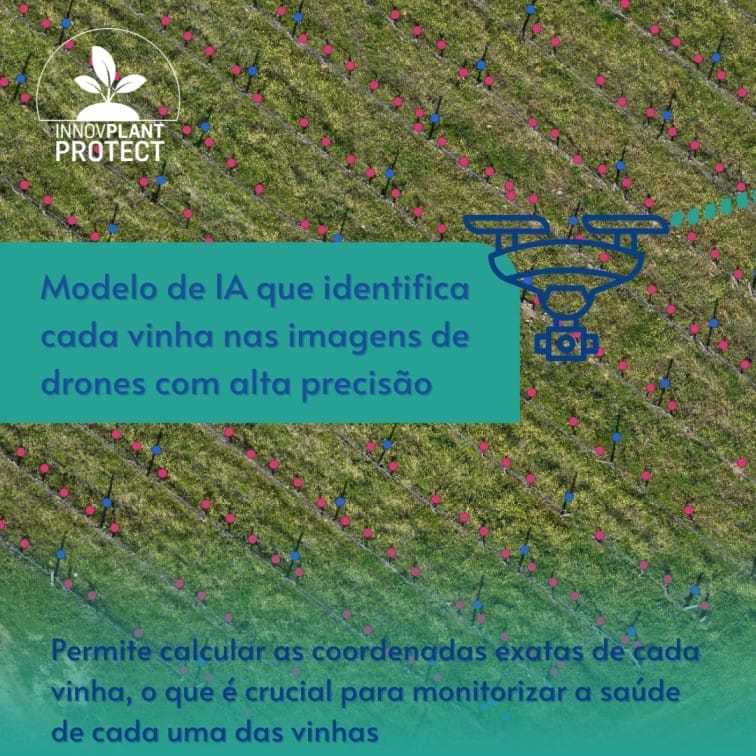
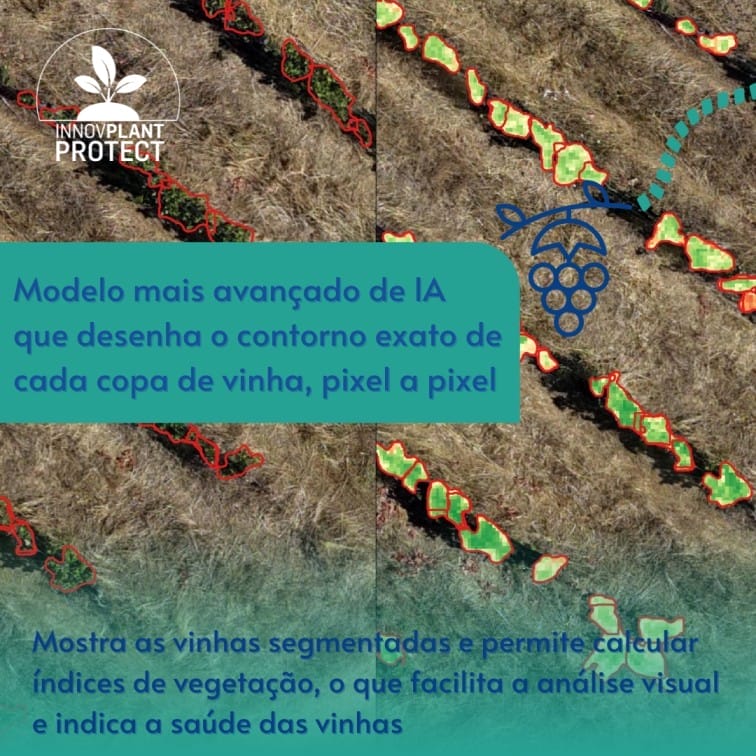
Manisha Sirsat, a researcher on the AI4Leafhopper team, has developed two artificial intelligence models that analyze the aerial images captured by our latest generation drone... and these models make it possible:
geolocation of each vine
to know if there are vine failures
quickly identify “sick” vines”
optimize the application of treatments
The result? Growers can have a detailed view of the health of their vineyards, detect problems early and make more informed decisions.
AI4Leafhopper is a project led by InPP and funded by the ICAERUS Horizon Europe program, which began in April 2024 and ended on April 30 with a final meeting involving the six European projects approved in the 1st edition of the ICAERUS program's PULL applications. The project team presented the AI-based models for detecting and monitoring the impact of the green leafhopper on vineyards.
The AI4Leafhopper project, InnovPlantProtect used a state-of-the-art drone to monitor the impact of the green leafhopper in the vineyards of our partners Reynolds Wine Growers and João Portugal Ramos. Although the results show that this advanced technology is more effective at detecting attacks at advanced stages, we are excited about the potential of this tool to provide valuable data for the management of this harmful insect.
We believe that with more research, we can refine our solution to detect early attacks and prevent significant damage to vineyards. Transforming the monitoring of this pest is where we want to go, always with the aim of protecting vineyards and guaranteeing the quality of production for winegrowers.
Over the next few days we'll be revealing everything that the AI4Leafhopper project is making a reality and how drones and artificial intelligence are working together to create a more sustainable future for viticulture. Stay tuned!
AI4Leafhopper, funded by the ICAERUS Horizon Europe program, which began in April 2024, is now in its final stages. The development phase of the project, which took place in the field, is now over and the final stage is to present the solutions developed by our team on Portuguese soil to the market.
Last Friday, August 26, the InPP received a visit from Catalonia's Councillor for External Action and Open Government, Victòria Alsina, and the delegate of the Government of Catalonia in Portugal, Rui Reis, They were accompanied by the Councillor of Elvas City Council, Paula Calado.
They were received by the heads of department, David Learmonth, iLaria Marengo e Sandra Correia, They presented InPP's infrastructures, laboratories and the different areas of research being explored by the collaborative laboratory's five departments.
The aim of this visit was to create and establish new partnerships and collaborations with this autonomous community of Spain, a key international player for Portugal in its economic and scientific spheres, in which the agri-food industries play a major role. Establishing partnerships is part of InPP's philosophy and, therefore, this visit allowed us to explore the strengths of each of those involved and find points of synergy, where we wanted to identify areas of interest for possible partnerships and collaborations.
During the visit to InPP's facilities, the delegation also had the opportunity to speak to some of InPP's researchers, who were able to personally explain some of the research they are currently carrying out at InPP in the fight against emerging plant pests and diseases.
Tiago Amaro explains the work of the New Biopesticides departmentRupesh Singh, researcher at the Department for the Protection of Specific CropsHadi Sheikhnejad, researcher at the Department for the Protection of Specific CulturesTânia Pinto, researcher in the Formulations and Process Development department
InnovPlantProtect (InPP) team identifies the most promising materials for encapsulating biological protection agents to control emerging pests and diseases in agricultural crops. Natural products of animal origin, from marine and terrestrial sources, as well as synthetic ones, have been the most widely used due to their low toxicity and biodegradability, the researchers conclude in a systematic review article now published in the scientific journal ACS Agricultural Science & Technology. But are these solutions scalable and economically viable?
Biological protection agents, microorganisms such as bacteria, fungi or biomolecules with active substances capable of preventing or controlling or suppressing pests and diseases in plants, have been considered more sustainable alternatives to traditional chemical pesticides. However, these agents are very sensitive to atmospheric conditions and begin to degrade due to humidity, temperature and solar radiation.
Due to the sensitivity of the active substances, the challenge is to develop a biodegradable and sustainable material that envelops, i.e. encapsulates the biological agents, protecting them so that they can be applied effectively to Mediterranean agricultural crops. The encapsulation of biological agents brings several advantages for the agricultural producer, namely ease of handling, controlled application of lower and less frequent dosages, greater specificity for the target, prolonged stability and maximized permanence, which leads to greater effectiveness of the biological agent in combating pests and diseases.
Schematic representation of the encapsulation process of a biological agent to protect pear pests
The four researchers analyzed the studies with a view to “identifying the materials most commonly used to encapsulate biological agents for pest and disease control with greater efficacy, greater systemic activity and less environmental impact”. The researchers also analyzed the encapsulation methods and techniques currently being used by research teams in various parts of the world.
“The data presented in this article indicate that materials based on polymers, of natural or synthetic origin, and inorganic materials can improve the stability and performance of a wide range of bioinspired active substances,” say the researchers.
However, the team warns that “although research interest in these encapsulating materials is increasing, the current level of knowledge does not yet allow for a totally fair and unbiased assessment of the pros and cons that will arise from the use of micro and nano systems for encapsulating biological agents and their use in agriculture”, adding that “a better understanding of the fate and long-term safety of these products is needed”.
“Although the technologies presented in this review exhibit promising efficacy and safety profiles, it is unlikely that all of them will be scalable and transformable into economically viable solutions to current and future agricultural problems. More research and development of efforts against crop pests and diseases is needed, focusing on strategies that truly take into account the needs of farmers in agricultural fields, as only then will innovation be possible,” the team concludes.
Researchers Cláudia Silva, Tânia Pinto, Sónia Siquenique and David Learmonth
On August 18th, researchers from the New Biopesticides Department of InnovPlantProtect (InPP).., Pedro Rosa e Tiago Amaro, were in the Tagus/Sorraia basin, in Coruche and Porto Alto, in Samora Correia, to collect samples of rice infected with the fungus Magnaporthe oryzae, which causes pyriculariosis. The sampling was carried out as part of the BlaSTOP project - Developing integrated solutions to combat rice pyriculariosis.



 Português
  English