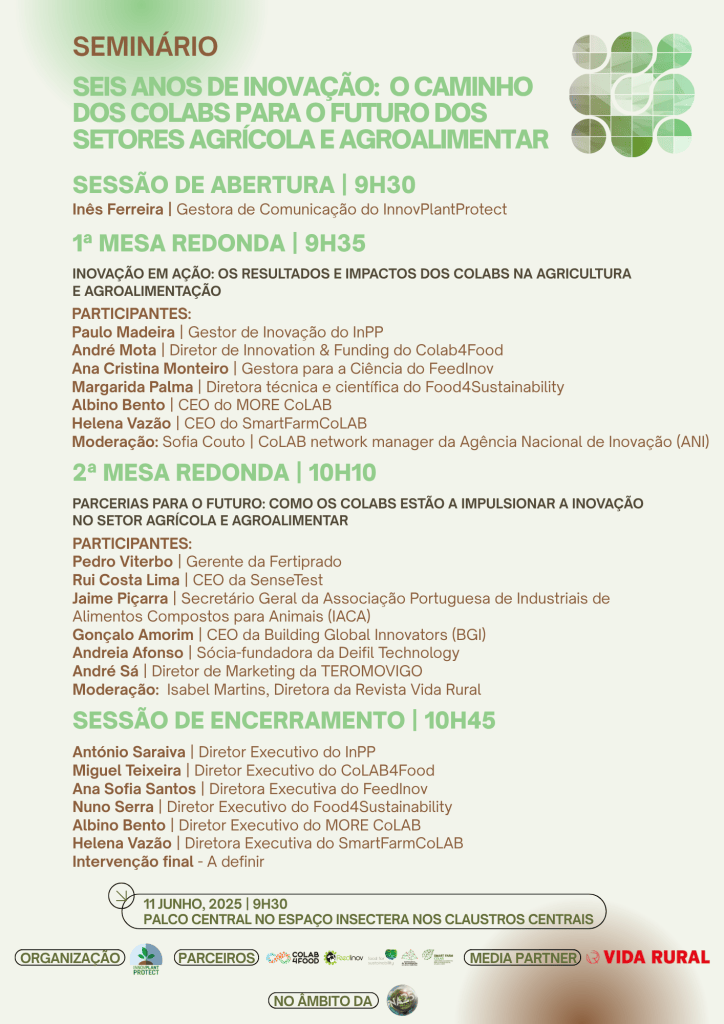
O InnovPlantProtect (InPP) promotes the seminar “Six years of innovation: The path of CoLABs for the future of the agricultural and agri-food sectors”, on the next day June 11th, from 09h30 until 11h00, in center stage at Espaço InsectERA, located in the Central Cloisters of the National Center for Agricultural Exhibitions and Markets (CNEMA) in Santarém.
The seminar aims to present the practical results and real impact of six Collaborative Laboratories (CoLABs) in Portugal - InnovPlantProtect, Colab4Food, FeedInov, Food4Sustainability, MORE and SmartFarmCoLAB. These interface infrastructures are essential pillars of the National Innovation System (SNI) and play a growing and essential role in the dynamics of innovation for agriculture and agri-food.
The event will be attended by members of the teams and partners of each of the CoLABs, who will talk about their vision of the added value of these interface and innovation entities, from the point of view of those who collaborate directly with them.
The initiative, which is part of the National Agriculture Fair (FNA) 2025, which this year has the theme “Biosolutions” and will be the stage for exploring the innovations that are shaping the future of the sector, brings together different representatives of the innovation ecosystem to show the role of CoLABs in stimulating the transfer of knowledge and making innovation available to agriculture and agri-food in Portugal, creating value and attracting highly qualified human resources to the country.
See the full program in the image below.
The registration for the event is free, but mandatory due to the limited capacity of the space. Guarantee your presence by filling in the available form here.
We look forward to welcoming you for a morning of sharing and debate on the future of innovation in the agricultural and agri-food sectors!
Estamos em contagem decrescente para a Feira Nacional de Agricultura (FNA), uma das maiores feiras agrícolas do país!
É já de 7 a 15 de junho que o InPP vai estar na 61ª edição da Feira Nacional de Agricultura, que se realiza no CNEMA – Centro Nacional de Exposições, em Santarém.
O tema da edição deste ano é “Biosoluções”e pretende destacar a importância das soluções e tecnologias inovadoras no setor agroalimentar e na promoção de práticas mais sustentáveis e eficientes.
A FNA reúne agricultores, empresários e especialistas dos setores agroalimentar, pecuário e agrícola e é um excelente espaço para aumentar a nossa rede de contactos, trocar conhecimentos e apresentar as mais recentes tendências e soluções agrícolas que a nossa equipa tem desenvolvido.
Vai poder encontrar-nos no stand nº.18, à entrada do Espaço dos claustros, dedicado à Agenda InsectERA, entre as 10h e as 20h.
InnovPlantProtect (InPP) took part in the National Olive Growing Fair (FNO 25) in Campo Maior, from May 23 to 25, presenting its latest biological and digital innovations for crop protection, including projects focused on biopesticides for olive diseases and early detection of fungi that cause gafa, and monitoring insect vectors of the bacterium Xylella fastidiosa, which attacks olive groves. The Elvas CoLAB was present with its own stand to demonstrate its strengths and the impact of its research on agricultural sustainability, inviting producers, technicians and researchers to learn about its innovative bio-based and digital solutions and to actively participate in the discussion of the sector's challenges.
The collaborative laboratory (CoLAB) welcomed visitors at the stand no. 14, located at thematic area at the Campo Maior Municipal Garden, to showcase their activity, the ongoing projects that are developing solutions to the main olive diseases, the patents already submitted, the apps for agricultural management and the bio-based and digital products and services they have to offer the agricultural sector and the market. Throughout the three days of the fair, some of InPP's researchers were at the stand to demonstrate to visitors the various features of the Elvas CoLAB, which has been developing innovation that it hopes will contribute to the sustainability of agricultural systems.
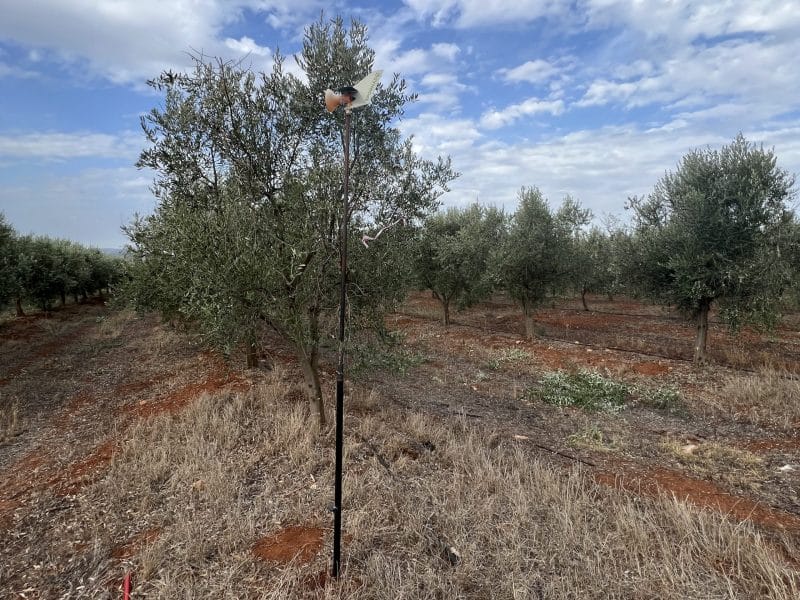
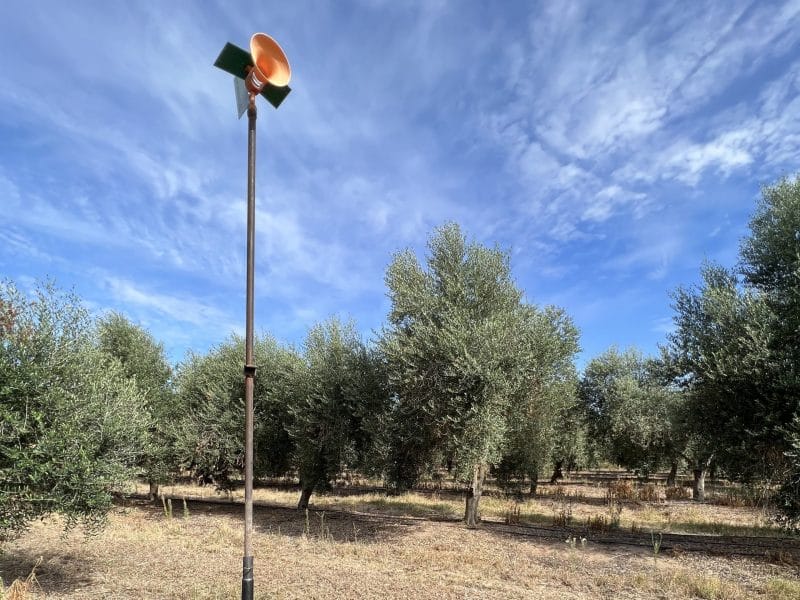
InPP announced ValorCannBio project, which is processing biomass that is not used in the medical cannabis industry to develop effective and sustainable biopesticides against gafa and tuberculosis, The project will be carried out in the municipality of Elvas, which is responsible for decimating entire harvests, leading to severe economic losses and compromising food quality. The impact of this project will be felt in the municipality of Elvas, where the project is being developed, but it is expected that it will extend to the entire olive-growing region from Trás-os-Montes to the Algarve, where production losses are increasing due to these diseases. O AlViGen project was also one of the protagonists and is using cutting-edge technology to detecting and identifying the strains of fungi that cause gafa, long before the symptoms become visible. The project team has used traps to collect spores that circulate in the air to monitor the presence of fungi, which can give farmers an important advantage in preventing infections and protecting their crops, reducing production losses.
O SNM_XylellaVt project, The SNM_XylellaVt project, led by DRAPCENTRO and in which InPP actively participates, was also highlighted at FNO. SNM_XylellaVt is monitor the insect vectors of the bacteria Xyllela fastidiosa, in particular the foam leafhopper, the insect responsible for transmitting the bacterium, which attacks various agricultural and forestry crops, and in particular olive groves. The project team is developing new tools, such as risk prediction models which, in the presence of the bacterium, whether in plants or insect vectors, will allow the National Agricultural Warning Service (SNAA) to alert, in real time, about the economic attack levels (EAL) for these insects, thus allowing prevent infection of the main crops. As part of this project, the team has also developed an online platform where citizens can report the sighting of foams, which are signs of the presence of the insect vectors of X. fastidiosa, This will help to map its temporal and spatial distribution and to plan measures to combat this bacterium.
The FNO, organized jointly by the Campo Maior City Council and the Centre for the Study and Promotion of Olive Oil in the Alentejo (CEPAAL), is an event that aims to enhance national olive growing, and in particular Portuguese olive oil, boosting the local economy and bringing together professionals from the sector - producers, technicians, or researchers - from all over the country to discuss challenges and trends in the Portuguese olive and olive oil sector.
A sustentabilidade da agricultura não seria possível atualmente sem o contributo da biotecnologia. As novas tecnologias que permitem alterar o DNA das plantas têm um impacto enorme nas novas culturas agrícolas e um papel crucial para garantir a soberania alimentar. Estas são questões a debater na conferência “A Importância da Biotecnologia para a Sustentabilidade na Agricultura”, no dia 17 de outubro, às 10h00, no Centro Cultural de Belém (CCB), in Lisbon.
No evento, organizado pela Associação Portuguesa dos Industriais de Alimentos Compostos para Animais (IACA), em parceria com o InnovPlantProtect (InPP) e o Centro de Informação de Biotecnologia (CiB), e que conta com a colaboração do Jornal Público, participarão vários especialistas da área da biotecnologia e da agricultura, serão discutidos temas cruciais para o setor, visando promover práticas agrícolas mais sustentáveis e eficazes. Pedro February, diretor executivo do InPP, vai participar no primeiro painel intitulado “O impacto da biotecnologia nas novas culturas agrícolas”.
A sessão de encerramento estará a cargo de Maria do Céu Antunes, Ministra da Agricultura e da Alimentação.
A participação no evento necessita de inscrição prévia obrigatória. As inscrições podem ser efetuadas através do preenchimento do formulário disponível here.
Para mais informações e para consultar o programa detalhado do evento, aceda here.
Não perca esta oportunidade de participar nesta conferência sobre o futuro da agricultura e a sua interação com a biotecnologia!
From September until November, the “AlViGen: Creation of a hub in the ALentejo for the GENomic VIgilance of diseases in agriculture” project team will be in the field to install spore traps, known as capta-esporos, in olive groves in Portalegre, Monforte, Elvas, Évora and Beja. The traps make it possible to capture spores from fungal species that circulate in the air and, in particular, from different strains of the fungus Colletotrichum, This is responsible for causing gafa disease in Olival.
The aim is to identify some important characteristics of this pathogen, such as virulence and resistance to fungicides or pesticides.
In total, the spore traps were installed in eight olive groves in the Alentejo (Alto, Central and Baixo), a region that is the main producer of this crop at a national level, and where the fungus Colletotrichum has had a particular impact.
The team will take samples every two weeks for three months a year during the olive tree's productive cycle. Regular monitoring of the diversity of fungal species circulating in the olive groves will also make it possible to detect the appearance of new pathogenic fungi.
AlViGen, coordinated by InnovPlantProtect (InPP) in partnership with the University of Évora (WOW), was one of the innovative pilot projects selected last October and funded by the La Caixa Foundation, BPI Bank and the Foundation for Science and Technology (FCT), as part of the 4th edition of the Promove Program. This project will enable InPP to create the capacity for early detection of multiple crop diseases, using molecular methods that allow the identification of important characteristics of pathogens, such as virulence, susceptible varieties and resistance to phytopharmaceuticals, benefiting producers and government authorities.
Find out more about the AlViGen project on the project website here.
O InnovPlantProtect (InPP), como membro da rede portuguesa de laboratórios de investigação sustentável, a GreenLabs Portugal, participou no primeiro “Green Labs Portugal Symposium: Promoting Sustainability in Research”, dedicado a promover práticas verdes na ciência para reduzir o impacto ambiental da investigação científica em Portugal, e que teve lugar esta sexta-feira, dia 22 de setembro, na Universidade de Coimbra.
O principal objetivo deste simpósio foi promover o debate e a discussão sobre como mitigar o impacto ambiental da investigação científica, reconhecendo ao mesmo tempo o papel fundamental da ciência e da inovação no progresso da sociedade. Em mais detalhe, a iniciativa abordou os diferentes aspetos do que são os Green Labs e o procedimento para obter certificação, a sustentabilidade na ciência e como as empresas estão a reinventar e a revolucionar os seus serviços para apoiar os laboratórios de investigação na adoção de práticas mais ecológicas, de forma a reduzir a pegada ecológica da investigação.
Cristina Azevedo, diretora do departamento de Novos Biopesticidas, participou na sessão 2 dedicada ao tema “Setting a green lab” com a apresentação “How to greenUP bio-based research labs”. A iniciativa contou ainda com palestras de especialistas na área, como Melina Kerou da Sustainable European Laboratory Network (SELs), e Martin Farley da Green Lab Associates.
O programa incluiu vários momentos interativos com os participantes, incluindo uma mesa redonda, um jogo “Ask the Green Teams” e uma sessão de posters. Alguns elementos da equipa de InPP Greeners do InPP, representada pelas investigadoras Cátia Patrício, Cláudia Silva e Leonor Martins participaram nesta última, na qual apresentaram o poster “InPPGreeners – Story of a colab built with sustainability as its cornerstone”.
Na sessão de encerramento teve lugar um momento especial em que foi plantada uma árvore no Jardim Botânico da Universidade de Coimbra.
O tempo para um futuro científico mais sustentável é agora, e todos somos responsáveis por fazer parte desta mudança!
Os InPP Greeners são a equipa de sustentabilidade do InPP, criada no final de 2021, com a missão de partilhar conhecimento e de promover boas práticas nas áreas da biotecnologia e da proteção de culturas agrícolas, que conduzam à criação de laboratórios e instituições mais sustentáveis, além da promoção da adoção de comportamentos mais sustentáveis por todos os cidadãos.
A GreenLabs Portugal é uma rede de laboratórios de investigação sustentável em Portugal que promove práticas sustentáveis para reduzir o impacto ambiental da investigação científica a nível nacional, e da qual o InPP faz parte.





 Português
  English