In the March issue of Fruits, vegetables and flowers you will find the opinion article entitled “The role of InnovPlantProtect in Organic Farming: Paths to sustainable and efficient solutions”, in which the executive director of InnovPlantProtect (InPP), António Saraiva, reveals how our CoLAB is contributing to the success of organic farming.
“By boosting research, collaboration and knowledge sharing, InPP is helping to solve the central challenges of this practice [organic farming], allowing it to expand and enhancing the supply of agricultural products to consumers. The solutions developed by InPP make organic farming a more viable option for producers,” says the executive director.
Read the full article and find out how we are shaping the future of agriculture.
We thank Frutas, legumes e flores magazine for its recognition and reiterate our commitment to the agriculture of the future.
Imagine a future where drones and artificial intelligence work together to protect your vineyards. That's what the AI4Leafhopper project is making a reality!
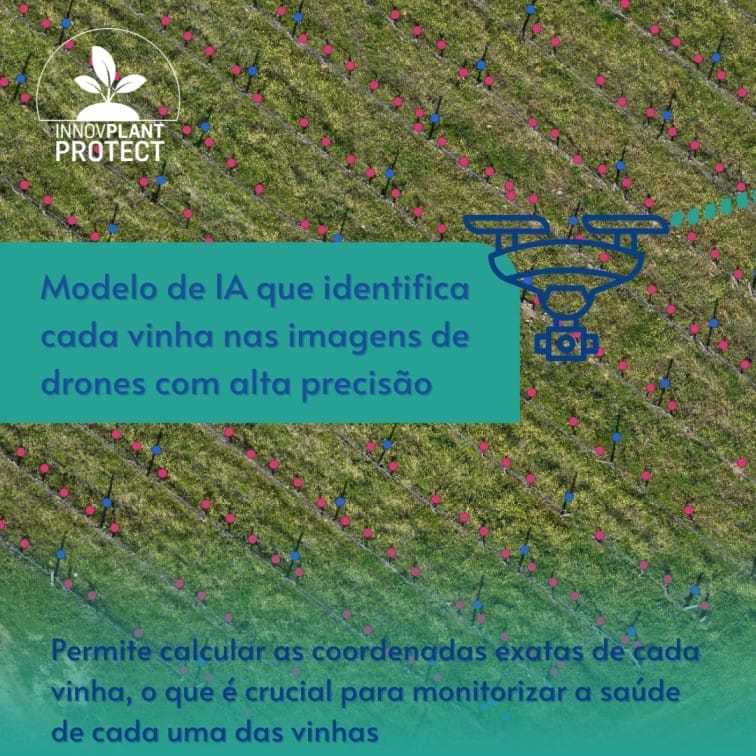
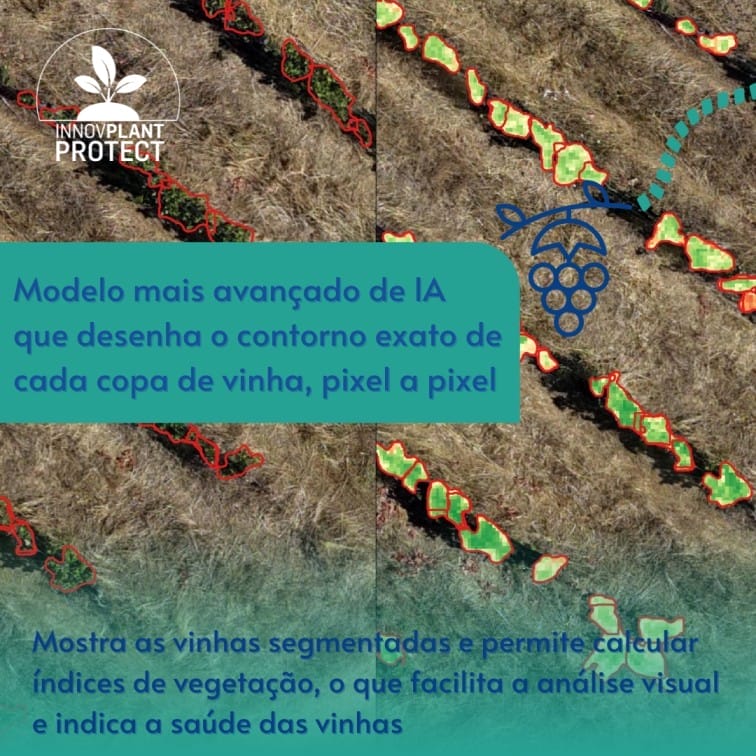
Manisha Sirsat, a researcher on the AI4Leafhopper team, has developed two artificial intelligence models that analyze the aerial images captured by our latest generation drone... and these models make it possible:
geolocation of each vine
to know if there are vine failures
quickly identify “sick” vines”
optimize the application of treatments
The result? Growers can have a detailed view of the health of their vineyards, detect problems early and make more informed decisions.
AI4Leafhopper is a project led by InPP and funded by the ICAERUS Horizon Europe program, which began in April 2024 and ended on April 30 with a final meeting involving the six European projects approved in the 1st edition of the ICAERUS program's PULL applications. The project team presented the AI-based models for detecting and monitoring the impact of the green leafhopper on vineyards.
The AI4Leafhopper project, InnovPlantProtect used a state-of-the-art drone to monitor the impact of the green leafhopper in the vineyards of our partners Reynolds Wine Growers and João Portugal Ramos. Although the results show that this advanced technology is more effective at detecting attacks at advanced stages, we are excited about the potential of this tool to provide valuable data for the management of this harmful insect.
We believe that with more research, we can refine our solution to detect early attacks and prevent significant damage to vineyards. Transforming the monitoring of this pest is where we want to go, always with the aim of protecting vineyards and guaranteeing the quality of production for winegrowers.
Over the next few days we'll be revealing everything that the AI4Leafhopper project is making a reality and how drones and artificial intelligence are working together to create a more sustainable future for viticulture. Stay tuned!
AI4Leafhopper, funded by the ICAERUS Horizon Europe program, which began in April 2024, is now in its final stages. The development phase of the project, which took place in the field, is now over and the final stage is to present the solutions developed by our team on Portuguese soil to the market.
Last Monday, November 27, the closing session of the ABC project took place in the auditorium of the Escola Superior Agrária de Elvas (ESAE) of the Polytechnic Institute of Portalegre, a project led by InnovPlantProtect (InPP) and financed by the Environmental Fund under the National Environmental Education Strategy 2020 program. The aim of the event was to give the students a voice, in different formats (posters, videos and others) that portrayed the themes that were developed during the project: sustainable agriculture, biodiversity, ecosystem services, citizen science and the circular economy. Rádio Elvas was invited to the event, as was Councillor Hermenegildo Rodrigues, representing Elvas Municipal Council. The opening session of the event was attended by the Director of ESAE, Rute Guedes dos Santos.
The InPP team began by presenting a summary of the event's program in multimedia format (“flash news”: ABC news). This was followed by a video summarizing the activities carried out during the last year of the project, both in the classroom and in the field, namely at the Reynolds Wine Growers estate in Arronches. Next, a group of students and teachers were interviewed in order to hear directly from them how they experienced the ABC project and what it meant to them. The ABC news continued with presentations of the students' work, in various formats, on the project's themes. We started with specific work on endophytic microorganisms, where an ESAE student, Henrique Canha, had the opportunity to do his internship and explained how microbiology can be used to help farmers.
The next moment was dedicated to the theme of the circular economy. The students presented four videos in interview format, aimed at various groups in our society (students, teachers, environmentalists, technicians and farmers), focusing mainly on the importance of the circular economy, but not only. There was also time to read a letter encouraging circular economy practices, written by the students of the D. Sancho II Secondary School and addressed to the Mayor of Elvas, Comendador Rondão de Almeida. Councillor Hermenegildo Rodrigues had the opportunity to respond to the letter and to inform the audience about current circular economy practices and those planned for the near future in the Municipality of Elvas.
Another of the topics covered was ecosystem services in vineyards. The students decided to present this topic in the form of a scientific poster. In this space, the student authors were interviewed about various topics in vineyard agroecology and the different types of benefits (services) that can be obtained with this approach. The next panel, in video format and entirely coordinated by ESAE students, was dedicated to microbiome activities, with testimonies from Nélson Martins, farm manager at Reynolds Wine Growers, higher education students and researchers on the current relevance of agricultural management based on improving the soil microbiome.
The event continued with a surprise theatrical performance by a group of students from the D. Sancho II Secondary School. In this short play, the students acted out an argument between three actors from our rural environment (farmer, citizen and scientist) on the subject of organic farming vs. conventional farming. For the originality and audacity of the actors, this activity was awarded a prize by the project team. The event ended with the screening of a video on citizen science prepared by a group of students from the D. Sancho II Secondary School. The project team considered this video elaborate and surprising, and it was also awarded a prize.
The ABC project leaves behind an educational program that established a collaboration between InPP and the local school and which helped students become aware of the tools they have at their disposal to promote biodiversity in agriculture, participate in a citizen science project, embrace the circular economy, understand the value of natural resources and the types of ecosystem services they provide.
Poster promoting the final event of the ABC - AgriBioCircular project
InnovPlantProtect (InPP) was present at the 6th edition of NOVA Science & Innovation Day, promoted by NOVA University Lisbon, at the Rectory facilities on the Campolide Campus in Lisbon, on November 21st.
NOVA Science & Innovation Day aimed to showcase the science, research and innovation of excellence at the University and was a unique opportunity for the academic community, as well as the general public, to get to know the scientific work carried out at NOVA University Lisbon and how it translates into innovation and the creation of value for society.
Throughout the day, an Innovation Fair was also held in the Rectory atrium, as part of the initiative. Visitors to the Fair had the opportunity to learn about the collaborative laboratory (CoLAB) and what it is already doing for crop protection and pest and disease prevention, with a highly qualified team and very broad and diverse skills.
Other CoLABs, proprietary technologies and specialized services were also represented at the Innovation Fair, Spin-offs and other companies in the University's ecosystem.
NOVA Science & Innovation Day was a unique opportunity for the academic community and the public to get a closer look at the work of excellence carried out at NOVA University Lisbon, and how it translates into innovation and the creation of value for society.
1st photo - InPP stand at NOVA Science & Innovation Day. 2nd and 3rd photos - Inês Ferreira, InPP's communications manager, on the right, representing InPP
NOVA Science & Innovation Day took place at the Rectory of NOVA University Lisbon
InnovPlantProtect (InPP) was in Lisbon on November 16 for the 4th Annual Meeting of Collaborative Laboratories (CoLAB), organized by the National Innovation Agency (ANI), which aimed to promote and monitor the activities and progressive evolution of the 41 currently recognized CoLABs, as well as their development in the context of regional, national and European research and innovation strategies.
The meeting, on the theme of “Innovation and Technological Valorization towards the Sustainable Development Goals”, brought together the CoLABs and some of the main players in the National Scientific and Technological System to participate in a discussion on the role of Research and Technology in addressing the SDGs, which was attended by some CoLABs, namely members of the BUILT CoLAB, from ForestWISE and DTX, They shared some of the best practices and success stories from their CoLABs. The moderator was Inês Sequeira, from Impact House.
Afterwards, the CoLAB had the opportunity to learn more about “Sustainable Funding Opportunities”, with the active presence of members of the European Commission, from the Alentejo Regional Coordination and Development Commission (CCDR Alentejo), the Mobilizing Agenda ILLIANCE, from the Mobilizing Agenda InsectERA - the ERA of insects, and ANI, as well as listening to the International Keynote, Jerry Sheehan, Director for Science, Technology, and Innovation, from OECD.
In the afternoon, CoLAB members had the opportunity to take part in a more practical activity, through a workshop that aimed to maximize the impact of the brand through collaboration. The annual CoLAB report was another of the topics covered.
This was an excellent opportunity to discuss how these entities can collaboratively contribute to solving the main challenges and most pressing issues of our time, putting innovation and knowledge at the service of society. It was also a moment to share good practices and exchange experiences.
Find out more about the event on the ANI website here.



 Português
  English