Estamos em contagem decrescente para a Feira Nacional de Agricultura (FNA), uma das maiores feiras agrícolas do país!
É já de 7 a 15 de junho que o InPP vai estar na 61ª edição da Feira Nacional de Agricultura, que se realiza no CNEMA – Centro Nacional de Exposições, em Santarém.
O tema da edição deste ano é “Biosoluções”e pretende destacar a importância das soluções e tecnologias inovadoras no setor agroalimentar e na promoção de práticas mais sustentáveis e eficientes.
A FNA reúne agricultores, empresários e especialistas dos setores agroalimentar, pecuário e agrícola e é um excelente espaço para aumentar a nossa rede de contactos, trocar conhecimentos e apresentar as mais recentes tendências e soluções agrícolas que a nossa equipa tem desenvolvido.
Vai poder encontrar-nos no stand nº.18, à entrada do Espaço dos claustros, dedicado à Agenda InsectERA, entre as 10h e as 20h.
O InnovPlantProtect (InPP) participou na Feira Nacional de Olivicultura (FNO 25) em Campo Maior, de 23 a 25 de maio, apresentando as suas mais recentes inovações biológicas e digitais para a proteção de culturas, incluindo projetos focados em biopesticidas para doenças do olival e deteção precoce de fungos causadores da gafa, e monitorização de insetos vetores da bactéria Xylella fastidiosa, que ataca o olival. O CoLAB de Elvas esteve presente com stand próprio para demonstrar as suas valências e o impacto da sua investigação na sustentabilidade agrícola, convidando produtores, técnicos e investigadores a conhecer as suas soluções inovadoras de base biológica e digital e a participar ativamente na discussão dos desafios do setor.
O laboratório colaborativo (CoLAB) recebeu os visitantes no stand n.º 14, localizado na área temática no Jardim Municipal de Campo Maior, para dar a conhecer a sua atividade, os projetos em curso que estão a desenvolver soluções para as principais doenças do olival, as patentes já submetidas, as apps para gestão agrícola e os produtos e serviços de base biológica e digital que têm para oferecer ao setor agrícola e ao mercado. Ao longo dos três dias da feira, alguns dos investigadores do InPP estiveram no stand para demonstrar aos visitantes as várias valências do CoLAB de Elvas, que tem desenvolvido inovação que espera contribuir para a sustentabilidade dos sistemas agrícolas.
O InPP deu a conhecer o projeto ValorCannBio, que está a transformar a biomassa que não é aproveitada na indústria da produção de canábis com fins medicinais para desenvolver biopesticidas eficazes e sustentáveis contra a gafa e a tuberculose, responsáveis por dizimar colheitas inteiras, levando a perdas económicas severas e comprometendo a qualidade dos alimentos. O impacto deste projeto será sentido no concelho de Elvas, onde o projeto se está a desenvolver, mas é expectável que este se alargue a toda a região de produção do olival de Trás-os-Montes ao Algarve, onde estão a aumentar as quebras de produção devido a estas doenças. O projeto AlViGen foi também um dos protagonistas e está a usar tecnologia de ponta para detetar e identificar as estirpes dos fungos causadores da gafa, muito antes de os sintomas se tornarem visíveis. A equipa do projeto tem utilizado armadilhas para recolher esporos que circulam no ar que permitem monitorizar a presença dos fungos, o que pode dar uma vantagem importante aos agricultores na prevenção de infeções e na proteção das suas culturas, reduzindo perdas de produção.
O projeto SNM_XylellaVt, liderado pela DRAPCENTRO e no qual o InPP participa ativamente, esteve também em destaque na FNO. O SNM_XylellaVt está a monitorizar os insetos vetores da bactéria Xyllela fastidiosa, em particular a cigarrinha das espumas, inseto responsável por transmitir a bactéria, que ataca várias culturas agrícolas e florestais, nomeadamente o olival. A equipa do projeto está a desenvolver novas ferramentas, como os modelos de previsão de risco que, na presença da bactéria, seja nas plantas ou nos insetos vetores, permitam ao Serviço Nacional de Avisos Agrícolas (SNAA) alertar, em tempo real, sobre os níveis económicos de ataque (NEA) para estes insetos, permitindo, assim prevenir a infeção das principais culturas. No âmbito deste projeto, a equipa desenvolveu ainda uma plataforma online na qual é possível os cidadãos reportarem o avistamento de espumas, que constituem sinais da presença dos insetos vetores da X. fastidiosa, ajudando assim a mapear a sua distribuição temporal e espacial e a planear medidas de combate a esta bactéria.
A FNO, organizada em conjunto pela Câmara Municipal de Campo Maior e pelo Centro de Estudos e Promoção do Azeite do Alentejo (CEPAAL), é um evento que pretende valorizar a olivicultura nacional, e em particular o azeite português, dinamizando a economia local e reunindo profissionais do setor – produtores, técnicos, ou investigadores – de todo o país para discutir desafios e tendências do setor Olivícola e Oleícola português.
Each year, crop diseases cause devastating losses in agricultural production, threatening food security and the livelihoods of millions of farmers. In the heart of Alentejo, an innovative project is harnessing the power of genomics to help combat these invisible threats. The AlViGen Project, with the participation of InnovPlantProtect researchers Rute Rego and João Bilro, is paving the way for a new era of crop surveillance and protection.
The Problem and the Solution
“Yellow rust in wheat and olive quick decline syndrome are real scourges for farmers,” explains Rute Rego, a researcher at AlViGen. “These diseases can decimate entire harvests, leading to severe economic losses and compromising food quality.”
But AlViGen is not limited to observing the problem. The team is using cutting-edge technology to detect and identify the strains of fungi that cause these diseases, long before the symptoms become visible.
“We use traps to collect spores circulating in the air,” Rute continues. “These traps allow us to monitor the presence of fungi in real-time, which gives us an important advantage in preventing infections.”
But the magic happens in the laboratory, where the team extracts the DNA from the spores and performs advanced genomic analyses, using powerful DNA sequencing technology based on the metabarcoding method, carried out with cutting-edge technology like the portable Nanopore sequencer.
Rute Rego, a researcher at InnovPlantProtect, analyzes samples of the fungus causing olive quick decline syndrome as part of the AlViGen project.
Unraveling the Genetic Code of Fungi
To better explain what metabarcoding is and its advantage in detecting the presence of species or strains of fungi that cause diseases in crops, the researcher gives the example of a bag full of different types of grains – rice, beans, corn – being analyzed by the reader. “Metabarcoding is like placing a unique label (a ‘barcode’) on each type of grain. Then, you can mix all the grains in a single sample, and by reading the labels, you can identify the quantity of each type of grain present.'”
In the case of AlViGen, this technique allows for the analysis of multiple fungal species simultaneously (in multiple samples), each with its own genetic ‘barcode,’ and to ‘identify exactly which fungi are present, even in small quantities,'” the researcher explains.
And what is the practical impact of this method for monitoring and predicting disease? The AlViGen project researcher can identify, with high precision, the moment when the pathogenic agent begins to appear in the field, which makes it possible to alert farmers in real-time about the risk of disease. Producers can adopt preventative measures and apply the necessary products to avoid infection, contributing to a rapid and effective response in disease prevention.
The Timeline of Fungal Evolution
AlViGen’s research is not limited to identifying the microorganisms harmful to crops; it also seeks to understand their evolution and diversity. João Bilro, another researcher on the project, is dedicated to studying the phylogeny of the Colletotrichum fungus, a microorganism responsible for causing olive anthracnose or blight, a disease that affects olive groves in Portugal. This disease mainly affects the olives, which compromises the quality of the olive oil.
“Phylogeny is crucial for understanding how the different strains of Colletotrichum are related and how they have evolved over time,” João explains. “Just as a family tree traces the history of a family, showing how members are related to each other, phylogenetic trees reveal the evolutionary relationships between the different strains of this fungus. Each branch of the tree represents an evolutionary lineage, and the nodes indicate common ancestors. By comparing the DNA sequences of these strains, we can reconstruct their evolutionary history, identifying which are genetically closer or more distant, and thus infer characteristics such as virulence or resistance to fungicides,” he reveals.
This knowledge allows researchers to identify patterns of dissemination and adaptation of the fungus, which is fundamental for developing more effective strategies to contain and/or reduce the damage this fungus causes to Portuguese olive groves.
“Um dos desafios da nossa investigação é a grande diversidade genética do Colletotrichum,” admite João. “No entanto, ao desvendar os seus segredos evolutivos, estamos a abrir caminho para o desenvolvimento de métodos de deteção e controlo mais precisos e direcionados.”
Left photo: João Bilro, a bioinformatician at InnovPlantProtect, studying the phylogeny of the Colletotrichum fungus within the scope of the AlViGen project; Right photo: Rute Rego and João Bilro discuss ideas about the AlViGen project.
The Future of Agriculture Starts Here
The AlViGen Project aims to have a significant impact on the agricultural landscape, especially in Alentejo, a region with a strong agricultural tradition. By providing farmers with early detection tools and precise information about the microorganisms that cause crop diseases, the project intends to aid in decision-making, allowing farmers to protect their crops and reduce production losses.
“Our ultimate goal is to empower farmers with the knowledge and tools they need to protect their crops sustainably,” states Rute. “We believe that genomic surveillance is a key tool for the future of crop protection.”
João Bilro agrees and adds, “Continuous research is fundamental to keep up with the evolution of harmful microorganisms and to develop new, consistently effective control strategies. In the future, we hope to expand the scope of AlViGen to include other microorganisms and crops, and to make genomic surveillance an accessible tool for all farmers.”
Science at the Service of Agriculture
The AlViGen Project, supported by the Promove Program of the “la Caixa” Foundation, in partnership with Banco BPI and the Foundation for Science and Technology (FCT), is an inspiring example of how science and technology can be applied to solve real-world problems and transform agriculture. By unraveling the genetic secrets of crop microorganisms, Rute Rego and João Bilro are paving the way for a safer, more sustainable, and resilient agriculture.
The fight against crop diseases continues, but with AlViGen, farmers can finally see the enemy before it becomes visible.
Inseto vetor da Xylella é atraído ou repelido por diferentes plantas aromáticas consoante o sexo do adulto e a distância a que se encontra da fonte de óleos essenciais.
Lavandula angustifolia Foto: JLPC/ Wiki
Já se sabia que a nefasta Xylella fastidiosa “gostava” de Lavandula spp.; afinal, foi numa planta de alfazema que a presença da bactéria em Portugal foi confirmada pela primeira vez, em janeiro de 2019. Uma equipa de cientistas concluiu entretanto que os machos do inseto vetor da Xylella na Europa são atraídos, a longa distância, pelos óleos essenciais da alfazema.
“O controlo sustentável dos vetores é uma parte essencial das estratégias de gestão de pragas”, recordam os responsáveis pelo projeto europeu XF-ACTORS. Os resultados do estudo citado podem contribuir para o desenvolvimento de abordagens e ferramentas inovadoras, alternativas ao uso de pesticidas sintéticos, para o controlo do inseto Philaenus spumarius, vetor da Xylella fastidiosa na Europa – essencial para controlar a disseminação da bactéria.
Lavandula angustifolia Foto: Norbert Nagel/ Wiki
A equipa verificou que o sistema olfativo periférico do P. spumarius capta os compostos orgânicos voláteis presentes nos óleos essenciais do pelargónio (também chamado entre nós gerânio ou sardinheira) Pelargonium graveolens, da Cymbopogon nardus (parente da erva-príncipe), que produz a citronela, e da Lavandula angustifolia (antes officinalis), a alfazema. Mas o efeito desta deteção depende da “dose” e da distância.
A qualquer distância, tanto a alfazema como o pelargónio repeliram as fêmeas. Já os machos foram atraídos pelo gerânio e repelidos pela citronela. A curta distância, tanto a alfazema como a citronela se mostraram repelentes tanto para fêmeas como machos.
In celebration of the International Day of Women and Girls in Science, some of InnovPlantProtect’s women researchers share the reasons they became scientists.
“I became a scientist for the thrill of being able to discover something new every day and a plant scientist in particular with the dream of producing plants resistant to pathogens, avoiding the need for chemical pesticides. A win-win solution to reduce the environmental impacts of agriculture and the production costs to small farmers.”
Cristina Azevedo, PhD researcher, Head of the New Biopesticides Department
Cristina Azevedo
Cláudia Rato da Silva
Manisha Sirsat
“Ever since I was a child, I always felt drawn to nature, particularly at the beach, where I would explore sea life, but also at my grandparents’ vegetable garden, where I loved to play. The fact that my mother is really passionate about nature, particularly about plants and birds, also played a role when I decided to apply for Biology. On top of that, there’s my desire to understand the world around me; being a scientist allows me to ask questions and work towards an answer, and that moment when you discover something new in the lab is still beyond thrilling.”
Cláudia Rato da Silva, PhD researcher, Protection of Specific Crops Department
“I have had a passion for technology and science since childhood, so I decided to pursue my career in a computer science discipline in which Artificial Intelligence is one the great research fields, which could help to solve complex problems of nearly every field. ‘The human brain cannot deal with terabytes but Machine Learning can!’ Hence I was inspired to do research in this field.”
Manisha Sirsat, PhD researcher, Department of Data Management and Risk Analysis
Cláudia Almeida Silva
Cátia Patrício
Ana Cláudia Silva
“When I was younger, I used to ask my parents ‘Why this happens?’ or ‘Why this works the way it does?’ Most of the questions were ‘Why?’ and my parents didn’t know how to answer, so they encouraged me to go look for it. From then on, I didn’t ask my parents anymore. I would search for the answer. That feeling did not disappear as I grew up. So, during my school years, I always searched for the answer to the question ‘Why?’. When I was in 12th grade, I had to choose my college degree and it was very difficult to choose between all the available courses, but I knew that it would be related to science, because 99% of the questions that you ask, Science can answer it. And that was the moment that I decided to become a scientist – to search for the answers to my questions. Science is a part of our life, Science is in everything, with Science you can change the world.”
Cláudia Almeida Silva, MSc researcher, Department of New Formulations and Matrices for the Application of Biopesticides
“I decided to become a scientist when my father got sick, and I knew that I should contribute to science to help answer the questions that still had no answers. This profession showed me that there are many things that we already know but, on the other hand, there is much more that we need to discover and learn. The idea that small discoveries that you can make can lead to the solution of big problems is gratifying to me.”
Cátia Patrício, MSc Researcher, Department of New Biopesticides
“As an undergraduate, I started collaborating in a Nematology laboratory at the University where I was studying. There began my passion for science, and particularly for phytopathology. Since then, I have been gaining more knowledge and working in this topic, and it is a great pleasure for me to be able to keep on following this career at the InnovPlantProtect CoLab, with such a prodigious team of women and men scientists.”
Ana Cláudia Silva, MSc Researcher, Department of New Biopesticides
Maria Miguel Pires
Diana Pimentel
Jordana Branco
“I didn’t always want to become a scientist. One thing I did know was that I had been forever fascinated with my surroundings, nature at its finest. And there was this random driving force that made me question things, as though I felt an overwhelming need to pursue all the answers. Why is everything the way it is? Why is that leaf falling from the tree? Questioning, and an overall endless curiosity, that’s what made me become ‘sort-of-a-scientist’”.
Maria Miguel Pires, MSc Researcher, Department of New Biopesticides
“Since childhood, I have always been fascinated with nature, how plants survive on rainy days, how the dough rises, how the grape juice that I could drink turns into something that I was not allowed to… at the end of the day, how life makes sense! So, I wanted to know more and more, and that curiosity made me pursue life sciences.”
Diana Pimentel, PhD researcher/ Biostatistics Technician, Department of Data Management and Risk Analysis
“Isn’t it fascinating how the tiniest organisms can affect a whole ecosystem? And, even more so, to understand how they work and how we can fight or improve them? This feeling was what made me pursue a scientific career. Science is non-stop challenges but is also non-stop knowledge and progress.”
Jordana Branco, MSc researcher, Department of New Biopesticides
Diana Sousa
“I have always loved nature and helping people, in order to always contribute to a more sustainable world and better health for all people. I confess that I was also fascinated by the investigation, due to CSI. Ahahah And that´s why I became a scientific researcher, always ready to promote a better world.”
Diana Sousa, MSc researcher, Department Protection of Specific Crops
O XfSTOP visa desenvolver uma solução para proteger o olival contra a bactéria Xylella fastidiosa. O projeto é liderado pelo Departamento de Novos Biopesticidas do InnovPlantProtect – Departamento 1, dirigido pela investigadora Cristina Azevedo.
A equipa está agora a iniciar o trabalho de laboratório, com o objetivo de tentar isolar péptidos (pequenos aminoácidos) inibidores do crescimento do agente patogénico bacteriano Xylella fastidiosa. “Estabelecemos colaboração com investigadores em diferentes países, através dos quais obtivemos DNA genómico de diferentes isolados [estirpes] de Xylella, e estamos em vias de isolar os genes que codificam para as proteínas de virulência contra as quais queremos selecionar os péptidos”, explica Cristina Azevedo.
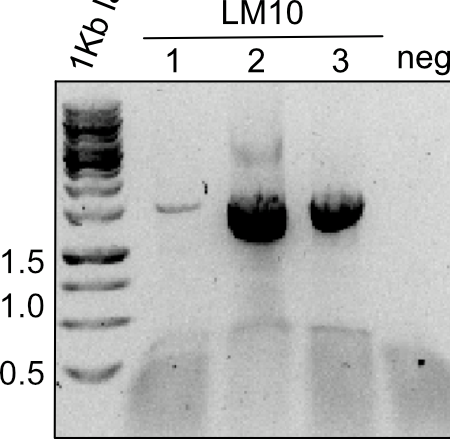
Isolamento de gene de Xylella fastidiosa (estirpe LM10)
A diretora do Dep. 1 adianta que a equipa está igualmente “a dar início ao isolamento de endófitos [organismos que vivem no interior de um hospedeiro] bacterianos presentes no xilema de variedades de oliveira cultivadas na região do Alentejo (Cobrançosa e Arbequina) e de uma variedade italiana que é resistente à Xylella (Leccino), provenientes da Herdade de Reguengo, pertencente ao INIAV, polo de Elvas”.
O acrónimo do projeto, XfSTOP, representa “Abordagem integrada à gestão da doença para o biocontrolo da Xylella fastidiosa nas oliveiras”. A oliveira tem uma enorme importância económica em Portugal, em particular no Alentejo. O biopesticida a desenvolver utilizará um micro-organismo capaz de coexistir no mesmo ambiente da Xylella, no interior da planta, para que produza um composto biológico capaz de eliminar a bactéria. Este mecanismo será sustentável, amigo do ambiente e não tóxico.
Os cookies necessários permitem funcionalidades essenciais do site, como logins seguros e ajustes das preferências de consentimento. Não armazenam dados pessoais.
Nenhum
►
Os cookies funcionais suportam funcionalidades como partilha de conteúdo nas redes sociais, recolha de feedback e ativação de ferramentas de terceiros.
Nenhum
►
Os cookies analíticos monitorizam as interações dos visitantes, fornecendo informações sobre métricas como número de visitantes, taxa de rejeição e fontes de tráfego.
Nenhum
►
Os cookies de publicidade entregam anúncios personalizados com base nas suas visitas anteriores e analisam a eficácia das campanhas publicitárias.
Nenhum
►
Os cookies não classificados são cookies que estamos a processar para classificar, em conjunto com os fornecedores de cookies individuais.


 Português
  English