No passado dia 13 de maio, a equipa do projeto AI4Leafhopper apresentou a nova aplicação iCountPests, uma solução inovadora que recorre à Inteligência Artificial (IA) para detetar e contar cigarrinhas-verdes em armadilhas cromotrópicas — de forma rápida, precisa e em tempo real.
Desenvolvida como uma aplicação móvel intuitiva, a iCountPests foi pensada para facilitar a monitorização de diversas pragas agrícolas. Com uma interface simples e acessível, permite ao utilizador registar a evolução das pragas nas suas culturas através da submissão de fotografias das armadilhas instaladas no campo.
A aplicação utiliza modelos avançados de visão computacional para a deteção automática e contagem de insetos, entregando resultados em cerca de um minuto — um processo muito mais rápido e prático face à contagem manual tradicional.
Na sua primeira versão, a app conta já com um modelo de deteção da cigarrinha-verde (Jacobiasca lybica), atingindo uma precisão média de aproximadamente 90%. Em breve, serão adicionadas funcionalidades para identificar outras pragas relevantes, como a traça-dos-cachos (Cryptoblabes gnidiella) e a traça-da-uva (Lobesia botrana).
Além da contagem automática, a iCountPests permite acompanhar a evolução das populações de pragas ao longo do tempo, facilitando a identificação de tendências e o planeamento de intervenções mais eficazes.
Este projeto resulta do trabalho conjunto de uma equipa multidisciplinar, que alia competências em ecologia, entomologia, inteligência artificial, visão computacional, deteção remota e desenvolvimento de software, com o objetivo de tornar a monitorização de pragas mais simples, precisa e acessível.
Durante a sessão de apresentação, foi possível ouvir as opiniões e sugestões dos futuros utilizadores da aplicação. Estes contributos são fundamentais para continuarmos a melhorar a ferramenta e assegurarmos que responde, de forma prática, às necessidades reais dos agricultores e técnicos do setor. Queremos desenvolver soluções que evoluam com a agricultura!
A inovação está no centro de tudo o que fazemos e o nosso lema é claro: “Inovar juntos, proteger melhor.”
Se deseja saber mais sobre a iCountPests, contacte-nos através do email: 📩 apps@iplantprotect.pt
O diretor executivo do InnovPlantProtect (InPP), António Saraiva, participou na conferência “Que desafios se colocam ao setor agroflorestal nacional para a próxima década?”, que decorreu na Escola Superior Agrária de Coimbra (ESAC) do Instituto Politécnico de Coimbra, na passada terça-feira, 22 de abril.
No evento, que reuniu mais de 150 participantes e foi organizado por 17 Centros de Competências nacionais, foram debatidos temas como inovação, sustentabilidade, conservação do solo, monitorização do montado e gestão eficiente da agropecuária.
António Saraiva integrou o painel de comentadores, que teve como orador Pedro Santos, Diretor-geral da CONSULAI, e moderação de Maria Custódia Correia, Coordenadora da Rede AKIS Portugal. A sessão de abertura contou com a presença do Ministro da Agricultura e Pescas, José Manuel Fernandes, que anunciou a publicação da Portaria de 21 de abril para abertura da Bolsa de Iniciativas para a constituição de Grupos Operacionais (GO).
Esta iniciativa disponibiliza um total de 11 milhões de euros para os novos GO, com um máximo de 350 mil euros por projeto e financiamento elegível de 100%.
Os GO são considerados estruturas cruciais para a transferência de conhecimento e o fortalecimento do AKIS (Sistema de Conhecimento e Inovação na Agricultura).
Um agradecimento especial aos 17 Centros de Competências pela oportunidade de participar neste encontro produtivo!
Beyond strategy: The secret ingredient of innovation
On the path to success, organizations define strategies, plan each step, and invest in crucial resources such as the sale of services and products, project applications, the development of solid business plans, and the protection of intellectual property. However, there is an often-neglected element that is fundamental to the flourishing of innovation: serendipity. But what exactly is this mysterious force, and why is it so vital to advancing agriculture and so many other areas?
When chance opens doors: The power of unplanned discovery
Serendipity lies in the art of finding something valuable when looking for something else. It’s the unintentional discoveries that arise from unexpected situations. Throughout history, some of the most transformative innovations have not been the result of a rigorous plan, but rather of a fortuitous encounter with the unknown. Although deliberate research and methodical experimentation are pillars of scientific and technological progress, openness to the unexpected proves to be a powerful catalyst. When researchers cultivate this openness, they often come across revelations that have the potential to revolutionize entire industries, transform technologies, and expand our understanding of the world around us.
A close look at the “error”: The genesis of an innovative biofungicide
Today, we unveil the surprising and inspiring story of Maria Miguel, a talented researcher from the InPP’s New Biopesticides Department, whose insight transformed a fortuitous event into a discovery of inestimable value: a broad-spectrum biofungicide capable of combating Botrytis cinerea, the relentless fungus responsible for the devastating gray mold disease in tomato plants. This pathology represents one of the greatest phytosanitary challenges in tomato cultivation, especially when grown in greenhouses, causing significant losses to producers if not controlled in a timely manner.
From discard to discovery: An investigator’s insight
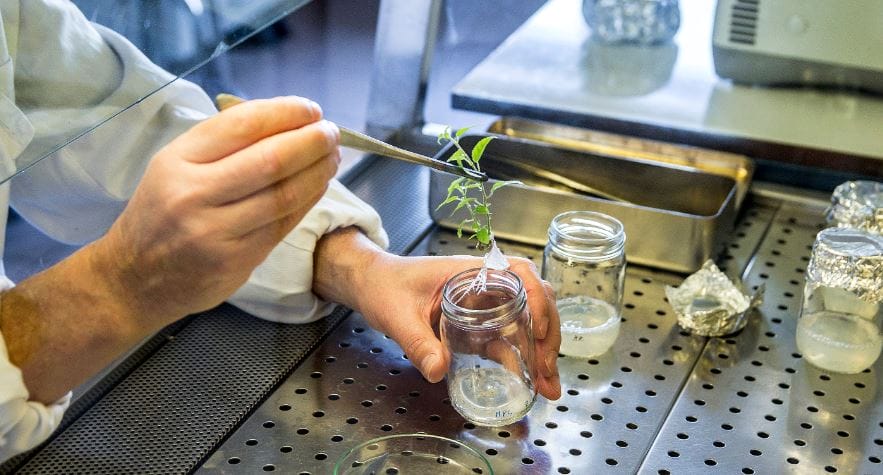
The journey of this discovery began in a scenario familiar to any researcher: the observation of Petri dishes, used to grow cell or microorganism cultures. In Maria Miguel’s Petri dishes, colonies of the fungus Botrytis cinerea were growing, intentionally introduced there for study. However, something else caught her attention: one of the plates was contaminated by mold, and curiously, a clear zone surrounded this intruder. Instead of discarding the plate and ignoring it as mere contamination, Maria Miguel decided to investigate the reason behind that clear area. Her curiosity revealed that the mold had a surprising ability to inhibit the growth of Botrytis cinerea in its vicinity.
“Sometimes we look at something and think it’s a mistake. The truth is that within a failure, there can be something good,” shares the researcher. The emotion and enthusiasm of a researcher when realizing that what at first seemed like an obstacle, a negative result, can actually be an opportunity, is contagious. For Maria Miguel, this “error” transformed into a serendipitous discovery with enormous potential.
Maria Miguel, a researcher at the InPP’s Department of New Biopesticides, transformed an unexpected event into a groundbreaking discovery: a broad-spectrum biofungicide to combat gray mold in tomato plants.
Beyond chance: The active ingredients of scientific discovery
As the story of this biofungicide demonstrates, the world of science is full of examples of discoveries that arose from the unexpected. One of the most famous cases is the discovery of penicillin by Alexander Fleming in 1928. While observing Petri dishes, Fleming noticed that a mold was producing a substance that eliminated Staphylococcus aureus bacteria around it. He identified the mold as Penicillium notatum and named his revolutionary antibiotic penicillin. Penicillin ended up becoming an extremely important drug for fighting infections.
However, chance is not the only protagonist of these important revelations. “Sometimes we have to follow our intuition and be able to prove that we are right or wrong,” explains Maria Miguel. In addition to intuition, a generous dose of curiosity, an open mind to accept unexpected results, a solid scientific knowledge, and the ability to see and advance to further investigations on surprising results play a crucial role in the alchemy of discovery.
The ecosystem of discovery: Fostering an environment conducive to innovation
There are other ingredients that contribute to the recipe for scientific success:
Creativity: The ability to generate new perspectives, concepts, questions, or solutions, and the willingness to explore existing ideas under a new light.
Flexibility: The courage to venture into unknown territories without fear of failure, thus increasing the odds of serendipitous encounters.
But no discovery flourishes in isolation. At InPP, the strong team spirit and culture of collaboration transcend departmental boundaries. Maria Miguel’s discovery is a testament to this synergy, as she herself acknowledges: “My colleagues opened doors so that I could do my research.”
To foster innovation, organizations need to cultivate an environment that stimulates open discussions and connects people from diverse areas of knowledge and life experiences, without judgment; that encourages curiosity and receptiveness to new experiences; and that promotes a relentless pursuit of improving scientific knowledge, the fertile ground where serendipity can germinate.
Sowing the future: The impact of a discovery and the path of research
Although Maria Miguel is about to embark on a new journey, driven by a prestigious Marie Skłodowska-Curie doctoral fellowship – a program that supports the career of researchers and promotes excellence and innovation in research – her legacy at InPP is already flourishing. Her innovative discovery is opening new and promising doors for future research in the area of crop protection, demonstrating how, at times, it is in the unexpected that the potential to transform our world lies.
Durante dois dias, o Centro de Congressos de Lisboa acolhe investigadores, empresários e público em geral para a realização do encontro anual Ciência 2020. Neste evento, a ANI-Agência Nacional de Inovação irá dinamizar seis sessões virtuais no âmbito da rede PERIN/Horizonte Europa e dos Laboratórios Colaborativos (CoLAB).
No encontro anual Ciência 2020, que se realiza hoje e amanhã no Centro de Congressos de Lisboa, a ANI-Agência Nacional de Inovação vai dinamizar 6 sessões virtuais no âmbito da rede PERIN/Horizonte Europa e dos Laboratórios Colaborativos (CoLAB).
O Horizonte Europa, o próximo programa-quadro da União Europeia para a Investigação e a Inovação, será o mote para 3 sessões promovidas pela ANI, enquanto membro da rede PERIN:
Sessão PERIN – Missões
No dia 3 de novembro, pelas 11h30, decorre uma apresentação das missões que farão parte do Horizonte Europa, seguida de uma intervenção da Comissão Europeia acerca do conceito de missão. A sessão conta ainda com uma mesa redonda de especialistas portugueses participantes em mission boards. Aceda ao evento aqui.
Sessão PERIN – Pilar II
Ainda no dia 3 de novembro, pelas 14h00, será apresentada a estrutura do “Pilar II do Horizonte Europa – Desafios Globais e Competitividade Industrial Europeia” com foco nas oportunidades e temáticas de cada um dos seus clusters/agrupamentos. Aceda ao evento aqui.
Sessão PERIN – Pilar III
No dia 4 de novembro, pelas 11h30, serão apresentadas as diferentes áreas do “Pilar III do Horizonte Europa – Europa Inovadora”: European Innovation Council, Eurostars 3 (com foco na presidência portuguesa do Eureka), Redes de Apoio às PME e European Institute of Innovation and Technology. Aceda ao evento aqui.
Também a 3 e 4 de novembro, decorrem as três sessões dedicadas aos Laboratórios Colaborativos, igualmente inseridas na programação do Encontro Ciência 2020. Cada apresentação será estruturada segundo um modelo de pitch em que cada CoLAB irá expor as atividades desenvolvidas e as tecnologias e serviços disponibilizados. As intervenções encontram-se distribuídas por 6 áreas temáticas, de acordo com a respetiva área de intervenção: Sistemas Digitais e de Informação, Clima, Espaço e Oceanos; Saúde e Serviços Sociais; Materiais, Economia Circular e Sustentabilidade Urbana; Energia e Sustentabilidade; Biodiversidade e Floresta; e, Agroalimentar. Consulte informação detalhada sobre as sessões do CoLAB e assista ao evento aqui.
A importância e os desafios da ciência, da investigação e da inovação na recuperação de Portugal em tempos de pandemia dão mote ao Encontro Ciência 2020. Este evento é particularmente relevante no momento em que Portugal se prepara para assumir a Presidência do Conselho da União Europeia no primeiro semestre de 2021. Os oradores e participantes irão discutir estratégias para o país e a Europa poderem ser mais resilientes, digitais, verdes, sociais e globais, no atual contexto. Durante dois dias, o programa conta com várias sessões temáticas nas mais diversas áreas científicas, promovendo a interação entre investigadores, o setor empresarial e o público em geral.
O Encontro Ciência é promovido pela Fundação para a Ciência e a Tecnologia em colaboração com a Ciência Viva – Agência Nacional para a Cultura Científica e Tecnológica e a Comissão Parlamentar de Educação e Ciência, e conta com o apoio institucional do Governo através do Ministro da Ciência, Tecnologia e Ensino Superior. Mais informações sobre o encontro serão divulgadas brevemente.
Main responsibilities This researcher reports directly to the Director of the Department of Protection of Specific Crops of InnovPlantProtect and has the following responsibility: • To identify pests and diseases in the field and in the laboratory • Sample plant, pests and pathogen material from crop fields • Interact with farmers and field researchers • Support field, greenhouse and laboratory plant-pathogen interaction assays
Specific requirements • Master degree in Phytopathology or related fields • Experience in phytopathology and agronomic techniques is desirable • Knowledge on molecular phytopathology and plant physiology • Fluency in English, spoken and written
InnovPlantProtect is a private non-profit association InnovPlantProtect aims to create innovation for the protection of crops, seeds and post-harvest products, in particular through: • Development of new technologies and knowledge, as well as the improvement of previously developed technologies, to protect crops, seeds and post-harvest products, as well as their intellectual protection and availability; • Development of applied scientific research to introduce the developed technologies in the market, and to develop processes and products; • Provide technical support to companies and entities, public or private, assisting them in the introduction of biotechnological strategies, methods and processes, and in the orientation and implementation of industrial research and development, directed towards the protection of crops, seeds and post-harvest products; • Collaboration with public or private institutions, national or foreign in their areas of activity.
Workplace The place of work will be the headquarters of InnovPlantProtect, at the INIAV Elvas pole, in the former National Plant Breeding Station (Elvas, Portugal).
Salary and contract A full-time contract will be offered, starting December 1st, 2020. The contract will last until December, 31, 2022, being renewed annually, and with a trial period of 30 days. The contract will be renewed past 2022 depending on further financial support. All the activities to be developed will be subject to confidentiality clauses. The gross value of the remuneration will be 1509,8€ (14 months – 21,152.6€/year) plus 4,77€ of lunch subsidy per working day.
Financial Support This contract is co-financed by the European Social Fund and Alentejo 2020, under the Operation: Highly qualified employment in companies – Hiring Highly Qualified Human Resources (PME or CoLAB). Project reference: ALT20-59-2018-49
To apply for this position, the following documents should be sent in a single PDF document: • Curriculum vitae (CV) • Motivation letter • Honor statement that all data provided in the CV is true (If the selected candidate does not hold a master degree by a Portuguese Higher Education Institution, its recognition by the Portuguese State must be delivered after signing the contract, under the terms of the Portuguese Decree-Law No. 66/2018)
Where to send the application To the care of the Chief Executive Officer of InnovPlantProtect Collaborative Lab, Professor Pedro Fevereiro (inpp@iplantprotect.pt).
Deadlines This call is open until November 6th 2020, with a decision expected by November 20th. The selected candidate is expected to start on December 1st.
General rules of data protection (GDPR) With the entry into force of Regulation (EU) 2016/679 of the European Parliament and of the Council of 26 April 2016, commonly known as the General Data Protection Regulation (GDPR) and in order to ensure a fair and transparent treatment of the holder of the data, InnovPlantProtect informs that by applying for this position you are authorizing InnovPlantProtect to (1) collect and process your personal data deemed necessary and relevant to this recruitment process, (2) to disclose the results of the evaluation in accordance with the legislation in force.
Os cookies necessários permitem funcionalidades essenciais do site, como logins seguros e ajustes das preferências de consentimento. Não armazenam dados pessoais.
Nenhum
►
Os cookies funcionais suportam funcionalidades como partilha de conteúdo nas redes sociais, recolha de feedback e ativação de ferramentas de terceiros.
Nenhum
►
Os cookies analíticos monitorizam as interações dos visitantes, fornecendo informações sobre métricas como número de visitantes, taxa de rejeição e fontes de tráfego.
Nenhum
►
Os cookies de publicidade entregam anúncios personalizados com base nas suas visitas anteriores e analisam a eficácia das campanhas publicitárias.
Nenhum
►
Os cookies não classificados são cookies que estamos a processar para classificar, em conjunto com os fornecedores de cookies individuais.





 Português
  English