O InPP participou no Fórum Nacional de Clubes Ciência Viva na Escola, que teve lugar no dia 27 de março, integrando a Mostra de Ciência e Tecnologia com um stand dedicado à proteção das plantas.
Neste espaço, foram apresentados diversos materiais demonstrativos, incluindo placas de Petri com fungos e bactérias, plantas, algas e exemplos de produtos formulados, com o objetivo de despertar o interesse e a curiosidade dos visitantes para a importância da saúde das plantas e da investigação científica nesta área.
Ao longo do dia, a Gestora de Comunicação, Inês Ferreira, e o Gestor de Inovação, Paulo Madeira, dinamizaram o contacto com o público visitante, explicando de que forma a investigação em proteção das plantas contribui para melhorar a proteção das culturas e promover uma agricultura mais resiliente e sustentável.
O Fórum Nacional de Clubes Ciência Viva na Escola decorreu no CNEMA, em Santarém, reunindo escolas, centros Ciência Viva, universidades, centros de investigação e diversas outras entidades, num encontro dedicado à ciência, tecnologia e inovação.
O InPP agradece a todos os visitantes que passaram pelo seu stand, destacando a importância destes momentos de partilha para promover o conhecimento científico junto da comunidade.
No dia 26 de março, o InPP participou numa sessão promovida pela Agência Nacional de Inovação (ANI), em Lisboa, que contou com a presença de uma comitiva da República Checa ligada ao setor das biotecnologias.
Em representação do InPP estiveram Cristina Azevedo, Diretora de Biosoluções, e Paulo Madeira, Gestor de Inovação, que apresentou a instituição e as suas principais áreas de atuação e competências.
A iniciativa teve como principal objetivo identificar oportunidades de cooperação entre entidades portuguesas e checas, nomeadamente nas áreas de transferência de tecnologia, codesenvolvimento, ensaios pré-clínicos e diagnósticos, coinvestimento e internacionalização da inovação.
A sessão contou com a participação de representantes de entidades relevantes da República Checa, incluindo Petra Kinzlova, CEO da Prague.bio, Katarina Psenakova, Head of Biology da PharmTheon, bem como representantes da Embaixada da República Checa e da Academia das Ciências da República Checa.
Este encontro contribuiu para reforçar o posicionamento do InPP na promoção de parcerias internacionais e no desenvolvimento de soluções inovadoras, evidenciando o compromisso contínuo da instituição em fortalecer redes de colaboração científica e tecnológica e em contribuir para o crescimento e internacionalização da inovação.
O InPP marcou presença no Encontro com orizicultores e técnicos(as) em Portugal, promovido pela EDAF, que decorreu no dia 5 de março, no Pólo de Inovação de Salvaterra de Magos, em Santarém.
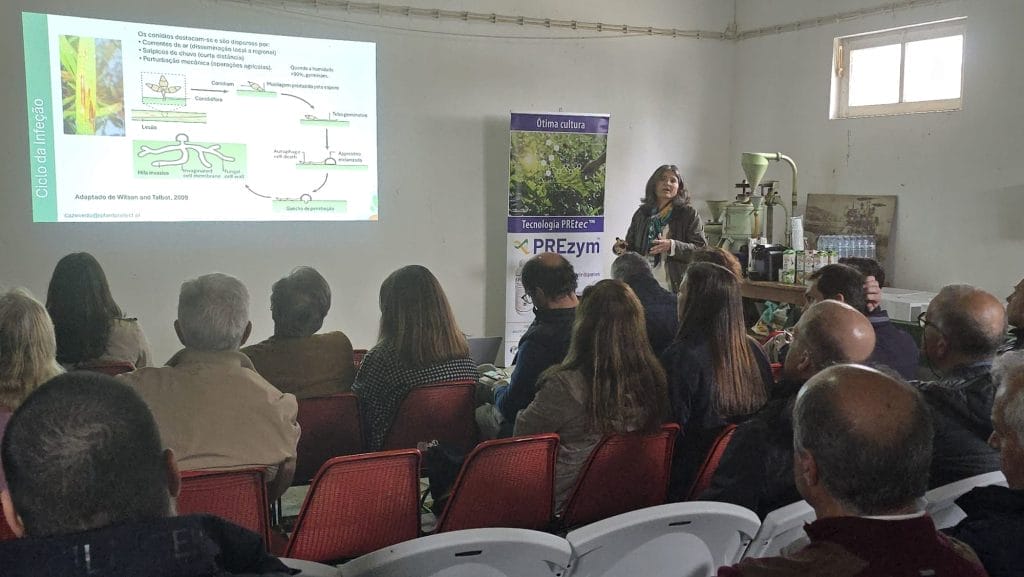
A Diretora de Biosoluções do InPP, Cristina Azevedo, integrou o painel de oradores convidados, tendo apresentado a comunicação intitulada “A problemática da Pyricularia na cultura do arroz”. A apresentação incidiu sobre os principais desafios fitossanitários associados a esta doença, que continua a constituir uma das maiores ameaças à produção de arroz a nível mundial e também em Portugal.
O encontro reuniu produtores, técnicos e especialistas da fileira do arroz, proporcionando um espaço de partilha de conhecimento e debate sobre soluções atuais e em desenvolvimento para o controlo da piriculariose. Foram igualmente abordados outros temas relevantes para a sustentabilidade e produtividade da cultura, nomeadamente a gestão da fertilização.
A participação do InPP neste tipo de iniciativas reforça o compromisso da instituição com a inovação, a transferência de conhecimento e o desenvolvimento de soluções sustentáveis para a agricultura nacional.
O InPP agradece à EDAF e ao COTArroz o convite e a organização deste importante encontro, esperando que esta colaboração continue a fortalecer-se no futuro.
CoLAB has been running for at least two years now InnovPlantProtect has a strategy to develop a biological solution against Xylella fastidiosa. However, to date, it has not been possible to find public or private funds to materialize this project.
However, the need for its development seems inevitable, since this pathogenic bacterium, which produces a disease that kills olive trees, almond trees and vineyards, among dozens of other plants, is already present in three areas of Portugal (Porto, Queluz and the Algarve) and its vectors exist throughout the territory.
When will the country realize that it has to invest now - in fact, it should have done so two years ago - so that this extremely aggressive disease doesn't spread to Portuguese olive and almond groves? Why isn't investment being made in prevention, instead of waiting for disaster to strike and then throwing up our hands?
Pedro Fevereiro, CEO of InnovPlantProtect, Visiting Professor, ITQB NOVA
Photo of the main insect vector of Xylella fastidiosa and micrograph of the bacteria
For the rector of the University of Évora, a member institution of InnovPlantProtect, participation in the Elvas CoLAB was “essential” and a step that the institution had to take. Ana Costa Freitas, who cycles to work and receives students in her office, considers collaborative laboratories to be instrumental in reviving the interior with qualified employment. As for plant biotechnology, she is adamant: you can't feed the entire population without genomics.
Text: Eva Ceia/ InnovPlantProtect Photo: Joaquim Miranda
Ana Costa Freitas, rector of the University of Évora, photographed by Joaquim Miranda.
Why did the University of Évora (UÉ) join the InnovPlantProtect (InPP) collaborative laboratory?
The University of Évora wasn't in the initial consortium. When I heard about the consortium, I spoke to the rector of NOVA University and told him that we were interested in being part of the Laboratory. In fact, he said, ‘we have to join’. I think these collaborative laboratories are the next step in science strategy and public policy. They're a step forward from what we've had before: we started with the research centers, then the associated laboratories and now the CoLABs, which have companies involved in the process.
I also think that the CoLABs are an interesting and avant-garde idea, and the fact that they are dispersed throughout the territory is fundamental, not least because I don't recognize many policies for the interior in the government. However, I do recognize in the Ministry of Science [Technology and Higher Education] more policies for the interior. In short, it's essential that we have employment capacity in these places, and qualified employment. And then because the University of Évora has a strong influence in the areas of agriculture and biology; we had a great connection with the [Plant Improvement] Station in Elvas. [InPP is based at INIAV Elvas, which is also a member of CoLAB].
UÉ was already at the genesis of, or associated with, other CoLABs. What does InPP add to the University?
We weren't [associates] of any in this area. And this area is extremely important for the University of Évora, for the region and for the country. It's a key area in our operation because it's part of us. For example, our largest research center is MED [Mediterranean Institute for Agriculture, Environment and Development]. It's an area, like all areas of science, that needs to be increasingly transversal, which involves many researchers. It's an area we couldn't be left out of. It was necessary to take this step.
He talks about plant biotechnology, crop protection...
Both - crop protection and plant biotechnology - because, more than the laboratory itself, it's a whole process. There's the soil, the plants, plant protection, (...) Although the laboratory is more focused on protecting Mediterranean crops.
For us, the Mediterranean is an area of choice right now, and the sustainability of this ecosystem is very important. All of this is linked to the need to reduce the intensive use of resources. This “little bit” that is in the InPP is in the whole sector in which the University of Évora has a lot of interest, a lot of impact and a lot of work. That's why I repeat, it was essential that we were [at CoLAB].
Specifically, what is UÉvora's role in this project at the moment?
We have a researcher who is specifically linked to CoLAB, Maria Rosário Félix, who has worked several times with Pedro Fevereiro [executive director of InPP]. I know that they have several projects in collaboration; one of them is a vaccine to protect plants, more particularly olive trees, from the sun. Xylella fastidiosa (a bacterium of the Gammaproteobacteria). Rosário has done very good work and it was important to expand her network of contacts. Small universities generally have smaller research groups, which we obviously need to expand in order to consolidate them even further.
Small university?
For the context of Portuguese universities... Generally, the universities located on the coast have over twenty thousand students, while the universities located in the interior have around eight to nine thousand. In recent years, we've seen an increase in the number of students and that's very positive. As far as master's degrees and doctorates are concerned, they are more difficult to attract, but the University of Évora has achieved very positive results; for example, we have more or less the same percentage as the University of Lisbon.
Now, we have a lot of advantages. It has advantages for the students because they have a much stronger connection with the professors, much greater proximity... I receive emails from students, I receive students here in my office; it's not common for rectors to do this in so-called big universities. We have many good research groups, we have many centers classified as “excellent and “very good”, but forming a research group and growing it becomes more difficult. Because there are fewer people here, so people have to move around; then they have to find a house, settle in the area... And in research, employment is still not a fixed job. We currently have a hundred researchers, but we don't have many with permanent contracts. Most of them have six-year contracts, which can be renewed, but obviously they continue with their projects...
On the other hand, the fact that the groups are smaller is more demanding. In Portugal, we've started to recognize the importance of research networks in the last ten or twenty years. Unfortunately, in Portugal - and this is a private opinion - we used to have too many “little research groups” competing with each other. Today, this issue is more attenuated. Expanding these research networks is very important because a small group can hardly assert itself internationally. The University is small in number, but not in quality.
In the case of InPP, how do you see the participation of companies? Do you think that the strategy followed allows for the development of a joint activity?
I hope so. We're involved in other CoLABs, the Digital Transformation Collaborative Laboratory (DTx), based in Minho, which has had projects with some companies and has companies in its constitution, which is mandatory. From InPP, I've had a bit more feedback, and even the local authority. We're at the beginning. There are several aspects that I think are important: the body of researchers they already have, the fact that these people are based in Elvas and the links with companies - I think this is fundamental and has been successful. On the other hand, the InPP had a difficult aspect, which was not having premises. The building work is due to be finished soon, which will be an important step.
We have Fertiprado and two big companies, Syngenta Crop Protection and Bayer CropScience. Do you think it's possible for companies and laboratories to collaborate effectively?
I think so. The basis of collaborative laboratories is to respond to problems posed by companies and I find the model of having large and small companies involved in the Laboratory very interesting.
We currently have a project with Fertiprado for a specific solution to identify and combat a pathogen that attacks Persian clover...
I think the big companies will be looking for a service, ‘we need this’, and Fertiprado wants to develop solutions. Small companies in Portugal need to get used to the fact that research is essential to the business model they are developing. I think that's what's missing. If this weren't the case, we'd have more PhDs working in companies. There is still no recognition of the need to invest in research. That's why it's great that this transformation is happening, it means that we're managing to do what I think CoLABs are meant to do.
Given that Syngenta or Bayer already have their own R&D departments set up, what can CoLAB offer them?
A research laboratory can always offer a foundation, which is knowledge. Unfortunately, knowledge is not highly valued in our country. People only value knowledge when they turn it into a financial return. And knowledge is much more than that. Large companies, when they need it, know that they have a knowledge base, which is always important. If only to discuss problems. It's about making use of knowledge. And that's important to them, to these companies.
This area, biotechnology and new genomic techniques (NTG) applied to crop protection, is problematic in terms of regulation. At the end of April, the European Commission acknowledged that the legislation approved in 2001 for genetically modified organisms (GMOs) is not working and promised to open an extended dialogue. How do you see this future...
The problem with the European Union [EU] is that there are 27 countries that all have to agree. We complain a lot about how long EU decisions take, but there's no one else in the world who has to have agreements approved by 27 heads of state and government. This discussion will take place, but it's complicated. In order to speed things up, we could take the discussion the other way around; in other words, we can't possibly feed the entire population if we don't use genomics. We have to look on the bright side. Now, it will take time.
But I also think it's a good step. It's a step that was inevitable. The opposite was strange. It's science. It's scientific evidence, period. The difficulty of having public policies, whatever they may be, based on scientific evidence... if that were the case, we'd all be happier. I think we would be, because science is the only thing that can promote sustainable development, it's the scientific basis of things. And we're seeing “murders” of sustainability on a daily basis. And then we have these cases, which are a blindfold. It's not wanting to see beyond this. And not being able to interpret the problem from the scientific side; or wanting to, which is even worse. Because it can be politically incorrect.
Do you think InPP will succeed in this challenge?
I think so. It's all about information and communication. It's a bit of a communication model. It's nothing that can't be done. For now, the acronym OGM can't be used, period. From then on, practically everything is allowed.
Do you think there is a lot of work to be done in terms of scientific communication? In terms of explaining that the NTGs are not what they were 20 years ago?
If we explain how useful things are... We need to do a very strong job of communicating, which is fundamental, because it's the future. It can't be any other way. Science communication has more challenges because you can't communicate science with scientific words. We have to have a model of discourse that reaches people. I've been watching the whole Covid-19 problem almost ecstatically. Just the fact that the Prime Minister says that he talks to scientists and none of them tell him exactly whether he should be suspicious or not... He can't tell him exactly! Even if he could, that will always be a political decision. He can listen to whoever he wants and in the end he has to decide, having absorbed as much knowledge as possible.
What do you think will be the most important impact of the InPP?
Well, the results of the research certainly have an impact, but they have a long-term impact. For me, the important thing is to bring these cities back to life. The fact that they already have 38 people living there, who have a different way of thinking, who aren't overwhelmed by loneliness... and Elvas is a particular case, because it has the city of Badajoz next door... I think it's going to be very important to revive these territories. The inland areas of the Alentejo are a third of the country that the country doesn't care about. They have no people. Évora has around 50,000 inhabitants, and Évora is the most populous - it elects three deputies, Portalegre two, Beja another three; and the trend is downwards. They have no impact on the election results. I think the electoral law should be changed.
Public policies are hardly short-term. And the return in electoral terms here is very small. I think the Metro network in Lisbon is great, but there's no transportation in the Alentejo. It's “cheaper” for a student living in Estremoz to go to Lisbon to study than to come from Estremoz to Évora. And whoever says Estremoz, which is 46 km away, says Viana do Alentejo, which is about 30 km away. We don't really have a transportation network. We should invest in this area but it's not profitable, there are few people...
So I think that's the great impact of the inPP: more people saying that you can live well in the Alentejo, and that the Alentejo has very important quality of life conditions to offer. To give you an example, I always cycle to university. We have good living conditions, what we need is for the territory to be able to offer people jobs, housing... because if we don't have jobs and housing for qualified people, they won't come.
InnovPlantProtect is a project that I consider to be structural for the region and the country
Ana Costa Freitas
InPP is the only CoLAB dedicated to biotechnology for crop protection. What other challenges does it face?
The only really important challenge is success. It has to succeed. In order to make it work well, we have to make sure that they succeed; that depends on us to a certain extent.
And the formula for success?
The return for companies needs to be significant and people need to be able to really stay. It's important to make sure that people enjoy what they're doing, that they're doing something they find useful and that they want to stick with it. A good researcher is passionate about what they do, “really likes it” and has an innate curiosity. Look, for example, at how successful the State Laboratories were at the beginning and then they stagnated because they stopped getting investment.
We must never forget this: the science research model in Portugal - and this is a model that is going to connect with companies and therefore it is hoped that companies will start investing too - is competitive: the state doesn't fund research properly and for this reason we have to guarantee funds for research. I don't think it's a bad model at all, but it is competitive. People need to maintain their enthusiasm to be able to apply for projects all the time. This is one of the big challenges.
How do you react to InPP being awarded the Rural Life “Investment that Makes a Mark” Award 2021?
The fact that this CoLAB is considered “the most important investment in the last year in the national agricultural and agro-industrial sector” reinforces its real importance at national level. InnovPlantProtect is a project that I consider to be structural for the region and the country, as it is fundamental in terms of research, employment capacity, and qualified employment in an activity that is crucial for our economy, such as agriculture, and in a region where the urgency of creating qualified employment is structural. This award is therefore very well deserved, but it is also challenging. Very high expectations have been created, which we have an obligation to fulfill in order to meet the challenge we have embraced, and which can only be a winning one.
Interview published first hand by Rural Life, August 2021 issue.
Artificial intelligence at the service of prediction and early detection of Phytophthora cinnamomi in cork oak and holm oak ecosystems deserves the support of the “la Caixa” Foundation, in collaboration with BPI, and the FCT.
The project “AI applied to an early warning and detection system for Phytophthora cinnamomi in dehesa”, led by InnovPlantProtect (InPP), is one of the winners of the 3rd edition of the Promove Program, in the category of innovative pilot projects. In total, more than 2.5 million euros will be allocated by the ”la Caixa” Foundation, BPI and the Foundation for Science and Technology (FCT) under this program for the development of Portugal's inland regions.
The result of a collaboration between Portugal and Spain, the project led by InPP, a collaborative laboratory (CoLAB) based in Elvas, aims to develop and test, in both countries, an Early Detection Warning System (EDWS) to control the spread of the cork oak decline disease, which affects these ecosystems irreversibly.
The disease is caused by a fungal organism (an oomycete) called Phytophthora cinnamomi and is worrying given the importance of cork oak forests in the local and global economies of both Portugal and Spain. The montado/hesa provides services such as the production of cork and firewood, food for animal species (black pigs and cattle), carbon sequestration, reduction of soil erosion, and habitat for rare and endemic species, as well as being a recreational space.
Using artificial intelligence, among other technologies, the proposed system will make it possible to develop predictive maps of the spatial dispersion of the pathogen and produce the appropriate recommendations/actions in the event of a disease outbreak. The project also aims to actively involve all those who depend economically on the state of conservation of the cork oak forest/hesa, namely through the creation of a free and easily accessible webGIS (online geographic information system) service.




 Português
  English