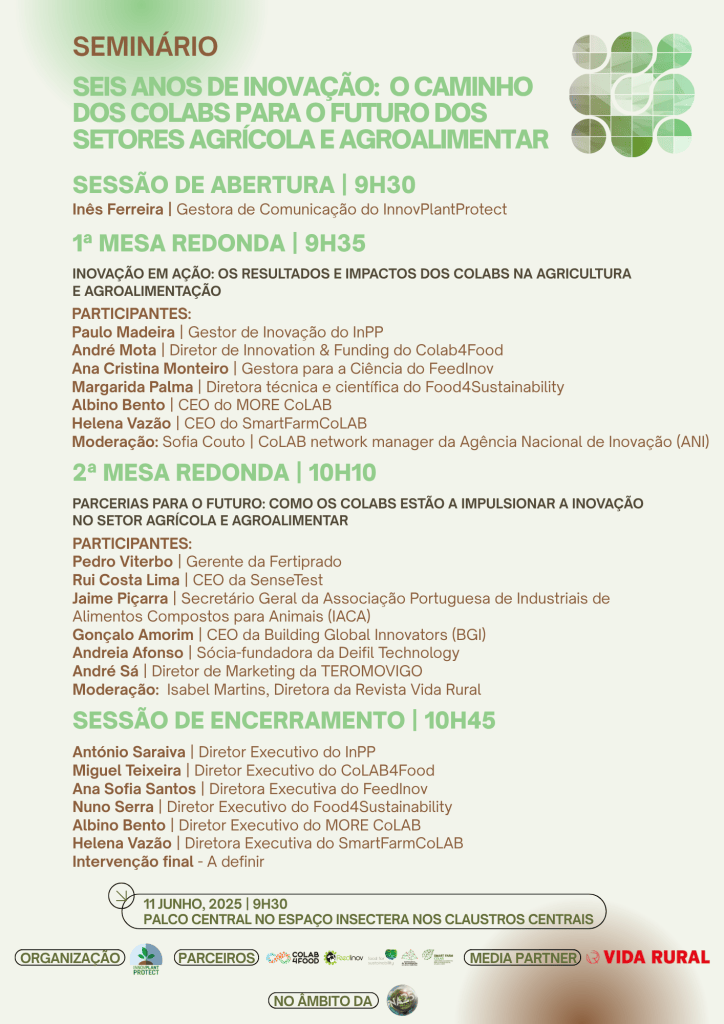
O InnovPlantProtect (InPP) promotes the seminar “Six years of innovation: The path of CoLABs for the future of the agricultural and agri-food sectors”, on the next day June 11th, from 09h30 until 11h00, in center stage at Espaço InsectERA, located in the Central Cloisters of the National Center for Agricultural Exhibitions and Markets (CNEMA) in Santarém.
The seminar aims to present the practical results and real impact of six Collaborative Laboratories (CoLABs) in Portugal - InnovPlantProtect, Colab4Food, FeedInov, Food4Sustainability, MORE and SmartFarmCoLAB. These interface infrastructures are essential pillars of the National Innovation System (SNI) and play a growing and essential role in the dynamics of innovation for agriculture and agri-food.
The event will be attended by members of the teams and partners of each of the CoLABs, who will talk about their vision of the added value of these interface and innovation entities, from the point of view of those who collaborate directly with them.
The initiative, which is part of the National Agriculture Fair (FNA) 2025, which this year has the theme “Biosolutions” and will be the stage for exploring the innovations that are shaping the future of the sector, brings together different representatives of the innovation ecosystem to show the role of CoLABs in stimulating the transfer of knowledge and making innovation available to agriculture and agri-food in Portugal, creating value and attracting highly qualified human resources to the country.
See the full program in the image below.
The registration for the event is free, but mandatory due to the limited capacity of the space. Guarantee your presence by filling in the available form here.
We look forward to welcoming you for a morning of sharing and debate on the future of innovation in the agricultural and agri-food sectors!
Estamos em contagem decrescente para a Feira Nacional de Agricultura (FNA), uma das maiores feiras agrícolas do país!
É já de 7 a 15 de junho que o InPP vai estar na 61ª edição da Feira Nacional de Agricultura, que se realiza no CNEMA – Centro Nacional de Exposições, em Santarém.
O tema da edição deste ano é “Biosoluções”e pretende destacar a importância das soluções e tecnologias inovadoras no setor agroalimentar e na promoção de práticas mais sustentáveis e eficientes.
A FNA reúne agricultores, empresários e especialistas dos setores agroalimentar, pecuário e agrícola e é um excelente espaço para aumentar a nossa rede de contactos, trocar conhecimentos e apresentar as mais recentes tendências e soluções agrícolas que a nossa equipa tem desenvolvido.
Vai poder encontrar-nos no stand nº.18, à entrada do Espaço dos claustros, dedicado à Agenda InsectERA, entre as 10h e as 20h.
InnovPlantProtect (InPP) took part in the National Olive Growing Fair (FNO 25) in Campo Maior, from May 23 to 25, presenting its latest biological and digital innovations for crop protection, including projects focused on biopesticides for olive diseases and early detection of fungi that cause gafa, and monitoring insect vectors of the bacterium Xylella fastidiosa, which attacks olive groves. The Elvas CoLAB was present with its own stand to demonstrate its strengths and the impact of its research on agricultural sustainability, inviting producers, technicians and researchers to learn about its innovative bio-based and digital solutions and to actively participate in the discussion of the sector's challenges.
The collaborative laboratory (CoLAB) welcomed visitors at the stand no. 14, located at thematic area at the Campo Maior Municipal Garden, to showcase their activity, the ongoing projects that are developing solutions to the main olive diseases, the patents already submitted, the apps for agricultural management and the bio-based and digital products and services they have to offer the agricultural sector and the market. Throughout the three days of the fair, some of InPP's researchers were at the stand to demonstrate to visitors the various features of the Elvas CoLAB, which has been developing innovation that it hopes will contribute to the sustainability of agricultural systems.
InPP announced ValorCannBio project, which is processing biomass that is not used in the medical cannabis industry to develop effective and sustainable biopesticides against gafa and tuberculosis, The project will be carried out in the municipality of Elvas, which is responsible for decimating entire harvests, leading to severe economic losses and compromising food quality. The impact of this project will be felt in the municipality of Elvas, where the project is being developed, but it is expected that it will extend to the entire olive-growing region from Trás-os-Montes to the Algarve, where production losses are increasing due to these diseases. O AlViGen project was also one of the protagonists and is using cutting-edge technology to detecting and identifying the strains of fungi that cause gafa, long before the symptoms become visible. The project team has used traps to collect spores that circulate in the air to monitor the presence of fungi, which can give farmers an important advantage in preventing infections and protecting their crops, reducing production losses.
O SNM_XylellaVt project, The SNM_XylellaVt project, led by DRAPCENTRO and in which InPP actively participates, was also highlighted at FNO. SNM_XylellaVt is monitor the insect vectors of the bacteria Xyllela fastidiosa, in particular the foam leafhopper, the insect responsible for transmitting the bacterium, which attacks various agricultural and forestry crops, and in particular olive groves. The project team is developing new tools, such as risk prediction models which, in the presence of the bacterium, whether in plants or insect vectors, will allow the National Agricultural Warning Service (SNAA) to alert, in real time, about the economic attack levels (EAL) for these insects, thus allowing prevent infection of the main crops. As part of this project, the team has also developed an online platform where citizens can report the sighting of foams, which are signs of the presence of the insect vectors of X. fastidiosa, This will help to map its temporal and spatial distribution and to plan measures to combat this bacterium.
The FNO, organized jointly by the Campo Maior City Council and the Centre for the Study and Promotion of Olive Oil in the Alentejo (CEPAAL), is an event that aims to enhance national olive growing, and in particular Portuguese olive oil, boosting the local economy and bringing together professionals from the sector - producers, technicians, or researchers - from all over the country to discuss challenges and trends in the Portuguese olive and olive oil sector.
The InnovPlantProtect (InPP) collaborative laboratory (CoLAB) has been integrated in the list of Competent Organizations of the European Food Safety Authority, or EFSA) designated by the member states, with the capacity to assist that European Union agency.
This integration “represents EFSA's recognition of the skills installed at the InPP,” notes CoLAB's executive director, Pedro Fevereiro, expressing CoLAB's full willingness to collaborate with the European Food Safety Authority in pursuing its objectives.
Today, March 21, 2022, InnovPlantProtect (InPP) received a visit from the Ministers of Science, Technology and Higher Education, Manuel Heitor, and Territorial Cohesion, Ana Abrunhosa, and the Secretary of State for the Enhancement of the Interior, Isabel Ferreira.
“Seeing these renovated facilities shows that there is an effort here that now needs to continue,” said Manuel Heitor, congratulating the InPP, particularly in terms of retaining highly qualified human resources, such as the 16 doctoral graduates from CoLAB. Ana Abrunhosa also congratulated InPP's associates on the combination of wills that gave birth to this collaborative laboratory, adding that the government will continue to give priority to interface structures such as CoLABs within the scope of European funding programs.
InPP's executive director, Pedro Fevereiro, led the tour of the new and old facilities at INIAV's Elvas Campus and presented InnovPlantProtect's structure, team, projects and future plans. Asked by Manuel Heitor about InPP's potential for internationalization, and while stressing that CoLAB is still in the installation phase, Pedro Fevereiro mentioned the various relationships already established in Spain and contacts to be explored with Brazil.
The fact that CoLAB has two multinationals (Bayer and Syngenta) as associates is aimed precisely at this strategy, recalled Isabel Rocha, vice-rector of NOVA University Lisbon, representing the InPP board of directors, arguing that this is a two-year project.
The visit was also attended by José Rondão Almeida, mayor of Elvas, Luís Loures, president of the Portalegre Polytechnic Institute (IPPortalegre), Fernando Rebola, vice-president of IPPortalegre, Rosário Félix, representing the University of Évora, Miguel de Castro Neto, from NOVA IMS, the president and vice-president of CCDR Alentejo, António Ceia da Silva and Carmen Carvalheira, Margarida Oliveira, from ITQB NOVA and coordinator of the InPP working group, the director of INIAV's Elvas Pole, Benvindo Maçãs, and Pedro Viterbo, manager of Fertiprado.
Better production, better nutrition, a better environment and a better life, leaving no one behind: InnovPlantProtect (InPP) subscribes to the principle of the “four bests” by FAO, The transformation to agri-food systems is achievable.more efficient, inclusive, resilient and sustainable, within the framework of the The organization's Strategic Framework for 2022-2031 and the 2030 Agenda for Sustainable Development.
With the “top four”, the Food and Agriculture Organization (FAO) of the United Nations aims to contribute to achieving the agenda of the Sustainable Development Goals (SDGs), namely SDGs #1 (Eradicate poverty), #2 (Eradicate hunger) and #10 (Reduce inequalities). InPP is committed to achieving this vision through its mission to develop bioinspired solutions for protecting crops against pests and diseases.
The interconnection between the economic, social and environmental dimensions of agri-food systems is reflected in the “four bests”, encouraging a strategic and systems-oriented approach. “Better production” refers to efficient and inclusive agri-food supply chains at local, regional and global levels, ensuring resilience and sustainability in the face of climate and environmental change, with a view to achieving more sustainable consumption and production patterns.
The “better nutrition” pillar represents the goals of eradicating hunger, achieving food security, promoting nutritious food and increasing access to healthy diets. On the other hand, more efficient, inclusive, resilient and sustainable agri-food systems must also contribute to a “better environment” by protecting, restoring and encouraging the sustainable use of terrestrial and marine ecosystems, and combating climate change.
Last not least, By reducing inequalities (between urban and rural areas, rich and poor countries, men and women), the FAO hopes that we can promote inclusive economic growth and a better life for all, leaving no one behind.



 Português
  English