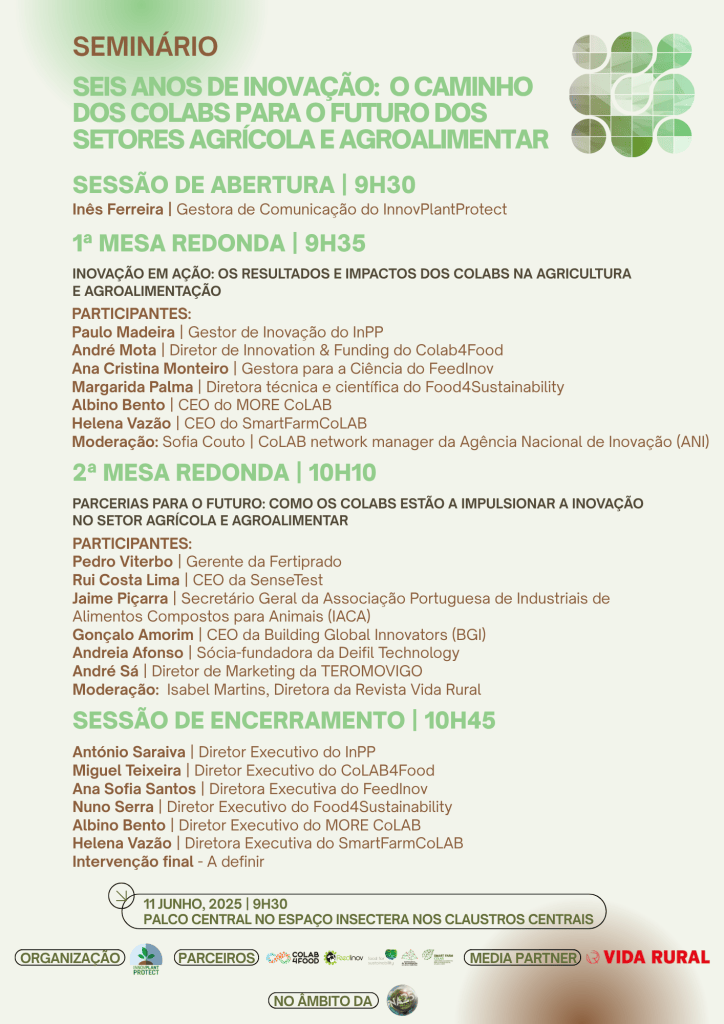
O InnovPlantProtect (InPP) promotes the seminar “Six years of innovation: The path of CoLABs for the future of the agricultural and agri-food sectors”, on the next day June 11th, from 09h30 until 11h00, in center stage at Espaço InsectERA, located in the Central Cloisters of the National Center for Agricultural Exhibitions and Markets (CNEMA) in Santarém.
The seminar aims to present the practical results and real impact of six Collaborative Laboratories (CoLABs) in Portugal - InnovPlantProtect, Colab4Food, FeedInov, Food4Sustainability, MORE and SmartFarmCoLAB. These interface infrastructures are essential pillars of the National Innovation System (SNI) and play a growing and essential role in the dynamics of innovation for agriculture and agri-food.
The event will be attended by members of the teams and partners of each of the CoLABs, who will talk about their vision of the added value of these interface and innovation entities, from the point of view of those who collaborate directly with them.
The initiative, which is part of the National Agriculture Fair (FNA) 2025, which this year has the theme “Biosolutions” and will be the stage for exploring the innovations that are shaping the future of the sector, brings together different representatives of the innovation ecosystem to show the role of CoLABs in stimulating the transfer of knowledge and making innovation available to agriculture and agri-food in Portugal, creating value and attracting highly qualified human resources to the country.
See the full program in the image below.
The registration for the event is free, but mandatory due to the limited capacity of the space. Guarantee your presence by filling in the available form here.
We look forward to welcoming you for a morning of sharing and debate on the future of innovation in the agricultural and agri-food sectors!
Estamos em contagem decrescente para a Feira Nacional de Agricultura (FNA), uma das maiores feiras agrícolas do país!
É já de 7 a 15 de junho que o InPP vai estar na 61ª edição da Feira Nacional de Agricultura, que se realiza no CNEMA – Centro Nacional de Exposições, em Santarém.
O tema da edição deste ano é “Biosoluções”e pretende destacar a importância das soluções e tecnologias inovadoras no setor agroalimentar e na promoção de práticas mais sustentáveis e eficientes.
A FNA reúne agricultores, empresários e especialistas dos setores agroalimentar, pecuário e agrícola e é um excelente espaço para aumentar a nossa rede de contactos, trocar conhecimentos e apresentar as mais recentes tendências e soluções agrícolas que a nossa equipa tem desenvolvido.
Vai poder encontrar-nos no stand nº.18, à entrada do Espaço dos claustros, dedicado à Agenda InsectERA, entre as 10h e as 20h.
InnovPlantProtect (InPP) took part in the National Olive Growing Fair (FNO 25) in Campo Maior, from May 23 to 25, presenting its latest biological and digital innovations for crop protection, including projects focused on biopesticides for olive diseases and early detection of fungi that cause gafa, and monitoring insect vectors of the bacterium Xylella fastidiosa, which attacks olive groves. The Elvas CoLAB was present with its own stand to demonstrate its strengths and the impact of its research on agricultural sustainability, inviting producers, technicians and researchers to learn about its innovative bio-based and digital solutions and to actively participate in the discussion of the sector's challenges.
The collaborative laboratory (CoLAB) welcomed visitors at the stand no. 14, located at thematic area at the Campo Maior Municipal Garden, to showcase their activity, the ongoing projects that are developing solutions to the main olive diseases, the patents already submitted, the apps for agricultural management and the bio-based and digital products and services they have to offer the agricultural sector and the market. Throughout the three days of the fair, some of InPP's researchers were at the stand to demonstrate to visitors the various features of the Elvas CoLAB, which has been developing innovation that it hopes will contribute to the sustainability of agricultural systems.
InPP announced ValorCannBio project, which is processing biomass that is not used in the medical cannabis industry to develop effective and sustainable biopesticides against gafa and tuberculosis, The project will be carried out in the municipality of Elvas, which is responsible for decimating entire harvests, leading to severe economic losses and compromising food quality. The impact of this project will be felt in the municipality of Elvas, where the project is being developed, but it is expected that it will extend to the entire olive-growing region from Trás-os-Montes to the Algarve, where production losses are increasing due to these diseases. O AlViGen project was also one of the protagonists and is using cutting-edge technology to detecting and identifying the strains of fungi that cause gafa, long before the symptoms become visible. The project team has used traps to collect spores that circulate in the air to monitor the presence of fungi, which can give farmers an important advantage in preventing infections and protecting their crops, reducing production losses.
O SNM_XylellaVt project, The SNM_XylellaVt project, led by DRAPCENTRO and in which InPP actively participates, was also highlighted at FNO. SNM_XylellaVt is monitor the insect vectors of the bacteria Xyllela fastidiosa, in particular the foam leafhopper, the insect responsible for transmitting the bacterium, which attacks various agricultural and forestry crops, and in particular olive groves. The project team is developing new tools, such as risk prediction models which, in the presence of the bacterium, whether in plants or insect vectors, will allow the National Agricultural Warning Service (SNAA) to alert, in real time, about the economic attack levels (EAL) for these insects, thus allowing prevent infection of the main crops. As part of this project, the team has also developed an online platform where citizens can report the sighting of foams, which are signs of the presence of the insect vectors of X. fastidiosa, This will help to map its temporal and spatial distribution and to plan measures to combat this bacterium.
The FNO, organized jointly by the Campo Maior City Council and the Centre for the Study and Promotion of Olive Oil in the Alentejo (CEPAAL), is an event that aims to enhance national olive growing, and in particular Portuguese olive oil, boosting the local economy and bringing together professionals from the sector - producers, technicians, or researchers - from all over the country to discuss challenges and trends in the Portuguese olive and olive oil sector.
InnovPlantProtect (InPP) is taking part in a European project, coordinated by the University of Minho (UMinho), which aims to create nanobiopesticides and nanobiofertilizers to combat pests in viticulture, protecting the environment, increasing production, reducing costs and tackling climate change. The project is called VINNY, brings together 19 partners from ten countries and will receive 8.3 million euros over the next four years from the Horizon Europe program. The European Union is the world's largest wine producer and is therefore looking to invest in ecological and economically sustainable production based on Portuguese know-how.
The VINNY kick-off meeting took place on July 25 and 26 in Porto and the Douro wine region, in an experimental field at Quinta do Pôpa, and was attended by InPP, represented by the directors of the New Biopesticides and Specific Crop Protection departments Cristina Azevedo and Sandra Correia. Moving from intensive to sustainable viticulture on a global scale and cutting agrochemicals in the sector by 50% are the main objectives of the consortium led by Margarida Fernandes, from the Center for Microelectromechanical Systems (CMEMS) at UMinho's School of Engineering.
The kick-off meeting of the VINNY project brought together all the partners in Porto and the Douro wine region
“We're going to study the microbiomes of vineyards in Portugal, Spain, Austria and Denmark to create potent cocktails with antifungal and plant protection profiles which, through nanoencapsulation and stimulation, will be more stable and effective. We're also going to create biofertilizers with nitrogen, phosphorus and potassium based on by-products from the meat industry and wastewater treatment,” he explains. The project will also propose agrotextiles impregnated with these nanobiofertilizers, as well as testing their efficiency, efficacy and safety in the laboratory, in pilot areas and in the field.
VINNY is expected to give rise to several projects in co-promotion with companies and associations. The project also has a social aspect, establishing the “European Vineyard Network” made up of three Living Labs and a Lighthouse to disseminate sustainable practices to farmers and organizations in the area, thus boosting innovation and sustainability in the primary sector.
At a national level, in addition to InPP, the consortium includes CMEMS (which is joined by the Center for Biological Engineering, as part of the associated laboratory LABBELS), the Center for Molecular and Environmental Biology, all from UMinho, as well as ADVID - Cluster da Vinha e do Vinho, and the communication agency LKCOM. At European level, it brings together five universities, eleven companies and three associations from ten countries. VINNY stands for “Advanced nano encapsulation of bio-based pesticides and fertilizers for a circular and sustainable viticulture”.
On July 24th, Eixo InFrass organized a webinar as part of the New Bioindustry - The future has already begun series of sessions, on the topic of “Agronomic valorization of organic insect fertilizer”.
The Secretary General of the Agenda, António Campos, opened the session and presented the InsectERA Mobilizing Agenda, followed by Sandra Correia, representing InnovPlantProtect as the leader of this WP, who presented the objectives of this axis.
This was followed by Ivã Lopes, from the Swedish University of Agricultural Sciences, who spoke about “The Potential and Advantages of Using Organic Insect Fertilizer”, resulting from the research he is carrying out. This included evaluating the chitin of three insects (black soldier fly, crickets and mealworms).
He concluded his speech by outlining the prospects for using frass:
Frass is an organic fertilizer with similar characteristics to conventional organic compounds... but there are differences!
The concentration of biostimulants in frass seems to be higher than other organics, which results in superior growth and metabolic effects
Frass contains a large amount of chitin, a natural stimulant of plant immunity
Can we consider applying frass alone? Yes. However, combining it with other raw materials results in more significant effects
We need to unravel the mechanisms behind how frass works! To do this: tests and more tests, with partnerships between industry and academia
Frass stimulates microorganisms that affect communication between plants. How can this synergistic effect be optimized?
Clarice Sousa (EntoGreen), Marisa Santos (Thunder Foods) and José Gonçalves (The Cricket) addressed the topic “Innovative Production of Organic Fertilizers: Insect Companies Present Sustainable Solutions”, which focused on the technical aspects of producing black soldier fly, tenebrio and cricket (Acheta domesticus), including the physical and chemical composition of the frass.
Sara Campos, from INEGI, presented “Challenges and Solutions in Frass Processing: Efficiency and Regulation”, addressing the issue of experimental analyses of frass quality, with variations in time and temperature and the technologies/processes used by partners for heat treatment, recalling that the work underway is for the development and application of new methods for processing insect excrement (frass) that comply with European standards and increase the efficiency of the process in terms of time and energy, without jeopardizing the quality obtained.
Ana Rita Caranova, from the DGAV, spoke about the “Legal Framework for Farmed Insect Excrement, its Treatment and Use”. She began by presenting the DGAV, its Mission and Vision. He then outlined the Agenda, in particular the legal issues, such as technical clarifications, meetings with partners, clarifications and the preparation of material to support the interpretation of the legislation in force. He referred to the definition of frass, as well as the legal requirements for placing frass on the market, as FOCOS (Organic Fertilizer and Organic Soil amendment), supported by Regulation (EU) 142/2011, points a), b), d) and e) of section 2, Chapter I, Annex XI.
He finished by referring to labeling, transport and placing on the market, which are covered by specific regulations.
Regina Menino and António Cordeiro, from INIAV, developed “Frass as an Organic Fertilizer”. Regina Menino began the presentation by saying that frass is being used in various greenhouse and field trials, with the aim of assessing its agronomic potential (both in soils and in different crops). She also mentioned the trials in pots, which are being carried out using ryegrass as a model crop, and whose aim is the agronomic enhancement of frass from different origins.
António Cordeiro presented information on the work being carried out in the olive grove field trials - hedged and intensive, and in partnership with Nutrifarms. There are many expectations in terms of monitoring and analyzing the results.
Ricardo Ramiro and Leonor Martins, from InnovPlantProtect, presented “The Impact of Frass on Plant and Soil Health”. Trials are being carried out which include assessing the effect of different frass: on vegetables (physiological parameters and crop productivity), on corn (physiological parameters and growth assessment), and on the susceptibility of different crops to diseases, by carrying out controlled infection trials. The effect of different frass on the microbiome of different crops will also be tested.
The intervention culminated in a very important question: Frass: a new tool for manipulating the microbiome? Since frass is rich in organic matter, macro- and micronutrients, with chitin being a key component, the properties of frass vary according to several factors:
insects' diet
application of treatments (e.g. temperature)
incorporation of other products
==> such versatility could allow for customized applications
The application of frass to the soil leads to an increase in the abundance of organisms capable of degrading chitin (e.g. Actinobacteria; Bacillus; Mortierellomycetes), with multiple benefits for the plant.
Diogo Cardoso, from the University of Aveiro, closed the presentations with the topic “Analysis of Soil Functionality and Ecosystem Services with the Use of Insect Frass: Sustainability and Impact Assessment”. He began by highlighting the problem of food sustainability for the global population and the need to adopt more sustainable agricultural practices. This is where organic fertilizer (Insect frass) can come in, boosting enzymatic activity, benefiting soil health, making it biologically active, with high microbial activity and good nutrient recycling. It is in this context that laboratory work is being carried out to assess the impact of frass on soil and plants, and on soil leaching. Tests are also being carried out in greenhouses and in the field.



 Português
  English