News & Events

white plant

NEWS

On June 30, InnovPlantProtect (InPP) was present at the meeting “7 years of CoLABs: impacts and perspectives”, which brought together political decision-makers, experts from the Portuguese innovation ecosystem, leaders from different sectors, representatives of public and private entities and the representatives of the 41 Collaborative Laboratories (CoLAB), at the Pavilhão do Conhecimento in Lisbon.

The meeting, organized by the Forum of Collaborative Laboratories (FCoLAB), aimed to reflect on the impact of the work carried out by the different CoLABs over the last seven years, as well as to address future prospects and identify strategies to boost the contribution of scientific research and innovation to the economy and society.

This initiative was an opportunity to showcase the products, services and solutions developed by CoLAB over the last seven years, highlighting its contribution to innovation, competitiveness and sustainability in various sectors of the economy. The application recently launched by InPP, iCountPests, which allows pests to be counted automatically using images from traps, reducing the time invested in monitoring and making it possible to create a pest history, was also highlighted.

The event was attended by the Minister of Education, Science and Innovation, Fernando Alexandre, the Secretary of State for the Economy, João Rui Ferreira, Manuel Heitor, from the IN+ Center for Innovation, Technology and Policy Research and former Minister of Science and Innovation, António Grilo, President of ANI, among others.

In his speech, the Minister for Education, Science and Innovation, Fernando Alexandre, highlighted the purpose of science at national level: “We hope that the science created in Portugal will generate innovation. More than technology, innovation is the answer to society's problems. You are the agents of change!”.

During the session, the main activity indicators and proven impact of the first seven years of CoLABs' activity were also presented, and multisectoral perspectives on their role in the national science and innovation ecosystem were debated, focusing on topics such as socio-economic impact, internationalization, business competitiveness, technological innovation and sustainability.

The activity indicators and the impact of the 7 years of activity are as follows:

  • More than 260 projects approved
  • More than 1,300 qualified jobs created
  • 19M€ in tax revenue generated
  • More than 900 interactions with companies
  • 33 patent applications (10 granted)
  • 680 scientific articles published

The two afternoon panels were attended by companies, partners and management entities, who reflected on the impact generated so far and presented proposals for maximizing CoLAB's long-term contribution to both the economy and Portuguese society.

At a time when the basic funding options for CoLABs are being discussed, this event is of the utmost importance. The area of crop protection, in particular, needs more investment in innovation. Holding this event was important for bringing this urgent and strategically important issue to the debate.

The InPP was also present in the exhibition area, receiving important visitors, including the Minister of Education, Science and Innovation, Fernando Alexandre, the Secretary of State for the Economy, João Rui Ferreira, the Secretary of State for Science and Innovation, Helena Canhão, the President of the FCT, Madalena Alves, the President of the National Innovation Agency, António Grilo, the President of the National Monitoring Committee for the RRP, Pedro Dominguinhos and the Executive Director of Ciência Viva, Ana Noronha.

Image credits: InnovPlantProtect - Inês Ferreira


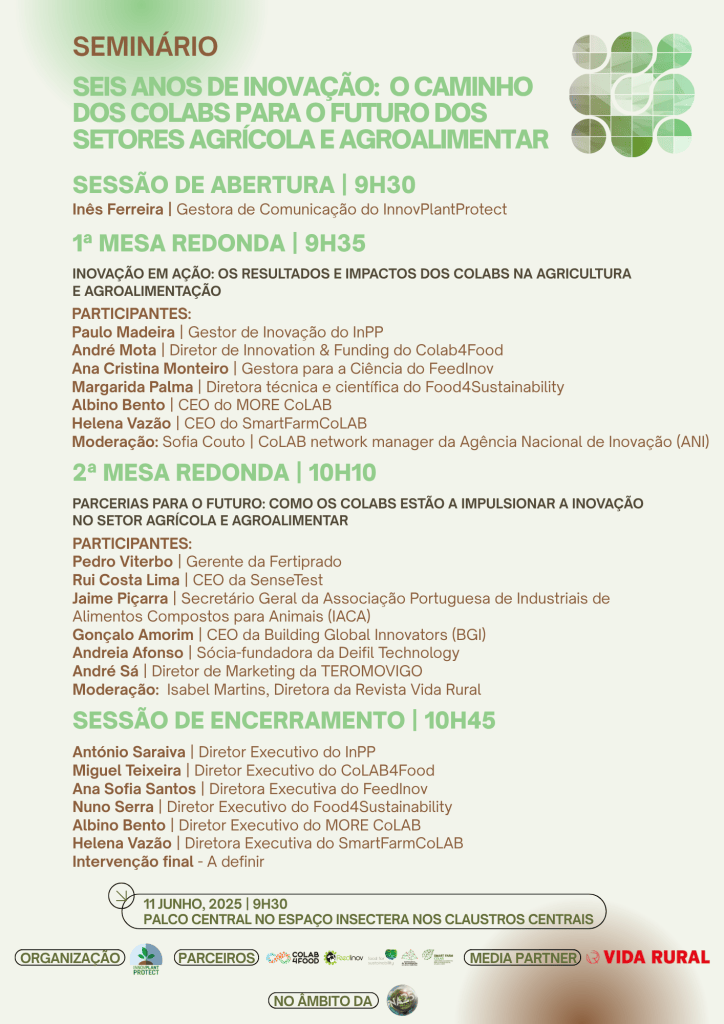
On June 11th, InnovPlantProtect (InPP) held a seminar on “Six years of innovation: CoLABs” path to the future of the agricultural and agri-food sectors", at the National Agriculture Fair (FNA) in Santarém.

The event brought together, for the first time, six Collaborative Laboratories (CoLABs) with direct involvement in the agricultural and agri-food sectors: InnovPlantProtect, CoLAB4Food, FeedInov CoLAB, Food4Sustainability, MORE CoLAB and SmartFarmCoLAB.

The program included two round tables. The first, dedicated to “Innovation in Action: The Results and Impacts of CoLABs in Agriculture and Agrifood”, representatives from each CoLAB took part, presenting success stories and projects developed, with emphasis on the intervention of the innovation manager at InnovPlantProtect, Paulo Madeira, He shared InPP's achievements in developing solutions for more sustainable agriculture.

The second round table, under the theme “Partnerships for the Future: How CoLABs are Driving Innovation in the Agricultural and Agri-Food Sector”, The event was attended by partner companies and associations, who stressed the importance of collaborating with the CoLABs. Among the speakers were Pedro Viterbo, manager of Fertiprado, InnovPlantProtect's partner, accompanied by representatives of the following organizations Sense Test, Associação Portuguesa Dos Industriais De Alimentos Compostos Para Animais (IACA), Building Global Innovators (BGI), DEIFIL Technology and TeroMovigo.

The seminar ended with a moment of joint reflection, with speeches from all the executive directors of the CoLABs present, including the executive director of InnovPlantProtect, António Saraiva, The meeting was organized by the European Commission, which stressed the importance of cooperation and strategic coordination between the Collaborative Laboratories, reinforcing their collective commitment to innovation and sustainable development in the agricultural and agri-food sectors.

Throughout the seminar, the importance of synergies between science, innovation and the market became clear, as did the need to strengthen funding and guarantee conditions for the continuity and growth of these Collaborative Laboratories, whose impacts are already visible in the national agricultural and agri-food ecosystem.

This meeting was an important moment for sharing experiences and strengthening collaborative work, charting a joint path towards a more competitive, sustainable and innovative future for agriculture and agri-food in Portugal.

O InnovPlantProtect (InPP) promotes the seminar “Six years of innovation: The path of CoLABs for the future of the agricultural and agri-food sectors”, on the next day June 11thfrom 09h30 until 11h00, in center stage at Espaço InsectERA, located in the Central Cloisters of the National Center for Agricultural Exhibitions and Markets (CNEMA) in Santarém.

The seminar aims to present the practical results and real impact of six Collaborative Laboratories (CoLABs) in Portugal - InnovPlantProtect, Colab4Food, FeedInov, Food4Sustainability, MORE and SmartFarmCoLAB. These interface infrastructures are essential pillars of the National Innovation System (SNI) and play a growing and essential role in the dynamics of innovation for agriculture and agri-food.

The event will be attended by members of the teams and partners of each of the CoLABs, who will talk about their vision of the added value of these interface and innovation entities, from the point of view of those who collaborate directly with them.

The initiative, which is part of the National Agriculture Fair (FNA) 2025, which this year has the theme “Biosolutions” and will be the stage for exploring the innovations that are shaping the future of the sector, brings together different representatives of the innovation ecosystem to show the role of CoLABs in stimulating the transfer of knowledge and making innovation available to agriculture and agri-food in Portugal, creating value and attracting highly qualified human resources to the country.

See the full program in the image below.

The registration for the event is free, but mandatory due to the limited capacity of the space. Guarantee your presence by filling in the available form here.

We look forward to welcoming you for a morning of sharing and debate on the future of innovation in the agricultural and agri-food sectors!

EVENTS

Latest information from the Stenphyliosis Working Group released by INIAV. Controlling the maturation of the future spores of the fungus that causes the disease is crucial to stamping it out.

Monitoring the development of the spores of the fungus that causes stenphylliosis, also known as brown spot disease of the pear tree, indicates that the time has come to remove the leaves from under the tree canopy, recommends the Stenphylliosis Working Group.

The maturity index (MI) of the pseudothecae - structures where the endogenous spores (ascospores) form during the winter - increased by 0.9 in the Alcobaça orchard, 0.8 in the Maiorga orchard, 0.5 in the Picanceira orchard and 0.4 in the Sobrena orchard, between January 25 and February 8, 2021. Compared to the same period last year, the IM in these orchards in Western Portugal is 0.4 lower in Sobrena, 0.2 lower in Picanceira and Alcobaça, and 0.1 higher in Maiorga.

The data can be found in 2nd Information from the Stenphilosis Working Group (Stenphilosis WG), coordinated by INIAV, in which it is considered important to “remove/destroy the leaves under the canopy before the pseudothecae mature and the ascospores are released (IM=7), so that the primary inoculum of stenphyliosis is minimal and, as a result, the incidence of the disease is reduced”.

Those responsible for the Stenphyliosis WG point out that, at this time, the ascospores won't necessarily infect the pear trees, “but they will infect the vegetation in the soil and, possibly, the organic matter on the surface of the soil” - where the inoculum will be produced during the spring.

On February 8, the orchard with the highest IM was Maiorga (IM=4.7, n=103), followed by Alcobaça (IM=4.2, n=90), Picanceira (IM=4.1,0 n=94) and Sobrena (IM=3.9, n=102). The IM of the Maiorga orchard, very close to stage 5, means that there are ascospores in formation and mature ones.

A stenphylosis, caused by the fungus Stemphylium versicarium, is a disease that affects the production and quality of the rock pear, and for which there are still no phytopharmaceuticals capable of effectively neutralizing it.

Feature image: Nicky/ Pixabay

How are we going to reduce the use of chemical pesticides by 50%? This was one of the questions discussed in the online debate on the Farm to Fork strategy organized today by Syngenta, which presented its Good Growth Plan 2.0, a plan of commitments for sustainable agriculture by 2025.

Two billion dollars is how much Syngenta is going to invest in sustainable agriculture under its new commitment plan until 2025, the Good Growth Plan 2.0. The company will also make two technologies available per year and develop specific commitments for Portugal and Spain, Felisbela Torres de Campos said today. The Head of Regulatory & Business Sustainability Portugal was speaking at a online debate promoted on 25/2/2021 by Syngenta, an associate of InnovPlantProtect (InPP), where the new Good Growth Plan of the company was presented and the European Farm to Fork (F2F) strategy was discussed.

Felisbela Campos explained to the InPP blog that the two technologies “can be used in various areas, such as new molecules, biopesticides, apps monitoring, digital tools, etc.” With regard to the specifics of Portugal and Spain, the company is “still developing local commitments, but the areas in which we already have concrete projects underway are biodiversity, soil conservation, carbon neutrality, and the safe and sustainable use of plant protection products”.

The head of Syngenta also stressed that the main objectives until 2025 are to accelerate innovation for agriculture and nature, working towards carbon-neutral agriculture. And that in the period relating to the first Good Growth Plan, between 2013 and 2020, there was an increase of 20% in crop productivity in Portugal and Spain.

In the debate, the various speakers said “yes” to F2F, which aims, among other things, to reduce the use of chemical pesticides by 50%, something that, in the words of José Diogo Albuquerque, CEO of the Agroportal, This worries farmers because of the risk of an increase in pests and a reduction in production.

Nuno Canada, president of INIAV, also a partner at InPP, recalled that the F2F “has tools to better manage the transition and adaptation” needed and that knowledge, innovation and science “make it possible to overcome” the challenges that lie ahead. He also argued that the European Commission “has created a set of financial instruments for this area, more robust than in the past, to innovate in agriculture and food” - instruments that the sector must be able to use.

The president of INIAV recalled that of the 26 collaborative laboratories that have been set up in Portugal, six are in the agri-food sector, which he considered to be very significant and exemplary of the improvements that have taken place in the national agricultural education and research ecosystem, as well as the “very significant journey” that has been made towards bringing the entities that produce knowledge closer to those that use and apply it.

For the director general of Office of Planning, Policy and General Administration, According to Eduardo Diniz, “the main debate is not about the objectives of the Green Deal [the European Green Deal that the F2F is part of], it's about being aware that they require the introduction of innovation and technology, which requires investment and income in the sector.”.

As for the use of biopesticides, Eduardo Diniz believes that there is still a long way to go, from the point of view of research and regulation, and that they will always be a complementary strategy in the fight against pests and diseases, not a total alternative. For his part, Nuno Canada mentioned the case of InPP, based at the INIAV center in Elvas, which aims precisely to develop biopesticides for crop protection and the post-harvest phase.

© 2021 InnovPlantProtect, All rights reserved

Gene in common wheat that promotes the fungal diseases yellow rust and black rust identified.

A team of researchers from John Innes Centre identified a common wheat gene (Triticum aestivum), which acts as a promoter of yellow rust and black rust, fungal infections that attack this breadmaking cereal worldwide, in a very destructive way and with great economic impact.

Disrupting the function of this gene makes wheat more resistant to these diseases, according to a published news on the website of that international center of excellence in Plant Science.

Yellow rust under the microscope
Yellow rust on a wheat leaf. © John Innes Center

In a study published in The Plant Cell, The scientists conclude that the gene, called TaBCAT1, is activated (becomes expressed) at an early stage of yellow rust infection - caused by the fungus Puccinia striiformis f.sp. tritici. When these fungi attack, they activate (induce) and deactivate specific genes to prevent the wheat from defending itself. If successful, the plant is unable to eliminate the invader and ends up getting sick.

Eliminating this gene in mutant plants drastically reduced infection. “We were amazed to see that removing just this one gene in our mutant plants makes them alert their defense responses even before they are attacked,” says Pilar Corredor-Moreno, first author of the study.

The full scientific article is available at https://doi.org/10.1093/plcell/koab049

© 2021 InnovPlantProtect, All rights reserved