News & Events

white plant

NEWS

InnovPlantProtect (InPP) recently received approval for an application submitted to COMPETE2030-2024-6 - Collective Actions - Transfer of scientific and technological knowledge - BioLivingLABS - Bioeconomy at the service of the sustainability of inland territories, led by MORE CoLAB - Laboratório Colaborativo Montanhas de Investigação, Associação, in partnership with the Polytechnic Institute of Bragança (IPB), the Polytechnic Institute of Castelo Branco (IPCB) and AQUAVALOR.

BioLivingLABS aims to promote the economic valorization of research and development (R&D) results obtained by various institutions in the North, Center and Alentejo. To this end, it will create an experimental demonstration network, the so-called Living Labs, The project will be held in the innovation hubs of Mirandela, Douro, Covilhã and Elvas. In addition, demonstration actions, workshops, an inland innovation catalog and training on intellectual property protection will be developed with the aim of encouraging the incorporation of innovative solutions in the business sectors of these regions.

Scheduled to begin in October and lasting 24 months, the project has a total eligible investment of over 740,000 euros, financed by COMPETE2030 - Thematic Program for Innovation and Digital Transition. For InPP, this project is a strategic opportunity to strengthen its mission as a center for technology development and transfer, boosting the practical application of scientific knowledge to promote sustainable development.

This initiative confirms InPP's commitment to open and sustainable innovation, integrating science, technology and regional development to respond to the challenges and potential of the interior of the country.

On September 18, the executive director of InnovPlantProtect (InPP), António Saraiva, the director of the New Biopesticides Department, Cristina Azevedo, and researcher Luís Grilo attended the Open Day “The Cereals of Baixo Mondego”, promoted by the Centro Regional Coordination and Development Commission (CCDR Centro), at the Bico da Barca Experimental Unit in Montemor-o-Velho.

The event highlighted the latest innovations from the Coimbra Innovation Hub, from new technologies applied to maize and rice, to fertilization strategies, protection and the use of biostimulants on these key crops in the Baixo Mondego region.

Our team also monitored trials with biofungicides, including the product I21, developed with our collaborative laboratory to combat pyriculariosis in two rice varieties, which is being patented.

In an interview with Voice of the Countryside, Cristina Azevedo shared the work we have been doing in the area of biosolutions.

(Re)watch the interview here.

Image credits: InnovPlantProtect and Voz do Campo magazine

Maize continues to be the Portugal's most important arable crop, The sector has a significant impact on food safety and the national agri-food industry. Involving thousands of producers and generating tens of millions of euros a year, the sector is currently facing increasingly complex phytosanitary challenges.

Among already known pests and emerging diseases, there are risks ranging from cartridge caterpillar until Maize Rugose Dwarfism Virus (MRDV), The presence of this virus is increasing in Portugal. This virus, transmitted by the corn leafhopper, can seriously compromise production and is found in the climate change increasingly favorable conditions for its spread.

However, it's not just MRDV that's worrying. There are new threats that require vigilance, such as the coleopter Diabrotica virgifera or the MDMV virus (Maize Dwarf Mosaic Virus), already detected in neighboring countries, and also toxic weeds, such as the winter fig (Datura stramonium), which in addition to impacting productivity pose public health risks.

Faced with this reality, the answer is integrated and sustainable strategies, matching:

  • crop rotation and good agricultural practices;
  • careful use of insecticides to avoid resistance and environmental impacts;
  • resistant or tolerant varieties, where available;
  • research and technological innovation, including new digital tools for early detection.

As the InnovPlantProtect researcher points out, Nuno Faria, in the article entitled “The main emerging pests and diseases of the maize crop in Portugal”, available in the August edition of Voz do Campo magazine: “The phytosanitary panorama of maize in Portugal requires continuous vigilance, investment in research and the application of integrated and sustainable strategies capable of responding to an increasingly dynamic and unpredictable reality.”

To find out more about the main current risks and mitigation measures, read the full article published in the August issue of Voz do Campo magazine (pages 88-89), available on newsstands and online.

EVENTS

The software used to access and visualize the data sent by the Tree Talker sensors installed in chestnut trees in Sabugal has been improved and is now more intelligent and interactive, thanks to the use of data science tools. This development was carried out by the Monitoring and Diagnostics Department as part of the project “Educating to know, protect and monitor chestnut trees through IoT technology”, co-financed by the Environmental Fund and led by InnovPlantProtect (InPP) in collaboration with Sabugal Municipal Council (CMS).

The application of the technology known as “Internet of Things” (IoT, from the English Internet of Things) is the main novelty of this year. innovative environmental education program. By installing remote sensors on the trunks, the trees communicate their state of health, including parameters such as water consumption, biomass growth, stem humidity, absorbed solar radiation and the state of health of the leaves through light reflection.

Once collected by the TT Cloud concentrator (gateway), the raw data from the Tree Talkers is transmitted to a server via the Internet and converted into “readable” information, in the form of graphs, tables and fault alerts, among other things. With the new development, users can no longer view static graphs but can interact with dynamic graphs, which, for example, allow them to zoom in on a particular peak or curve to access a very specific and precise time period.

In addition to facilitating and improving the consultation and analysis of data on the variation in the voltage of the batteries that power the Tree Talkers, or on the temperature recorded, among many others, the new software automatically triggers email messages to pre-defined users in the event of an alert - for example, if a battery suddenly runs out of charge, in which case a trip to the site is necessary to replace the power supply device.

As part of its strategy for developing bio-inspired products, InnovPlantProtect (InPP) is building a library of microorganisms isolated from various environments, which are being identified by molecular characterization and evaluated for their biochemical properties, indicative of their potential role as Biological Control Agents (BCA). In parallel, InPP is building up a portfolio of phytopathogenic agents (bacteria and fungi), which will serve as a basis for evaluating the BCA. in vitro e in vivo the potential of isolated BCA. 

According to the Food and Agriculture Organization of the United Nations (FAO), around 40% of global agricultural production is lost every year due to pests and diseases, which translates into losses of more than 195 billion euros. For decades, phytopharmaceuticals have played a fundamental role in maintaining agricultural health, protecting crops against pests and diseases and ensuring food safety. However, their excessive and sometimes inappropriate use has a negative impact on soil, water and biodiversity, and can have harmful effects on the health of animals and humans.

As part of the “From Farm to Fork” strategy, one of the pillars of the European Green Deal, the European Commission has set targets for the sustainable use of phytopharmaceuticals, one of which is to reduce their use by 50% by 2030. In order to cope with the withdrawal of these products from the market, it is necessary to develop effective, sustainable, environmentally friendly and economical alternatives.

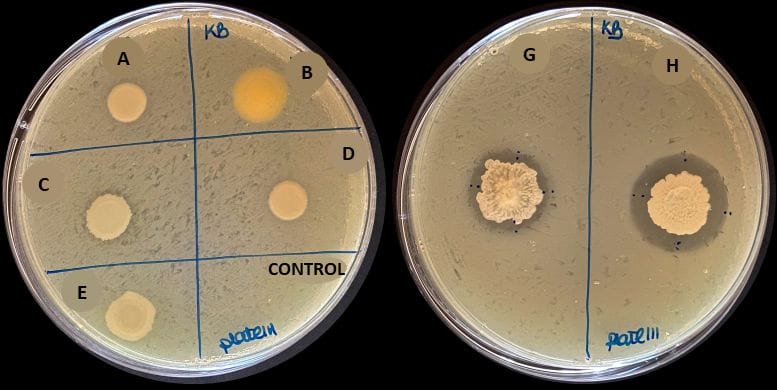
Bacterial growth inhibition test.

One of these alternatives is the use of BCA. These microorganisms are efficient at reducing the incidence or severity of diseases caused by phytopathogens, and some also act as biostimulants, i.e. they have the ability to increase the strength and speed of plant development.

There are several mechanisms through which BCAs carry out their functions, namely: inducing resistance mechanisms in the plant; competing with pathogens for space and nutrients; interacting through antibiosis mechanisms (in which one organism harms the development of the other); secreting antimicrobial or antifungal compounds; and invading and/or killing the cells of plant pathogens.

In the current context of climate change in the Alentejo region, the green leafhopper (or cicada) represents one of the biggest challenges in terms of pests faced by wine producers, with a significant impact on production. It was against this backdrop that a team from InnovPlantProtect (InPP) designed and carried out the experimental trial “Monitoring and Diagnosis of Green Leafhopper Infestations in Vineyards of the João Portugal Ramos”, work on which began in May 2021, on the Vila Santa estate in Estremoz.

The green leafhopper (species Jacobiasca lybicand Empoasca spp.), in this case, is a pest that sucks the leaves of the vine, altering their color and shape. The leaves lose their ability to photosynthesize, darken and, in the most serious cases, fall off. The grapes lose quality and quantity. The vineyard can also be weakened in the post-harvest period.

The main objectives of this trial, led by Pest and Disease Monitoring and Diagnosis Department of the InPP, were to characterize the damage caused by leafhoppers and to obtain information on the demographic parameters of these insects, which will serve as a basis for using remote sensing to predict the time and space of the pest's occurrence. 

In the first phase, traps were placed in 14 locations, in collaboration between technicians from João Portugal Ramos and the InPP. These traps were monitored weekly between May and August by an InPP team to count adult individuals of the green leafhopper. In June, field work intensified, with surveys being carried out to detect vines infested by green leafhoppers.

The surveys ran until the end of July and 58 vines were selected and marked for weekly monitoring. The selected vines were monitored between June and August, and the number of nymphs was counted, the instar of the nymphs observed (stage of metamorphosis between two moulting periods), as well as recording the severity of the symptoms observed.

All the information obtained was recorded using the app ODK Collect for Android, being immediately accessible through a WebGIS platform created with the software open source QGIS/Lizmap. Other tasks carried out included collecting specimens for identification in the laboratory and prospecting for the pest in potential natural hosts during the winter period.

InPP will soon be presenting some of the results of this trial, and the R&D plan for 2022 is currently being prepared.