InPP took part in the kick-off meeting for the European PROSPER project, held on October 2 and 3 in Pavia, Italy. In attendance were the director of the Monitoring and Diagnostics Department, Ilaria Marengo, and the project manager, Bruno Orrico.
PROSPER's main objective is to transform European agriculture by valorizing highly resilient “orphan” legumes - forgotten crops, but full of potential to face the climate and food challenges of the future.
The project promotes sustainable, innovative practices adapted to different agricultural realities.
Over the two days, 27 partners from 13 countries met for presentations, in-depth discussions and strategic talks about the project's next steps.
We are excited about what comes next, certain that this journey will be more than a collaboration - it will be a true cooperation within an exceptional team.
Join us and keep up to date with all the news from the PROSPER Project!
InnovPlantProtect (InPP) was present at the project launch meeting BioLivingLABS - Bioeconomia ao Serviço da Sustentabilidade dos Territórios do Interior (Bioeconomy at the Service of the Sustainability of Inland Territories), which took place on October 1st at the School of Agriculture of the Polytechnic Institute of Castelo Branco (IPCB).
Funded by COMPETE 2023, the BioLivingLABS project, led by MORE CoLAB - Laboratório Colaborativo Montanhas de Investigação, in partnership with the InPP, the IPCB, from AQUAVALOR and the Polytechnic Institute of Bragança (IPB).
This project's mission is to add value to the low-density territories in the north, center and south of the country by demonstrating and economically boosting the work carried out by the partners - through the creation, demonstration and application of products, processes and services resulting from joint research.
Four living laboratories will be created (Living Labs) in the innovation hubs of Mirandela, Douro, Covilhã and Elvas, which they intend to promote:
the transfer of knowledge;
technology demonstration;
strategic roadmapping and
the protection of intellectual property.
BioLivingLABS strengthens the link between academia, business and society, driving innovation and sustainability.
Expected impact: Over the course of 24 months, and with Living Labs dedicated to sectors such as olive groves and olive oil, vineyards and wine, fruit and cereals, legumes, among others, the project will contribute to:
increase regional competitiveness;
promote sustainable practices and
responding to the environmental, social and economic challenges facing inland territories.
On September 25, InnovPlantProtect (InPP) was present at the National Exhibition of Blue Bioeconomy Pact Projects, held at the Port of Leixões Cruise Terminal, for the exhibition session of the Algae Vertical project, led by PhytoBloom by Necton.
InPP, leader of sub-project 6 - Agriculture, was represented by department director Cristina Azevedo and executive director António Saraiva, who presented some of the new algae-based biosolutions that our team and partners are developing.
There were more than 300 participants and 80 entities, including companies, research centers and political decision-makers. The Opening Conference was attended by the Chairman of Inovamar's General and Supervisory Board, José Soares dos Santos, and round tables were held on the future of the blue economy in Portugal.
Algae Vertical explores the biotechnological potential of algae in sectors as diverse as food, cosmetics, pharmaceuticals, agriculture and energy.
Find out more about the Algae Vertical Project here.
MASSA - Knowledge Centre for Sustainable Agricultural Modernization and Food Security is one of the priority CAIS of the South Campus and is based at the Elvas CoLAB.
InnovPlantProtect (InPP) is the headquarters of one of the three priority centers for applied knowledge and innovation of the recently created South Campus, This consortium brings together the University of Évora (UÉ), NOVA University Lisbon and the University of the Algarve. NOVA and UÉ are members of the collaborative laboratory (CoLAB).
The Centers of Applied Knowledge and Innovation for Sustainability (CAIS) focus on designing “innovative solutions in specific areas of sustainable development in the South, based on existing infrastructures,” explain the consortium's leaders. The specific objective of MASS CAISES - The Knowledge Centre for Sustainable Agricultural Modernization and Food Security, based at the InPP in Elvas, aims to “promote agriculture based on a sustainable model, aligned with the principles of the circular economy and the eco-economy (...), contributing to the development and cohesion of the territories of the Iberian South and Interior”.
Innovation applied to agricultural production, the valorization of endogenous natural resources, the promotion of the Mediterranean diet and the training of human resources in the area of sustainable agriculture are the main thematic lines of action. The strategic partners of this CAIS include local authorities, CCDRs (Algarve, Alentejo, Lisbon), the Institute of Agricultural and Veterinary Research (INIAV, also an InPP associate), Bayer Crop Science, Syngenta Crop Protection (both InPP associates), the Eugénio de Almeida Foundation, the Fraunhofer Institute and the Association of Young Farmers of Portugal (AJAP), as well as other academic partners at Iberian and international level.
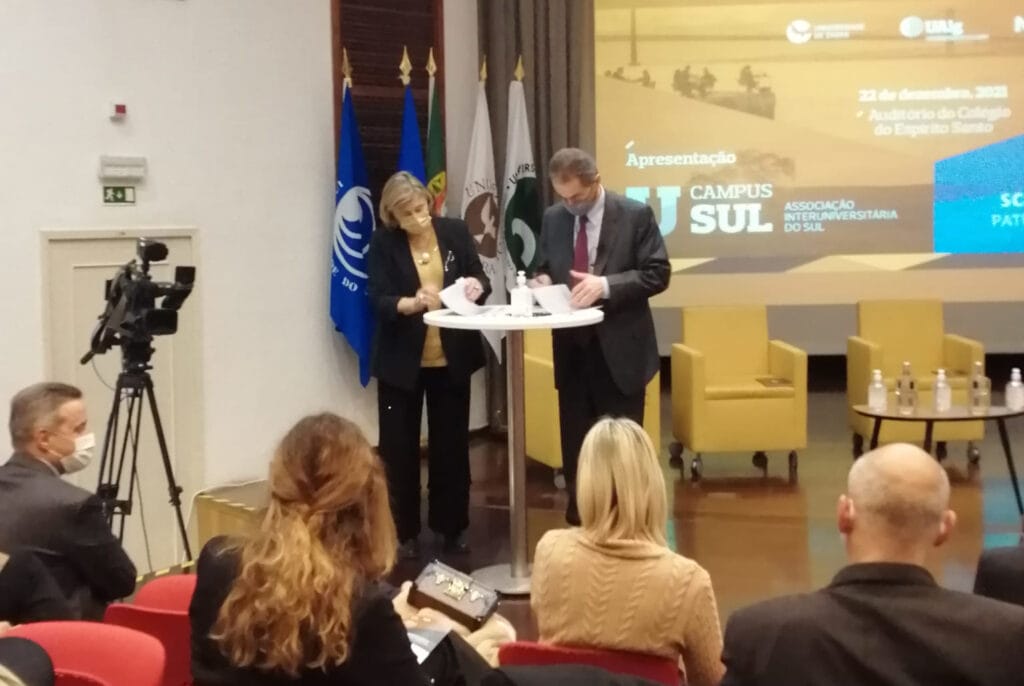
The South Campus - Interuniversity Association of the South was presented was publicly announced on December 22, 2021, in the Auditorium of the Colégio do Espírito Santo at the University of Évora. InPP's executive director was one of the speakers at the afternoon session (Science Day@South). Pedro Fevereiro spoke on the panel “Earth Research and Social Innovation”, with a presentation entitled “Innovative Bio-based Solutions for Crop Protection”.
Read more on the Innovation component of the South Campus and on the priority CAIS, including MASSA.
InnovPlantProtect (InPP) would like to wish the entire team, Associates and partners Happy Holidays by sharing the Christmas Tree set up by CoLAB's newly created sustainability team, InPP Greeners.
The maritime pine (Pinus pinaster) was purchased locally from the Elvas Volunteer Fire Brigade for a symbolic price, helping to raise funds for the organization, which collects the trees for the benefit of the Serra de São Mamede forest.
It is decorated with repurposed laboratory materials, including reused paper ribbons and recycled cardboard balls.
The Elvas Volunteer Fire Brigade is selling the pine trees at a symbolic price of €5 and €10. The maritime pine is widely used in Portugal as a Christmas tree. Plastic, paper and cardboard, among other materials, were reused in the decorations.
InnovPlantProtect is participating in three ideas that applied to the Recovery and Resilience Plan (PRR) measure “Mobilizing Agendas for Business Innovation - Proposals for the Economy of the Future”, which have been selected to move on to phase two of the process: InsectERA, the Blue Bioeconomy Pact and OesteFruta 4.0.
OesteFruta 4.0 is a mobilizing agenda for fruit growing in the West. The aim is to provide the region and the sector with tools that will enable them to face current and future challenges, with a focus on the Rocha pear and the Alcobaça apple. The consortium is led by Atlantic Portuguese Apple - Clube da Maçã and the idea, presented on Friday in Leixões by Armando Torres Paulo, corresponds to a total investment of €97 million.
The public session to present the Mobilizing Agendas took place on December 2nd and 3rd at the Port of Leixões Cruise Terminal. At the day 3 Daniel Murta, CEO of Ingredient Odyssey, and Tiago Pitta e Cunha, representing Inovamar, which is leading the Blue Bioeconomy Pact. This idea, which corresponds to a total investment of €220 million, aims to reindustrialize the blue bioeconomy by creating new economic models based on the use of marine bio-resources, as well as creating the first blue bioeconomy in the world. hub european blue bioeconomy.
The InsectERA agenda, which involves a total investment of €57 million, aims to apply circular economy concepts to the insect industry. The idea is to return by-products from the agro-industry, and some agricultural and urban waste, to the value chain in the form of nutritional solutions for people, animals and plants, as well as new industrial solutions, from cosmetics to bioplastics.
The information is public and can be consulted on the from IAPMEI.





 Português
  English