News & Events

white plant

NEWS

In viticulture, every little decision has an impact: on the soil, on the health of the plants and on the quality of the grapes that form the basis of the wine that reaches our table. The future of viticulture may depend on a single biosolution. Or a hundred. In VINNY, an ambitious European project of which InPP is a part, researchers from ten countries are looking for bioactives capable of curbing vine diseases - and, at the same time, reducing dependence on synthetic agrochemicals. What's at stake is not just science: it's the sustainability of this industry.

The aim of the VINNY project is simple but transformative: develop and implement effective, sustainable solutions and adaptable to the needs of winegrowers in various European countries, creating environmentally friendly biopesticides and biofertilizers, and advanced nano-encapsulation technologies, to reduce dependence on conventional chemicals and promote a healthier ecosystem and a better environment and a circular viticulture.

And at the heart of this mission is an essential cog in the wheel: the daily work of the researchers who search for answers invisible to the human eye - as is the case with Tiago Amaro, a researcher at InPP.

Image credits: VINNY Project

Searching for the Guardians of the Vine

The road to these new biosolutions begins in the field, with the vine. The initial work of Tiago Amaro, started in September 2024 and focuses on identifying and isolating microorganisms naturally present in the vines themselves, in samples received from partners in Portugal, Spain, Austria and Denmark.

From grapes, sticks or woody fragments, small microscopic worlds arrive in the laboratory that may contain the natural weapons needed to fighting three major threats to the vineyard, with a direct impact on farm profitability:
- A gray mold (Botrytis cinerea) and blue mold (Penicillium expansum): Fungi that cause post-harvest diseases, In the case of wine grapes, this affects the quality of the wine and makes it completely impossible to sell table grapes.
- The vine tumors: Caused by bacteria Allorhizobium vitis, This disease affects the plant in the field, causing leaf fall and reduced grape production.

Tiago Amaro, InnovPlantProtect researcher, identifying and isolating bacteria as part of the VINNY project. Image credits: InnovPlantProtect - Inês Ferreira

After isolating the microorganisms, Tiago dedicated himself to creating libraries of bacteria. What is a ‘Bacteria Library’? In the context of the investigation, a bacteria library is an organized and catalogued collection of bacteria isolated from different sources. It allows scientists to test each strain of bacteria against specific pathogens, constituting a vast catalog of potential biological ‘superheroes’ for plant protection.

This rigorous screening, which has already led to the analysis of more than 190 bacteria of this library is the first line of defense. The team selects the best candidates with the potential to be used as biological control agents against the diseases under study.

The Power of European Collaboration

What if the solution to protecting Portuguese vineyards is hidden in a Danish grape? Or in a bacterium isolated in Spain? One of the most exciting aspects of the project is its truly collaborative dimension, where researchers from ten countries are working in parallel, sharing answers, challenges and microorganisms in search of effective biosolutions for the whole of Europe.

All the solutions found will be shared, all the solutions will be tested by all the partners and it will be possible to build a ‘library of solutions’ against the various vine diseases“ emphasizes researcher Tiago Amaro.

The sharing of bacteria and extracts from different ecosystems (Portugal, Spain, Denmark and Austria) is crucial. An effective bacterium in Denmark could be the key to protecting Portuguese vineyards, and vice versa. This exchange of biological solutions, one of the innovative pillars of the project, makes it possible to exploit the microbial biodiversity beyond national borders. InPP has the fundamental role of testing, in grapes, the solutions discovered by our team as well as by other national and European partners.

This diversity of tests is a bet on the future: microorganisms that don't prove effective against vine diseases could be the solution for pathologies in other crops.

Left photo: Tiago Amaro, InPP researcher, observing a grapevine leaf, the target crop of the VINNY project, Right photo: Potted grapevine plants in the InPP greenhouse, ready to test the solutions found by the various VINNY partners. Image credits: InnovPlantProtect - Inês Ferreira

The Real Test: From the Lab to the Field

After selection in the laboratory, the next step - the formulation of the most promising bacteria - will be carried out in Portugal and Spain, at the University of Minho and the Polytechnic University of Catalonia. But it is in the field-testing phase that the greatest challenge of plant protection science lies, because even brilliant results in the laboratory can fail in the field. Formulation is the process that turns a bacterium into a product - stable, applicable and compatible with the farmer's needs.

Tiago Amaro emphasizes necessary resilience:

  • Field Uncertainty: Often, promising solutions in the laboratory or greenhouse are not as effective when applied in the field, due to environmental variables (climate, soil, etc.).
  • The Time Factor: Diseases such as Allorhizobium vitis may take a long time to develop, or the infection may not be relevant in certain years, which makes it difficult to obtain robust conclusions.
  • The Agricultural Cycle: It is necessary to test the formulation in the field during three to five consecutive years, and recording all the variations observed. With only one harvest a year, this process requires patience and persistence.

In total, from the discovery of a promising bacterium to the creation of a formulated product, proven to be effective and ready for the market, it can take around 10 years - a real test of any scientist's resilience.

Customized solutions: the new requirement of modern agriculture

The final challenge is to ensure that the tests are relevant to the producer's reality. The current trend in the agricultural sector is the search for customized solutions, adapted to the specific conditions of the farms: “There has to be a solution for every field and every farmer”, says the researcher.

This personalized approach requires more science, more rigor and more local knowledge - exactly what VINNY seeks to build.

A Europe united by science and the vine

InPP is part of this consortium, made up of 19 partners from ten countries, The project is led by the University of Minho and funded by the Horizon Europe program.

Together, they seek to answer a question that could shape the future of European viticulture: Will it be possible to find effective biosolutions for all partner countries?

The answer is still being written - in laboratories, in experimental vineyards, in fields in different climates and geographies.
And it's made up of small discoveries, many frustrations and a huge commitment to science.

Because protecting the vineyard of the future is not just a technical ambition.
It is a cultural, economic and environmental commitment.
And VINNY is helping to design that future - one microorganism at a time.

The final workshop highlighted three years of research dedicated to the early detection of pathogens in crops such as wheat and olive groves.

The project AlViGen has reached its final stretch, concluding three years of research focused on the genomic surveillance of agricultural diseases. The results now presented promise to strengthen the Alentejo agricultural sector's ability to respond to emerging phytosanitary threats.

On the day October 23rd, The final project workshop, The event brought together researchers, producers and technicians to share results and reflect on the future of genomic surveillance in Portuguese agriculture.

A pioneering genomic surveillance center

During AlViGen, the Alentejo's first genomic surveillance center, an infrastructure with capacity for early detection of diseases in strategic crops such as wheat and olive grove. This breakthrough marks a decisive step towards a more precise, sustainable and science-based agriculture.

Results and scientific contributions

Using innovative molecular tools, the project team succeeded:

  • Identify pathogenic fungi before visible symptoms appear on the plants;
  • Characterizing yellow rust strains, genetically linking them to others known at a global level;
  • Detecting resistance genes in wheat to the strains currently present in Portugal;
  • Developing diagnostic methods able to distinguish the different species of the fungus that causes gafa in olive groves.

During the workshop, the potential of the analysis of the airborne fungi community as a tool for early warning for multiple pathogens, allowing for more effective and preventive management of crop diseases.

From research to practical application

The event ended with a debate on how transform AlViGen results in a detection and warning service accessible to the agricultural sector. The initiative reflects the joint commitment between science, innovation and production, with a view to protecting national agriculture from the challenges of the future.

Partnerships and thanks

InnovPlantProtect would like to thank all the partners and funders of the project:
University of Évora, John Innes Centre, INIAV, De Prado, CERSUL, Eugénio de Almeida Foundation, Torre das Figueiras Estate, Almojanda, Malheiro Estate, Directorate-General for Food and Veterinary (DGAV), la Caixa“ Foundation”, BPI Bank e Foundation for Science and Technology (FCT).

Image credits: InnovPlantProtect - Inês Ferreira

InPP took part in the kick-off meeting for the European PROSPER project, held on October 2 and 3 in Pavia, Italy. In attendance were the director of the Monitoring and Diagnostics Department, Ilaria Marengo, and the project manager, Bruno Orrico.

PROSPER's main objective is to transform European agriculture by valorizing highly resilient “orphan” legumes - forgotten crops, but full of potential to face the climate and food challenges of the future.

The project promotes sustainable, innovative practices adapted to different agricultural realities.

Over the two days, 27 partners from 13 countries met for presentations, in-depth discussions and strategic talks about the project's next steps.

We are excited about what comes next, certain that this journey will be more than a collaboration - it will be a true cooperation within an exceptional team.

Join us and keep up to date with all the news from the PROSPER Project!

EVENTS

Beyond strategy: The secret ingredient of innovation

On the road to success, organizations define strategies, plan every step and invest in crucial resources such as selling services and products, applying for projects, drawing up solid business plans and protecting intellectual property. However, there is an element that is often overlooked, but which is fundamental to the flourishing of innovation: serendipity. But what exactly is this mysterious force and why is it so vital to the advancement of agriculture and so many other areas?

When chance opens doors: The power of unplanned discovery

Serendipity is the art of finding something valuable when you're looking for something else. It's the unintentional discoveries that arise from unexpected situations. Throughout history, some of the most transformative innovations have not been the result of a rigorous plan, but rather a chance encounter with the unknown. While deliberate research and methodical experimentation are pillars of scientific and technological progress, openness to the unexpected proves to be a powerful catalyst. When researchers cultivate this openness, they often stumble upon revelations that have the potential to revolutionize entire industries, transform technologies and expand our understanding of the world around us.

A close look at “error”: The genesis of an innovative biofungicide

Today, we unveil the surprising and inspiring story of Maria Miguel, a talented researcher from InPP's New Biopesticides Department, whose acumen turned a chance event into a priceless discovery: a broad-spectrum biofungicide capable of combating the Botrytis cinerea, the relentless fungus responsible for the devastating gray rot disease in tomato plants. This pathology represents one of the biggest phytosanitary challenges in tomato cultivation, especially when grown in greenhouses, causing significant losses to producers if it is not controlled in good time.

From discard to discovery: The insight of a researcher

The journey of this discovery began in a setting familiar to any researcher: the observation of Petri dishes, used to grow cultures of cells or microorganisms. On Maria Miguel's plates, colonies of the fungus Botrytis cinerea were growing, intentionally introduced there for study. However, something else caught her eye: one of the plates was contaminated by mold, and curiously, a clear area surrounded this intruder. Instead of discarding the plate and dismissing it as mere contamination, Maria Miguel decided to investigate the reason behind the clear area. Her curiosity revealed that the mold had a surprising ability to prevent the growth of Botrytis cinerea in its vicinity.

“Sometimes we look at something and think it's a mistake. The truth is that in a failure there can be something good,” the researcher shares. The excitement and enthusiasm of a researcher realizing that what at first glance seemed like an obstacle, a negative result, could actually be an opportunity, is contagious. For Maria Miguel, this “mistake” turned into a serendipitous discovery with enormous potential.

Maria Miguel, a researcher at InPP's New Biopesticides Department, who turned an unexpected event into a discovery that changed the course of her work: a broad-spectrum biofungicide to combat gray rot in tomato plants.

Beyond chance: The active ingredients of scientific discovery

As the history of this biofungicide shows, the world of science is full of examples of discoveries that came out of the blue. One of the most famous cases is Alexander Fleming's discovery of penicillin in 1928. While observing Petri dishes, Fleming noticed that a mold was producing a substance that eliminated bacteria Staphylococcus aureus around him. He identified the mold as Penicillium notatum and named his revolutionary antibiotic penicillin. Penicillin ended up becoming an extremely important medicine for fighting infections.

However, chance is not the only protagonist of these important revelations. “Sometimes we have to follow our intuition and be able to prove ourselves right or wrong,” explains Maria Miguel. In addition to intuition, a generous dose of curiosity, an open mind to accept unexpected results, solid scientific knowledge and the ability to see and move on to further research into surprising results play a crucial role in the alchemy of discovery.

The discovery ecosystem: Fostering an environment conducive to innovation

There are other ingredients that contribute to the recipe for scientific success:

  • Creativity: The ability to generate new perspectives, concepts, questions or solutions, and the willingness to explore existing ideas in a new light.
  • Flexibility: The courage to venture into unknown territory without the fear of failure, thus increasing the chances of serendipitous encounters.

But no discovery flourishes in isolation. At InPP, the strong team spirit and culture of collaboration transcend departmental boundaries. The case of Maria Miguel's discovery is testimony to this synergy, as she herself acknowledges: “My colleagues opened doors so that I could do my research”.

To foster innovation, organizations need to cultivate an environment that encourages open discussions and connects people from different areas of knowledge and life experiences, without judgment; that encourages curiosity and receptiveness to new experiences; and that promotes an incessant quest to improve scientific knowledge, the fertile ground where serendipity can germinate.

Sowing the future: The impact of a discovery and the path of research

Although Maria Miguel is about to embark on a new journey, boosted by a prestigious Marie Skłodowska-Curie PhD scholarship - a program that supports the careers of researchers and promotes excellence and innovation in research - her legacy at InPP is already flourishing. Her groundbreaking discovery is opening promising new doors for future research in the field of crop protection, demonstrating how sometimes it is in the unexpected that the potential to transform our world lies.

In the March issue of Fruits, vegetables and flowers you will find the opinion article entitled “The role of InnovPlantProtect in Organic Farming: Paths to sustainable and efficient solutions”, in which the executive director of InnovPlantProtect (InPP), António Saraiva, reveals how our CoLAB is contributing to the success of organic farming.

“By boosting research, collaboration and knowledge sharing, InPP is helping to solve the central challenges of this practice [organic farming], allowing it to expand and enhancing the supply of agricultural products to consumers. The solutions developed by InPP make organic farming a more viable option for producers,” says the executive director.

Read the full article and find out how we are shaping the future of agriculture.

We thank Frutas, legumes e flores magazine for its recognition and reiterate our commitment to the agriculture of the future.

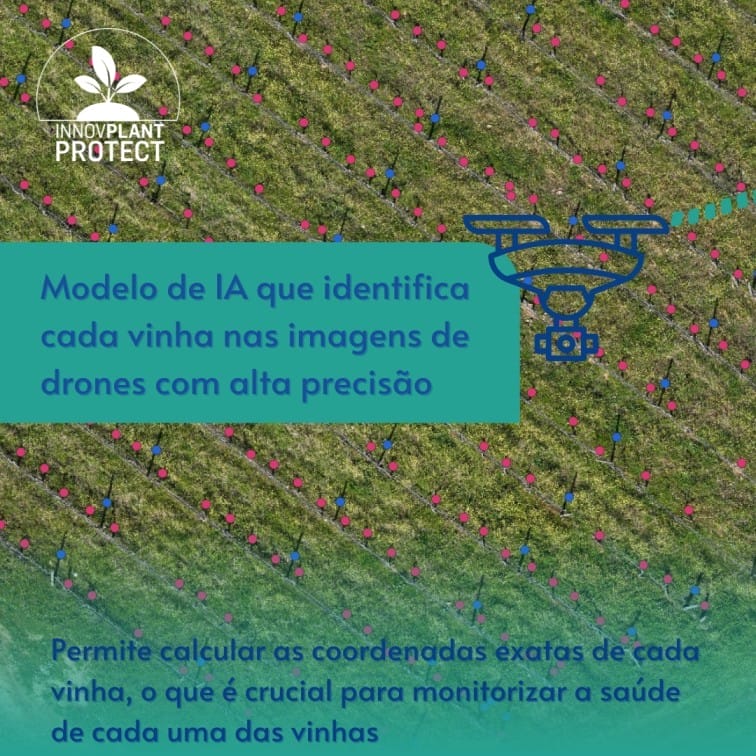
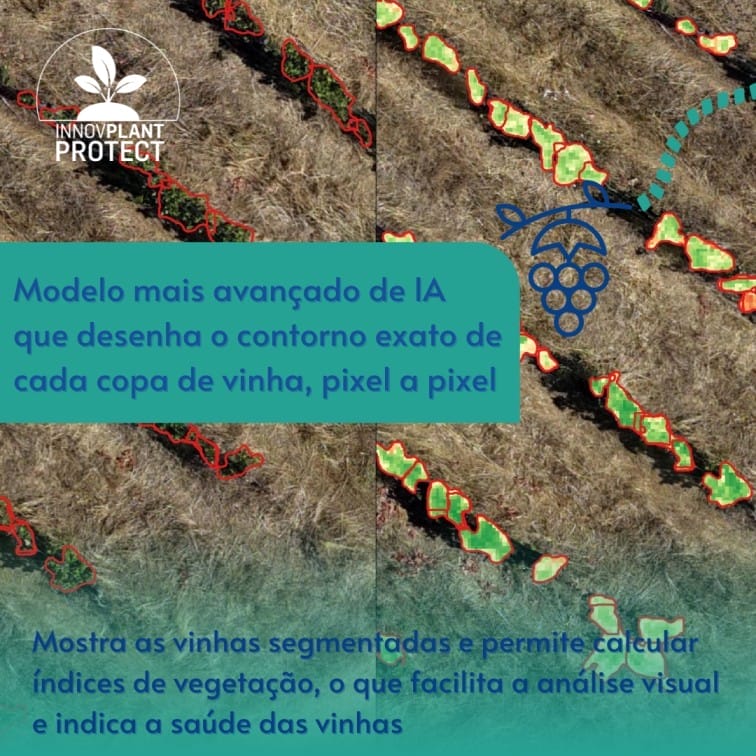
Imagine a future where drones and artificial intelligence work together to protect your vineyards. That's what the AI4Leafhopper project is making a reality!

Manisha Sirsat, a researcher on the AI4Leafhopper team, has developed two artificial intelligence models that analyze the aerial images captured by our latest generation drone... and these models make it possible:

  • geolocation of each vine
  • to know if there are vine failures
  • quickly identify “sick” vines”
  • optimize the application of treatments

The result? Growers can have a detailed view of the health of their vineyards, detect problems early and make more informed decisions.

Find out all about it here.

AI4Leafhopper is a project led by InPP and funded by the ICAERUS Horizon Europe program, which began in April 2024 and ended on April 30 with a final meeting involving the six European projects approved in the 1st edition of the ICAERUS program's PULL applications. The project team presented the AI-based models for detecting and monitoring the impact of the green leafhopper on vineyards.