Imagine a future where drones and artificial intelligence work together to protect your vineyards. That's what the AI4Leafhopper project is making a reality!
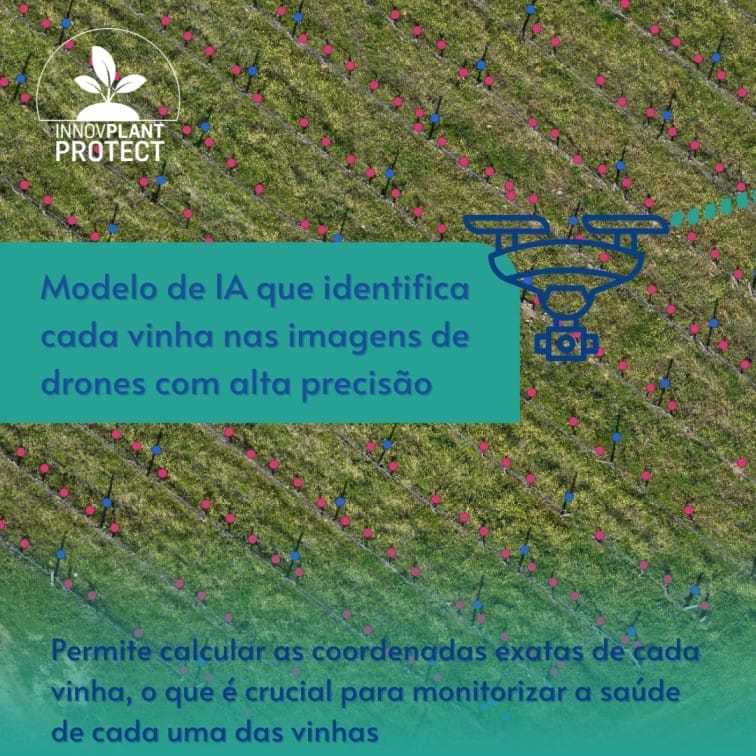
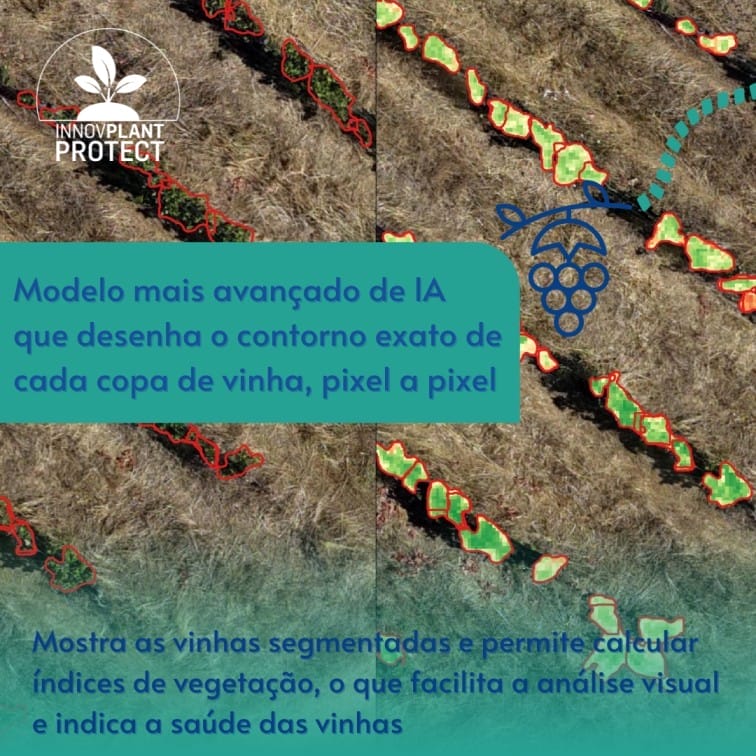
Manisha Sirsat, a researcher on the AI4Leafhopper team, has developed two artificial intelligence models that analyze the aerial images captured by our latest generation drone... and these models make it possible:
geolocation of each vine
to know if there are vine failures
quickly identify “sick” vines”
optimize the application of treatments
The result? Growers can have a detailed view of the health of their vineyards, detect problems early and make more informed decisions.
AI4Leafhopper is a project led by InPP and funded by the ICAERUS Horizon Europe program, which began in April 2024 and ended on April 30 with a final meeting involving the six European projects approved in the 1st edition of the ICAERUS program's PULL applications. The project team presented the AI-based models for detecting and monitoring the impact of the green leafhopper on vineyards.
The AI4Leafhopper project, InnovPlantProtect used a state-of-the-art drone to monitor the impact of the green leafhopper in the vineyards of our partners Reynolds Wine Growers and João Portugal Ramos. Although the results show that this advanced technology is more effective at detecting attacks at advanced stages, we are excited about the potential of this tool to provide valuable data for the management of this harmful insect.
We believe that with more research, we can refine our solution to detect early attacks and prevent significant damage to vineyards. Transforming the monitoring of this pest is where we want to go, always with the aim of protecting vineyards and guaranteeing the quality of production for winegrowers.
Over the next few days we'll be revealing everything that the AI4Leafhopper project is making a reality and how drones and artificial intelligence are working together to create a more sustainable future for viticulture. Stay tuned!
AI4Leafhopper, funded by the ICAERUS Horizon Europe program, which began in April 2024, is now in its final stages. The development phase of the project, which took place in the field, is now over and the final stage is to present the solutions developed by our team on Portuguese soil to the market.
O pedipaper, The event, which is aimed at three 10th grade classes from the D. Sancho II School, takes place between 8.30am and 1pm. In the afternoon, the drawing meeting promoted by AIAR will take place, starting at 6pm. The aim of the pedipaper is to allow the students, who are studying biodiversity this year, to explore, identify and marvel at the different trees in the Garden - the largest green space in the city - and their differentiating characteristics.
As a result of this activity, InPP, Escola Secundária D. Sancho II, AIAR and CME intend to continue collaborating with a view to developing a physical identification system for the Garden's trees based on a QR code that will allow mobile access to a “digital brochure” with more information.
Plant Fascination Day is an initiative of the European Plant Science Organization (EPSO), which takes place every two years on May 18th. It is coordinated at national level by the Portuguese Society of Plant Physiology and by the ITQB NOVA, with events across the country.
What is natural about the plants we eat? If it weren't for man's intervention in nature, would we have the variability we have today? Would bananas, avocados, carrots and grapes have anything to eat or were they just seeds? These and many other questions will be answered in the debate “Do the plants we eat really come from nature?”, which will take place online on May 18 at 6pm to celebrate Plant Fascination Day.
“Do the plants we eat really come from nature?” is the theme of the online debate that ITQB NOVA, CiB, Anseme, iBET, GREEN-IT e InnovPlantProtect will take place on May 18, International Day for the Fascination of Plants, at 6 p.m.
Whether they're edible, ornamental or have medicinal properties, plants are always fascinating. But have the plants we know always been like this? Or has our intervention in nature led to the diversity we have today? And, after all, do we have more or less biodiversity to celebrate today?
The truth is that the plants we eat are a positive construction of the human species. If the plants that nature has given us hadn't been actively manipulated by man over the millennia, they wouldn't be enough to feed us. Instead of ears full of corn kernels, we'd have teosinto. Instead of full-bodied orange carrots rich in beta-carotenes, we'd have thin, whitish roots. Watermelons, bananas, grapes and avocados would have more seeds than pulp. And the tomato wouldn't have the variability of colors, flavors and properties that it has today. It was the activity of the human species that led to what we eat today. And we did so in order to develop plant varieties that would produce seeds or fruit suitable for our diet and that would guarantee us food security and diversity.
With the aim of uncovering what is, after all, “natural” about the plants we eat, the event will feature an initial presentation by plant biology researcher Pedro Fevereiro, which will include comparative images of ‘Before’ & ’Now’ plants, followed by a debate moderated by Luís Ribeiro, a journalist from the magazine Vision specializing in the environment and sustainability, with the participation of Pedro Fevereiro, farmer Gabriela Cruz, nutritionist Conceição Calhau, and chef and gastronome José Maria Moreira.
Anyone who wants to celebrate the fascinating world of the plants we eat should join the live event, from 6pm (GMT+1). No prior registration is required.
Fascination of Plants Day takes place every two years on May 18th. In addition to this event, there are other activitiesAn online workshop, a virtual exhibition and a guided tour are some of the activities to celebrate the fascinating world of plants.
The Fascination of Plants Day is an initiative coordinated at national level by the Portuguese Society of Plant Physiology and ITQB NOVA, with activities taking place throughout the country
It was on a beautiful sunny Thursday that a team from the New Biopesticides Department, involved in the XfSTOP project, went to Herdade do Álamo de Cima, belonging to the Eugénio de Almeida Foundation, near Évora, and returned with a car full of olive and almond branches.
And it wasn't, of course, for the pleasure of pruning trees. The aim was to collect samples of two crops that are very important to the local agricultural economy, and which are targets of the nefarious bacterium Xylella fastidiosa, for which InnovPlantProtect intends to develop a new biopesticide.
The researchers collected samples from four varieties of olive tree - Cobrançosa, Arbequina, Galega and Picual - and four varieties of almond tree - Solena, Guara, Belona and Avijor. This work will make it possible to isolate bacterial endophytes common to olive and almond trees.
The following day, Friday, the team processed the samples. They began by cutting branches about 15-20 cm long, removing the bark, disinfecting the outside of the branch to eliminate epiphytic microorganisms and macerating the xylem vessels with a buffer solution. This solution is then filtered through special bags, diluted, plated on culture medium and placed in an incubator at 30 ºC for around 15 days. Throughout this period, the appearance of colonies is monitored.
From the almond grove (and the olive grove)... to the laboratory.



 Português
  English