News & Events

white plant

NEWS

Imagine a future where drones and artificial intelligence work together to protect your vineyards. That's what the AI4Leafhopper project is making a reality!

Manisha Sirsat, a researcher on the AI4Leafhopper team, has developed two artificial intelligence models that analyze the aerial images captured by our latest generation drone... and these models make it possible:

  • geolocation of each vine
  • to know if there are vine failures
  • quickly identify “sick” vines”
  • optimize the application of treatments

The result? Growers can have a detailed view of the health of their vineyards, detect problems early and make more informed decisions.

Find out all about it here.

AI4Leafhopper is a project led by InPP and funded by the ICAERUS Horizon Europe program, which began in April 2024 and ended on April 30 with a final meeting involving the six European projects approved in the 1st edition of the ICAERUS program's PULL applications. The project team presented the AI-based models for detecting and monitoring the impact of the green leafhopper on vineyards.
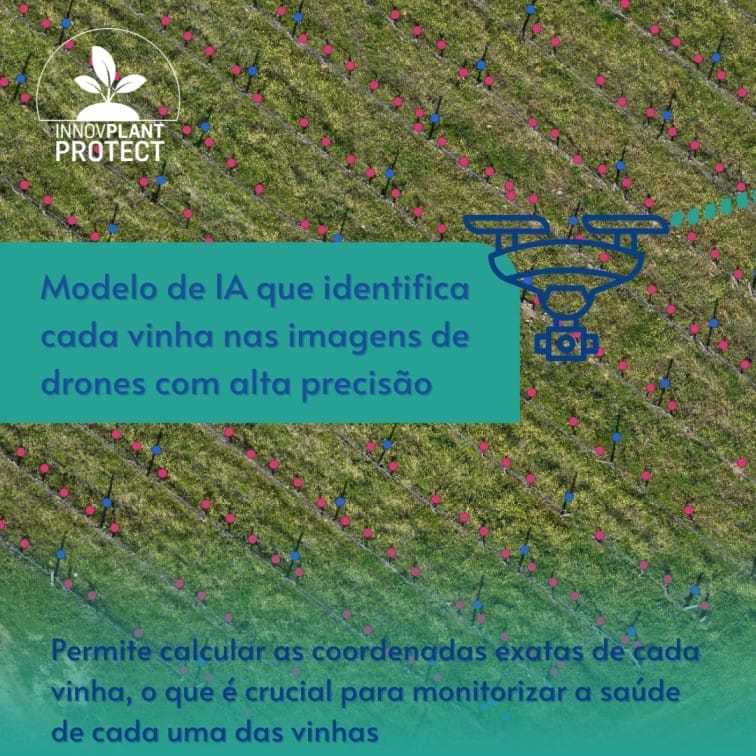
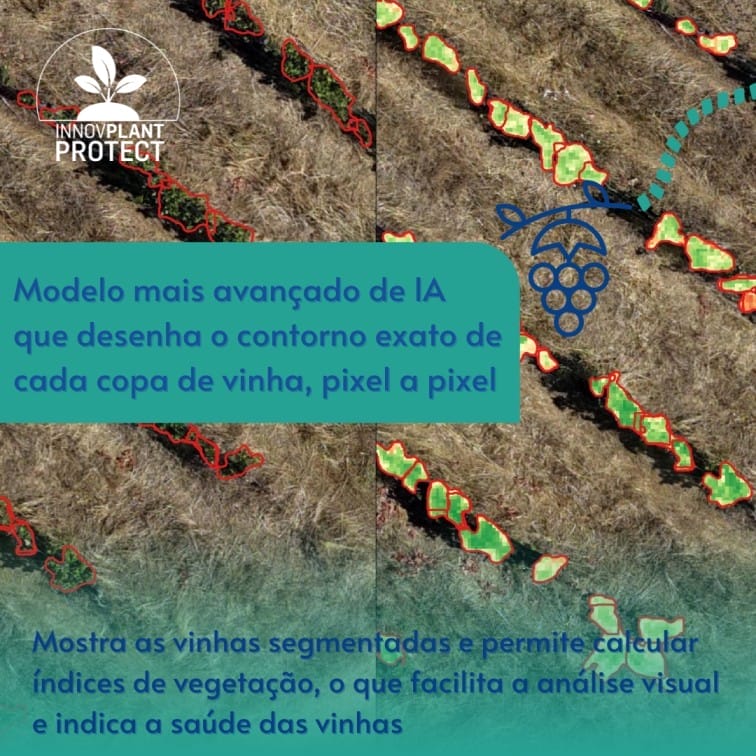
The AI4Leafhopper project, InnovPlantProtect used a state-of-the-art drone to monitor the impact of the green leafhopper in the vineyards of our partners Reynolds Wine Growers and João Portugal Ramos. Although the results show that this advanced technology is more effective at detecting attacks at advanced stages, we are excited about the potential of this tool to provide valuable data for the management of this harmful insect.

We believe that with more research, we can refine our solution to detect early attacks and prevent significant damage to vineyards. Transforming the monitoring of this pest is where we want to go, always with the aim of protecting vineyards and guaranteeing the quality of production for winegrowers.

Over the next few days we'll be revealing everything that the AI4Leafhopper project is making a reality and how drones and artificial intelligence are working together to create a more sustainable future for viticulture. Stay tuned!

Find out all about it here.

AI4Leafhopper, funded by the ICAERUS Horizon Europe program, which began in April 2024, is now in its final stages. The development phase of the project, which took place in the field, is now over and the final stage is to present the solutions developed by our team on Portuguese soil to the market.

EVENTS

Casa da História Judaica da Rainha da Fronteira wins a government award for actions and initiatives by local authorities to “save, protect and dignify human lives in Portugal in the face of contemporary threats and atrocities”.

A Elvas City Council won the first municipal award “Aristides de Sousa Mendes and other Portuguese saviors - Holocaust, universal values, humanism and justice”, in the category “Arts, Heritage and other Cultural Domains”, with the application of the House of Jewish History.

The honorary distinction, which is national in scope, was launched by the government in 2021. Among other things, it “aims to distinguish practices, programs, projects, symbols and material and immaterial works, which, inspired by memories and teachings arising from the Holocaust, and/or developed around universal values of humanism and justice, are factors of identification, aggregation and recognition by the respective communities, and valorization by differentiation, of localities and territories”.

The House of Jewish History is located at Rua dos Açougues, nº 4-6, in Elvas, and is open from Tuesday to Sunday, from 10am to 6pm.

In addition to the diploma that will be presented to the Municipality of Elvas by the Directorate-General for Local Authorities, The government undertakes to publicize the winning project.

Elvas City Council is a founding member of CoLAB InnovPlantProtect, which is based in the city.

Image: Elvas City Council

InnovPlantProtect and the Municipality of Sabugal install sensors in the municipality's chestnut groves and launch an educational program to value the chestnut tree as a local natural capital.

The trees will communicate their state of health thanks to TreeTalker sensors. The project “Educate to know, protect and monitor chestnut trees through IoT technology”, which has been approved by the Environmental Fund, is led by InnovPlantProtect (InPP) and managed by the Sabugal Municipal Council (CMS).

The initiative is aimed at the sustainable management of chestnut trees, the enhancement of ecosystem services and protection against diseases, particularly ink disease, for which there is still no concrete solution. The project includes training courses for those currently and potentially responsible for the sustainable management and protection of chestnut trees: CMS and chestnut producers associated with CastCoa - Associação de Produtores de Castanha do Coa; and secondary school students from the Sabugal School Group.

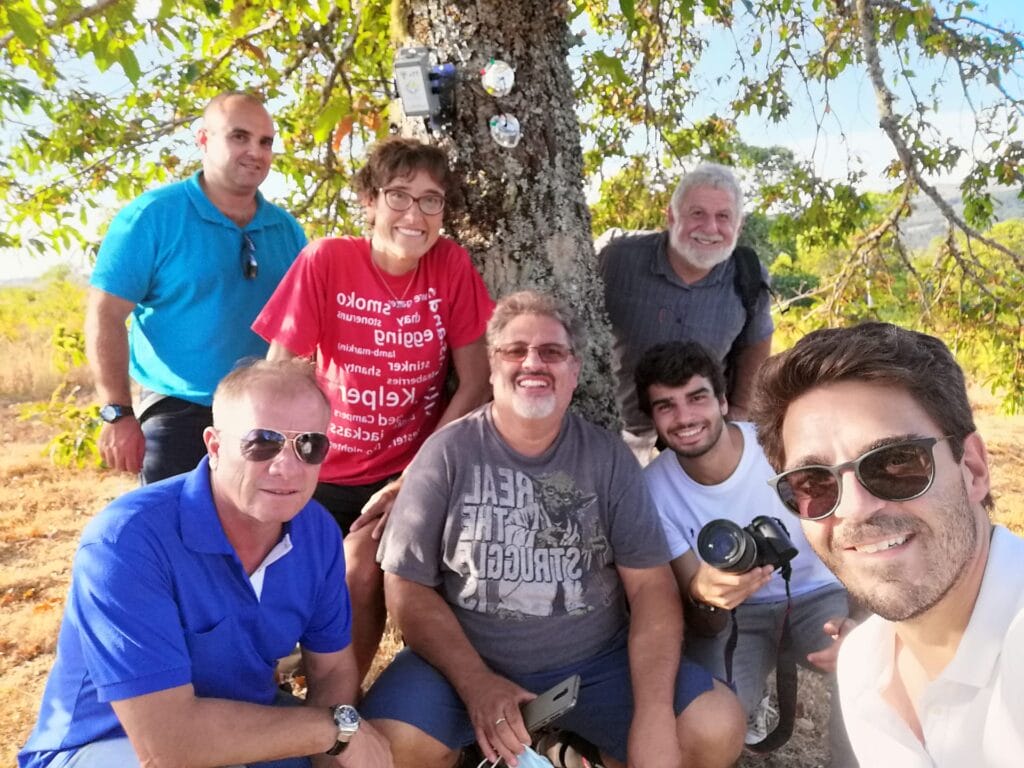
The CMS and InPP team in Sabugal at the beginning of September 2021.

The novelty of the educational program, however, is that digital 4.0 technology, based on the “Internet of Things” (IoT), is being applied to support and add value to traditional teaching methods. The TreeTalker sensors, installed around the trunk, allow the phytosanitary conditions of the trees to be monitored in real time, detecting water consumption (through sap flow), biomass growth (diameter), stem humidity, absorbed solar radiation and the state of health of the leaves through spectral indices (light reflection).

Sabugal City Council has just publicize the project. Don't miss the newly released video, which highlights the importance of the chestnut tree to the livelihoods of local communities and the value of the souto ecosystem, and shows the team at work in the field. It's also a unique opportunity to see InPP researchers in action Manuel Simões, Márcio Almeida e Ilaria Marengo, director of Pest and Disease Monitoring and Diagnosis Department, and coordinator of this project.

Pedro Fevereiro in podcast version, as part of a partnership between CiB - Centro de Informação de Biotecnologia and TSF radio. In total, 5 Notes on Gene Editing were produced.

The executive director of InnovPlantProtect answers the question “Can gene editing increase agricultural production?” in this podcast, produced as part of a CiB / TSF partnership. The initiative resulted in 5 Notes on Gene Editing in food production and health. The recordings were broadcast by TSF during the week of October 4 to 8, 2021.

The challenge for 2050 is how to feed 10 million people without destroying the planet. This requires changes in food production. Pedro Fevereiro explains how gene editing can help in this process.

Listen too the other four podcasts, which feature:

Jorge Canhoto, researcher, head of the Plant Biotechnology Laboratory of the Functional Ecology Center of the University of Coimbra and president of CiB - Biotechnology Information Center

Margarida Oliveira, who leads the Plant Functional Genomics research group of the GPlantS - Plant Genomics under Stress unit at the Institute of Chemical and Biological Technology (ITQB NOVA).

Ana Sofia Coroadinha, professor at ITQB NOVA

Filipe Castro, researcher at the Interdisciplinary Center for Marine and Environmental Research, and professor at the Faculty of Sciences of the University of Porto 

Feature image: CiB