News & Events

white plant

NEWS

Seminar highlights CoLABs' contribution to the future of agricultural and agri-food innovation

On June 11th, InnovPlantProtect (InPP) held a seminar on “Six years of innovation: CoLABs” path to the future of the agricultural and agri-food sectors", at the National Agriculture Fair (FNA) in Santarém.

The event brought together, for the first time, six Collaborative Laboratories (CoLABs) with direct involvement in the agricultural and agri-food sectors: InnovPlantProtect, CoLAB4Food, FeedInov CoLAB, Food4Sustainability, MORE CoLAB and SmartFarmCoLAB.

The program included two round tables. The first, dedicated to “Innovation in Action: The Results and Impacts of CoLABs in Agriculture and Agrifood”, representatives from each CoLAB took part, presenting success stories and projects developed, with emphasis on the intervention of the innovation manager at InnovPlantProtect, Paulo Madeira, He shared InPP's achievements in developing solutions for more sustainable agriculture.

The second round table, under the theme “Partnerships for the Future: How CoLABs are Driving Innovation in the Agricultural and Agri-Food Sector”, The event was attended by partner companies and associations, who stressed the importance of collaborating with the CoLABs. Among the speakers were Pedro Viterbo, manager of Fertiprado, InnovPlantProtect's partner, accompanied by representatives of the following organizations Sense Test, Associação Portuguesa Dos Industriais De Alimentos Compostos Para Animais (IACA), Building Global Innovators (BGI), DEIFIL Technology and TeroMovigo.

The seminar ended with a moment of joint reflection, with speeches from all the executive directors of the CoLABs present, including the executive director of InnovPlantProtect, António Saraiva, The meeting was organized by the European Commission, which stressed the importance of cooperation and strategic coordination between the Collaborative Laboratories, reinforcing their collective commitment to innovation and sustainable development in the agricultural and agri-food sectors.

Throughout the seminar, the importance of synergies between science, innovation and the market became clear, as did the need to strengthen funding and guarantee conditions for the continuity and growth of these Collaborative Laboratories, whose impacts are already visible in the national agricultural and agri-food ecosystem.

This meeting was an important moment for sharing experiences and strengthening collaborative work, charting a joint path towards a more competitive, sustainable and innovative future for agriculture and agri-food in Portugal.
CoLABs in the spotlight at FNA: Innovation and Impact for Agriculture and Agrifood

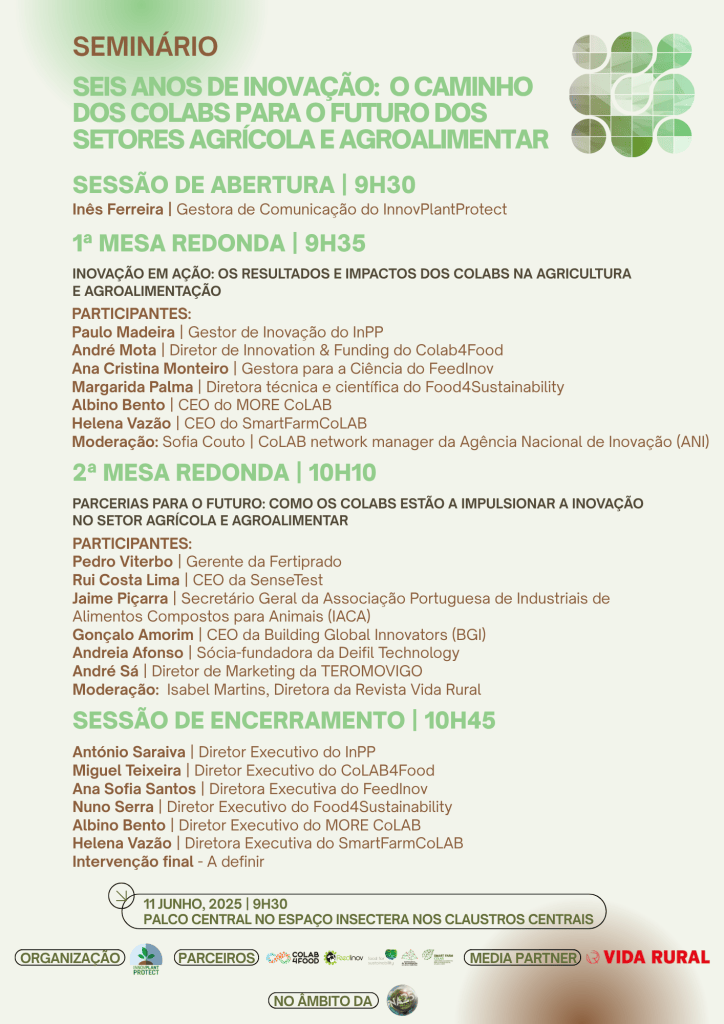
O InnovPlantProtect (InPP) promotes the seminar “Six years of innovation: The path of CoLABs for the future of the agricultural and agri-food sectors”, on the next day June 11thfrom 09h30 until 11h00, in center stage at Espaço InsectERA, located in the Central Cloisters of the National Center for Agricultural Exhibitions and Markets (CNEMA) in Santarém.

The seminar aims to present the practical results and real impact of six Collaborative Laboratories (CoLABs) in Portugal - InnovPlantProtect, Colab4Food, FeedInov, Food4Sustainability, MORE and SmartFarmCoLAB. These interface infrastructures are essential pillars of the National Innovation System (SNI) and play a growing and essential role in the dynamics of innovation for agriculture and agri-food.

The event will be attended by members of the teams and partners of each of the CoLABs, who will talk about their vision of the added value of these interface and innovation entities, from the point of view of those who collaborate directly with them.

The initiative, which is part of the National Agriculture Fair (FNA) 2025, which this year has the theme “Biosolutions” and will be the stage for exploring the innovations that are shaping the future of the sector, brings together different representatives of the innovation ecosystem to show the role of CoLABs in stimulating the transfer of knowledge and making innovation available to agriculture and agri-food in Portugal, creating value and attracting highly qualified human resources to the country.

See the full program in the image below.

The registration for the event is free, but mandatory due to the limited capacity of the space. Guarantee your presence by filling in the available form here.

We look forward to welcoming you for a morning of sharing and debate on the future of innovation in the agricultural and agri-food sectors!

InPP participa na FNA25

Estamos em contagem decrescente para a Feira Nacional de Agricultura (FNA), uma das maiores feiras agrícolas do país!

É já de 7 a 15 de junho que o InPP vai estar na 61ª edição da Feira Nacional de Agricultura, que se realiza no CNEMA – Centro Nacional de Exposições, em Santarém.

O tema da edição deste ano é “Biosoluções”e pretende destacar a importância das soluções e tecnologias inovadoras no setor agroalimentar e na promoção de práticas mais sustentáveis e eficientes.

A FNA reúne agricultores, empresários e especialistas dos setores agroalimentar, pecuário e agrícola e é um excelente espaço para aumentar a nossa rede de contactos, trocar conhecimentos e apresentar as mais recentes tendências e soluções agrícolas que a nossa equipa tem desenvolvido.

Vai poder encontrar-nos no stand nº.18, à entrada do Espaço dos claustros, dedicado à Agenda InsectERA, entre as 10h e as 20h.

Venha visitar-nos. Esperamos por si!

EVENTS

Comparing genomes to understand the “tricks” of microbes

Sometimes, if you're inside a building, it's hard to tell whether or not it's raining outside. However, you will easily conclude that it is raining if you see people with open umbrellas. The umbrella is an accessory that helps human beings deal with their environment.

Bacteria can also use “accessories” to better cope with their environments. These accessories, however, have much more profound effects on the lives of microbes, as they take the form of genes that can be integrated into their own genomes. These “accessory” genes are obtained from other microbes or from the environment, and can play various roles, from allowing bacteria to resist antibiotics to enabling symbiotic associations with plants.

Image: Adrianna Calvo/ Pexels

At InPP, the Data Management and Risk Analysis Department is comparing bacterial genomes to identify those that have “accessory” genes that can help plants defend themselves better against pathogens. On the other hand, these analyses also allow us to rule out bacterial strains that could have adverse effects. This information will be crucial for identifying microbes and microbial characteristics that are important for plant protection.

First gene transfer from a plant to an insect identified

Tobacco whitefly uses a stolen gene to avoid the host's defenses. The discovery is highly relevant to pest control.

The first known case of a natural gene transfer from a plant to an insect has been identified by an international team of researchers. The insect is a whitefly and the discovery could pave the way for new pest control strategies, according to a report published in the newspaper Nature.

Scientists have discovered that Bemisia tabaci appropriated a gene from a host plant millions of years ago, reveals a article published in Cell. The gene allows this pest to neutralize a toxin produced by certain plants to defend themselves against insects.

Some whiteflies use plant genes to render toxins harmless. Image: Gaucho/ Wiki

This aleirodid, also known as the bean or sweet potato whitefly, although it attacks many other vegetable crops, is a worldwide pest and one of the most destructive we know of. A Bemisia tabaci ingests the sugary sap of hundreds of types of plants, excreting a sweet, sticky substance, honeydew, which then serves as a medium for fungi to grow. Whiteflies are also vectors for more than a hundred viruses that are pathogenic to plants.

“It's a remarkable example of how the study of evolution can underpin new approaches to applications such as crop protection,” says Andrew Gloss, who studies plant-pest interactions at the University of Chicago in the USA. The study suggests that inhibiting the gene identified could make this whitefly vulnerable to the toxin, opening up a new way of combating this pest.

Alternative strategy to protect crops without genetic modification

Protecting plants from pathogens without genetically modifying crops? A team of Chinese researchers suggests an alternative strategy in the latest issue of Plant Communications.

The biotechnological methods that currently exist to create crops that are resistant to pests and diseases are limited in their applicability, mainly because they are based on transgenics or surface application (which does not allow access to the inner areas of the plant). A scientists' proposal involves the use of small RNA produced by beneficial microbes for crop protection, guaranteeing the stability and delivery of these RNAs to the appropriate place and time.

RNA associated with beneficial microbes in the microbiome to protect crops against pathogens.

The strategy, which eliminates “the need for genetic modification of cultures”, assumes that small RNAs (sRNAs) can be transferred from the microbiome to the host and pathogen, or between elements of the microbiome.

sRNAs are the crucial molecular devices of so-called gene silencing via RNA interference, a mechanism that regulates gene expression at both the transcriptional and post-transcriptional levels.

Title of original article: Trans-kingdom RNAs and their fates in recipient cells: advances, utilization, and perspectives

doi.org/10.1016/j.xplc.2021.100167

