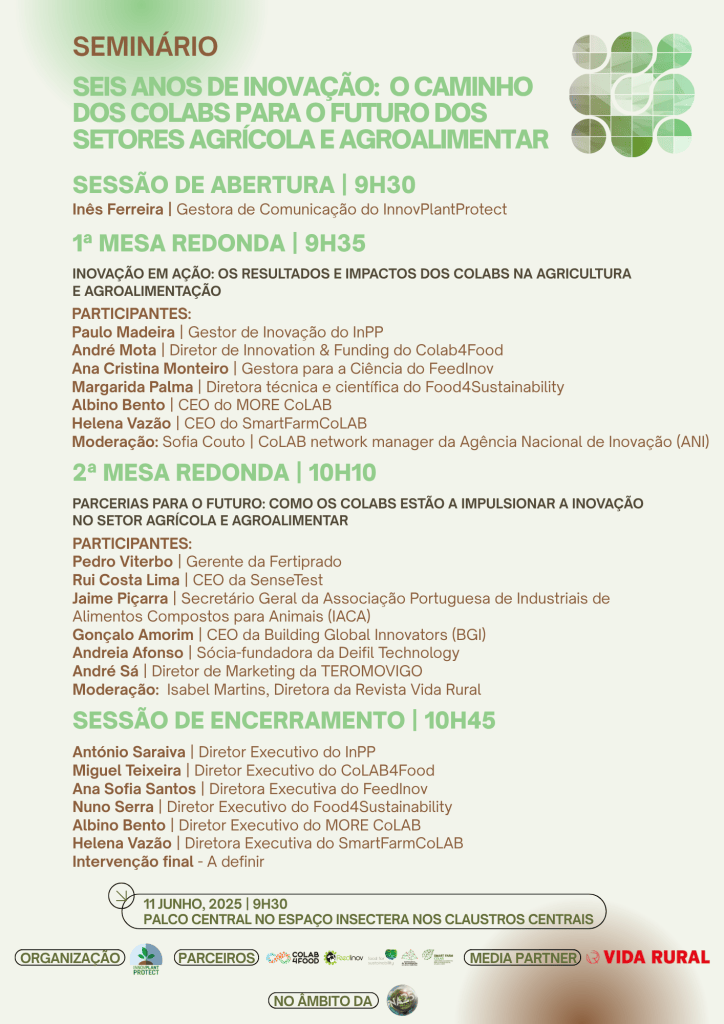
O InnovPlantProtect (InPP) promotes the seminar “Six years of innovation: The path of CoLABs for the future of the agricultural and agri-food sectors”, on the next day June 11th, from 09h30 until 11h00, in center stage at Espaço InsectERA, located in the Central Cloisters of the National Center for Agricultural Exhibitions and Markets (CNEMA) in Santarém.
The seminar aims to present the practical results and real impact of six Collaborative Laboratories (CoLABs) in Portugal - InnovPlantProtect, Colab4Food, FeedInov, Food4Sustainability, MORE and SmartFarmCoLAB. These interface infrastructures are essential pillars of the National Innovation System (SNI) and play a growing and essential role in the dynamics of innovation for agriculture and agri-food.
The event will be attended by members of the teams and partners of each of the CoLABs, who will talk about their vision of the added value of these interface and innovation entities, from the point of view of those who collaborate directly with them.
The initiative, which is part of the National Agriculture Fair (FNA) 2025, which this year has the theme “Biosolutions” and will be the stage for exploring the innovations that are shaping the future of the sector, brings together different representatives of the innovation ecosystem to show the role of CoLABs in stimulating the transfer of knowledge and making innovation available to agriculture and agri-food in Portugal, creating value and attracting highly qualified human resources to the country.
See the full program in the image below.
The registration for the event is free, but mandatory due to the limited capacity of the space. Guarantee your presence by filling in the available form here.
We look forward to welcoming you for a morning of sharing and debate on the future of innovation in the agricultural and agri-food sectors!
Estamos em contagem decrescente para a Feira Nacional de Agricultura (FNA), uma das maiores feiras agrícolas do país!
É já de 7 a 15 de junho que o InPP vai estar na 61ª edição da Feira Nacional de Agricultura, que se realiza no CNEMA – Centro Nacional de Exposições, em Santarém.
O tema da edição deste ano é “Biosoluções”e pretende destacar a importância das soluções e tecnologias inovadoras no setor agroalimentar e na promoção de práticas mais sustentáveis e eficientes.
A FNA reúne agricultores, empresários e especialistas dos setores agroalimentar, pecuário e agrícola e é um excelente espaço para aumentar a nossa rede de contactos, trocar conhecimentos e apresentar as mais recentes tendências e soluções agrícolas que a nossa equipa tem desenvolvido.
Vai poder encontrar-nos no stand nº.18, à entrada do Espaço dos claustros, dedicado à Agenda InsectERA, entre as 10h e as 20h.
InnovPlantProtect (InPP) took part in the National Olive Growing Fair (FNO 25) in Campo Maior, from May 23 to 25, presenting its latest biological and digital innovations for crop protection, including projects focused on biopesticides for olive diseases and early detection of fungi that cause gafa, and monitoring insect vectors of the bacterium Xylella fastidiosa, which attacks olive groves. The Elvas CoLAB was present with its own stand to demonstrate its strengths and the impact of its research on agricultural sustainability, inviting producers, technicians and researchers to learn about its innovative bio-based and digital solutions and to actively participate in the discussion of the sector's challenges.
The collaborative laboratory (CoLAB) welcomed visitors at the stand no. 14, located at thematic area at the Campo Maior Municipal Garden, to showcase their activity, the ongoing projects that are developing solutions to the main olive diseases, the patents already submitted, the apps for agricultural management and the bio-based and digital products and services they have to offer the agricultural sector and the market. Throughout the three days of the fair, some of InPP's researchers were at the stand to demonstrate to visitors the various features of the Elvas CoLAB, which has been developing innovation that it hopes will contribute to the sustainability of agricultural systems.
InPP announced ValorCannBio project, which is processing biomass that is not used in the medical cannabis industry to develop effective and sustainable biopesticides against gafa and tuberculosis, The project will be carried out in the municipality of Elvas, which is responsible for decimating entire harvests, leading to severe economic losses and compromising food quality. The impact of this project will be felt in the municipality of Elvas, where the project is being developed, but it is expected that it will extend to the entire olive-growing region from Trás-os-Montes to the Algarve, where production losses are increasing due to these diseases. O AlViGen project was also one of the protagonists and is using cutting-edge technology to detecting and identifying the strains of fungi that cause gafa, long before the symptoms become visible. The project team has used traps to collect spores that circulate in the air to monitor the presence of fungi, which can give farmers an important advantage in preventing infections and protecting their crops, reducing production losses.
O SNM_XylellaVt project, The SNM_XylellaVt project, led by DRAPCENTRO and in which InPP actively participates, was also highlighted at FNO. SNM_XylellaVt is monitor the insect vectors of the bacteria Xyllela fastidiosa, in particular the foam leafhopper, the insect responsible for transmitting the bacterium, which attacks various agricultural and forestry crops, and in particular olive groves. The project team is developing new tools, such as risk prediction models which, in the presence of the bacterium, whether in plants or insect vectors, will allow the National Agricultural Warning Service (SNAA) to alert, in real time, about the economic attack levels (EAL) for these insects, thus allowing prevent infection of the main crops. As part of this project, the team has also developed an online platform where citizens can report the sighting of foams, which are signs of the presence of the insect vectors of X. fastidiosa, This will help to map its temporal and spatial distribution and to plan measures to combat this bacterium.
The FNO, organized jointly by the Campo Maior City Council and the Centre for the Study and Promotion of Olive Oil in the Alentejo (CEPAAL), is an event that aims to enhance national olive growing, and in particular Portuguese olive oil, boosting the local economy and bringing together professionals from the sector - producers, technicians, or researchers - from all over the country to discuss challenges and trends in the Portuguese olive and olive oil sector.
O InnovPlantProtect (InPP) tem colaborado com a GreenBE Pharma para desenvolver um software de planeamento de recursos de negócios: o CannBeTrace. A GreenBE Pharma é uma empresa especializada no cultivo e produção da planta de canábis medicinal para a Indústria Farmacêutica e o CannBeTrace permitirá monitorizar e gerir todos os processos de produção de canábis, desde o cultivo até a venda do produto.
A aplicação CannBeTrace começou a ser desenvolvida no final de abril de 2022 por Manisha Sirsat, investigadora do InPP, e Ricardo Ramiro, diretor do departamento de Gestão de Dados e Análise de Risco, e será utilizada pela GreenBe Pharm para automatizar e simplificar as atividades individuais em toda a organização. A app permitirá que a equipa aceda aos dados com mais facilidade e consiga gerir várias áreas, como produção, qualidade do produto, pragas ou nutrição e irrigação das plantas.
Futuras colaborações também envolverão a integração de dados de sensores IoT na aplicação (IoT=Internet of Things) ou o desenvolvimento de modelos de previsão de pragas e doenças, baseados em inteligência artificial.
Um agradecimentos especial a João Sena Janeiro, diretor executivo da GreenBE Pharma, Carlos Carola, agrónomo, e António Martins, software developer da GreenBE Pharma, pelas valiosas e inovadoras sessões de brainstorming em todas as etapas de desenvolvimento deste software.
No passado dia 29 de abril de 2023, o InnovPlantProtect (InPP), esteve em destaque no programa televisivo de âmbito nacional da RTP 2, “Faça Chuva Faça Sol”. O episódio emitido na RTP2 teve como protagonista a Associação Nacional da Indústria para a Proteção das Plantas (ANIPLA), associado do InPP, e no qual se deu a conhecer o projeto SmartFarm e o trabalho desenvolvido pelo nosso CoLAB e pelo SmartFarmCOLAB.
O mais recente episódio do programa “Faça Chuva Faça Sol” conta com um conjunto de reportagens e entrevistas que pretenderam dar a conhecer o projeto SmartFarm, uma quinta inteligente desenvolvida pela Anipla, através da qual os associados mostram todos os cuidados a ter no manuseamento de produtos fitofarmacêuticos, mas também onde se testam novas soluções de combate a pragas e doenças.
As novas soluções fitofarmacêuticas patenteadas, desenvolvidas pelo InPP, que podem ser adquiridas pelas empresas, estiveram também em destaque neste episódio. O programa emitido no passado sábado apresentou ainda a tecnologia que está a ser desenvolvida pelo laboratório colaborativo SmartFarmCOLAB, que ajuda a monitorizar culturas e prevenir a existência de problemas fitossanitários nas culturas, e visitou a produção de limões do agricultor Domingos dos Santos, no Oeste, que falou dos vários métodos de captura de insetos que utiliza, uma estratégia de proteção das plantas amiga do ambiente.
Assista here ao programa emitido na RTP2 no passado dia 29 de abril e descubra mais sobre o projeto SmartFarm e sobre o trabalho que temos desenvolvido.
O Faça Chuva Faça Sol é um programa de televisão, com periodicidade semanal, sobre a agricultura e a floresta em Portugal, onde se procura evidenciar os grandes projetos de referência e as novas formas de gestão agrícola, mostrando casos concretos, de norte a sul do país, Açores e Madeira, nas várias valências da agricultura contemporânea – da tradicional à inovadora, da tecnológica à transformadora.
Vídeo autopromocional do mais recente episódio do programa Faça Chuva Faça Sol, emitido na RTP 2, no passado sábado, dia 29 de abril de 2023.
O InnovPlantProtect (InPP) participou no Workshop regional sobre a implementação em Portugal dos laboratórios vivos da Missão Solo do programa do Horizonte Europa, que teve lugar no dia 21 de abril, na sede da Comissão de Coordenação e Desenvolvimento Regional do Alentejo (CCDRA Alentejo), em Évora.
O workshop, organizado em parceria pela CCDR Alentejo, University of Évora, Agência Nacional de Inovação (ANI) e a Direção Geral de Agricultura e Desenvolvimento Rural (DGADR), pretendeu dar a conhecer a Missão Solo, esclarecer o conceito e critérios a que devem obedecer os “laboratórios-vivos” (living labs, em inglês) regionais e os clusters europeus elegíveis ao financiamento europeu, assim como debater possíveis abordagens e diferentes Living Labs sobre a saúde do solo que seria possível e desejável instalar no nosso país.
Para além das duas sessões plenárias que compunham o programa da iniciativa, a Ilaria Marengo e o Ricardo Ramiro, diretores de departamento do InPP, e a Manisha Sirsat, investigadora do InPP, tiveram a oportunidade de participar nas sessões paralelas “Culturas anuais” e “Pastagem, pecuária, sistemas silvo-pastoris” que promoveram o debate acerca do que está em falta para a criação dos laboratórios vivos na região dos participantes destas sessões, bem como acerca de quais devem ser as soluções ou passos a dar e quem podem ser os parceiros desta jornada.
A iniciativa juntou investigadores, agricultores, empresas agroalimentares, associações de consumidores, comunidades locais e administração pública.
O 2º workshop regional decorrerá já no próximo mês, dia 12 de maio, em Vila Real, para continuar a debater os desafios e as oportunidades da criação destes laboratórios vivos!
Os living labs podem ser definidos como espaços de teste de soluções inovadoras, onde múltiplas partes interessadas colaboram no desenvolvimento, prototipagem, validação e teste de novas tecnologias, serviços e respetivas aplicações em contexto real, em áreas delimitadas, com identidade local e reconhecíveis pelos cidadãos.
O objetivo da Missão Solos é ser um precursor, demonstrador e catalisador da transição para solos saudáveis em 2030, por meio de ações ambiciosas em 100 laboratórios vivos. O financiamento que será disponibilizado para a implementação da Missão Solos será uma grande oportunidade para as entidades portuguesas comprometidas com a saúde do solo.



 Português
  English