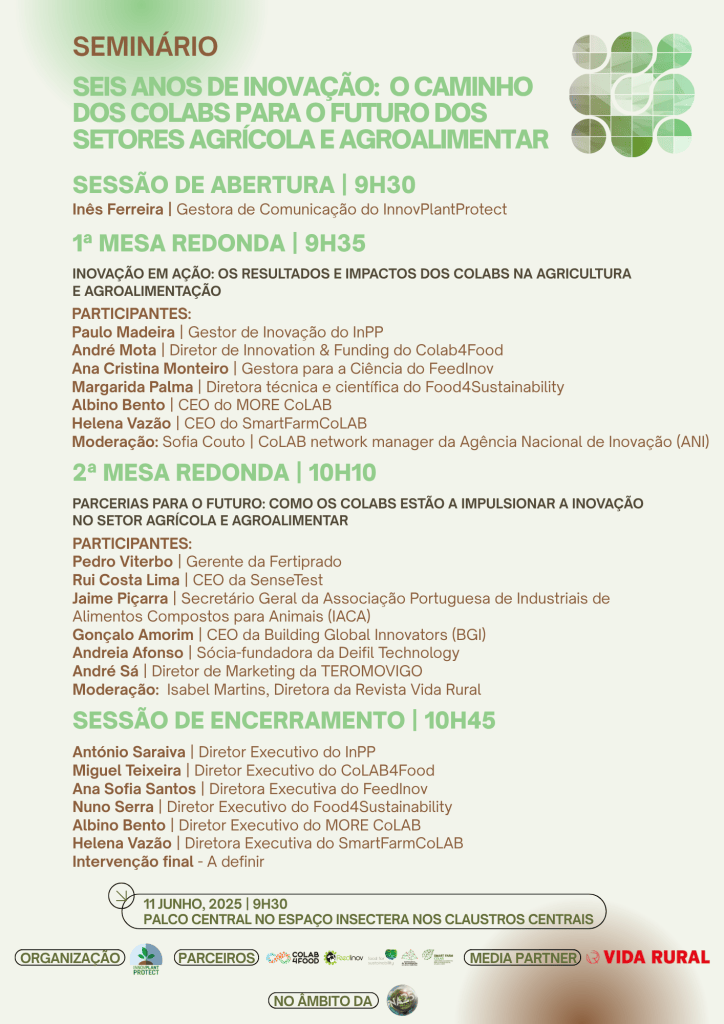
O InnovPlantProtect (InPP) promotes the seminar “Six years of innovation: The path of CoLABs for the future of the agricultural and agri-food sectors”, on the next day June 11th, from 09h30 until 11h00, in center stage at Espaço InsectERA, located in the Central Cloisters of the National Center for Agricultural Exhibitions and Markets (CNEMA) in Santarém.
The seminar aims to present the practical results and real impact of six Collaborative Laboratories (CoLABs) in Portugal - InnovPlantProtect, Colab4Food, FeedInov, Food4Sustainability, MORE and SmartFarmCoLAB. These interface infrastructures are essential pillars of the National Innovation System (SNI) and play a growing and essential role in the dynamics of innovation for agriculture and agri-food.
The event will be attended by members of the teams and partners of each of the CoLABs, who will talk about their vision of the added value of these interface and innovation entities, from the point of view of those who collaborate directly with them.
The initiative, which is part of the National Agriculture Fair (FNA) 2025, which this year has the theme “Biosolutions” and will be the stage for exploring the innovations that are shaping the future of the sector, brings together different representatives of the innovation ecosystem to show the role of CoLABs in stimulating the transfer of knowledge and making innovation available to agriculture and agri-food in Portugal, creating value and attracting highly qualified human resources to the country.
See the full program in the image below.
The registration for the event is free, but mandatory due to the limited capacity of the space. Guarantee your presence by filling in the available form here.
We look forward to welcoming you for a morning of sharing and debate on the future of innovation in the agricultural and agri-food sectors!
Estamos em contagem decrescente para a Feira Nacional de Agricultura (FNA), uma das maiores feiras agrícolas do país!
É já de 7 a 15 de junho que o InPP vai estar na 61ª edição da Feira Nacional de Agricultura, que se realiza no CNEMA – Centro Nacional de Exposições, em Santarém.
O tema da edição deste ano é “Biosoluções”e pretende destacar a importância das soluções e tecnologias inovadoras no setor agroalimentar e na promoção de práticas mais sustentáveis e eficientes.
A FNA reúne agricultores, empresários e especialistas dos setores agroalimentar, pecuário e agrícola e é um excelente espaço para aumentar a nossa rede de contactos, trocar conhecimentos e apresentar as mais recentes tendências e soluções agrícolas que a nossa equipa tem desenvolvido.
Vai poder encontrar-nos no stand nº.18, à entrada do Espaço dos claustros, dedicado à Agenda InsectERA, entre as 10h e as 20h.
InnovPlantProtect (InPP) took part in the National Olive Growing Fair (FNO 25) in Campo Maior, from May 23 to 25, presenting its latest biological and digital innovations for crop protection, including projects focused on biopesticides for olive diseases and early detection of fungi that cause gafa, and monitoring insect vectors of the bacterium Xylella fastidiosa, which attacks olive groves. The Elvas CoLAB was present with its own stand to demonstrate its strengths and the impact of its research on agricultural sustainability, inviting producers, technicians and researchers to learn about its innovative bio-based and digital solutions and to actively participate in the discussion of the sector's challenges.
The collaborative laboratory (CoLAB) welcomed visitors at the stand no. 14, located at thematic area at the Campo Maior Municipal Garden, to showcase their activity, the ongoing projects that are developing solutions to the main olive diseases, the patents already submitted, the apps for agricultural management and the bio-based and digital products and services they have to offer the agricultural sector and the market. Throughout the three days of the fair, some of InPP's researchers were at the stand to demonstrate to visitors the various features of the Elvas CoLAB, which has been developing innovation that it hopes will contribute to the sustainability of agricultural systems.
InPP announced ValorCannBio project, which is processing biomass that is not used in the medical cannabis industry to develop effective and sustainable biopesticides against gafa and tuberculosis, The project will be carried out in the municipality of Elvas, which is responsible for decimating entire harvests, leading to severe economic losses and compromising food quality. The impact of this project will be felt in the municipality of Elvas, where the project is being developed, but it is expected that it will extend to the entire olive-growing region from Trás-os-Montes to the Algarve, where production losses are increasing due to these diseases. O AlViGen project was also one of the protagonists and is using cutting-edge technology to detecting and identifying the strains of fungi that cause gafa, long before the symptoms become visible. The project team has used traps to collect spores that circulate in the air to monitor the presence of fungi, which can give farmers an important advantage in preventing infections and protecting their crops, reducing production losses.
O SNM_XylellaVt project, The SNM_XylellaVt project, led by DRAPCENTRO and in which InPP actively participates, was also highlighted at FNO. SNM_XylellaVt is monitor the insect vectors of the bacteria Xyllela fastidiosa, in particular the foam leafhopper, the insect responsible for transmitting the bacterium, which attacks various agricultural and forestry crops, and in particular olive groves. The project team is developing new tools, such as risk prediction models which, in the presence of the bacterium, whether in plants or insect vectors, will allow the National Agricultural Warning Service (SNAA) to alert, in real time, about the economic attack levels (EAL) for these insects, thus allowing prevent infection of the main crops. As part of this project, the team has also developed an online platform where citizens can report the sighting of foams, which are signs of the presence of the insect vectors of X. fastidiosa, This will help to map its temporal and spatial distribution and to plan measures to combat this bacterium.
The FNO, organized jointly by the Campo Maior City Council and the Centre for the Study and Promotion of Olive Oil in the Alentejo (CEPAAL), is an event that aims to enhance national olive growing, and in particular Portuguese olive oil, boosting the local economy and bringing together professionals from the sector - producers, technicians, or researchers - from all over the country to discuss challenges and trends in the Portuguese olive and olive oil sector.
O InnovPlantProtect (InPP) estará presente na terceira edição do Encontro Anual de Laboratórios Colaborativos (CoLAB), organizada pela National Innovation Agency (ANI), cujo objetivo é promover e monitorizar as atividades e a evolução progressiva dos 41 CoLABs atualmente reconhecidos, assim como o seu desenvolvimento no contexto de estratégias de investigação e inovação regionais, nacionais e europeias, e que vai decorrer na Universidade do Algarve, no Campus da Penha, entre os dias 6 e 7 de dezembro.
O 3.º Encontro Anual de Laboratórios Colaborativos pretende debater a evolução das atividades dos CoLAB e a sua integração na dinâmica dos ecossistemas regionais, durante a transição para um novo ciclo de financiamento de base, no âmbito da Missão Interface e do Plano Nacional de Recuperação e Resiliência (PRR). Este evento contará com a apresentação dos principais resultados obtidos durante 2022 e os highlights da rede nacional de CoLAB.
O evento contará com a presença de Joana Mendonça, Presidente da ANI, Madalena Alves, Presidente da Fundação para a Ciência e Tecnologia (FCT), João Mendes Borga, Membro da Direção da ANI, e Paulo Águas, reitor da Universidade do Algarve. Nesta edição participaram ainda empresas, decisores políticos e peritos nacionais e internacionais.
Neste evento serão debatidos diversos temas de grande impacto como os desafios da população cada vez mais envelhecida, a transformação digital, a crise energética, a economia circular com novos modelos de negócio para um futuro sustentável, as perspetivas portuguesas dos CoLAB e a plataforma da Missão de Interface, entre outros.
Todas as sessões vão decorrer exclusivamente em inglês e serão transmitidas em direto, através do canal de Youtube da ANI here.
A ANI é a entidade que acompanha a implementação da agenda de investigação e inovação de todos os CoLAB. O processo de reconhecimento dos Laboratórios Colaborativos é assegurado pela FCT.
Gafa, or anthracnose, is a disease of the olive grove caused by several species of fungus of the genus Colletotrichum, such as Colletotrichum accutatum, C. nymphaeae or C. godetiae [1,2]. Symptoms typically appear on ripening olives and include: brownish/black spots with depression, dehydration and early fall. In extreme cases, defoliation and branch death can occur [3]. The presence of diseased olives also has a negative influence on olive oil quality, increasing acidity and lowering the oil's oxidative stability [4].
Olive with gafa/anthracnose. Source: Olive Times
Gafa is considered the main disease in olive groves in Portugal and is one of the diseases that will be monitored in the AlViGen project. In order to be able to monitor the strains of Colletotrichum present in the olive grove and derive useful information from this monitoring, we need to have an association between the genome and the phenotype of these strains. That way, when we apply genomic surveillance to Colletotrichum If we identify a particular genotype, we can also identify its phenotypic characteristics. For example, its virulence or pattern of resistance to fungicides.
In order to have this association between genetics and the phenotype of the Colletotrichum, We are working with Rosário Félix's group, a professor at the University of Évora, on the isolation and characterization of strains of Colletotrichum isolated throughout the country. As such, we are asking for the community's help in sending us olive samples so that we can characterize the Colletotrichum present in your olive grove!
The process is very simple:
1. Put 10 olives in a bag (of a single variety) at the time of the color change (with or without symptoms).
2. Fill in the questionnaire to characterize the sample, using your cell phone (see below).
3. Write the sample code on the bag (code generated when filling in the form)
4. Put the bag in a box or padded envelope and send it to: Maria do Rosário Félix Plant Virology Laboratory, room 108, Santos Júnior Building Mitra Center, University of Évora 7000-083 Évora
Cell phone data collection form
So that we can collect data about the sampling site and the type of farm, we ask those who send us samples to also fill in a questionnaire via cell phone.
Once the application is installed, you can access the form with the QR code below using two methods: click on “Configure with QR code” and use the camera to add the QR code below. Alternatively, download the QR code and after clicking on “Configure with QR code”, click on the three dots (top right) and click on “Import QR Code”. From here you will have uploaded the QR code and simply click on “Blank Form” to start adding your sample data.
References
1. Materatski, P., Varanda, C., Carvalho, T., Dias, A. B., Campos, M. D., Rei, F., & Félix, M. D. R. (2018). Diversity of Colletotrichum species associated with olive anthracnose and new perspectives on controlling the disease in Portugal. Agronomy, 8(12), 301.
2. Talhinhas, P., Mota-Capitão, C., Martins, S., Ramos, A. P., Neves-Martins, J., Guerra-Guimarães, L., ... & Oliveira, H. (2011). Epidemiology, histopathology and aetiology of olive anthracnose caused by Colletotrichum acutatum and C. gloeosporioides in Portugal. Plant Pathology, 60(3), 483-495.
3. Talhinhas, P., Sreenivasaprasad, S., Neves-Martins, J., & Oliveira, H. (2005). Molecular and phenotypic analyses reveal association of diverse Colletotrichum acutatum groups and a low level of C. gloeosporioides with olive anthracnose. Applied and Environmental Microbiology, 71(6), 2987-2998.
4. Carvalho, M. T., Simões-Lopes, P., & Monteiro da Silva, M. J. (2008). Influence of different olive infection rates of Colletotrichum acutatum on some important olive oil chemical parameters. In V International Symposium on Olive Growing 791 (pp. 555-558).
Nos dias 16 e 17 de novembro, o InnovPlantProtect (InPP) participou no Seminário de Lançamento do Programa de Cooperação Transfronteiriça Interreg Espanha-Portugal – POCTEP 2021-2027, que decorreu entre os dias 16 e 17 de novembro, no Centro de Exposições e Congressos na cidade Ayamonte, em Espanha.
Pedro February, diretor executivo do InPP, iLaria Marengo, Diretora de Departamento, Manisha Sirsat, investigadora do InPP, e Bruno Orrico, gestor de projeto, marcaram presença no seminário do POCTEP2127, o maior programa transfronteiriço da União Europeia (UE) aprovado pela Comissão Europeia, que pretendeu dar a conhecer todas as novidades deste novo ciclo de financiamento (com um orçamento de mais de 320 milhões de euros) e destacar a importância dos projetos transfronteiriços para alcançar territórios mais globais, tecnológicos, inclusivos e sustentáveis.
Com um programa diversificado, que contou com a participação da Secretária de Estado do Desenvolvimento Regional, Isabel Ferreira, e do Diretor da Unidade de Política Regional, Rui Inácio, e com espaços para networking, a iniciativa foi uma excelente ocasião para a troca de experiências e esclarecimento de dúvidas.





 Português
  English