News & Events

white plant

NEWS

On June 30, InnovPlantProtect (InPP) was present at the meeting “7 years of CoLABs: impacts and perspectives”, which brought together political decision-makers, experts from the Portuguese innovation ecosystem, leaders from different sectors, representatives of public and private entities and the representatives of the 41 Collaborative Laboratories (CoLAB), at the Pavilhão do Conhecimento in Lisbon.

The meeting, organized by the Forum of Collaborative Laboratories (FCoLAB), aimed to reflect on the impact of the work carried out by the different CoLABs over the last seven years, as well as to address future prospects and identify strategies to boost the contribution of scientific research and innovation to the economy and society.

This initiative was an opportunity to showcase the products, services and solutions developed by CoLAB over the last seven years, highlighting its contribution to innovation, competitiveness and sustainability in various sectors of the economy. The application recently launched by InPP, iCountPests, which allows pests to be counted automatically using images from traps, reducing the time invested in monitoring and making it possible to create a pest history, was also highlighted.

The event was attended by the Minister of Education, Science and Innovation, Fernando Alexandre, the Secretary of State for the Economy, João Rui Ferreira, Manuel Heitor, from the IN+ Center for Innovation, Technology and Policy Research and former Minister of Science and Innovation, António Grilo, President of ANI, among others.

In his speech, the Minister for Education, Science and Innovation, Fernando Alexandre, highlighted the purpose of science at national level: “We hope that the science created in Portugal will generate innovation. More than technology, innovation is the answer to society's problems. You are the agents of change!”.

During the session, the main activity indicators and proven impact of the first seven years of CoLABs' activity were also presented, and multisectoral perspectives on their role in the national science and innovation ecosystem were debated, focusing on topics such as socio-economic impact, internationalization, business competitiveness, technological innovation and sustainability.

The activity indicators and the impact of the 7 years of activity are as follows:

  • More than 260 projects approved
  • More than 1,300 qualified jobs created
  • 19M€ in tax revenue generated
  • More than 900 interactions with companies
  • 33 patent applications (10 granted)
  • 680 scientific articles published

The two afternoon panels were attended by companies, partners and management entities, who reflected on the impact generated so far and presented proposals for maximizing CoLAB's long-term contribution to both the economy and Portuguese society.

At a time when the basic funding options for CoLABs are being discussed, this event is of the utmost importance. The area of crop protection, in particular, needs more investment in innovation. Holding this event was important for bringing this urgent and strategically important issue to the debate.

The InPP was also present in the exhibition area, receiving important visitors, including the Minister of Education, Science and Innovation, Fernando Alexandre, the Secretary of State for the Economy, João Rui Ferreira, the Secretary of State for Science and Innovation, Helena Canhão, the President of the FCT, Madalena Alves, the President of the National Innovation Agency, António Grilo, the President of the National Monitoring Committee for the RRP, Pedro Dominguinhos and the Executive Director of Ciência Viva, Ana Noronha.

Image credits: InnovPlantProtect - Inês Ferreira


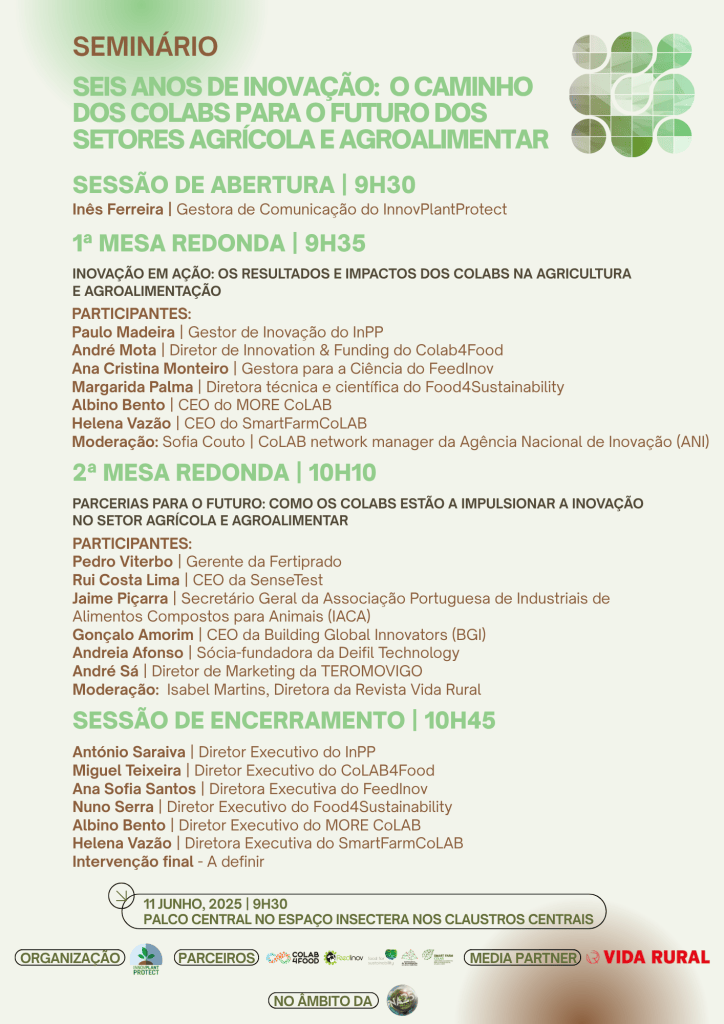
On June 11th, InnovPlantProtect (InPP) held a seminar on “Six years of innovation: CoLABs” path to the future of the agricultural and agri-food sectors", at the National Agriculture Fair (FNA) in Santarém.

The event brought together, for the first time, six Collaborative Laboratories (CoLABs) with direct involvement in the agricultural and agri-food sectors: InnovPlantProtect, CoLAB4Food, FeedInov CoLAB, Food4Sustainability, MORE CoLAB and SmartFarmCoLAB.

The program included two round tables. The first, dedicated to “Innovation in Action: The Results and Impacts of CoLABs in Agriculture and Agrifood”, representatives from each CoLAB took part, presenting success stories and projects developed, with emphasis on the intervention of the innovation manager at InnovPlantProtect, Paulo Madeira, He shared InPP's achievements in developing solutions for more sustainable agriculture.

The second round table, under the theme “Partnerships for the Future: How CoLABs are Driving Innovation in the Agricultural and Agri-Food Sector”, The event was attended by partner companies and associations, who stressed the importance of collaborating with the CoLABs. Among the speakers were Pedro Viterbo, manager of Fertiprado, InnovPlantProtect's partner, accompanied by representatives of the following organizations Sense Test, Associação Portuguesa Dos Industriais De Alimentos Compostos Para Animais (IACA), Building Global Innovators (BGI), DEIFIL Technology and TeroMovigo.

The seminar ended with a moment of joint reflection, with speeches from all the executive directors of the CoLABs present, including the executive director of InnovPlantProtect, António Saraiva, The meeting was organized by the European Commission, which stressed the importance of cooperation and strategic coordination between the Collaborative Laboratories, reinforcing their collective commitment to innovation and sustainable development in the agricultural and agri-food sectors.

Throughout the seminar, the importance of synergies between science, innovation and the market became clear, as did the need to strengthen funding and guarantee conditions for the continuity and growth of these Collaborative Laboratories, whose impacts are already visible in the national agricultural and agri-food ecosystem.

This meeting was an important moment for sharing experiences and strengthening collaborative work, charting a joint path towards a more competitive, sustainable and innovative future for agriculture and agri-food in Portugal.

O InnovPlantProtect (InPP) promotes the seminar “Six years of innovation: The path of CoLABs for the future of the agricultural and agri-food sectors”, on the next day June 11thfrom 09h30 until 11h00, in center stage at Espaço InsectERA, located in the Central Cloisters of the National Center for Agricultural Exhibitions and Markets (CNEMA) in Santarém.

The seminar aims to present the practical results and real impact of six Collaborative Laboratories (CoLABs) in Portugal - InnovPlantProtect, Colab4Food, FeedInov, Food4Sustainability, MORE and SmartFarmCoLAB. These interface infrastructures are essential pillars of the National Innovation System (SNI) and play a growing and essential role in the dynamics of innovation for agriculture and agri-food.

The event will be attended by members of the teams and partners of each of the CoLABs, who will talk about their vision of the added value of these interface and innovation entities, from the point of view of those who collaborate directly with them.

The initiative, which is part of the National Agriculture Fair (FNA) 2025, which this year has the theme “Biosolutions” and will be the stage for exploring the innovations that are shaping the future of the sector, brings together different representatives of the innovation ecosystem to show the role of CoLABs in stimulating the transfer of knowledge and making innovation available to agriculture and agri-food in Portugal, creating value and attracting highly qualified human resources to the country.

See the full program in the image below.

The registration for the event is free, but mandatory due to the limited capacity of the space. Guarantee your presence by filling in the available form here.

We look forward to welcoming you for a morning of sharing and debate on the future of innovation in the agricultural and agri-food sectors!

EVENTS

Beyond strategy: The secret ingredient of innovation

On the road to success, organizations define strategies, plan every step and invest in crucial resources such as selling services and products, applying for projects, drawing up solid business plans and protecting intellectual property. However, there is an element that is often overlooked, but which is fundamental to the flourishing of innovation: serendipity. But what exactly is this mysterious force and why is it so vital to the advancement of agriculture and so many other areas?

When chance opens doors: The power of unplanned discovery

Serendipity is the art of finding something valuable when you're looking for something else. It's the unintentional discoveries that arise from unexpected situations. Throughout history, some of the most transformative innovations have not been the result of a rigorous plan, but rather a chance encounter with the unknown. While deliberate research and methodical experimentation are pillars of scientific and technological progress, openness to the unexpected proves to be a powerful catalyst. When researchers cultivate this openness, they often stumble upon revelations that have the potential to revolutionize entire industries, transform technologies and expand our understanding of the world around us.

A close look at “error”: The genesis of an innovative biofungicide

Today, we unveil the surprising and inspiring story of Maria Miguel, a talented researcher from InPP's New Biopesticides Department, whose acumen turned a chance event into a priceless discovery: a broad-spectrum biofungicide capable of combating the Botrytis cinerea, the relentless fungus responsible for the devastating gray rot disease in tomato plants. This pathology represents one of the biggest phytosanitary challenges in tomato cultivation, especially when grown in greenhouses, causing significant losses to producers if it is not controlled in good time.

From discard to discovery: The insight of a researcher

The journey of this discovery began in a setting familiar to any researcher: the observation of Petri dishes, used to grow cultures of cells or microorganisms. On Maria Miguel's plates, colonies of the fungus Botrytis cinerea were growing, intentionally introduced there for study. However, something else caught her eye: one of the plates was contaminated by mold, and curiously, a clear area surrounded this intruder. Instead of discarding the plate and dismissing it as mere contamination, Maria Miguel decided to investigate the reason behind the clear area. Her curiosity revealed that the mold had a surprising ability to prevent the growth of Botrytis cinerea in its vicinity.

“Sometimes we look at something and think it's a mistake. The truth is that in a failure there can be something good,” the researcher shares. The excitement and enthusiasm of a researcher realizing that what at first glance seemed like an obstacle, a negative result, could actually be an opportunity, is contagious. For Maria Miguel, this “mistake” turned into a serendipitous discovery with enormous potential.

Maria Miguel, a researcher at InPP's New Biopesticides Department, who turned an unexpected event into a discovery that changed the course of her work: a broad-spectrum biofungicide to combat gray rot in tomato plants.

Beyond chance: The active ingredients of scientific discovery

As the history of this biofungicide shows, the world of science is full of examples of discoveries that came out of the blue. One of the most famous cases is Alexander Fleming's discovery of penicillin in 1928. While observing Petri dishes, Fleming noticed that a mold was producing a substance that eliminated bacteria Staphylococcus aureus around him. He identified the mold as Penicillium notatum and named his revolutionary antibiotic penicillin. Penicillin ended up becoming an extremely important medicine for fighting infections.

However, chance is not the only protagonist of these important revelations. “Sometimes we have to follow our intuition and be able to prove ourselves right or wrong,” explains Maria Miguel. In addition to intuition, a generous dose of curiosity, an open mind to accept unexpected results, solid scientific knowledge and the ability to see and move on to further research into surprising results play a crucial role in the alchemy of discovery.

The discovery ecosystem: Fostering an environment conducive to innovation

There are other ingredients that contribute to the recipe for scientific success:

  • Creativity: The ability to generate new perspectives, concepts, questions or solutions, and the willingness to explore existing ideas in a new light.
  • Flexibility: The courage to venture into unknown territory without the fear of failure, thus increasing the chances of serendipitous encounters.

But no discovery flourishes in isolation. At InPP, the strong team spirit and culture of collaboration transcend departmental boundaries. The case of Maria Miguel's discovery is testimony to this synergy, as she herself acknowledges: “My colleagues opened doors so that I could do my research”.

To foster innovation, organizations need to cultivate an environment that encourages open discussions and connects people from different areas of knowledge and life experiences, without judgment; that encourages curiosity and receptiveness to new experiences; and that promotes an incessant quest to improve scientific knowledge, the fertile ground where serendipity can germinate.

Sowing the future: The impact of a discovery and the path of research

Although Maria Miguel is about to embark on a new journey, boosted by a prestigious Marie Skłodowska-Curie PhD scholarship - a program that supports the careers of researchers and promotes excellence and innovation in research - her legacy at InPP is already flourishing. Her groundbreaking discovery is opening promising new doors for future research in the field of crop protection, demonstrating how sometimes it is in the unexpected that the potential to transform our world lies.

In the March issue of Fruits, vegetables and flowers you will find the opinion article entitled “The role of InnovPlantProtect in Organic Farming: Paths to sustainable and efficient solutions”, in which the executive director of InnovPlantProtect (InPP), António Saraiva, reveals how our CoLAB is contributing to the success of organic farming.

“By boosting research, collaboration and knowledge sharing, InPP is helping to solve the central challenges of this practice [organic farming], allowing it to expand and enhancing the supply of agricultural products to consumers. The solutions developed by InPP make organic farming a more viable option for producers,” says the executive director.

Read the full article and find out how we are shaping the future of agriculture.

We thank Frutas, legumes e flores magazine for its recognition and reiterate our commitment to the agriculture of the future.

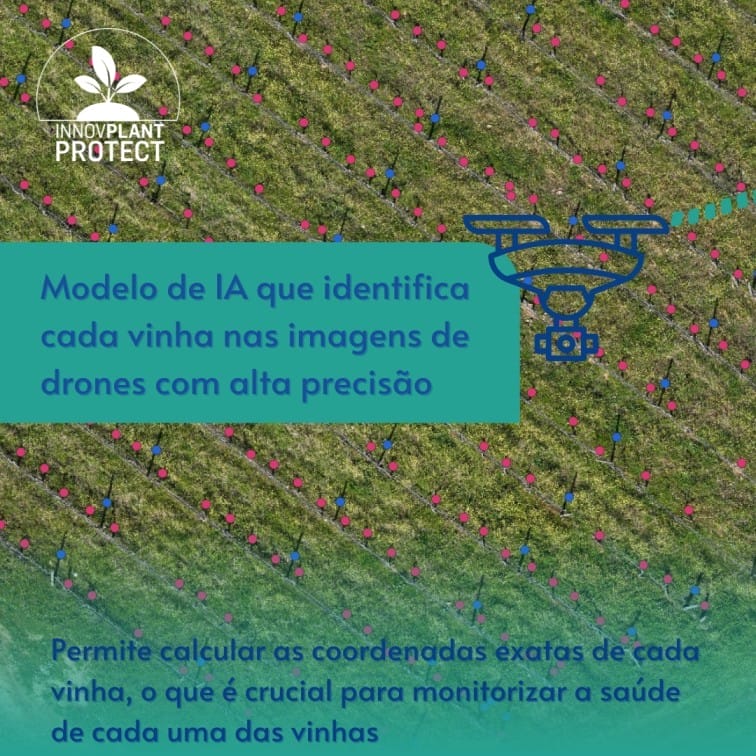
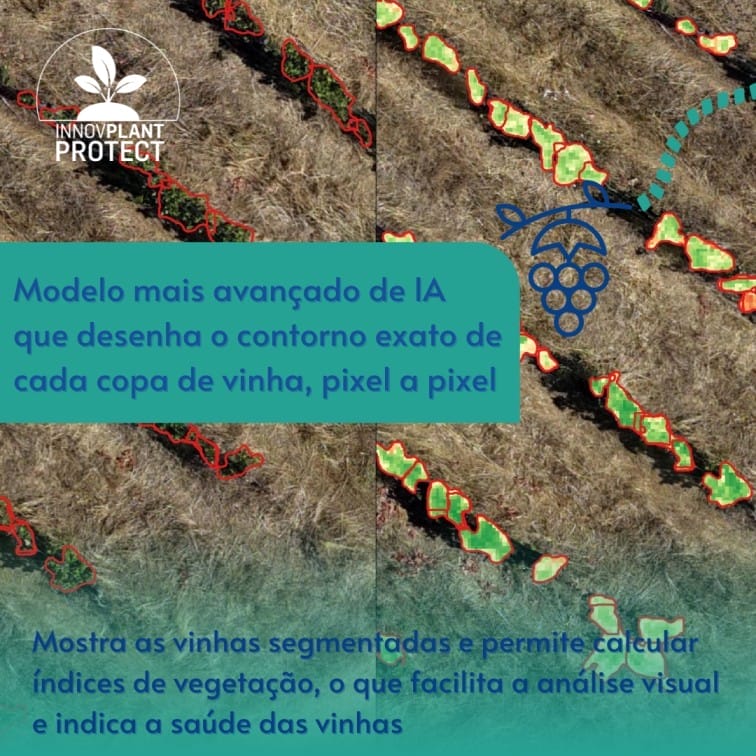
Imagine a future where drones and artificial intelligence work together to protect your vineyards. That's what the AI4Leafhopper project is making a reality!

Manisha Sirsat, a researcher on the AI4Leafhopper team, has developed two artificial intelligence models that analyze the aerial images captured by our latest generation drone... and these models make it possible:

  • geolocation of each vine
  • to know if there are vine failures
  • quickly identify “sick” vines”
  • optimize the application of treatments

The result? Growers can have a detailed view of the health of their vineyards, detect problems early and make more informed decisions.

Find out all about it here.

AI4Leafhopper is a project led by InPP and funded by the ICAERUS Horizon Europe program, which began in April 2024 and ended on April 30 with a final meeting involving the six European projects approved in the 1st edition of the ICAERUS program's PULL applications. The project team presented the AI-based models for detecting and monitoring the impact of the green leafhopper on vineyards.