News & Events

white plant

NEWS

Seminar highlights CoLABs' contribution to the future of agricultural and agri-food innovation

On June 11th, InnovPlantProtect (InPP) held a seminar on “Six years of innovation: CoLABs” path to the future of the agricultural and agri-food sectors", at the National Agriculture Fair (FNA) in Santarém.

The event brought together, for the first time, six Collaborative Laboratories (CoLABs) with direct involvement in the agricultural and agri-food sectors: InnovPlantProtect, CoLAB4Food, FeedInov CoLAB, Food4Sustainability, MORE CoLAB and SmartFarmCoLAB.

The program included two round tables. The first, dedicated to “Innovation in Action: The Results and Impacts of CoLABs in Agriculture and Agrifood”, representatives from each CoLAB took part, presenting success stories and projects developed, with emphasis on the intervention of the innovation manager at InnovPlantProtect, Paulo Madeira, He shared InPP's achievements in developing solutions for more sustainable agriculture.

The second round table, under the theme “Partnerships for the Future: How CoLABs are Driving Innovation in the Agricultural and Agri-Food Sector”, The event was attended by partner companies and associations, who stressed the importance of collaborating with the CoLABs. Among the speakers were Pedro Viterbo, manager of Fertiprado, InnovPlantProtect's partner, accompanied by representatives of the following organizations Sense Test, Associação Portuguesa Dos Industriais De Alimentos Compostos Para Animais (IACA), Building Global Innovators (BGI), DEIFIL Technology and TeroMovigo.

The seminar ended with a moment of joint reflection, with speeches from all the executive directors of the CoLABs present, including the executive director of InnovPlantProtect, António Saraiva, The meeting was organized by the European Commission, which stressed the importance of cooperation and strategic coordination between the Collaborative Laboratories, reinforcing their collective commitment to innovation and sustainable development in the agricultural and agri-food sectors.

Throughout the seminar, the importance of synergies between science, innovation and the market became clear, as did the need to strengthen funding and guarantee conditions for the continuity and growth of these Collaborative Laboratories, whose impacts are already visible in the national agricultural and agri-food ecosystem.

This meeting was an important moment for sharing experiences and strengthening collaborative work, charting a joint path towards a more competitive, sustainable and innovative future for agriculture and agri-food in Portugal.
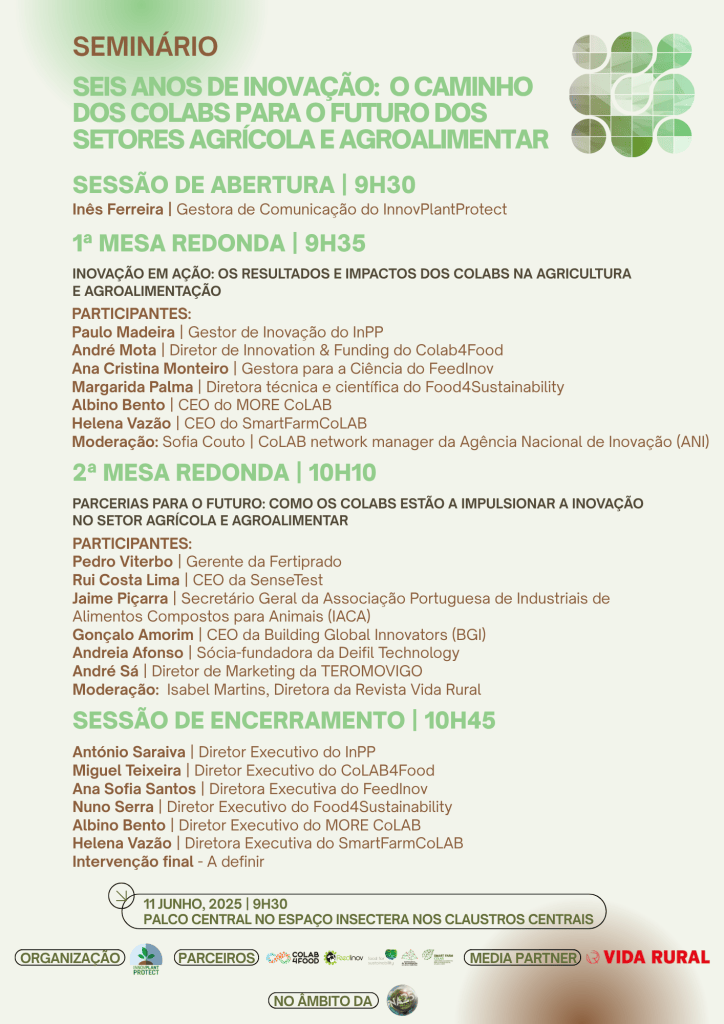
CoLABs in the spotlight at FNA: Innovation and Impact for Agriculture and Agrifood

O InnovPlantProtect (InPP) promotes the seminar “Six years of innovation: The path of CoLABs for the future of the agricultural and agri-food sectors”, on the next day June 11thfrom 09h30 until 11h00, in center stage at Espaço InsectERA, located in the Central Cloisters of the National Center for Agricultural Exhibitions and Markets (CNEMA) in Santarém.

The seminar aims to present the practical results and real impact of six Collaborative Laboratories (CoLABs) in Portugal - InnovPlantProtect, Colab4Food, FeedInov, Food4Sustainability, MORE and SmartFarmCoLAB. These interface infrastructures are essential pillars of the National Innovation System (SNI) and play a growing and essential role in the dynamics of innovation for agriculture and agri-food.

The event will be attended by members of the teams and partners of each of the CoLABs, who will talk about their vision of the added value of these interface and innovation entities, from the point of view of those who collaborate directly with them.

The initiative, which is part of the National Agriculture Fair (FNA) 2025, which this year has the theme “Biosolutions” and will be the stage for exploring the innovations that are shaping the future of the sector, brings together different representatives of the innovation ecosystem to show the role of CoLABs in stimulating the transfer of knowledge and making innovation available to agriculture and agri-food in Portugal, creating value and attracting highly qualified human resources to the country.

See the full program in the image below.

The registration for the event is free, but mandatory due to the limited capacity of the space. Guarantee your presence by filling in the available form here.

We look forward to welcoming you for a morning of sharing and debate on the future of innovation in the agricultural and agri-food sectors!

InPP participa na FNA25

Estamos em contagem decrescente para a Feira Nacional de Agricultura (FNA), uma das maiores feiras agrícolas do país!

É já de 7 a 15 de junho que o InPP vai estar na 61ª edição da Feira Nacional de Agricultura, que se realiza no CNEMA – Centro Nacional de Exposições, em Santarém.

O tema da edição deste ano é “Biosoluções”e pretende destacar a importância das soluções e tecnologias inovadoras no setor agroalimentar e na promoção de práticas mais sustentáveis e eficientes.

A FNA reúne agricultores, empresários e especialistas dos setores agroalimentar, pecuário e agrícola e é um excelente espaço para aumentar a nossa rede de contactos, trocar conhecimentos e apresentar as mais recentes tendências e soluções agrícolas que a nossa equipa tem desenvolvido.

Vai poder encontrar-nos no stand nº.18, à entrada do Espaço dos claustros, dedicado à Agenda InsectERA, entre as 10h e as 20h.

Venha visitar-nos. Esperamos por si!

EVENTS

Combating clover root rot disease

1st InPP field trip - Fertiprado
First InPP / Fertiprado field trip, by the Guadiana River, southwest of Elvas

CoLab InPP and Fertiprado collected the first samples of Persian clover and the pathogen that attacks this plant, which is used in the Alentejo and Elvas to produce pasture to feed free-range cattle.

The InnovPlantProtect (InPP) collaborative laboratory will develop a technological solution, based on existing products on the market, to protect Persian clover meadows (Trifolium resupinatum) against root rot. The initiative is the result of a partnership signed on December 2, 2020 with Fertiprado, an InPP member company.

This forage legume is particularly adapted - especially Fertiprado's varieties - to pasture production in Portugal and countries with winters similar to the Portuguese one. In the Alentejo and Elvas, Persian clover is mainly used as feed for free-range cattle, “due to its high protein content and its ability to retain atmospheric nitrogen,” says Pedro Fevereiro, InPP's executive director.

The action aims to isolate and identify the causative agent of root rot. The need was recognized by Fertiprado, which over the years has seen an increase in the incidence of this disease in its meadows, particularly those used for seed production. In the second week of January, InPP phytopathologists carried out their first field trip, accompanied by Ana Barradas, Fertiprado's Director of Research and Development, to collect samples of Persian clover and the pathogen that attacks it.

The work is in its initial phase and the identification of the causal species/strain of the disease is expected between March and April 2021, says Pedro Fevereiro. In a second phase, the “sequencing of its genome and the molecular identification of the strain” will be carried out. The third phase will consist of “testing and identifying the best solution based on coating the seeds with a biopesticide”.

National agri-food research has a name: INIAV

INIAV-National Institute for Agricultural and Veterinary Research is one of the founding members of InnovPlantProtec. In this interview with Oeiras Valley, Nuno Canadas lists the differentiating elements of the institution he chairs and emphasizes its position within the national scientific and technological system. See Part I and Part II of the interview.

After the new era, what future for genomics?

The new era in genomics began 20 years ago with the publication of the first draft of the human genome. And now, which way forward? This is the question that two genomics experts will try to answer in a live online chat this Monday at 19:00.

Since the new era in genomics began 20 years ago, a lot has changed: DNA sequencing costs have fallen, gene therapy is back, ethical boundaries are being pushed to the limit by gene editing, new technologies such as single cell and transcriptomics are leading researchers towards genomic breakthroughs.

How far the field of genomics has advanced in the last 20 years is not in question. What is under discussion now is what will happen next. With the progress that has been made, what is the way forward? What path should be taken?

On the 14th, at 7pm, in an online meeting organized by the US publication Genetic Engineering & Biotechnology News, two genomics experts from The National Human Genome Research Institute (NHGRI) and the authors of the recently concluded 2020 strategic plan will look back at the past of genomics, analyzing its highs and lows, and try to figure out its future. For the authors of the 2020 strategic plan, “the vision of genomics has never been clearer” and the future, they say, lies in “responsible stewardship” and increasing diversity.

To take part, register here.

