On September 18, the executive director of InnovPlantProtect (InPP), António Saraiva, the director of the New Biopesticides Department, Cristina Azevedo, and researcher Luís Grilo attended the Open Day “The Cereals of Baixo Mondego”, promoted by the Centro Regional Coordination and Development Commission (CCDR Centro), at the Bico da Barca Experimental Unit in Montemor-o-Velho.
The event highlighted the latest innovations from the Coimbra Innovation Hub, from new technologies applied to maize and rice, to fertilization strategies, protection and the use of biostimulants on these key crops in the Baixo Mondego region.
Our team also monitored trials with biofungicides, including the product I21, developed with our collaborative laboratory to combat pyriculariosis in two rice varieties, which is being patented.
In an interview with Voice of the Countryside, Cristina Azevedo shared the work we have been doing in the area of biosolutions.
Maize continues to be the Portugal's most important arable crop, The sector has a significant impact on food safety and the national agri-food industry. Involving thousands of producers and generating tens of millions of euros a year, the sector is currently facing increasingly complex phytosanitary challenges.
Among already known pests and emerging diseases, there are risks ranging from cartridge caterpillar until Maize Rugose Dwarfism Virus (MRDV), The presence of this virus is increasing in Portugal. This virus, transmitted by the corn leafhopper, can seriously compromise production and is found in the climate change increasingly favorable conditions for its spread.
However, it's not just MRDV that's worrying. There are new threats that require vigilance, such as the coleopter Diabrotica virgifera or the MDMV virus (Maize Dwarf Mosaic Virus), already detected in neighboring countries, and also toxic weeds, such as the winter fig (Datura stramonium), which in addition to impacting productivity pose public health risks.
Faced with this reality, the answer is integrated and sustainable strategies, matching:
crop rotation and good agricultural practices;
careful use of insecticides to avoid resistance and environmental impacts;
resistant or tolerant varieties, where available;
research and technological innovation, including new digital tools for early detection.
As the InnovPlantProtect researcher points out, Nuno Faria, in the article entitled “The main emerging pests and diseases of the maize crop in Portugal”, available in the August edition of Voz do Campo magazine: “The phytosanitary panorama of maize in Portugal requires continuous vigilance, investment in research and the application of integrated and sustainable strategies capable of responding to an increasingly dynamic and unpredictable reality.”
To find out more about the main current risks and mitigation measures, read the full article published in the August issue of Voz do Campo magazine (pages 88-89), available on newsstands and online.
InnovPlantProtect (InPP) is pleased to announce the publication of an international patent application (PCT) for a strain of Bacillus velezensis with application as a plant biostimulant. This innovation represents a significant milestone in our research, with a direct impact on sustainable agriculture and crop resilience in the face of climate and environmental challenges.
A natural and effective solution
The biostimulant developed by our team has been carefully studied and tested on different vegetable crops, such as tomatoes and lettuce, and on cereals, such as rice. The results obtained demonstrate the potential of this technology:
Greater development in the early stages of crops, This promotes more vigorous and healthy starts.
Increased productivity, This is evidenced by greater fresh biomass in lettuce and greater fruit production in tomatoes.
Proven molecular responses, with analyses confirming the activation of genes associated with plant responses to different types of abiotic stress.
These results reinforce the effectiveness of the Bacillus velezensis as a natural biostimulation tool, capable of boosting crop performance and contributing to more sustainable agriculture.
From the lab to the field
This patent is another step in InPP's commitment to developing innovative, sustainable biotechnological solutions with industrial applicability. The aim is clear: to support farmers and companies in the sector in meeting the challenges of crop productivity, quality and resilience, in an era when agriculture needs sustainable, high-impact responses.
We are looking for strategic partnerships
We are currently looking for new partnerships with companies and entities in the agricultural sector to take this technology from the laboratory to the field. We believe that collaboration is the key to turning scientific innovation into practical solutions that benefit the entire agricultural value chain.
If you're interested in learning more about this technology or exploring opportunities for collaboration, talk to us. Together we can drive a more productive, resilient and sustainable agriculture.
Innovate together. Protect better.
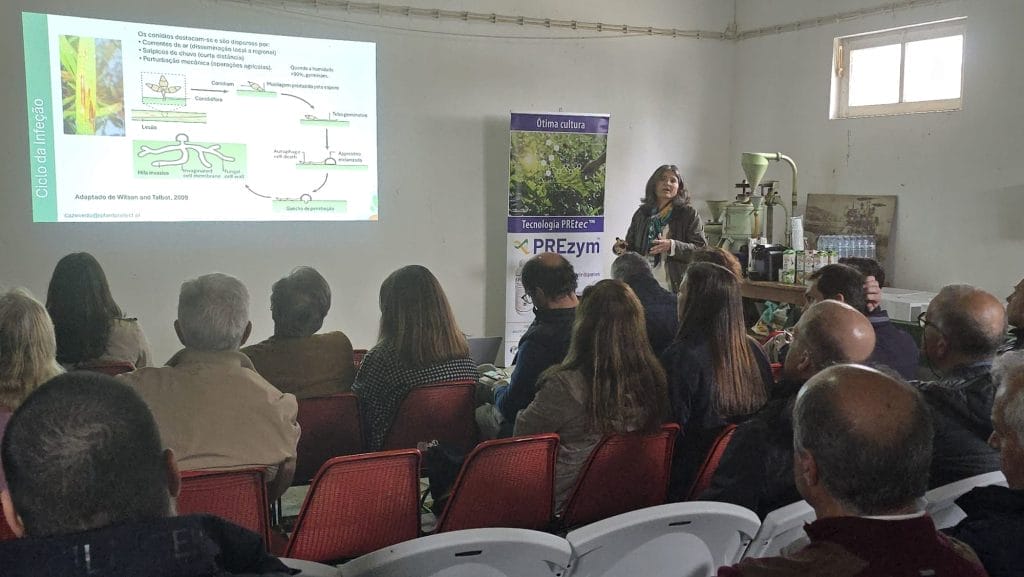
Image credits: InnovPlantProtect - Inês Ferreira (Photos from left to right: Sandra Caeiro and Rui Figueiras, researchers from the Specific Crop Protection Department and Inês Mexia, researcher from the Formulations and Process Development Department.
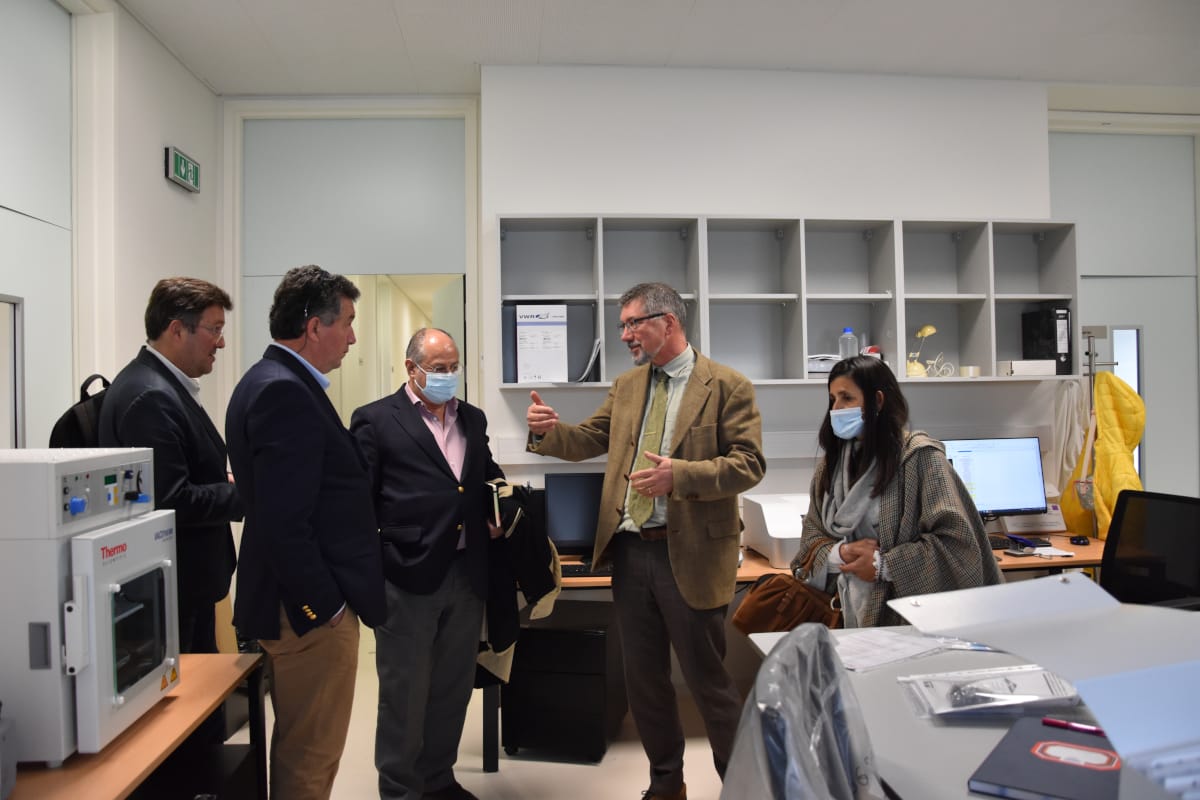
Today, April 5, InnovPlantProtect (InPP) members had the opportunity to visit the new facilities of the collaborative laboratory (CoLAB), at the Elvas Campus of the INIAV, The 39-strong team is already at work, although some laboratory equipment is still being assembled.
The visit was attended by Isabel Rocha, vice-rector of the NOVA University Lisbon, José Pereira Palha, president of the National Association of Protein, Oilseed and Cereal Producers (Anpoc), José Rato Nunes, representing the Polytechnic Institute of Portalegre, Pedro Monteiro, president of Casa do Arroz, Tiago Pinto, secretary-general of the National Association of Maize and Sorghum Producers (Anpromis), José Maria Rasquilha, vice-president of Anpoc and president of Cersul, Pedro Viterbo, manager of Fertiprado, Domingos dos Santos, president of the National Federation of Fruit and Vegetable Producers' Organizations (Fnop), Felisbela Torres de Campos, Director of Corporate Regulation and Sustainability for Portugal at Syngenta Crop Protection, Maria do Rosário Félix, representing the University of Évora, Margarida Oliveira, deputy director of the ITQB NOVA and coordinator of the InPP working group, and Benvindo Maçãs, director of INIAV's Elvas Center, who were accompanied by CoLAB's executive director, Pedro Fevereiro.
As well as the new laboratories, it was possible to visit INIAV's newly renovated auditorium and cafeteria, which also serve InPP. Below, center, the director of the Formulations and Process Development department, David Learmonth, and researcher Sónia Siquenique while determining the viscosity of formulations with a viscometer; on the right, the director of the New Biopesticides department, Cristina Azevedo, and researchers Miguel Carvalho and Jordana Branco, in a meeting.
InnovPlantProtect (InPP) will be present at the 38th Ovibeja, The event will take place from April 21 to 25, with its own stand and a program of activities to be announced in due course. On Saturday, April 23rd, at 3pm, the InPP is organizing a colloquium on the theme “Protecting crops to feed the world: from soil microorganisms to pest and disease monitoring techniques”.
The executive director of the InPP is taking part in this conference, Pedro February, who will present CoLAB, iLaria Marengo, director of the Monitoring and Diagnostics department, who will talk about remote sensing applied to crop protection, and Ricardo Ramiro, director of the Data Management and Risk Analysis department, who will address the topic of the soil microbiome.
Pedro Fevereiro is also taking part in the seminar ACOS - The Southern Farmers“ Association is organizing a conference on ”How to feed the planet?“, the theme of Ovibeja 2022, on the 23rd at 11.30 a.m., and the colloquium ”The European green agenda. Sustainability of agriculture and food sovereignty", which takes place on Friday, April 22, at 4pm. The event takes place at the Manuel de Castro e Brito Fair and Exhibition Park in Beja.
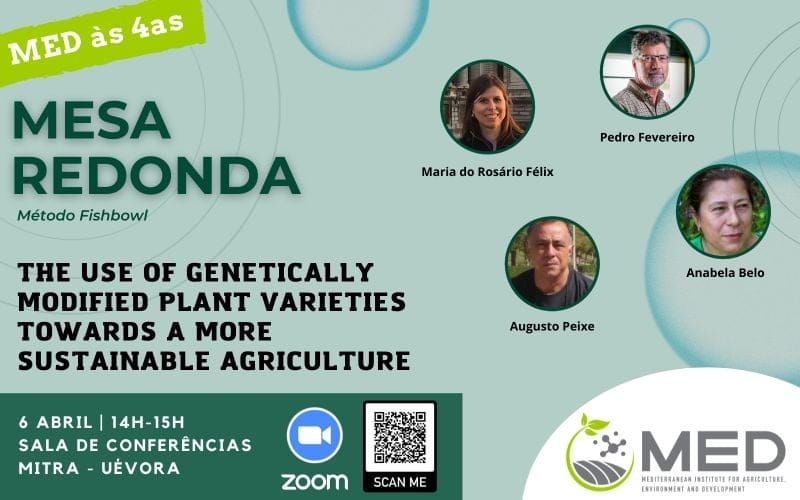
The executive director of InnovPlantProtect, Pedro Fevereiro, will take part in the next “MED às 4as” (MED on Wednesdays), on April 6, a round table organized by the MED - Mediterranean Institute for Agriculture, Environment and Development, on “The use of genetically modified plants for more sustainable agriculture”.
The session will take place in person in the Conference Room of the Mitra Campus. University of Évora, between 2 p.m. and 3 p.m., but it is also possible to attend via Zoom.
The use of genetically modified varieties is a possible solution for achieving the strategic objectives of the European Green Deal, as part of the “From Plate to Plate” and Biodiversity Strategy for 2030. However, it is still limited and remains under European legislation that does not take into account the new genomic techniques (NTG). The development of specific legislation allowing the development and use of plants subject to these NTGs would be particularly timely for meeting the objectives of the European Green Deal, say the organizers.
Find out more and meet the panel of speakers here.