Estamos em contagem decrescente para a Feira Nacional de Agricultura (FNA), uma das maiores feiras agrícolas do país!
É já de 7 a 15 de junho que o InPP vai estar na 61ª edição da Feira Nacional de Agricultura, que se realiza no CNEMA – Centro Nacional de Exposições, em Santarém.
O tema da edição deste ano é “Biosoluções”e pretende destacar a importância das soluções e tecnologias inovadoras no setor agroalimentar e na promoção de práticas mais sustentáveis e eficientes.
A FNA reúne agricultores, empresários e especialistas dos setores agroalimentar, pecuário e agrícola e é um excelente espaço para aumentar a nossa rede de contactos, trocar conhecimentos e apresentar as mais recentes tendências e soluções agrícolas que a nossa equipa tem desenvolvido.
Vai poder encontrar-nos no stand nº.18, à entrada do Espaço dos claustros, dedicado à Agenda InsectERA, entre as 10h e as 20h.
InnovPlantProtect (InPP) took part in the National Olive Growing Fair (FNO 25) in Campo Maior, from May 23 to 25, presenting its latest biological and digital innovations for crop protection, including projects focused on biopesticides for olive diseases and early detection of fungi that cause gafa, and monitoring insect vectors of the bacterium Xylella fastidiosa, which attacks olive groves. The Elvas CoLAB was present with its own stand to demonstrate its strengths and the impact of its research on agricultural sustainability, inviting producers, technicians and researchers to learn about its innovative bio-based and digital solutions and to actively participate in the discussion of the sector's challenges.
The collaborative laboratory (CoLAB) welcomed visitors at the stand no. 14, located at thematic area at the Campo Maior Municipal Garden, to showcase their activity, the ongoing projects that are developing solutions to the main olive diseases, the patents already submitted, the apps for agricultural management and the bio-based and digital products and services they have to offer the agricultural sector and the market. Throughout the three days of the fair, some of InPP's researchers were at the stand to demonstrate to visitors the various features of the Elvas CoLAB, which has been developing innovation that it hopes will contribute to the sustainability of agricultural systems.
InPP announced ValorCannBio project, which is processing biomass that is not used in the medical cannabis industry to develop effective and sustainable biopesticides against gafa and tuberculosis, The project will be carried out in the municipality of Elvas, which is responsible for decimating entire harvests, leading to severe economic losses and compromising food quality. The impact of this project will be felt in the municipality of Elvas, where the project is being developed, but it is expected that it will extend to the entire olive-growing region from Trás-os-Montes to the Algarve, where production losses are increasing due to these diseases. O AlViGen project was also one of the protagonists and is using cutting-edge technology to detecting and identifying the strains of fungi that cause gafa, long before the symptoms become visible. The project team has used traps to collect spores that circulate in the air to monitor the presence of fungi, which can give farmers an important advantage in preventing infections and protecting their crops, reducing production losses.
O SNM_XylellaVt project, The SNM_XylellaVt project, led by DRAPCENTRO and in which InPP actively participates, was also highlighted at FNO. SNM_XylellaVt is monitor the insect vectors of the bacteria Xyllela fastidiosa, in particular the foam leafhopper, the insect responsible for transmitting the bacterium, which attacks various agricultural and forestry crops, and in particular olive groves. The project team is developing new tools, such as risk prediction models which, in the presence of the bacterium, whether in plants or insect vectors, will allow the National Agricultural Warning Service (SNAA) to alert, in real time, about the economic attack levels (EAL) for these insects, thus allowing prevent infection of the main crops. As part of this project, the team has also developed an online platform where citizens can report the sighting of foams, which are signs of the presence of the insect vectors of X. fastidiosa, This will help to map its temporal and spatial distribution and to plan measures to combat this bacterium.
The FNO, organized jointly by the Campo Maior City Council and the Centre for the Study and Promotion of Olive Oil in the Alentejo (CEPAAL), is an event that aims to enhance national olive growing, and in particular Portuguese olive oil, boosting the local economy and bringing together professionals from the sector - producers, technicians, or researchers - from all over the country to discuss challenges and trends in the Portuguese olive and olive oil sector.
Each year, crop diseases cause devastating losses in agricultural production, threatening food security and the livelihoods of millions of farmers. In the heart of Alentejo, an innovative project is harnessing the power of genomics to help combat these invisible threats. The AlViGen Project, with the participation of InnovPlantProtect researchers Rute Rego and João Bilro, is paving the way for a new era of crop surveillance and protection.
The Problem and the Solution
“Yellow rust in wheat and olive quick decline syndrome are real scourges for farmers,” explains Rute Rego, a researcher at AlViGen. “These diseases can decimate entire harvests, leading to severe economic losses and compromising food quality.”
But AlViGen is not limited to observing the problem. The team is using cutting-edge technology to detect and identify the strains of fungi that cause these diseases, long before the symptoms become visible.
“We use traps to collect spores circulating in the air,” Rute continues. “These traps allow us to monitor the presence of fungi in real-time, which gives us an important advantage in preventing infections.”
But the magic happens in the laboratory, where the team extracts the DNA from the spores and performs advanced genomic analyses, using powerful DNA sequencing technology based on the metabarcoding method, carried out with cutting-edge technology like the portable Nanopore sequencer.
Rute Rego, a researcher at InnovPlantProtect, analyzes samples of the fungus causing olive quick decline syndrome as part of the AlViGen project.
Unraveling the Genetic Code of Fungi
To better explain what metabarcoding is and its advantage in detecting the presence of species or strains of fungi that cause diseases in crops, the researcher gives the example of a bag full of different types of grains - rice, beans, corn - being analyzed by the reader. “Metabarcoding is like placing a unique label (a ‘barcode’) on each type of grain. Then, you can mix all the grains in a single sample, and by reading the labels, you can identify the quantity of each type of grain present.'”
In the case of AlViGen, this technique allows for the analysis of multiple fungal species simultaneously (in multiple samples), each with its own genetic ‘barcode,’ and to ‘identify exactly which fungi are present, even in small quantities,'” the researcher explains.
And what is the practical impact of this method for monitoring and predicting disease? The AlViGen project researcher can identify, with high precision, the moment when the pathogenic agent begins to appear in the field, which makes it possible to alert farmers in real-time about the risk of disease. Producers can adopt preventative measures and apply the necessary products to avoid infection, contributing to a rapid and effective response in disease prevention.
The Timeline of Fungal Evolution
AlViGen's research is not limited to identifying the microorganisms harmful to crops; it also seeks to understand their evolution and diversity. João Bilro, another researcher on the project, is dedicated to studying the phylogeny of the Colletotrichum fungus, a microorganism responsible for causing olive anthracnose or blight, a disease that affects olive groves in Portugal. This disease mainly affects the olives, which compromises the quality of the olive oil.
“Phylogeny is crucial for understanding how the different strains of Colletotrichum Just as a family tree traces the history of a family, showing how members are related to each other, phylogenetic trees reveal the evolutionary relationships between the different strains of this fungus. Each branch of the tree represents an evolutionary lineage, and the nodes indicate common ancestors. By comparing the DNA sequences of these strains, we can reconstruct their evolutionary history, identifying which are genetically closer or more distant, and thus infer characteristics such as virulence or resistance to fungicides,” he reveals.
This knowledge allows researchers to identify patterns of dissemination and adaptation of the fungus, which is fundamental for developing more effective strategies to contain and/or reduce the damage this fungus causes to Portuguese olive groves.
“One of the challenges of our research is the great genetic diversity of the Colletotrichum,” admits João. “However, by uncovering their evolutionary secrets, we are paving the way for the development of more precise and targeted detection and control methods.”
Left photo: João Bilro, a bioinformatician at InnovPlantProtect, studying the phylogeny of the Colletotrichum fungus within the scope of the AlViGen project; Right photo: Rute Rego and João Bilro discuss ideas about the AlViGen project.
The Future of Agriculture Starts Here
The AlViGen Project aims to have a significant impact on the agricultural landscape, especially in Alentejo, a region with a strong agricultural tradition. By providing farmers with early detection tools and precise information about the microorganisms that cause crop diseases, the project intends to aid in decision-making, allowing farmers to protect their crops and reduce production losses.
“Our ultimate goal is to empower farmers with the knowledge and tools they need to protect their crops sustainably,” states Rute. “We believe that genomic surveillance is a key tool for the future of crop protection.”
João Bilro agrees and adds, “Continuous research is fundamental to keep up with the evolution of harmful microorganisms and to develop new, consistently effective control strategies. In the future, we hope to expand the scope of AlViGen to include other microorganisms and crops, and to make genomic surveillance an accessible tool for all farmers.”
Science at the Service of Agriculture
The AlViGen Project, supported by the Promove Program of the “la Caixa” Foundation, in partnership with Banco BPI and the Foundation for Science and Technology (FCT), is an inspiring example of how science and technology can be applied to solve real-world problems and transform agriculture. By unraveling the genetic secrets of crop microorganisms, Rute Rego and João Bilro are paving the way for a safer, more sustainable, and resilient agriculture.
The fight against crop diseases continues, but with AlViGen, farmers can finally see the enemy before it becomes visible.
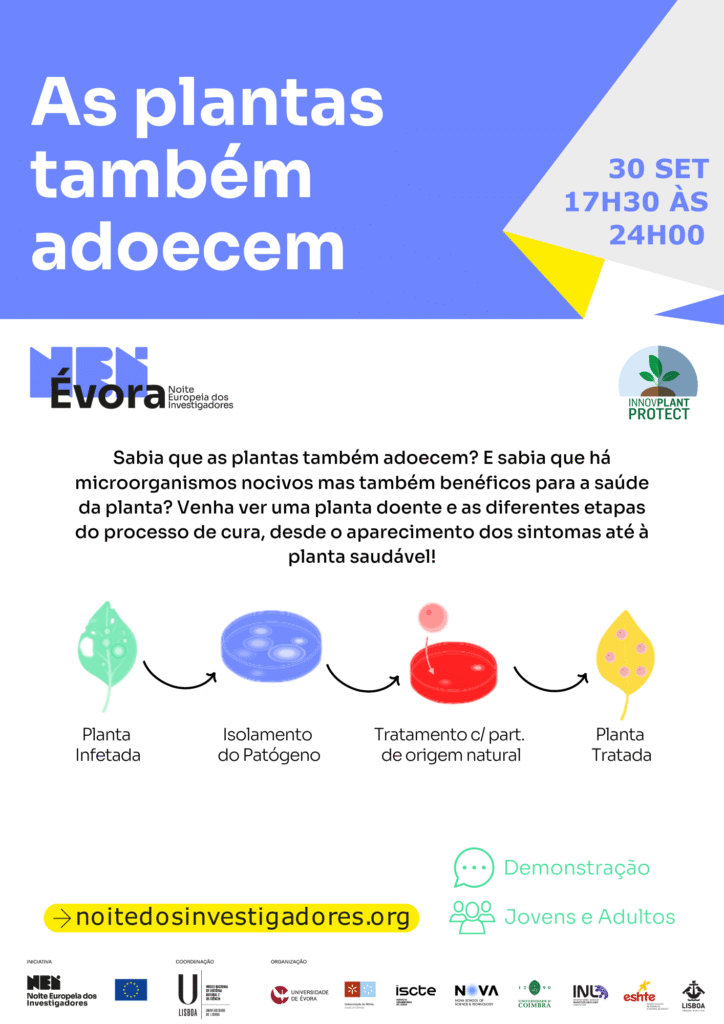
Será que os insetos também têm ciclo de vida? Já conhece o ciclo de vida da traça da colmeia? Ou sabia que as plantas também adoecem ou que existem microrganismos nocivos mas também benéficos para a saúde das plantas? Venha descobrir as respostas a todas estas questões já na próxima sexta-feira, dia 30 de setembro, na Noite Europeia dos Investigadores (NEI) 2022. Entre as 17h30 e as 00h, os investigadores e investigadoras do InPP vão marcar presença na Praça do Giraldo, em Évora.
O InPP estará no stand EU-Corner 4 e este será o ponto de encontro entre os investigadores e todos aqueles que querem descobrir a ciência que é desenvolvida no nosso laboratório colaborativo. Nesta noite vai poder participar em duas atividades científicas: na primeira vai poder descobrir o incrível ciclo de vida da traça da colmeia e na segunda vai poder ver uma planta doente e todo o processo de cura.
Entre jogos, debates, demonstrações, conversas, workshops, visitas, exposições e tertúlias, são muitas as atividades de diversas instituições científicas para explorar nesta festa da ciência.
A participação é gratuita.
Junte a família e venha ter connosco a esta festa da Ciência! Contamos com a sua visita!
Consulte a programação completa de atividades presenciais de Évora here.
A NEI ocorre todos os anos e tem o objetivo de partilhar o trabalho dos investigadores com o público em geral. O tema para o ano de 2022 é “Ciência para Todos – Sustentabilidade e Inclusão”.
Atividade científica “Ciclo de vida do inseto traça da colmeia”Atividade científica “As plantas também adoecem”
Um artigo publicado recentemente pela equipa do InnovPlantProtect (InPP) revela o potencial dos métodos computacionais de machine learning para prever características fenotípicas, como é o caso do rendimento/produtividade do trigo, a partir de informações genéticas desta planta.
O machine learning (ML) é uma área da ciência de dados que tem ganho cada vez mais relevância na última década. O ML é um ramo da inteligência artificial que permite o desenvolvimento de modelos de previsão que podem ser aplicados nas mais variadas áreas. Apesar de não nos apercebermos, utilizamos ferramentas baseadas em ML no nosso dia-a-dia, como por exemplo, os resultados personalizados apresentados no feed do seu Facebook. Mas as aplicações futuras vão desde permitir a condução autonoma até à deteção de doenças através da análise de radiografias (em humanos) ou imagens de drone (em pomares).
A predição genómica (PG) é outra das áreas em que o ML tem estado a ser aplicado. Esta consiste em usar dados genómicos (que nos dão informação acerca do genótipo) para desenvolver modelos computacionais que prevêem características fenotípicas complexas dos organismos, tal como rendimento/produtividade do trigo (Ver representação esquemática).
Nesta investigação agora publicada na revista científicaAgriculture, os investigadores Manisha Sirsat e Ricardo Ramiro, ambos do departamento de Gestão de Dados e Análise de Risco, em colaboração com a Paula Oblessuc do departamento de Proteção de Culturas Específicas, exploraram a utilização de vários modelos de PG baseados em diferentes métodos computacionais para além do ML, como é o caso dos métodos estatísticos ou de deep learning (DL), com o objetivo de comparar a robustez e a performance de cada um deles em prever a característica fenotípica rendimento/produtividade do trigo. A ideia foi perceber quais os métodos que permitem prever características fenotípicas com maior fiabilidade.
“Os métodos estatísticos têm sido os mais utilizados em predição genómica pelas equipas de investigação em todo o mundo. Contudo, os métodos de ML estão a revelar-se uma boa alternativa, sendo mais precisos e rápidos”, evidencia Manisha Sirsat, primeira autora do estudo.
“A PG baseada em ML pode ajudar a reduzir o tempo e o custo da avaliação extensiva do processo de fenotipagem (durante os programas de melhoramento) e a acelerar o ganho genético”, explica a investigadora. “Este estudo contribui assim para ajudar os investigadores a perceber os fatores chave no desenvolvimento de modelos que possam acelerar os programas de melhoramento do trigo, ou de outras culturas, e a aumentar a produtividade agrícola”, acrescenta.
Representação esquemática do processo de predição genómica
A equipa tem estado a trabalhar em predição genómica desde 2020, e espera que a genómica e a predição genética sejam fundamentais para permitir manter ou aumentar a produtividade das culturas, apesar das múltiplas ameaças que enfrentamos, e para responder ao aumento de 50% na procura por alimentos até 2050, quando a população mundial atingir 9,7 mil milhões.
No passado dia 31 de Agosto, a diretora de departamento Cristina Azevedo esteve no Dia Aberto do Arroz – “A cultura do arroz no Baixo Mondego”, organizado pelo Pólo de Inovação de Coimbra da Direção Regional de Agricultura e Pescas do Centro (DRAPCentro), e que teve lugar no Campo do Bico da Barca, em Montemor-o-Velho. A iniciativa pretendeu dar a conhecer o que de mais inovador se tem feito ao nível da cultura deste cereal.
Durante o Dia Aberto, que contou com a colaboração de várias entidades e empresas ligadas ao setor da cultura do arroz, os participantes visitaram ensaios e campos de arroz, ficaram a conhecer um ensaio de novas variedades deste cereal, que está a avaliar o comportamento agronómico das cultivares e a determinar o seu rendimento industrial, e um novo fertilizante – CHAMAE – desenvolvido pela Lusosem, Syngenta, Bayer CropScience e DRAP Centro, que está a ser testado para esta cultura.
Os visitantes tiveram ainda a oportunidade de experienciar o incrível trabalho que tem sido realizado pelo INIAV, IP na conservação e melhoramento desta cultura, bem como um sistema em modo de produção biológico, no qual a Lusosem e a Associação de Beneficiários da Obra de Fomento Hidroagrícola do Baixo Mondego (Abofhbm) estão a testar novas tecnologias inovadoras e sustentáveis de sementeira e controlo de infestantes.
No âmbito da cultura do arroz, o departamento de Novos Biopesticidas, liderado por Cristina Azevedo, tem estado a trabalhar no desenvolvimento de biopesticidas para o controlo da piriculariose, uma das doenças que mais afeta este cereal, e, no passado mês de Agosto já recolheu duas amostras de arroz infetado na bacia do Mondego (em Montemor-o-Velho) e do Tejo/Sorraia (em Coruche e Porto Alto, em Samora Correia). A equipa planeia amostrar ainda este ano na zona do Sado.






 Português
  English