Estamos em contagem decrescente para a Feira Nacional de Agricultura (FNA), uma das maiores feiras agrícolas do país!
É já de 7 a 15 de junho que o InPP vai estar na 61ª edição da Feira Nacional de Agricultura, que se realiza no CNEMA – Centro Nacional de Exposições, em Santarém.
O tema da edição deste ano é “Biosoluções”e pretende destacar a importância das soluções e tecnologias inovadoras no setor agroalimentar e na promoção de práticas mais sustentáveis e eficientes.
A FNA reúne agricultores, empresários e especialistas dos setores agroalimentar, pecuário e agrícola e é um excelente espaço para aumentar a nossa rede de contactos, trocar conhecimentos e apresentar as mais recentes tendências e soluções agrícolas que a nossa equipa tem desenvolvido.
Vai poder encontrar-nos no stand nº.18, à entrada do Espaço dos claustros, dedicado à Agenda InsectERA, entre as 10h e as 20h.
InnovPlantProtect (InPP) took part in the National Olive Growing Fair (FNO 25) in Campo Maior, from May 23 to 25, presenting its latest biological and digital innovations for crop protection, including projects focused on biopesticides for olive diseases and early detection of fungi that cause gafa, and monitoring insect vectors of the bacterium Xylella fastidiosa, which attacks olive groves. The Elvas CoLAB was present with its own stand to demonstrate its strengths and the impact of its research on agricultural sustainability, inviting producers, technicians and researchers to learn about its innovative bio-based and digital solutions and to actively participate in the discussion of the sector's challenges.
The collaborative laboratory (CoLAB) welcomed visitors at the stand no. 14, located at thematic area at the Campo Maior Municipal Garden, to showcase their activity, the ongoing projects that are developing solutions to the main olive diseases, the patents already submitted, the apps for agricultural management and the bio-based and digital products and services they have to offer the agricultural sector and the market. Throughout the three days of the fair, some of InPP's researchers were at the stand to demonstrate to visitors the various features of the Elvas CoLAB, which has been developing innovation that it hopes will contribute to the sustainability of agricultural systems.
InPP announced ValorCannBio project, which is processing biomass that is not used in the medical cannabis industry to develop effective and sustainable biopesticides against gafa and tuberculosis, The project will be carried out in the municipality of Elvas, which is responsible for decimating entire harvests, leading to severe economic losses and compromising food quality. The impact of this project will be felt in the municipality of Elvas, where the project is being developed, but it is expected that it will extend to the entire olive-growing region from Trás-os-Montes to the Algarve, where production losses are increasing due to these diseases. O AlViGen project was also one of the protagonists and is using cutting-edge technology to detecting and identifying the strains of fungi that cause gafa, long before the symptoms become visible. The project team has used traps to collect spores that circulate in the air to monitor the presence of fungi, which can give farmers an important advantage in preventing infections and protecting their crops, reducing production losses.
O SNM_XylellaVt project, The SNM_XylellaVt project, led by DRAPCENTRO and in which InPP actively participates, was also highlighted at FNO. SNM_XylellaVt is monitor the insect vectors of the bacteria Xyllela fastidiosa, in particular the foam leafhopper, the insect responsible for transmitting the bacterium, which attacks various agricultural and forestry crops, and in particular olive groves. The project team is developing new tools, such as risk prediction models which, in the presence of the bacterium, whether in plants or insect vectors, will allow the National Agricultural Warning Service (SNAA) to alert, in real time, about the economic attack levels (EAL) for these insects, thus allowing prevent infection of the main crops. As part of this project, the team has also developed an online platform where citizens can report the sighting of foams, which are signs of the presence of the insect vectors of X. fastidiosa, This will help to map its temporal and spatial distribution and to plan measures to combat this bacterium.
The FNO, organized jointly by the Campo Maior City Council and the Centre for the Study and Promotion of Olive Oil in the Alentejo (CEPAAL), is an event that aims to enhance national olive growing, and in particular Portuguese olive oil, boosting the local economy and bringing together professionals from the sector - producers, technicians, or researchers - from all over the country to discuss challenges and trends in the Portuguese olive and olive oil sector.
Each year, crop diseases cause devastating losses in agricultural production, threatening food security and the livelihoods of millions of farmers. In the heart of Alentejo, an innovative project is harnessing the power of genomics to help combat these invisible threats. The AlViGen Project, with the participation of InnovPlantProtect researchers Rute Rego and João Bilro, is paving the way for a new era of crop surveillance and protection.
The Problem and the Solution
“Yellow rust in wheat and olive quick decline syndrome are real scourges for farmers,” explains Rute Rego, a researcher at AlViGen. “These diseases can decimate entire harvests, leading to severe economic losses and compromising food quality.”
But AlViGen is not limited to observing the problem. The team is using cutting-edge technology to detect and identify the strains of fungi that cause these diseases, long before the symptoms become visible.
“We use traps to collect spores circulating in the air,” Rute continues. “These traps allow us to monitor the presence of fungi in real-time, which gives us an important advantage in preventing infections.”
But the magic happens in the laboratory, where the team extracts the DNA from the spores and performs advanced genomic analyses, using powerful DNA sequencing technology based on the metabarcoding method, carried out with cutting-edge technology like the portable Nanopore sequencer.
Rute Rego, a researcher at InnovPlantProtect, analyzes samples of the fungus causing olive quick decline syndrome as part of the AlViGen project.
Unraveling the Genetic Code of Fungi
To better explain what metabarcoding is and its advantage in detecting the presence of species or strains of fungi that cause diseases in crops, the researcher gives the example of a bag full of different types of grains - rice, beans, corn - being analyzed by the reader. “Metabarcoding is like placing a unique label (a ‘barcode’) on each type of grain. Then, you can mix all the grains in a single sample, and by reading the labels, you can identify the quantity of each type of grain present.'”
In the case of AlViGen, this technique allows for the analysis of multiple fungal species simultaneously (in multiple samples), each with its own genetic ‘barcode,’ and to ‘identify exactly which fungi are present, even in small quantities,'” the researcher explains.
And what is the practical impact of this method for monitoring and predicting disease? The AlViGen project researcher can identify, with high precision, the moment when the pathogenic agent begins to appear in the field, which makes it possible to alert farmers in real-time about the risk of disease. Producers can adopt preventative measures and apply the necessary products to avoid infection, contributing to a rapid and effective response in disease prevention.
The Timeline of Fungal Evolution
AlViGen's research is not limited to identifying the microorganisms harmful to crops; it also seeks to understand their evolution and diversity. João Bilro, another researcher on the project, is dedicated to studying the phylogeny of the Colletotrichum fungus, a microorganism responsible for causing olive anthracnose or blight, a disease that affects olive groves in Portugal. This disease mainly affects the olives, which compromises the quality of the olive oil.
“Phylogeny is crucial for understanding how the different strains of Colletotrichum Just as a family tree traces the history of a family, showing how members are related to each other, phylogenetic trees reveal the evolutionary relationships between the different strains of this fungus. Each branch of the tree represents an evolutionary lineage, and the nodes indicate common ancestors. By comparing the DNA sequences of these strains, we can reconstruct their evolutionary history, identifying which are genetically closer or more distant, and thus infer characteristics such as virulence or resistance to fungicides,” he reveals.
This knowledge allows researchers to identify patterns of dissemination and adaptation of the fungus, which is fundamental for developing more effective strategies to contain and/or reduce the damage this fungus causes to Portuguese olive groves.
“One of the challenges of our research is the great genetic diversity of the Colletotrichum,” admits João. “However, by uncovering their evolutionary secrets, we are paving the way for the development of more precise and targeted detection and control methods.”
Left photo: João Bilro, a bioinformatician at InnovPlantProtect, studying the phylogeny of the Colletotrichum fungus within the scope of the AlViGen project; Right photo: Rute Rego and João Bilro discuss ideas about the AlViGen project.
The Future of Agriculture Starts Here
The AlViGen Project aims to have a significant impact on the agricultural landscape, especially in Alentejo, a region with a strong agricultural tradition. By providing farmers with early detection tools and precise information about the microorganisms that cause crop diseases, the project intends to aid in decision-making, allowing farmers to protect their crops and reduce production losses.
“Our ultimate goal is to empower farmers with the knowledge and tools they need to protect their crops sustainably,” states Rute. “We believe that genomic surveillance is a key tool for the future of crop protection.”
João Bilro agrees and adds, “Continuous research is fundamental to keep up with the evolution of harmful microorganisms and to develop new, consistently effective control strategies. In the future, we hope to expand the scope of AlViGen to include other microorganisms and crops, and to make genomic surveillance an accessible tool for all farmers.”
Science at the Service of Agriculture
The AlViGen Project, supported by the Promove Program of the “la Caixa” Foundation, in partnership with Banco BPI and the Foundation for Science and Technology (FCT), is an inspiring example of how science and technology can be applied to solve real-world problems and transform agriculture. By unraveling the genetic secrets of crop microorganisms, Rute Rego and João Bilro are paving the way for a safer, more sustainable, and resilient agriculture.
The fight against crop diseases continues, but with AlViGen, farmers can finally see the enemy before it becomes visible.
MASSA - Knowledge Centre for Sustainable Agricultural Modernization and Food Security is one of the priority CAIS of the South Campus and is based at the Elvas CoLAB.
InnovPlantProtect (InPP) is the headquarters of one of the three priority centers for applied knowledge and innovation of the recently created South Campus, This consortium brings together the University of Évora (UÉ), NOVA University Lisbon and the University of the Algarve. NOVA and UÉ are members of the collaborative laboratory (CoLAB).
The Centers of Applied Knowledge and Innovation for Sustainability (CAIS) focus on designing “innovative solutions in specific areas of sustainable development in the South, based on existing infrastructures,” explain the consortium's leaders. The specific objective of MASS CAISES - The Knowledge Centre for Sustainable Agricultural Modernization and Food Security, based at the InPP in Elvas, aims to “promote agriculture based on a sustainable model, aligned with the principles of the circular economy and the eco-economy (...), contributing to the development and cohesion of the territories of the Iberian South and Interior”.
Innovation applied to agricultural production, the valorization of endogenous natural resources, the promotion of the Mediterranean diet and the training of human resources in the area of sustainable agriculture are the main thematic lines of action. The strategic partners of this CAIS include local authorities, CCDRs (Algarve, Alentejo, Lisbon), the Institute of Agricultural and Veterinary Research (INIAV, also an InPP associate), Bayer Crop Science, Syngenta Crop Protection (both InPP associates), the Eugénio de Almeida Foundation, the Fraunhofer Institute and the Association of Young Farmers of Portugal (AJAP), as well as other academic partners at Iberian and international level.
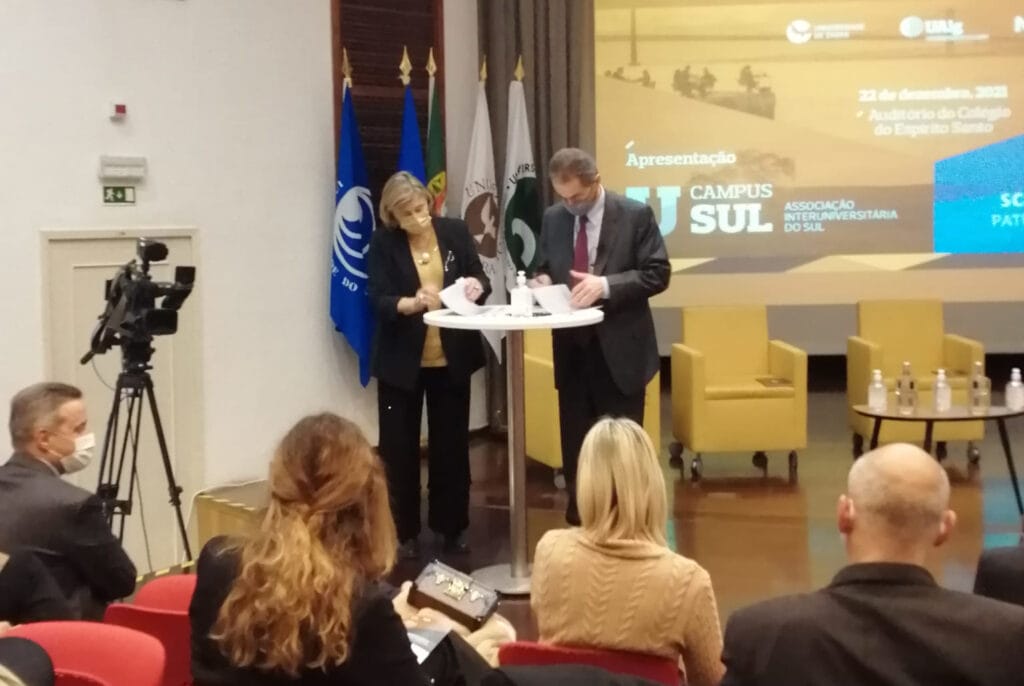
The South Campus - Interuniversity Association of the South was presented was publicly announced on December 22, 2021, in the Auditorium of the Colégio do Espírito Santo at the University of Évora. InPP's executive director was one of the speakers at the afternoon session (Science Day@South). Pedro Fevereiro spoke on the panel “Earth Research and Social Innovation”, with a presentation entitled “Innovative Bio-based Solutions for Crop Protection”.
Read more on the Innovation component of the South Campus and on the priority CAIS, including MASSA.
InnovPlantProtect (InPP) would like to wish the entire team, Associates and partners Happy Holidays by sharing the Christmas Tree set up by CoLAB's newly created sustainability team, InPP Greeners.
The maritime pine (Pinus pinaster) was purchased locally from the Elvas Volunteer Fire Brigade for a symbolic price, helping to raise funds for the organization, which collects the trees for the benefit of the Serra de São Mamede forest.
It is decorated with repurposed laboratory materials, including reused paper ribbons and recycled cardboard balls.
The Elvas Volunteer Fire Brigade is selling the pine trees at a symbolic price of €5 and €10. The maritime pine is widely used in Portugal as a Christmas tree. Plastic, paper and cardboard, among other materials, were reused in the decorations.
InnovPlantProtect is participating in three ideas that applied to the Recovery and Resilience Plan (PRR) measure “Mobilizing Agendas for Business Innovation - Proposals for the Economy of the Future”, which have been selected to move on to phase two of the process: InsectERA, the Blue Bioeconomy Pact and OesteFruta 4.0.
OesteFruta 4.0 is a mobilizing agenda for fruit growing in the West. The aim is to provide the region and the sector with tools that will enable them to face current and future challenges, with a focus on the Rocha pear and the Alcobaça apple. The consortium is led by Atlantic Portuguese Apple - Clube da Maçã and the idea, presented on Friday in Leixões by Armando Torres Paulo, corresponds to a total investment of €97 million.
The public session to present the Mobilizing Agendas took place on December 2nd and 3rd at the Port of Leixões Cruise Terminal. At the day 3 Daniel Murta, CEO of Ingredient Odyssey, and Tiago Pitta e Cunha, representing Inovamar, which is leading the Blue Bioeconomy Pact. This idea, which corresponds to a total investment of €220 million, aims to reindustrialize the blue bioeconomy by creating new economic models based on the use of marine bio-resources, as well as creating the first blue bioeconomy in the world. hub european blue bioeconomy.
The InsectERA agenda, which involves a total investment of €57 million, aims to apply circular economy concepts to the insect industry. The idea is to return by-products from the agro-industry, and some agricultural and urban waste, to the value chain in the form of nutritional solutions for people, animals and plants, as well as new industrial solutions, from cosmetics to bioplastics.
The information is public and can be consulted on the from IAPMEI.





 Português
  English