O InnovPlantProtect (InPP) marcou presença na Assembleia Geral dos 24 meses do projeto europeu VINNY, que decorreu nos dias 23 e 24 de junho em Viena e Klosterneuburg, na Áustria. A instituição foi representada por Cristina Azevedo, diretora da Área de Biosoluções, e por Tiago Amaro, investigador da subárea de Proteção de Plantas.
A reunião reuniu os parceiros do consórcio com o objetivo de avaliar o progresso alcançado ao longo dos primeiros dois anos do projeto, analisar os resultados obtidos e definir as próximas etapas para o desenvolvimento de soluções inovadoras que promovam uma viticultura mais sustentável, resiliente e competitiva.
Durante os primeiros 2 anos de implementação do VINNY, foram alcançados importantes marcos científicos e tecnológicos. Entre os principais destaques encontram-se a validação, em condições controladas, de compostos bioativos derivados da videira e de biofertilizantes de origem biológica, o desenvolvimento de novas tecnologias e metodologias de aplicação e o arranque dos ensaios em condições reais de campo, permitindo avaliar o desempenho das soluções em contexto produtivo.
A participação do InPP nesta Assembleia Geral constituiu também uma oportunidade para reforçar a colaboração com os restantes parceiros europeus, promover a partilha de conhecimento e discutir os desafios técnicos e científicos associados ao desenvolvimento de biosoluções inovadoras para o setor vitivinícola.
O segundo dia do encontro incluiu uma visita técnica às instalações da HBLA und BA für Wein- und Obstbau Klosterneuburg, onde os participantes acompanharam os ensaios em vinha e em estufa atualmente em curso. A visita permitiu conhecer de perto as atividades experimentais desenvolvidas pelos parceiros e promover a troca de experiências relativamente às diferentes abordagens de validação das soluções em ambiente real.
A Assembleia Geral terminou com o alinhamento das atividades previstas para a próxima fase do projeto, reforçando o compromisso do consórcio em acelerar a adoção de práticas agrícolas mais sustentáveis e de biosoluções seguras, eficazes e ambientalmente responsáveis para responder aos desafios atuais e futuros da viticultura europeia.
A participação do InPP neste encontro reflete o seu compromisso contínuo com a investigação, a inovação e a transferência de conhecimento, contribuindo ativamente para o desenvolvimento de biosoluções seguras, eficazes e amigas do ambiente que promovam uma agricultura mais sustentável e resiliente.
O projeto VINNY reúne um consórcio internacional de entidades de investigação, universidades, empresas e organizações do setor agrícola, que trabalham em conjunto no desenvolvimento de estratégias inovadoras para reduzir a dependência de produtos convencionais de proteção das culturas e potenciar a utilização de biosoluções na produção vitivinícola.
O InPP participou na reunião final do projeto Algae Vertical, realizada no Instituto Superior de Agronomia, onde foram apresentados os principais resultados e foi feito um balanço daquela que foi a maior iniciativa dedicada às algas integrada no Pacto da Bioeconomia Azul.
Na qualidade de líder do subprojeto SP6 – Agricultura, o InPP apresentou os principais resultados alcançados no desenvolvimento de soluções inovadoras para o setor agrícola baseadas em biomassa de algas, em colaboração com diversos parceiros do consórcio. A apresentação esteve a cargo de Cristina Azevedo, diretora da área de Biosoluções do InPP.
Cinco soluções inovadoras para a agricultura
Ao longo de quatro anos de trabalho colaborativo, o SP6 – Agricultura permitiu o desenvolvimento de cinco soluções baseadas em algas, destinadas a responder a desafios concretos do setor agrícola:
Dois bioestimulantes
Dois bioprotectores para o controlo de doenças das plantas
Um modulador da microbiota do solo para promoção da saúde do solo
Estas soluções foram concebidas para aplicação em várias culturas agrícolas relevantes para o setor, contribuindo para práticas de produção mais sustentáveis, eficientes e resilientes.
Um marco para o InPP e para o setor das algas
A participação na sessão final do Algae Vertical representa um momento particularmente significativo para o InPP, enquanto entidade líder do SP6 – Agricultura e parceira ativa numa iniciativa que reuniu 37 entidades e mobilizou um investimento de 44 milhões de euros.
O projeto demonstrou o potencial das algas como recurso estratégico para o desenvolvimento de novas biosoluções agrícolas, reforçando a ligação entre investigação, inovação e aplicação industrial.
“Mais do que o encerramento de um projeto, este momento representa um reconhecimento da capacidade de coordenação científica e tecnológica do nosso CoLAB em projetos de grande escala, bem como do nosso compromisso com o desenvolvimento de biosoluções inovadoras para a agricultura.”, sublinha António Saraiva, diretor executivo do InPP.
O diretor executivo assinala ainda o resultado de quatro anos de colaboração intensa entre parceiros científicos e empresariais, que criaram “bases sólidas para futuras oportunidades de valorização das algas na agricultura.”
Portugal reforça posição no setor das algas
O projeto Algae Vertical demonstrou a capacidade nacional para desenvolver tecnologias, processos e aplicações inovadoras em torno das algas, abrangendo áreas como a alimentação humana, aquicultura, agricultura, nutracêuticos e cosmecêuticos, e posicionando Portugal como um dos países com maior capacidade de desenvolvimento tecnológico neste domínio.
O InPP felicita todos os parceiros envolvidos pelo trabalho realizado ao longo destes quatro anos e pelos resultados alcançados, que contribuem para reforçar a competitividade e a sustentabilidade da bioeconomia azul em Portugal.
No passado dia 17 de junho, a Herdade de Rui Vaz, em Avis, recebeu a sessão prática “Tree Talkers: Sensores IoT que permitem compreender a fisiologia das árvores”, uma iniciativa promovida pelo InnovPlantProtect, no âmbito do projeto BioLivingLABs.
A ação reuniu produtores, académicos, técnicos e representantes de diferentes entidades interessados em conhecer uma tecnologia inovadora de monitorização florestal capaz de recolher e transmitir, em tempo real, informação detalhada sobre o estado fisiológico das árvores e as condições ambientais envolventes.
A sessão teve início com um conjunto de apresentações técnicas dedicadas à gestão sustentável do montado e da floresta mediterrânica, ao funcionamento dos sensores Tree Talkers e à interpretação dos dados recolhidos pela tecnologia.
Seguiu-se uma demonstração prática em campo, durante a qual os participantes puderam observar os sensores instalados numa área florestal, compreender os parâmetros monitorizados e visualizar exemplos de resultados obtidos em condições reais.
Os Tree Talkers permitem monitorizar indicadores como o crescimento das árvores, o fluxo de seiva, a disponibilidade hídrica e outras variáveis ambientais relevantes, contribuindo para uma melhor compreensão da resposta das árvores a diferentes fatores de stress e apoiando uma gestão florestal mais informada e sustentável.
A sessão ficou ainda marcada pela participação ativa dos presentes, que colocaram diversas questões sobre as potencialidades da tecnologia e as suas aplicações em contexto florestal.
O InnovPlantProtect agradece a todos os participantes pela sua presença e interesse, bem como à Herdade de Rui Vaz pela disponibilidade para acolher a iniciativa.
Sobre o projeto BioLivingLABs
A ação foi realizada no âmbito do projeto BioLivingLABS: Bioeconomy at the service of the sustainability of inland territories, cofinanciado pelo COMPETE 2030, que visa aproximar a ciência das empresas e dos produtores, transformando os resultados da investigação em soluções práticas e sustentáveis que tragam valor económico e ambiental aos territórios de baixa densidade das regiões Norte, Centro e Alentejo.
O consórcio integra cinco instituições de investigação e inovação – o Instituto Politécnico de Bragança, o Instituto Politécnico de Castelo Branco, o Laboratório Colaborativo Montanhas de Investigação (MORE), o Laboratório Colaborativo InnovPlantProtect e o Centro de Valorização e Transferência de Tecnologia da Água (AquaValor).
Beyond strategy: The secret ingredient of innovation
On the road to success, organizations define strategies, plan every step and invest in crucial resources such as selling services and products, applying for projects, drawing up solid business plans and protecting intellectual property. However, there is an element that is often overlooked, but which is fundamental to the flourishing of innovation: serendipity. But what exactly is this mysterious force and why is it so vital to the advancement of agriculture and so many other areas?
When chance opens doors: The power of unplanned discovery
Serendipity is the art of finding something valuable when you're looking for something else. It's the unintentional discoveries that arise from unexpected situations. Throughout history, some of the most transformative innovations have not been the result of a rigorous plan, but rather a chance encounter with the unknown. While deliberate research and methodical experimentation are pillars of scientific and technological progress, openness to the unexpected proves to be a powerful catalyst. When researchers cultivate this openness, they often stumble upon revelations that have the potential to revolutionize entire industries, transform technologies and expand our understanding of the world around us.
A close look at “error”: The genesis of an innovative biofungicide
Today, we unveil the surprising and inspiring story of Maria Miguel, a talented researcher from InPP's New Biopesticides Department, whose acumen turned a chance event into a priceless discovery: a broad-spectrum biofungicide capable of combating the Botrytis cinerea, the relentless fungus responsible for the devastating gray rot disease in tomato plants. This pathology represents one of the biggest phytosanitary challenges in tomato cultivation, especially when grown in greenhouses, causing significant losses to producers if it is not controlled in good time.
From discard to discovery: The insight of a researcher
The journey of this discovery began in a setting familiar to any researcher: the observation of Petri dishes, used to grow cultures of cells or microorganisms. On Maria Miguel's plates, colonies of the fungus Botrytis cinerea were growing, intentionally introduced there for study. However, something else caught her eye: one of the plates was contaminated by mold, and curiously, a clear area surrounded this intruder. Instead of discarding the plate and dismissing it as mere contamination, Maria Miguel decided to investigate the reason behind the clear area. Her curiosity revealed that the mold had a surprising ability to prevent the growth of Botrytis cinerea in its vicinity.
“Sometimes we look at something and think it's a mistake. The truth is that in a failure there can be something good,” the researcher shares. The excitement and enthusiasm of a researcher realizing that what at first glance seemed like an obstacle, a negative result, could actually be an opportunity, is contagious. For Maria Miguel, this “mistake” turned into a serendipitous discovery with enormous potential.
Maria Miguel, a researcher at InPP's New Biopesticides Department, who turned an unexpected event into a discovery that changed the course of her work: a broad-spectrum biofungicide to combat gray rot in tomato plants.
Beyond chance: The active ingredients of scientific discovery
As the history of this biofungicide shows, the world of science is full of examples of discoveries that came out of the blue. One of the most famous cases is Alexander Fleming's discovery of penicillin in 1928. While observing Petri dishes, Fleming noticed that a mold was producing a substance that eliminated bacteria Staphylococcus aureus around him. He identified the mold as Penicillium notatum and named his revolutionary antibiotic penicillin. Penicillin ended up becoming an extremely important medicine for fighting infections.
However, chance is not the only protagonist of these important revelations. “Sometimes we have to follow our intuition and be able to prove ourselves right or wrong,” explains Maria Miguel. In addition to intuition, a generous dose of curiosity, an open mind to accept unexpected results, solid scientific knowledge and the ability to see and move on to further research into surprising results play a crucial role in the alchemy of discovery.
The discovery ecosystem: Fostering an environment conducive to innovation
There are other ingredients that contribute to the recipe for scientific success:
Creativity: The ability to generate new perspectives, concepts, questions or solutions, and the willingness to explore existing ideas in a new light.
Flexibility: The courage to venture into unknown territory without the fear of failure, thus increasing the chances of serendipitous encounters.
But no discovery flourishes in isolation. At InPP, the strong team spirit and culture of collaboration transcend departmental boundaries. The case of Maria Miguel's discovery is testimony to this synergy, as she herself acknowledges: “My colleagues opened doors so that I could do my research”.
To foster innovation, organizations need to cultivate an environment that encourages open discussions and connects people from different areas of knowledge and life experiences, without judgment; that encourages curiosity and receptiveness to new experiences; and that promotes an incessant quest to improve scientific knowledge, the fertile ground where serendipity can germinate.
Sowing the future: The impact of a discovery and the path of research
Although Maria Miguel is about to embark on a new journey, boosted by a prestigious Marie Skłodowska-Curie PhD scholarship - a program that supports the careers of researchers and promotes excellence and innovation in research - her legacy at InPP is already flourishing. Her groundbreaking discovery is opening promising new doors for future research in the field of crop protection, demonstrating how sometimes it is in the unexpected that the potential to transform our world lies.
In the March issue of Fruits, vegetables and flowers you will find the opinion article entitled “The role of InnovPlantProtect in Organic Farming: Paths to sustainable and efficient solutions”, in which the executive director of InnovPlantProtect (InPP), António Saraiva, reveals how our CoLAB is contributing to the success of organic farming.
“By boosting research, collaboration and knowledge sharing, InPP is helping to solve the central challenges of this practice [organic farming], allowing it to expand and enhancing the supply of agricultural products to consumers. The solutions developed by InPP make organic farming a more viable option for producers,” says the executive director.
Read the full article and find out how we are shaping the future of agriculture.
We thank Frutas, legumes e flores magazine for its recognition and reiterate our commitment to the agriculture of the future.
Imagine a future where drones and artificial intelligence work together to protect your vineyards. That's what the AI4Leafhopper project is making a reality!
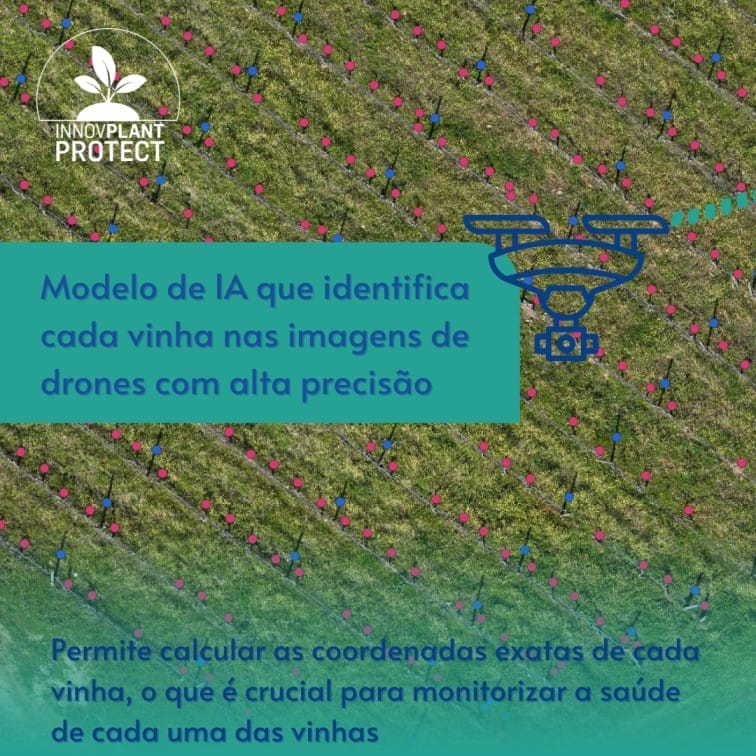
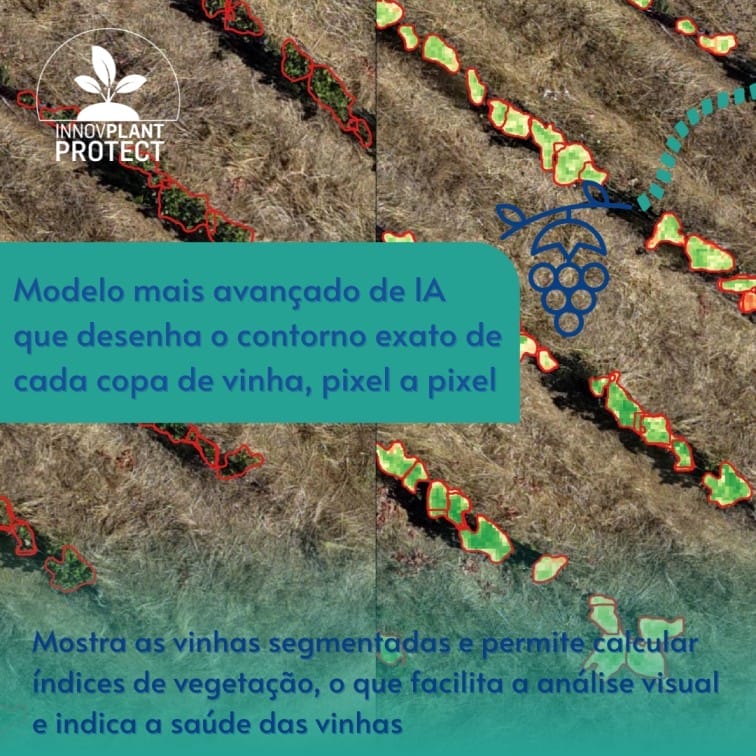
Manisha Sirsat, a researcher on the AI4Leafhopper team, has developed two artificial intelligence models that analyze the aerial images captured by our latest generation drone... and these models make it possible:
geolocation of each vine
to know if there are vine failures
quickly identify “sick” vines”
optimize the application of treatments
The result? Growers can have a detailed view of the health of their vineyards, detect problems early and make more informed decisions.
AI4Leafhopper is a project led by InPP and funded by the ICAERUS Horizon Europe program, which began in April 2024 and ended on April 30 with a final meeting involving the six European projects approved in the 1st edition of the ICAERUS program's PULL applications. The project team presented the AI-based models for detecting and monitoring the impact of the green leafhopper on vineyards.


 Português
 English