News & Events

white plant

NEWS

InnovPlantProtect (InPP) is pleased to announce the publication of an international patent application (PCT) for a strain of Bacillus velezensis with application as a plant biostimulant. This innovation represents a significant milestone in our research, with a direct impact on sustainable agriculture and crop resilience in the face of climate and environmental challenges.

A natural and effective solution

The biostimulant developed by our team has been carefully studied and tested on different vegetable crops, such as tomatoes and lettuce, and on cereals, such as rice. The results obtained demonstrate the potential of this technology:

  • Greater development in the early stages of crops, This promotes more vigorous and healthy starts.
  • Increased productivity, This is evidenced by greater fresh biomass in lettuce and greater fruit production in tomatoes.
  • Proven molecular responses, with analyses confirming the activation of genes associated with plant responses to different types of abiotic stress.

These results reinforce the effectiveness of the Bacillus velezensis as a natural biostimulation tool, capable of boosting crop performance and contributing to more sustainable agriculture.

From the lab to the field

This patent is another step in InPP's commitment to developing innovative, sustainable biotechnological solutions with industrial applicability. The aim is clear: to support farmers and companies in the sector in meeting the challenges of crop productivity, quality and resilience, in an era when agriculture needs sustainable, high-impact responses.

We are looking for strategic partnerships

We are currently looking for new partnerships with companies and entities in the agricultural sector to take this technology from the laboratory to the field. We believe that collaboration is the key to turning scientific innovation into practical solutions that benefit the entire agricultural value chain.

If you're interested in learning more about this technology or exploring opportunities for collaboration, talk to us. Together we can drive a more productive, resilient and sustainable agriculture.

Innovate together. Protect better.

Image credits: InnovPlantProtect - Inês Ferreira (Photos from left to right: Sandra Caeiro and Rui Figueiras, researchers from the Specific Crop Protection Department and Inês Mexia, researcher from the Formulations and Process Development Department.

“We're here to listen to the sector's problems and find solutions together”. This was said by António Saraiva, executive director of InnovPlantProtect (InPP), who attended the eighth edition of the National Olive Oil Congress, held in Campo Maior and featured in the July edition of Voz do Campo magazine.

In the interview, António Saraiva highlighted the importance of olive growing, one of the most representative crops in the Mediterranean, and pointed out some of the major challenges currently facing the sector:

  • A growing shortage of phytosanitary solutions: many tools are disappearing and effective alternatives are not always emerging.
  • The long road between research and application in the field: the process of bringing a scientific solution to farmers can take around 10 years.
  • Impacts of climate change and emerging pests, which make farming even more difficult.

Faced with these challenges, InPP is committed to developing new innovative solutions that are environmentally friendly and sustainable for farmers. CoLAB is looking for agents such as active substances and microorganisms capable of controlling diseases and boosting biostimulants, as well as investing in digital technologies that allow producers to detect crop problems early and increase the effectiveness of interventions.

Another point highlighted by the executive director is the need to speed up the transfer of knowledge to the field, through partnerships and commercial agreements that ensure that innovations actually reach farmers.

“We're here to listen to the sector's problems and find solutions together. We want to be close to farmers, associations and companies, because that's the only way we can develop effective and sustainable tools,” António Saraiva stressed.

The full interview is available in the July issue of Voz do Campo magazine, on newsstands now, and in the image below.

It's called PROSPER and it's a new European project that aims to transform European agriculture through the valorization of “orphan” legumes - resistant crops, little exploited, but with great potential to face the challenges of climate and food in the future.

The consortium, with total funding of around 5 million euros, brings together 27 partners from 13 European countries and Tunisia, including universities, research centers, companies and non-profit organizations in the agricultural sector. Among them are countries from the Mediterranean (Italy, Spain, Greece, Portugal and France), Central Europe (Germany, Belgium, Poland, Bulgaria and Romania), Northern Europe (Denmark, Sweden and Finland).

The aim of PROSPER is to test and validate new agricultural diversification strategies, adapted to different climates and social and economic contexts, promoting more sustainable, innovative practices that are adjusted to the needs of different agricultural realities.

InPP, PROSPER's partner, will be responsible for analyzing:

  • Soil health and environmental impact
  • Energy efficiency and waste management
  • Nutritional quality of crops
  • Fair valuation along the production chain

To do this, the InPP team will use advanced technologies, such as real-time sensors and geospatial analysis, which will help study soil health, carbon sequestration captured by crops, water management and biodiversity, among others.

PROSPER is co-created with the main players in the agricultural sector, ensuring that the solutions developed do not remain on paper: they will be practical, useful and transformative.

The project starts in September 2025. We are ready to embark on this journey towards a greener, fairer and more resilient agriculture.

Stay tuned for more news!

EVENTS

Casa da História Judaica da Rainha da Fronteira wins a government award for actions and initiatives by local authorities to “save, protect and dignify human lives in Portugal in the face of contemporary threats and atrocities”.

A Elvas City Council won the first municipal award “Aristides de Sousa Mendes and other Portuguese saviors - Holocaust, universal values, humanism and justice”, in the category “Arts, Heritage and other Cultural Domains”, with the application of the House of Jewish History.

The honorary distinction, which is national in scope, was launched by the government in 2021. Among other things, it “aims to distinguish practices, programs, projects, symbols and material and immaterial works, which, inspired by memories and teachings arising from the Holocaust, and/or developed around universal values of humanism and justice, are factors of identification, aggregation and recognition by the respective communities, and valorization by differentiation, of localities and territories”.

The House of Jewish History is located at Rua dos Açougues, nº 4-6, in Elvas, and is open from Tuesday to Sunday, from 10am to 6pm.

In addition to the diploma that will be presented to the Municipality of Elvas by the Directorate-General for Local Authorities, The government undertakes to publicize the winning project.

Elvas City Council is a founding member of CoLAB InnovPlantProtect, which is based in the city.

Image: Elvas City Council

InnovPlantProtect and the Municipality of Sabugal install sensors in the municipality's chestnut groves and launch an educational program to value the chestnut tree as a local natural capital.

The trees will communicate their state of health thanks to TreeTalker sensors. The project “Educate to know, protect and monitor chestnut trees through IoT technology”, which has been approved by the Environmental Fund, is led by InnovPlantProtect (InPP) and managed by the Sabugal Municipal Council (CMS).

The initiative is aimed at the sustainable management of chestnut trees, the enhancement of ecosystem services and protection against diseases, particularly ink disease, for which there is still no concrete solution. The project includes training courses for those currently and potentially responsible for the sustainable management and protection of chestnut trees: CMS and chestnut producers associated with CastCoa - Associação de Produtores de Castanha do Coa; and secondary school students from the Sabugal School Group.

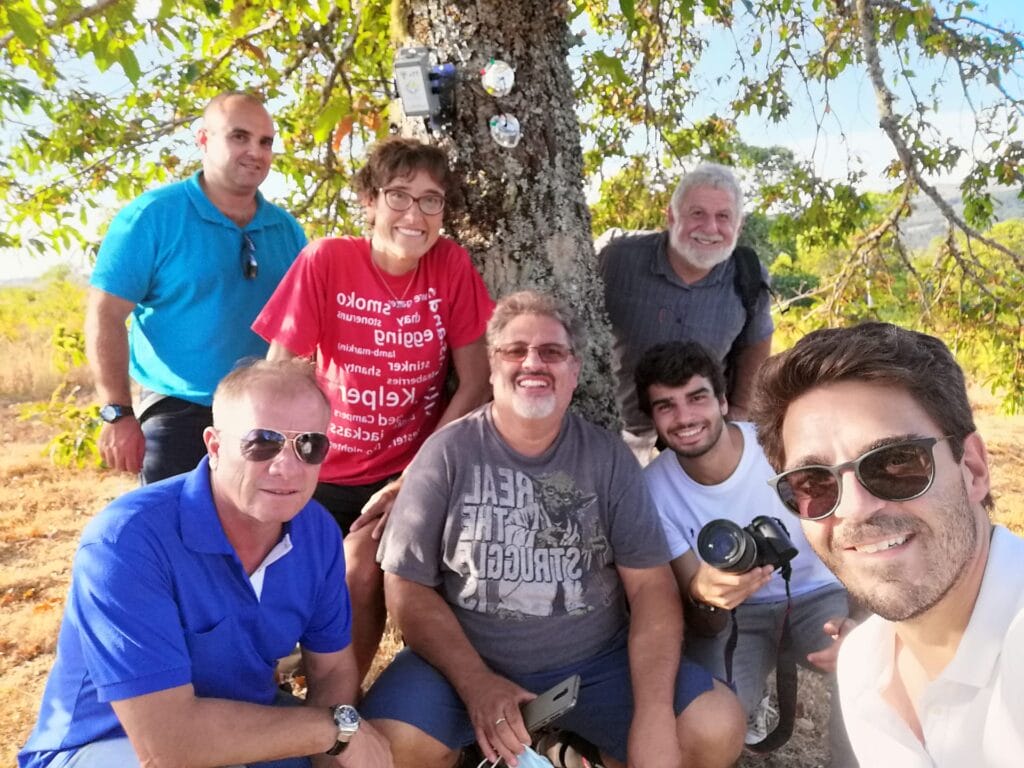
The CMS and InPP team in Sabugal at the beginning of September 2021.

The novelty of the educational program, however, is that digital 4.0 technology, based on the “Internet of Things” (IoT), is being applied to support and add value to traditional teaching methods. The TreeTalker sensors, installed around the trunk, allow the phytosanitary conditions of the trees to be monitored in real time, detecting water consumption (through sap flow), biomass growth (diameter), stem humidity, absorbed solar radiation and the state of health of the leaves through spectral indices (light reflection).

Sabugal City Council has just publicize the project. Don't miss the newly released video, which highlights the importance of the chestnut tree to the livelihoods of local communities and the value of the souto ecosystem, and shows the team at work in the field. It's also a unique opportunity to see InPP researchers in action Manuel Simões, Márcio Almeida e Ilaria Marengo, director of Pest and Disease Monitoring and Diagnosis Department, and coordinator of this project.

Pedro Fevereiro in podcast version, as part of a partnership between CiB - Centro de Informação de Biotecnologia and TSF radio. In total, 5 Notes on Gene Editing were produced.

The executive director of InnovPlantProtect answers the question “Can gene editing increase agricultural production?” in this podcast, produced as part of a CiB / TSF partnership. The initiative resulted in 5 Notes on Gene Editing in food production and health. The recordings were broadcast by TSF during the week of October 4 to 8, 2021.

The challenge for 2050 is how to feed 10 million people without destroying the planet. This requires changes in food production. Pedro Fevereiro explains how gene editing can help in this process.

Listen too the other four podcasts, which feature:

Jorge Canhoto, researcher, head of the Plant Biotechnology Laboratory of the Functional Ecology Center of the University of Coimbra and president of CiB - Biotechnology Information Center

Margarida Oliveira, who leads the Plant Functional Genomics research group of the GPlantS - Plant Genomics under Stress unit at the Institute of Chemical and Biological Technology (ITQB NOVA).

Ana Sofia Coroadinha, professor at ITQB NOVA

Filipe Castro, researcher at the Interdisciplinary Center for Marine and Environmental Research, and professor at the Faculty of Sciences of the University of Porto 

Feature image: CiB