News & Events

white plant

NEWS

There are days when science begins long before you enter the laboratory or the field. It starts at dawn, when the alarm clock goes off too early. When you mentally review the day's list: an experiment that can't be missed, a trip to the field that depends on the weather, an unfinished report, a meeting scheduled at the wrong time. In between, someone to wake up, someone to drop off, someone to call. And yet science moves forward.

At InnovPlantProtect, there are now 15 women who give a face to the science and innovation developed here. Women who represent commitment, demand, resilience, overcoming, quality, talent, excellence and creativity. But they are only part of a greater whole. There are many more - and each one brings with it a story that doesn't fit into a CV, a patent application or an article.

Today, February 11th, marks the International Day of Women and Girls in Science, a UNESCO initiative that underlines the importance of the female role in the production of scientific and technological knowledge and the need to continue promoting equal access to careers in science and innovation. Portugal has encouraging figures: women represent almost 50% researchers in the country. It's a relevant figure, reflecting decades of progress. But the figures don't show what happens between them.

Because science, for many women, is made up of fragile balances.

There are women with intense family lives, others with more solitary journeys, still others who build support networks outside traditional models, with effort and creativity. There are difficult choices and decisions, unexpected circumstances, forced breaks, changes of pace, different phases of life. All legitimate. Many are invisible when you only look at the end result of a project, an article or a biosolution developed. - but they all influence the paths of science.

One day, one of our researchers - let's just call her that - told us that she had finished a field trial close to sunset. The phone rang while she was putting away her materials. It was the school. A delay. Nothing extraordinary. It was business as usual. She came home exhausted, with dirt still on her boots, opened her computer after dinner and went back to her data, because the experiment couldn't wait.
“It wasn't a heroic day,” she said. “It was just a normal day.”

And perhaps that is what is most remarkable.

In the field of crop protection, the work is demanding, technical and often unpredictable. It takes place in the laboratory and in the field, between strict protocols and decisions made under real conditions. It requires persistence, adaptability, attention to detail and an integrated view of problems. Characteristics that so many women bring with them - not by nature, but by experience, by path, by everything they have learned to manage at the same time.

Each personal story profoundly shapes the way we do science. The doubts, the challenges, the forced breaks, the changes of pace, the new beginnings. None of this is left at the laboratory door. It all silently enters into the way we observe, question and build knowledge.

To celebrate the International Day of Women and Girls in Science is to recognise this reality as a whole. It is to honour the women who continue to do science despite the challenges — and often because of them. And it is to remember that innovation is also born from lives fully lived, shaped by imperfection, effort and courage.

Today we celebrate them. Not just for what they produce, but for all that they are. In science, in the field, in the laboratory - and in the life that happens in between.

O InnovPlantProtect (InPP), Collaborative Laboratory specializing in biological and digital solutions for crop protection, aligned with the emerging challenges of agriculture, will launch its new institutional website on January 24th, on a symbolic date marking 7 years working in the agricultural sector.

This launch is part of a phase of institutional evolution and consolidation InPP, reinforcing its strategy of proximity to the sector, clarity in the communication of its competencies and affirmation as a strategic partner for companies, producers, associations and public bodies.

An even clearer, more up-to-date and sector-oriented platform

With a renewed structure and a more intuitive browsing experience, the new website features:

  • an area of Services and Products completely reorganized, which facilitates access to specialized services, laboratory capabilities and biological and digital solutions developed by InPP, as well as to a updated catalog of services and biosolutions;
  • more complete institutional content that reinforces transparency, scientific rigor and CoLAB's mission;
  • a clearer presentation of scientific skills and research areas, highlighting the impact of the work carried out by InPP's multidisciplinary teams.

New image, same mission - but reinforced

The launch of the website is accompanied by the implementation of InnovPlantProtect's new visual identity, This reflects the maturity of CoLAB and its future ambitions.

The new image - accompanied by the slogan “Innovate together. Protect better.” - reflects InPP's ongoing commitment to:

  • Developing new generation biological and digital solutions;
  • Promoting safer, more innovative and more productive agriculture;
  • Strengthen collaboration and partnership with the agricultural sector and the innovation ecosystem.

A new phase for InPP

The digital and visual renovation is part of a broader strategy of maturity and consolidation, Through this initiative, InPP aims to strengthen its role as a scientific and technological partner for the agricultural sector in applied research and the development of crop protection solutions.

According to António Saraiva, InPP's executive director: “This new website isn't just a digital revamp - it's a reflection of the ambition we have for our future and how we want to communicate with the sector. We want every visitor to understand the purpose that drives us: to create innovative solutions that protect crops, boost productivity and contribute to more sustainable agricultural systems. InPP is entering a new phase, with a clearer, more accessible identity aligned with the real needs of agriculture and a renewed commitment to real impact on the ground.”

Available from January 24th

The new InnovPlantProtect website will be available from January 24th at: https://iplantprotect.pt/

The start of a new year also marks a new cycle for InnovPlantProtect. In 2026, InPP enters a phase of evolution and consolidation, with several new features that reinforce its position as a strategic partner for the intelligent transformation of agriculture.

Over the next few months, initiatives, content and tools will be presented that reflect the work carried out by our teams in the areas of applied research, biological solutions, specialized services and digital innovation.

The first step in this new phase will be presented in the next January 24th, InnovPlantProtect is celebrating the date 7 years in business at the service of the agricultural sector.

Until then, we continue to prepare a range of new products that reflect our mission to promote safer, more innovative and more productive agriculture.

Stay tuned. What's coming is just the beginning.

EVENTS

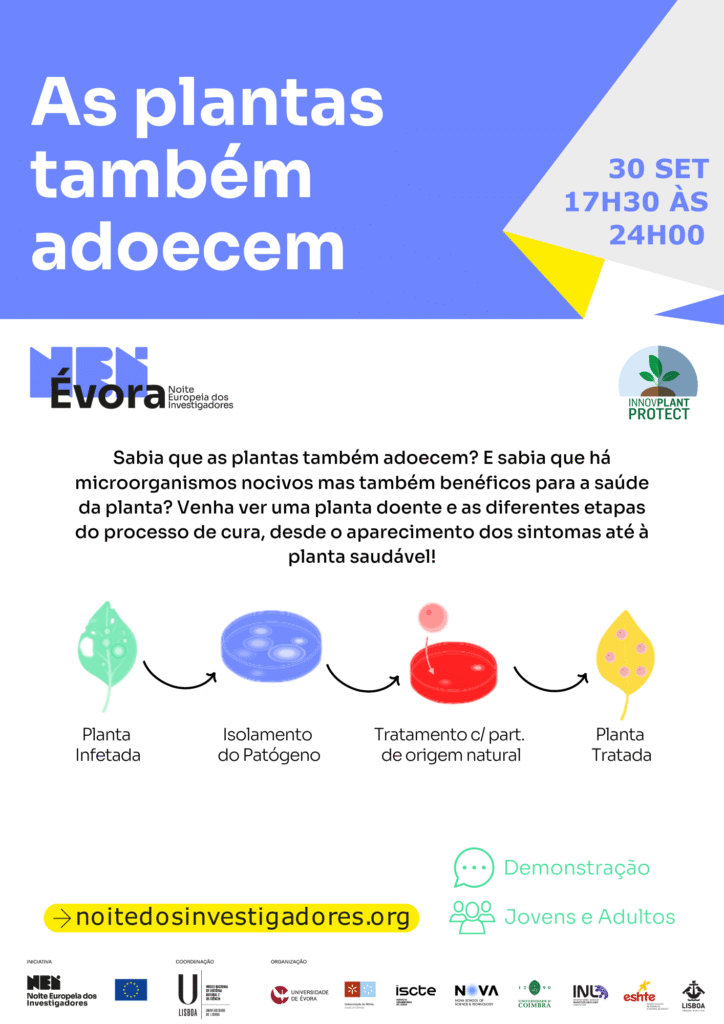
Será que os insetos também têm ciclo de vida? Já conhece o ciclo de vida da traça da colmeia? Ou sabia que as plantas também adoecem ou que existem microrganismos nocivos mas também benéficos para a saúde das plantas? Venha descobrir as respostas a todas estas questões já na próxima sexta-feira, dia 30 de setembro, na Noite Europeia dos Investigadores (NEI) 2022. Entre as 17h30 e as 00h, os investigadores e investigadoras do InPP vão marcar presença na Praça do Giraldo, em Évora.

O InPP estará no stand EU-Corner 4 e este será o ponto de encontro entre os investigadores e todos aqueles que querem descobrir a ciência que é desenvolvida no nosso laboratório colaborativo. Nesta noite vai poder participar em duas atividades científicas: na primeira vai poder descobrir o incrível ciclo de vida da traça da colmeia e na segunda vai poder ver uma planta doente e todo o processo de cura.

Entre jogos, debates, demonstrações, conversas, workshops, visitas, exposições e tertúlias, são muitas as atividades de diversas instituições científicas para explorar nesta festa da ciência.

A participação é gratuita.

Junte a família e venha ter connosco a esta festa da Ciência! Contamos com a sua visita!

Consulte a programação completa de atividades presenciais de Évora here.

A NEI ocorre todos os anos e tem o objetivo de partilhar o trabalho dos investigadores com o público em geral. O tema para o ano de 2022 é “Ciência para Todos – Sustentabilidade e Inclusão”.

Um artigo publicado recentemente pela equipa do InnovPlantProtect (InPP) revela o potencial dos métodos computacionais de machine learning para prever características fenotípicas, como é o caso do rendimento/produtividade do trigo, a partir de informações genéticas desta planta.

O machine learning (ML) é uma área da ciência de dados que tem ganho cada vez mais relevância na última década. O ML é um ramo da inteligência artificial que permite o desenvolvimento de modelos de previsão que podem ser aplicados nas mais variadas áreas. Apesar de não nos apercebermos, utilizamos ferramentas baseadas em ML no nosso dia-a-dia, como por exemplo, os resultados personalizados apresentados no feed do seu Facebook. Mas as aplicações futuras vão desde permitir a condução autonoma até à deteção de doenças através da análise de radiografias (em humanos) ou imagens de drone (em pomares).

A predição genómica (PG) é outra das áreas em que o ML tem estado a ser aplicado. Esta consiste em usar dados genómicos (que nos dão informação acerca do genótipo) para desenvolver modelos computacionais que prevêem características fenotípicas complexas dos organismos, tal como rendimento/produtividade do trigo (Ver representação esquemática).

Nesta investigação agora publicada na revista científica Agriculture, os investigadores Manisha Sirsat e Ricardo Ramiro, ambos do departamento de Gestão de Dados e Análise de Risco, em colaboração com a Paula Oblessuc do departamento de Proteção de Culturas Específicas, exploraram a utilização de vários modelos de PG baseados em diferentes métodos computacionais para além do ML, como é o caso dos métodos estatísticos ou de deep learning (DL), com o objetivo de comparar a robustez e a performance de cada um deles em prever a característica fenotípica rendimento/produtividade do trigo. A ideia foi perceber quais os métodos que permitem prever características fenotípicas com maior fiabilidade.

“Os métodos estatísticos têm sido os mais utilizados em predição genómica pelas equipas de investigação em todo o mundo. Contudo, os métodos de ML estão a revelar-se uma boa alternativa, sendo mais precisos e rápidos”, evidencia Manisha Sirsat, primeira autora do estudo.

“A PG baseada em ML pode ajudar a reduzir o tempo e o custo da avaliação extensiva do processo de fenotipagem (durante os programas de melhoramento) e a acelerar o ganho genético”, explica a investigadora. “Este estudo contribui assim para ajudar os investigadores a perceber os fatores chave no desenvolvimento de modelos que possam acelerar os programas de melhoramento do trigo, ou de outras culturas, e a aumentar a produtividade agrícola”, acrescenta.

Representação esquemática do processo de predição genómica

A equipa tem estado a trabalhar em predição genómica desde 2020, e espera que a genómica e a predição genética sejam fundamentais para permitir manter ou aumentar a produtividade das culturas, apesar das múltiplas ameaças que enfrentamos, e para responder ao aumento de 50% na procura por alimentos até 2050, quando a população mundial atingir 9,7 mil milhões.

O estudo foi cofinanciado por fundos europeus, através do Programa Alentejo2020, e pela Foundation for Science and Technology.

Investigadores Manisha Sirsat, Ricardo Ramiro e Paula Oblessuc (da esquerda para a direita)

Original article

Revista Agriculture

Genomic Prediction of Wheat Grain Yield Using Machine Learning

Manisha Sirsat e Ricardo Ramiro

DOI: https://doi.org/10.3390/agriculture12091406

No passado dia 31 de Agosto, a diretora de departamento Cristina Azevedo esteve no Dia Aberto do Arroz – “A cultura do arroz no Baixo Mondego”, organizado pelo Pólo de Inovação de Coimbra da Direção Regional de Agricultura e Pescas do Centro (DRAPCentro), e que teve lugar no Campo do Bico da Barca, em Montemor-o-Velho. A iniciativa pretendeu dar a conhecer o que de mais inovador se tem feito ao nível da cultura deste cereal. 

Durante o Dia Aberto, que contou com a colaboração de várias entidades e empresas ligadas ao setor da cultura do arroz, os participantes visitaram ensaios e campos de arroz, ficaram a conhecer um ensaio de novas variedades deste cereal, que está a avaliar o comportamento agronómico das cultivares e a determinar o seu rendimento industrial, e um novo fertilizante – CHAMAE – desenvolvido pela Lusosem, Syngenta, Bayer CropScience e DRAP Centro, que está a ser testado para esta cultura.

Os visitantes tiveram ainda a oportunidade de experienciar o incrível trabalho que tem sido realizado pelo INIAV, IP na conservação e melhoramento desta cultura, bem como um sistema em modo de produção biológico, no qual a Lusosem e a Associação de Beneficiários da Obra de Fomento Hidroagrícola do Baixo Mondego (Abofhbm) estão a testar novas tecnologias inovadoras e sustentáveis de sementeira e controlo de infestantes.

No âmbito da cultura do arroz, o departamento de Novos Biopesticidas, liderado por Cristina Azevedo, tem estado a trabalhar no desenvolvimento de biopesticidas para o controlo da piriculariose, uma das doenças que mais afeta este cereal, e, no passado mês de Agosto já recolheu duas amostras de arroz infetado na bacia do Mondego (em Montemor-o-Velho) e do Tejo/Sorraia (em Coruche e Porto Alto, em Samora Correia). A equipa planeia amostrar ainda este ano na zona do Sado.