News & Events

white plant

NEWS

AlViGen project strengthens genomic surveillance of agricultural diseases in Alentejo

The final workshop highlighted three years of research dedicated to the early detection of pathogens in crops such as wheat and olive groves.

The project AlViGen has reached its final stretch, concluding three years of research focused on the genomic surveillance of agricultural diseases. The results now presented promise to strengthen the Alentejo agricultural sector's ability to respond to emerging phytosanitary threats.

On the day October 23rd, The final project workshop, The event brought together researchers, producers and technicians to share results and reflect on the future of genomic surveillance in Portuguese agriculture.

A pioneering genomic surveillance center

During AlViGen, the Alentejo's first genomic surveillance center, an infrastructure with capacity for early detection of diseases in strategic crops such as wheat and olive grove. This breakthrough marks a decisive step towards a more precise, sustainable and science-based agriculture.

Results and scientific contributions

Using innovative molecular tools, the project team succeeded:

  • Identify pathogenic fungi before visible symptoms appear on the plants;
  • Characterizing yellow rust strains, genetically linking them to others known at a global level;
  • Detecting resistance genes in wheat to the strains currently present in Portugal;
  • Developing diagnostic methods able to distinguish the different species of the fungus that causes gafa in olive groves.

During the workshop, the potential of the analysis of the airborne fungi community as a tool for early warning for multiple pathogens, allowing for more effective and preventive management of crop diseases.

From research to practical application

The event ended with a debate on how transform AlViGen results in a detection and warning service accessible to the agricultural sector. The initiative reflects the joint commitment between science, innovation and production, with a view to protecting national agriculture from the challenges of the future.

Partnerships and thanks

InnovPlantProtect would like to thank all the partners and funders of the project:
University of Évora, John Innes Centre, INIAV, De Prado, CERSUL, Eugénio de Almeida Foundation, Torre das Figueiras Estate, Almojanda, Malheiro Estate, Directorate-General for Food and Veterinary (DGAV), la Caixa“ Foundation”, BPI Bank e Foundation for Science and Technology (FCT).

Image credits: InnovPlantProtect - Inês Ferreira

InPP was in Italy for the kick-off meeting of the European PROSPER project

InPP took part in the kick-off meeting for the European PROSPER project, held on October 2 and 3 in Pavia, Italy. In attendance were the director of the Monitoring and Diagnostics Department, Ilaria Marengo, and the project manager, Bruno Orrico.

PROSPER's main objective is to transform European agriculture by valorizing highly resilient “orphan” legumes - forgotten crops, but full of potential to face the climate and food challenges of the future.

The project promotes sustainable, innovative practices adapted to different agricultural realities.

Over the two days, 27 partners from 13 countries met for presentations, in-depth discussions and strategic talks about the project's next steps.

We are excited about what comes next, certain that this journey will be more than a collaboration - it will be a true cooperation within an exceptional team.

Join us and keep up to date with all the news from the PROSPER Project!

InPP is part of the BioLivingLABS project, dedicated to the sustainability of inland territories

InnovPlantProtect (InPP) was present at the project launch meeting BioLivingLABS - Bioeconomia ao Serviço da Sustentabilidade dos Territórios do Interior (Bioeconomy at the Service of the Sustainability of Inland Territories), which took place on October 1st at the School of Agriculture of the Polytechnic Institute of Castelo Branco (IPCB).

Funded by COMPETE 2023, the BioLivingLABS project, led by MORE CoLAB - Laboratório Colaborativo Montanhas de Investigação, in partnership with the InPP, the IPCB, from AQUAVALOR and the Polytechnic Institute of Bragança (IPB).

This project's mission is to add value to the low-density territories in the north, center and south of the country by demonstrating and economically boosting the work carried out by the partners - through the creation, demonstration and application of products, processes and services resulting from joint research.

Four living laboratories will be created (Living Labs) in the innovation hubs of Mirandela, Douro, Covilhã and Elvas, which they intend to promote:

  • the transfer of knowledge;
  • technology demonstration;
  • strategic roadmapping and
  • the protection of intellectual property.

BioLivingLABS strengthens the link between academia, business and society, driving innovation and sustainability.

Expected impact:
Over the course of 24 months, and with Living Labs dedicated to sectors such as olive groves and olive oil, vineyards and wine, fruit and cereals, legumes, among others, the project will contribute to:

  • increase regional competitiveness;
  • promote sustainable practices and
  • responding to the environmental, social and economic challenges facing inland territories.

More news about this new project soon.

EVENTS

Aristides de Sousa Mendes Municipal Award for Elvas

Casa da História Judaica da Rainha da Fronteira wins a government award for actions and initiatives by local authorities to “save, protect and dignify human lives in Portugal in the face of contemporary threats and atrocities”.

A Elvas City Council won the first municipal award “Aristides de Sousa Mendes and other Portuguese saviors - Holocaust, universal values, humanism and justice”, in the category “Arts, Heritage and other Cultural Domains”, with the application of the House of Jewish History.

The honorary distinction, which is national in scope, was launched by the government in 2021. Among other things, it “aims to distinguish practices, programs, projects, symbols and material and immaterial works, which, inspired by memories and teachings arising from the Holocaust, and/or developed around universal values of humanism and justice, are factors of identification, aggregation and recognition by the respective communities, and valorization by differentiation, of localities and territories”.

The House of Jewish History is located at Rua dos Açougues, nº 4-6, in Elvas, and is open from Tuesday to Sunday, from 10am to 6pm.

In addition to the diploma that will be presented to the Municipality of Elvas by the Directorate-General for Local Authorities, The government undertakes to publicize the winning project.

Elvas City Council is a founding member of CoLAB InnovPlantProtect, which is based in the city.

Image: Elvas City Council

Chestnut trees speak in Sabugal

InnovPlantProtect and the Municipality of Sabugal install sensors in the municipality's chestnut groves and launch an educational program to value the chestnut tree as a local natural capital.

The trees will communicate their state of health thanks to TreeTalker sensors. The project “Educate to know, protect and monitor chestnut trees through IoT technology”, which has been approved by the Environmental Fund, is led by InnovPlantProtect (InPP) and managed by the Sabugal Municipal Council (CMS).

The initiative is aimed at the sustainable management of chestnut trees, the enhancement of ecosystem services and protection against diseases, particularly ink disease, for which there is still no concrete solution. The project includes training courses for those currently and potentially responsible for the sustainable management and protection of chestnut trees: CMS and chestnut producers associated with CastCoa - Associação de Produtores de Castanha do Coa; and secondary school students from the Sabugal School Group.

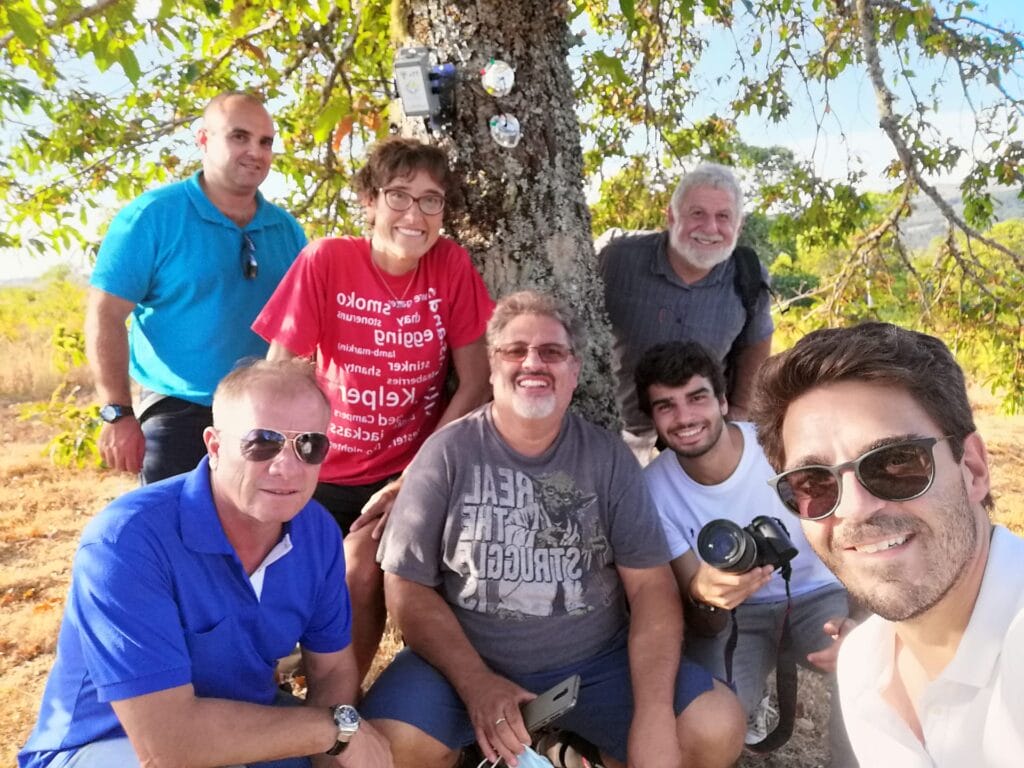
The CMS and InPP team in Sabugal at the beginning of September 2021.

The novelty of the educational program, however, is that digital 4.0 technology, based on the “Internet of Things” (IoT), is being applied to support and add value to traditional teaching methods. The TreeTalker sensors, installed around the trunk, allow the phytosanitary conditions of the trees to be monitored in real time, detecting water consumption (through sap flow), biomass growth (diameter), stem humidity, absorbed solar radiation and the state of health of the leaves through spectral indices (light reflection).

Sabugal City Council has just publicize the project. Don't miss the newly released video, which highlights the importance of the chestnut tree to the livelihoods of local communities and the value of the souto ecosystem, and shows the team at work in the field. It's also a unique opportunity to see InPP researchers in action Manuel Simões, Márcio Almeida e Ilaria Marengo, director of Pest and Disease Monitoring and Diagnosis Department, and coordinator of this project.

Can gene editing increase agricultural production?

Pedro Fevereiro in podcast version, as part of a partnership between CiB - Centro de Informação de Biotecnologia and TSF radio. In total, 5 Notes on Gene Editing were produced.

The executive director of InnovPlantProtect answers the question “Can gene editing increase agricultural production?” in this podcast, produced as part of a CiB / TSF partnership. The initiative resulted in 5 Notes on Gene Editing in food production and health. The recordings were broadcast by TSF during the week of October 4 to 8, 2021.

The challenge for 2050 is how to feed 10 million people without destroying the planet. This requires changes in food production. Pedro Fevereiro explains how gene editing can help in this process.

Listen too the other four podcasts, which feature:

Jorge Canhoto, researcher, head of the Plant Biotechnology Laboratory of the Functional Ecology Center of the University of Coimbra and president of CiB - Biotechnology Information Center

Margarida Oliveira, who leads the Plant Functional Genomics research group of the GPlantS - Plant Genomics under Stress unit at the Institute of Chemical and Biological Technology (ITQB NOVA).

Ana Sofia Coroadinha, professor at ITQB NOVA

Filipe Castro, researcher at the Interdisciplinary Center for Marine and Environmental Research, and professor at the Faculty of Sciences of the University of Porto 

Feature image: CiB