InnovPlantProtect (InPP) recently received approval for an application submitted to COMPETE2030-2024-6 - Collective Actions - Transfer of scientific and technological knowledge - BioLivingLABS - Bioeconomy at the service of the sustainability of inland territories, led by MORE CoLAB - Laboratório Colaborativo Montanhas de Investigação, Associação, in partnership with the Polytechnic Institute of Bragança (IPB), the Polytechnic Institute of Castelo Branco (IPCB) and AQUAVALOR.
BioLivingLABS aims to promote the economic valorization of research and development (R&D) results obtained by various institutions in the North, Center and Alentejo. To this end, it will create an experimental demonstration network, the so-called Living Labs, The project will be held in the innovation hubs of Mirandela, Douro, Covilhã and Elvas. In addition, demonstration actions, workshops, an inland innovation catalog and training on intellectual property protection will be developed with the aim of encouraging the incorporation of innovative solutions in the business sectors of these regions.
Scheduled to begin in October and lasting 24 months, the project has a total eligible investment of over 740,000 euros, financed by COMPETE2030 - Thematic Program for Innovation and Digital Transition. For InPP, this project is a strategic opportunity to strengthen its mission as a center for technology development and transfer, boosting the practical application of scientific knowledge to promote sustainable development.
This initiative confirms InPP's commitment to open and sustainable innovation, integrating science, technology and regional development to respond to the challenges and potential of the interior of the country.
On September 18, the executive director of InnovPlantProtect (InPP), António Saraiva, the director of the New Biopesticides Department, Cristina Azevedo, and researcher Luís Grilo attended the Open Day “The Cereals of Baixo Mondego”, promoted by the Centro Regional Coordination and Development Commission (CCDR Centro), at the Bico da Barca Experimental Unit in Montemor-o-Velho.
The event highlighted the latest innovations from the Coimbra Innovation Hub, from new technologies applied to maize and rice, to fertilization strategies, protection and the use of biostimulants on these key crops in the Baixo Mondego region.
Our team also monitored trials with biofungicides, including the product I21, developed with our collaborative laboratory to combat pyriculariosis in two rice varieties, which is being patented.
In an interview with Voice of the Countryside, Cristina Azevedo shared the work we have been doing in the area of biosolutions.
Maize continues to be the Portugal's most important arable crop, The sector has a significant impact on food safety and the national agri-food industry. Involving thousands of producers and generating tens of millions of euros a year, the sector is currently facing increasingly complex phytosanitary challenges.
Among already known pests and emerging diseases, there are risks ranging from cartridge caterpillar until Maize Rugose Dwarfism Virus (MRDV), The presence of this virus is increasing in Portugal. This virus, transmitted by the corn leafhopper, can seriously compromise production and is found in the climate change increasingly favorable conditions for its spread.
However, it's not just MRDV that's worrying. There are new threats that require vigilance, such as the coleopter Diabrotica virgifera or the MDMV virus (Maize Dwarf Mosaic Virus), already detected in neighboring countries, and also toxic weeds, such as the winter fig (Datura stramonium), which in addition to impacting productivity pose public health risks.
Faced with this reality, the answer is integrated and sustainable strategies, matching:
crop rotation and good agricultural practices;
careful use of insecticides to avoid resistance and environmental impacts;
resistant or tolerant varieties, where available;
research and technological innovation, including new digital tools for early detection.
As the InnovPlantProtect researcher points out, Nuno Faria, in the article entitled “The main emerging pests and diseases of the maize crop in Portugal”, available in the August edition of Voz do Campo magazine: “The phytosanitary panorama of maize in Portugal requires continuous vigilance, investment in research and the application of integrated and sustainable strategies capable of responding to an increasingly dynamic and unpredictable reality.”
To find out more about the main current risks and mitigation measures, read the full article published in the August issue of Voz do Campo magazine (pages 88-89), available on newsstands and online.
On August 7th, InPP had the pleasure of welcoming.., Carmina Falcato Cabral, Team Manager for Animal & Plant Biosolutions Formulation in Novonesis, for an in-depth technical session on the science and evolution that drive the development of innovative and effective biosolutions for crop protection.
Presentation Highlights
In her speech, Carmina Falcato Cabral highlighted the critical importance of innovation throughout the process of developing biosolutions:
Innovation in Pipelines: The role of innovation in pipelines formulation, which are essential to guarantee the stability, efficacy and usability of the final products.
Advances in Development Processes: The expert shared insights on the progress of product development processes that use microorganisms as a base, a rapidly expanding area of great relevance for sustainable agriculture.
Impact on CoLAB
The session was a unique opportunity for the InPP team, especially for our CoLAB, to improve knowledge, discuss trends and look for new application strategies in the day-to-day work of research and development.
It was a productive session, enriched by new perspectives and technical knowledge, reaffirming our commitment to the continuous pursuit of impactful solutions that meet the needs of the agricultural sector.
Thank you
InPP warmly thanks Carmina Falcato Cabral for the visit and for providing such a valuable and inspiring exchange of experiences in the field of biosolutions.
On June 30th, InnovPlantProtect (InPP) was present at the meeting “7 years of CoLABs: impacts and prospects”,The event brought together political decision-makers, experts from the Portuguese innovation ecosystem, leaders from different sectors, representatives from public and private entities and the representatives of the 41 Collaborative Laboratories (CoLAB), at the Pavilion of Knowledge in Lisbon.
The meeting, organized by the Forum of Collaborative Laboratories (FCoLAB), aimed to reflect on the impact of the work carried out by the different CoLABs over the last 7 years, It also addresses future prospects and identifies strategies to boost the contribution of scientific research and innovation to the economy and society.
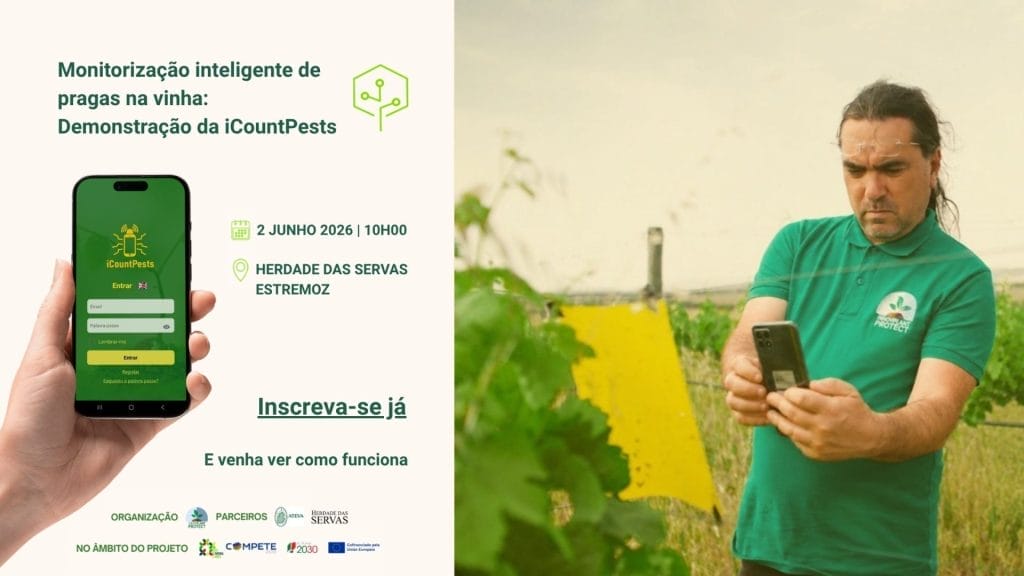
This initiative was an opportunity to showcase the products, services and solutions developed by CoLAB over the last seven years, highlighting its contribution to innovation, competitiveness and sustainability in various sectors of the economy. The application recently launched by InPP, iCountPests, which allows pests to be counted automatically using images from traps, reducing the time invested in monitoring and making it possible to create a pest history, was also highlighted.
The event featured speeches by Minister of Education, Science and Innovation, Fernando Alexandre, from Secretary of State for the Economy, João Rui Ferreira, from Manuel Heitor, from the IN+ Center for Innovation, Technology and Policy Research e former Minister of Science and Innovation, António Grilo, President of ANI, among others.
In his speech, the Minister for Education, Science and Innovation, Fernando Alexandre, highlighted the purpose of science at national level: “We hope that the science created in Portugal will generate innovation. More than technology, innovation is the answer to society's problems. You are the agents of change!”.
During the session, the main activity indicators and proven impact of the first seven years of CoLABs' activity were also presented, and multisectoral perspectives on their role in the national science and innovation ecosystem were debated, focusing on topics such as socio-economic impact, internationalization, business competitiveness, technological innovation and sustainability.
The activity indicators and the impact of the 7 years of activity are as follows:
More than 260 projects approved
More than 1,300 qualified jobs created
19M€ in tax revenue generated
More than 900 interactions with companies
33 patent applications (10 granted)
680 scientific articles published
The two afternoon panels were attended by companies, partners and management entities, who reflected on the impact generated so far and presented proposals for maximizing CoLAB's long-term contribution to both the economy and Portuguese society.
At a time when the basic funding options for CoLABs are being discussed, this event is of the utmost importance. The area of crop protection, in particular, needs more investment in innovation. Holding this event was important for bringing this urgent and strategically important issue to the debate.
The InPP was also present in the exhibition area, receiving important visitors, including the Minister of Education, Science and Innovation, Fernando Alexandre, the Secretary of State for the Economy, João Rui Ferreira, the Secretary of State for Science and Innovation, Helena Canhão, the President of the FCT, Madalena Alves, the President of the National Innovation Agency, António Grilo, the President of the National Monitoring Committee for the RRP, Pedro Dominguinhos and the Executive Director of Ciência Viva, Ana Noronha.
On June 11th, InnovPlantProtect (InPP) held a seminar on “Six years of innovation: CoLABs” path to the future of the agricultural and agri-food sectors", at the National Agriculture Fair (FNA) in Santarém.
The event brought together, for the first time, six Collaborative Laboratories (CoLABs) with direct involvement in the agricultural and agri-food sectors: InnovPlantProtect, CoLAB4Food, FeedInov CoLAB, Food4Sustainability, MORE CoLAB and SmartFarmCoLAB.
Round table 1 - Sofia Couto (ANI), Paulo Madeira (InPP), André Mota (Colab4Food), Cristina Monteiro (FeedInov), Margarida Palma (Food4Sustainability), Albino Bento (MORE CoLAB), and Helena Vazão (SmartFarmCoLAB)Round table 2 - Isabel Martins (Vida Rural), Pedro Viterbo (Fertiprado), Rui Lima (SenseTest), Jaime Piçarra (IACA), Gonçalo Amorim (BGI), Andreia Afonso (Deifil Technology) and André Sá (TEROMOVIGO)Closing session - Tiago Pinto (ANPROMIS), António Saraiva (InPP), Miguel Teixeira (CoLAB4Food), Ana Sofia Santos (FeedInov), Nuno Serra (Food4Sustainability), Albino Bento (MORE CoLAB) and Helena Vazão (SmartFarmCoLAB)
The program included two round tables. The first, dedicated to “Innovation in Action: The Results and Impacts of CoLABs in Agriculture and Agrifood”, representatives from each CoLAB took part, presenting success stories and projects developed, with emphasis on the intervention of the innovation manager at InnovPlantProtect, Paulo Madeira, He shared InPP's achievements in developing solutions for more sustainable agriculture.
The second round table, under the theme “Partnerships for the Future: How CoLABs are Driving Innovation in the Agricultural and Agri-Food Sector”, The event was attended by partner companies and associations, who stressed the importance of collaborating with the CoLABs. Among the speakers were Pedro Viterbo, manager of Fertiprado, InnovPlantProtect's partner, accompanied by representatives of the following organizations Sense Test, Associação Portuguesa Dos Industriais De Alimentos Compostos Para Animais (IACA), Building Global Innovators (BGI), DEIFIL Technology and TeroMovigo.
The seminar ended with a moment of joint reflection, with speeches from all the executive directors of the CoLABs present, including the executive director of InnovPlantProtect, António Saraiva, The meeting was organized by the European Commission, which stressed the importance of cooperation and strategic coordination between the Collaborative Laboratories, reinforcing their collective commitment to innovation and sustainable development in the agricultural and agri-food sectors.
Round table 1 - Paulo Madeira (InPP)Round table 2 - Pedro Viterbo (Fertiprado)Closing session - António Saraiva (InPP)
Throughout the seminar, the importance of synergies between science, innovation and the market became clear, as did the need to strengthen funding and guarantee conditions for the continuity and growth of these Collaborative Laboratories, whose impacts are already visible in the national agricultural and agri-food ecosystem.
This meeting was an important moment for sharing experiences and strengthening collaborative work, charting a joint path towards a more competitive, sustainable and innovative future for agriculture and agri-food in Portugal.