InPP took part in the kick-off meeting for the European PROSPER project, held on October 2 and 3 in Pavia, Italy. In attendance were the director of the Monitoring and Diagnostics Department, Ilaria Marengo, and the project manager, Bruno Orrico.
PROSPER's main objective is to transform European agriculture by valorizing highly resilient “orphan” legumes - forgotten crops, but full of potential to face the climate and food challenges of the future.
The project promotes sustainable, innovative practices adapted to different agricultural realities.
Over the two days, 27 partners from 13 countries met for presentations, in-depth discussions and strategic talks about the project's next steps.
We are excited about what comes next, certain that this journey will be more than a collaboration - it will be a true cooperation within an exceptional team.
Join us and keep up to date with all the news from the PROSPER Project!
InnovPlantProtect (InPP) was present at the project launch meeting BioLivingLABS - Bioeconomia ao Serviço da Sustentabilidade dos Territórios do Interior (Bioeconomy at the Service of the Sustainability of Inland Territories), which took place on October 1st at the School of Agriculture of the Polytechnic Institute of Castelo Branco (IPCB).
Funded by COMPETE 2023, the BioLivingLABS project, led by MORE CoLAB - Laboratório Colaborativo Montanhas de Investigação, in partnership with the InPP, the IPCB, from AQUAVALOR and the Polytechnic Institute of Bragança (IPB).
This project's mission is to add value to the low-density territories in the north, center and south of the country by demonstrating and economically boosting the work carried out by the partners - through the creation, demonstration and application of products, processes and services resulting from joint research.
Four living laboratories will be created (Living Labs) in the innovation hubs of Mirandela, Douro, Covilhã and Elvas, which they intend to promote:
the transfer of knowledge;
technology demonstration;
strategic roadmapping and
the protection of intellectual property.
BioLivingLABS strengthens the link between academia, business and society, driving innovation and sustainability.
Expected impact: Over the course of 24 months, and with Living Labs dedicated to sectors such as olive groves and olive oil, vineyards and wine, fruit and cereals, legumes, among others, the project will contribute to:
increase regional competitiveness;
promote sustainable practices and
responding to the environmental, social and economic challenges facing inland territories.
On September 25, InnovPlantProtect (InPP) was present at the National Exhibition of Blue Bioeconomy Pact Projects, held at the Port of Leixões Cruise Terminal, for the exhibition session of the Algae Vertical project, led by PhytoBloom by Necton.
InPP, leader of sub-project 6 - Agriculture, was represented by department director Cristina Azevedo and executive director António Saraiva, who presented some of the new algae-based biosolutions that our team and partners are developing.
There were more than 300 participants and 80 entities, including companies, research centers and political decision-makers. The Opening Conference was attended by the Chairman of Inovamar's General and Supervisory Board, José Soares dos Santos, and round tables were held on the future of the blue economy in Portugal.
Algae Vertical explores the biotechnological potential of algae in sectors as diverse as food, cosmetics, pharmaceuticals, agriculture and energy.
Find out more about the Algae Vertical Project here.
Professor Pedro Fevereiro, CEO of InnovPlantProtect
InnovPlantProtect was present at the Science 2020 Meeting, which took place on November 3 and 4 at the Lisbon Congress Center in a hybrid format (face-to-face and online). Pedro Fevereiro, CEO of InPP, spoke about the activity of this Collaborative Laboratory in Elvas and its objectives for protecting Mediterranean crops from pests and diseases.
After 18 of the 26 Collaborative Laboratories (CoLAB) recognized in Portugal were presented on the first day of the Ciência2020 Meeting, the event continued yesterday with the presentation of eight more CoLAB, including InnovPlantProtect (InPP).
In the session dedicated to Biodiversity and Forestry and Agri-food (session 3), moderated by ANI-National Innovation Agency, InPP's CEO, Pedro Fevereiro, gave a short seven-minute presentation in which he spoke about the importance of InPP's activity in the current context of major challenges for food production.
This Collaborative Laboratory based in Elvas is trying to develop innovative biological solutions to protect agricultural crops from the effects of emerging pests and diseases for which there are no solutions on the market. These pests and diseases, due to the increase in global average temperature, are moving and settling in territories where they didn't exist before, including Portugal.
If the current situation is serious - “around 40% of the world's crop production is lost to pests and diseases every year”, as Pedro Fevereiro pointed out - imagine what it will be like when the average global temperature rises by the much-feared 2 degrees Celsius. “Climate change is increasing the risk of new pests and diseases emerging and expanding the areas affected. This problem, coupled with the EC's decision to discontinue traditional active molecules [synthetic agrochemicals] in Europe, imposes the need to develop alternative solutions,” warned the researcher who leads InnovPlantProtect, stressing that this is precisely the focus of the activity of the CoLAB he leads.
NASA map shows global temperature variation in 2019
In this sense, sustainability is the concept that best characterizes the products that InPP is developing. “New solutions for protecting Mediterranean crops must be more sustainable. In addition to new biopesticides based on oligopeptides and small RNAs, and formulated with biocompatible micro or nanoparticles, InPP will develop new plant varieties through genome editing and molecular selection assisted by molecular markers,” he explained.
With regard to the most interesting crops for the application of these solutions, Pedro Fevereiro gave a list of fruits and cereals whose production is of great importance to the national economy: olive trees, pears, grapes, cherries, blackberries, raspberries, strawberries, citrus fruits, tomatoes, almonds, corn, wheat, barley, oats and rice.
In addition to products, InPP will also provide services for the identification and molecular diagnosis of pests and diseases, as well as the “characterization of matrices using Fourier Transform Infrared (FTIR) spectra analysis, the molecular certification of plant varieties, the monitoring and diagnosis of pests and diseases, the creation of models for the spread of agricultural pests and diseases, forecasting models based on remote sensing data and risk models for emerging pests and diseases.
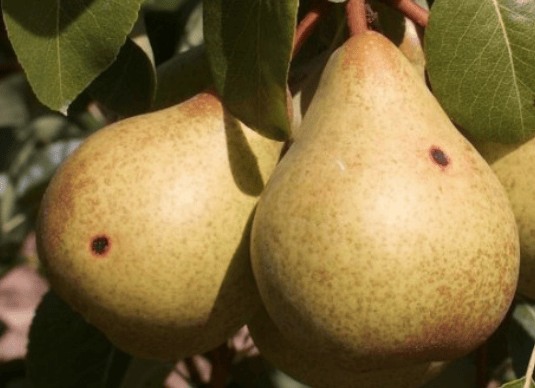
Rocha pear stenosis
Image credit: Voz do Campo
Pedro Fevereiro concluded his presentation at the Ciência2020 meeting with a summary of InPP's agenda for the coming months. In this regard, he revealed that InnovPlantProtect, the only one in Portugal working in this area of innovation, intends to develop a biopesticide to control the Xylella fastidiosa, a molecular strategy to control stenphyliosis in Rocha pears, tools based on geographic information systems to assist public and private decision-making in pest and disease control, an Artificial Intelligence-based early detection system for the early detection of the decline of cork oak forests produced by Phytophthora, Finally, to identify bread wheat alleles resistant to the new “Warrior” race of yellow rust and mobilize them in the desired varieties.
InnovPlantProtect will be present today at the Science 2020 Meeting, which is taking place at the Lisbon Congress Center in a hybrid format (in person and online). Pedro Fevereiro, CEO of InPP, will talk about the activity of this Collaborative Laboratory and its objectives in protecting agricultural crops from pests and diseases.
After 18 of the 26 Collaborative Laboratories (CoLAB) recognized in Portugal were presented in two sessions yesterday, the Science 2020 Meeting continues today with the presentation of eight more CoLAB, including InnovPlantProtect, a private non-profit association based in Elvas that is trying to develop innovative biological solutions for crop protection.
In today's session, dedicated to Biodiversity and Forestry and Agri-food (session 3), InPP's CEO, Pedro Fevereiro, will give a seven-minute presentation in which he will talk about the importance of InPP's activity, the products and services that its team of researchers is trying to develop to protect agricultural crops from biotic and abiotic factors, including climate change and new emerging pests and diseases that, due to the increase in global average temperature, are moving and settling in regions where they didn't exist before.
Session 3, moderated by the National Innovation Agency, will take place between 11.30 and 12.30.