News & Events

white plant

NEWS

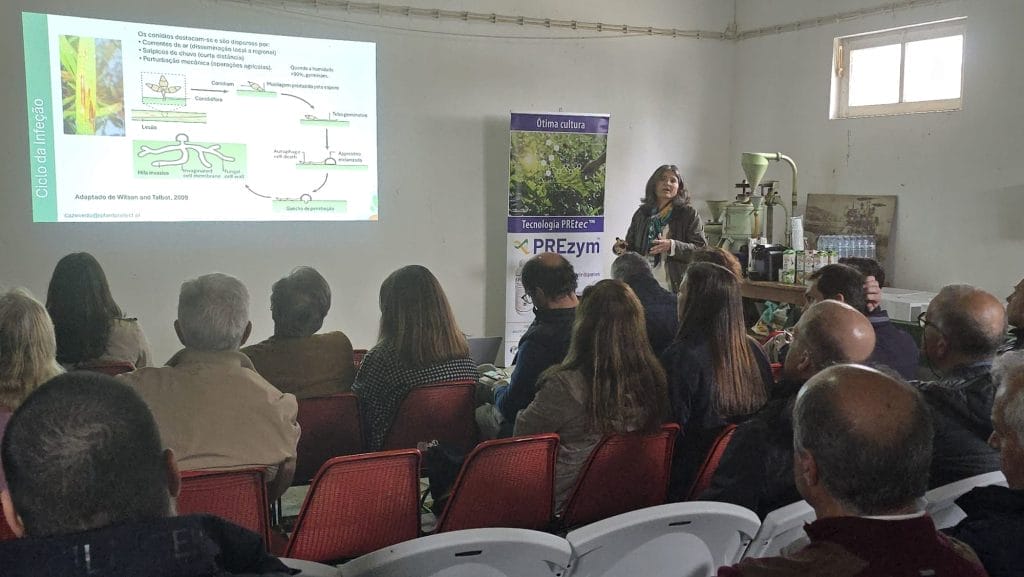
On September 18, the executive director of InnovPlantProtect (InPP), António Saraiva, the director of the New Biopesticides Department, Cristina Azevedo, and researcher Luís Grilo attended the Open Day “The Cereals of Baixo Mondego”, promoted by the Centro Regional Coordination and Development Commission (CCDR Centro), at the Bico da Barca Experimental Unit in Montemor-o-Velho.

The event highlighted the latest innovations from the Coimbra Innovation Hub, from new technologies applied to maize and rice, to fertilization strategies, protection and the use of biostimulants on these key crops in the Baixo Mondego region.

Our team also monitored trials with biofungicides, including the product I21, developed with our collaborative laboratory to combat pyriculariosis in two rice varieties, which is being patented.

In an interview with Voice of the Countryside, Cristina Azevedo shared the work we have been doing in the area of biosolutions.

(Re)watch the interview here.

Image credits: InnovPlantProtect and Voz do Campo magazine

Maize continues to be the Portugal's most important arable crop, The sector has a significant impact on food safety and the national agri-food industry. Involving thousands of producers and generating tens of millions of euros a year, the sector is currently facing increasingly complex phytosanitary challenges.

Among already known pests and emerging diseases, there are risks ranging from cartridge caterpillar until Maize Rugose Dwarfism Virus (MRDV), The presence of this virus is increasing in Portugal. This virus, transmitted by the corn leafhopper, can seriously compromise production and is found in the climate change increasingly favorable conditions for its spread.

However, it's not just MRDV that's worrying. There are new threats that require vigilance, such as the coleopter Diabrotica virgifera or the MDMV virus (Maize Dwarf Mosaic Virus), already detected in neighboring countries, and also toxic weeds, such as the winter fig (Datura stramonium), which in addition to impacting productivity pose public health risks.

Faced with this reality, the answer is integrated and sustainable strategies, matching:

  • crop rotation and good agricultural practices;
  • careful use of insecticides to avoid resistance and environmental impacts;
  • resistant or tolerant varieties, where available;
  • research and technological innovation, including new digital tools for early detection.

As the InnovPlantProtect researcher points out, Nuno Faria, in the article entitled “The main emerging pests and diseases of the maize crop in Portugal”, available in the August edition of Voz do Campo magazine: “The phytosanitary panorama of maize in Portugal requires continuous vigilance, investment in research and the application of integrated and sustainable strategies capable of responding to an increasingly dynamic and unpredictable reality.”

To find out more about the main current risks and mitigation measures, read the full article published in the August issue of Voz do Campo magazine (pages 88-89), available on newsstands and online.

InnovPlantProtect (InPP) is pleased to announce the publication of an international patent application (PCT) for a strain of Bacillus velezensis with application as a plant biostimulant. This innovation represents a significant milestone in our research, with a direct impact on sustainable agriculture and crop resilience in the face of climate and environmental challenges.

A natural and effective solution

The biostimulant developed by our team has been carefully studied and tested on different vegetable crops, such as tomatoes and lettuce, and on cereals, such as rice. The results obtained demonstrate the potential of this technology:

  • Greater development in the early stages of crops, This promotes more vigorous and healthy starts.
  • Increased productivity, This is evidenced by greater fresh biomass in lettuce and greater fruit production in tomatoes.
  • Proven molecular responses, with analyses confirming the activation of genes associated with plant responses to different types of abiotic stress.

These results reinforce the effectiveness of the Bacillus velezensis as a natural biostimulation tool, capable of boosting crop performance and contributing to more sustainable agriculture.

From the lab to the field

This patent is another step in InPP's commitment to developing innovative, sustainable biotechnological solutions with industrial applicability. The aim is clear: to support farmers and companies in the sector in meeting the challenges of crop productivity, quality and resilience, in an era when agriculture needs sustainable, high-impact responses.

We are looking for strategic partnerships

We are currently looking for new partnerships with companies and entities in the agricultural sector to take this technology from the laboratory to the field. We believe that collaboration is the key to turning scientific innovation into practical solutions that benefit the entire agricultural value chain.

If you're interested in learning more about this technology or exploring opportunities for collaboration, talk to us. Together we can drive a more productive, resilient and sustainable agriculture.

Innovate together. Protect better.

Image credits: InnovPlantProtect - Inês Ferreira (Photos from left to right: Sandra Caeiro and Rui Figueiras, researchers from the Specific Crop Protection Department and Inês Mexia, researcher from the Formulations and Process Development Department.

EVENTS

The InnovPlantProtect (InPP) collaborative laboratory (CoLAB) has been integrated in the list of Competent Organizations of the European Food Safety Authority, or EFSA) designated by the member states, with the capacity to assist that European Union agency.

This integration “represents EFSA's recognition of the skills installed at the InPP,” notes CoLAB's executive director, Pedro Fevereiro, expressing CoLAB's full willingness to collaborate with the European Food Safety Authority in pursuing its objectives.

Today, March 21, 2022, InnovPlantProtect (InPP) received a visit from the Ministers of Science, Technology and Higher Education, Manuel Heitor, and Territorial Cohesion, Ana Abrunhosa, and the Secretary of State for the Enhancement of the Interior, Isabel Ferreira.

“Seeing these renovated facilities shows that there is an effort here that now needs to continue,” said Manuel Heitor, congratulating the InPP, particularly in terms of retaining highly qualified human resources, such as the 16 doctoral graduates from CoLAB. Ana Abrunhosa also congratulated InPP's associates on the combination of wills that gave birth to this collaborative laboratory, adding that the government will continue to give priority to interface structures such as CoLABs within the scope of European funding programs.

InPP's executive director, Pedro Fevereiro, led the tour of the new and old facilities at INIAV's Elvas Campus and presented InnovPlantProtect's structure, team, projects and future plans. Asked by Manuel Heitor about InPP's potential for internationalization, and while stressing that CoLAB is still in the installation phase, Pedro Fevereiro mentioned the various relationships already established in Spain and contacts to be explored with Brazil.

The fact that CoLAB has two multinationals (Bayer and Syngenta) as associates is aimed precisely at this strategy, recalled Isabel Rocha, vice-rector of NOVA University Lisbon, representing the InPP board of directors, arguing that this is a two-year project.

The visit was also attended by José Rondão Almeida, mayor of Elvas, Luís Loures, president of the Portalegre Polytechnic Institute (IPPortalegre), Fernando Rebola, vice-president of IPPortalegre, Rosário Félix, representing the University of Évora, Miguel de Castro Neto, from NOVA IMS, the president and vice-president of CCDR Alentejo, António Ceia da Silva and Carmen Carvalheira, Margarida Oliveira, from ITQB NOVA and coordinator of the InPP working group, the director of INIAV's Elvas Pole, Benvindo Maçãs, and Pedro Viterbo, manager of Fertiprado.

Better production, better nutrition, a better environment and a better life, leaving no one behind: InnovPlantProtect (InPP) subscribes to the principle of the “four bests” by FAO, The transformation to agri-food systems is achievable. more efficient, inclusive, resilient and sustainable, within the framework of the The organization's Strategic Framework for 2022-2031 and the 2030 Agenda for Sustainable Development.

With the “top four”, the Food and Agriculture Organization (FAO) of the United Nations aims to contribute to achieving the agenda of the Sustainable Development Goals (SDGs), namely SDGs #1 (Eradicate poverty), #2 (Eradicate hunger) and #10 (Reduce inequalities). InPP is committed to achieving this vision through its mission to develop bioinspired solutions for protecting crops against pests and diseases.

The interconnection between the economic, social and environmental dimensions of agri-food systems is reflected in the “four bests”, encouraging a strategic and systems-oriented approach. “Better production” refers to efficient and inclusive agri-food supply chains at local, regional and global levels, ensuring resilience and sustainability in the face of climate and environmental change, with a view to achieving more sustainable consumption and production patterns.

The “better nutrition” pillar represents the goals of eradicating hunger, achieving food security, promoting nutritious food and increasing access to healthy diets. On the other hand, more efficient, inclusive, resilient and sustainable agri-food systems must also contribute to a “better environment” by protecting, restoring and encouraging the sustainable use of terrestrial and marine ecosystems, and combating climate change.

Last not least, By reducing inequalities (between urban and rural areas, rich and poor countries, men and women), the FAO hopes that we can promote inclusive economic growth and a better life for all, leaving no one behind.