News & Events

white plant

NEWS

InnovPlantProtect (InPP) recently received approval for an application submitted to COMPETE2030-2024-6 - Collective Actions - Transfer of scientific and technological knowledge - BioLivingLABS - Bioeconomy at the service of the sustainability of inland territories, led by MORE CoLAB - Laboratório Colaborativo Montanhas de Investigação, Associação, in partnership with the Polytechnic Institute of Bragança (IPB), the Polytechnic Institute of Castelo Branco (IPCB) and AQUAVALOR.

BioLivingLABS aims to promote the economic valorization of research and development (R&D) results obtained by various institutions in the North, Center and Alentejo. To this end, it will create an experimental demonstration network, the so-called Living Labs, The project will be held in the innovation hubs of Mirandela, Douro, Covilhã and Elvas. In addition, demonstration actions, workshops, an inland innovation catalog and training on intellectual property protection will be developed with the aim of encouraging the incorporation of innovative solutions in the business sectors of these regions.

Scheduled to begin in October and lasting 24 months, the project has a total eligible investment of over 740,000 euros, financed by COMPETE2030 - Thematic Program for Innovation and Digital Transition. For InPP, this project is a strategic opportunity to strengthen its mission as a center for technology development and transfer, boosting the practical application of scientific knowledge to promote sustainable development.

This initiative confirms InPP's commitment to open and sustainable innovation, integrating science, technology and regional development to respond to the challenges and potential of the interior of the country.

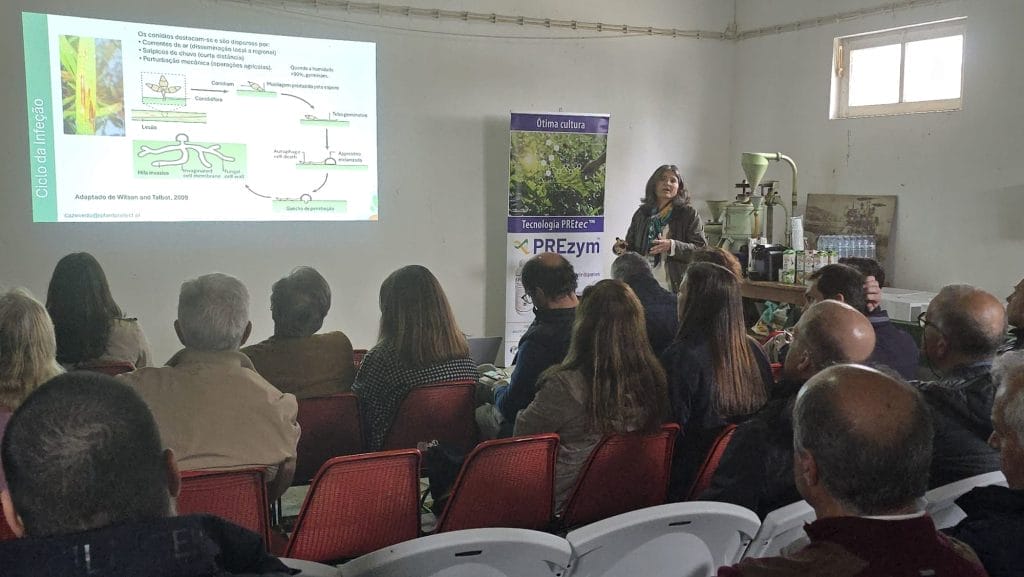
On September 18, the executive director of InnovPlantProtect (InPP), António Saraiva, the director of the New Biopesticides Department, Cristina Azevedo, and researcher Luís Grilo attended the Open Day “The Cereals of Baixo Mondego”, promoted by the Centro Regional Coordination and Development Commission (CCDR Centro), at the Bico da Barca Experimental Unit in Montemor-o-Velho.

The event highlighted the latest innovations from the Coimbra Innovation Hub, from new technologies applied to maize and rice, to fertilization strategies, protection and the use of biostimulants on these key crops in the Baixo Mondego region.

Our team also monitored trials with biofungicides, including the product I21, developed with our collaborative laboratory to combat pyriculariosis in two rice varieties, which is being patented.

In an interview with Voice of the Countryside, Cristina Azevedo shared the work we have been doing in the area of biosolutions.

(Re)watch the interview here.

Image credits: InnovPlantProtect and Voz do Campo magazine

Maize continues to be the Portugal's most important arable crop, The sector has a significant impact on food safety and the national agri-food industry. Involving thousands of producers and generating tens of millions of euros a year, the sector is currently facing increasingly complex phytosanitary challenges.

Among already known pests and emerging diseases, there are risks ranging from cartridge caterpillar until Maize Rugose Dwarfism Virus (MRDV), The presence of this virus is increasing in Portugal. This virus, transmitted by the corn leafhopper, can seriously compromise production and is found in the climate change increasingly favorable conditions for its spread.

However, it's not just MRDV that's worrying. There are new threats that require vigilance, such as the coleopter Diabrotica virgifera or the MDMV virus (Maize Dwarf Mosaic Virus), already detected in neighboring countries, and also toxic weeds, such as the winter fig (Datura stramonium), which in addition to impacting productivity pose public health risks.

Faced with this reality, the answer is integrated and sustainable strategies, matching:

  • crop rotation and good agricultural practices;
  • careful use of insecticides to avoid resistance and environmental impacts;
  • resistant or tolerant varieties, where available;
  • research and technological innovation, including new digital tools for early detection.

As the InnovPlantProtect researcher points out, Nuno Faria, in the article entitled “The main emerging pests and diseases of the maize crop in Portugal”, available in the August edition of Voz do Campo magazine: “The phytosanitary panorama of maize in Portugal requires continuous vigilance, investment in research and the application of integrated and sustainable strategies capable of responding to an increasingly dynamic and unpredictable reality.”

To find out more about the main current risks and mitigation measures, read the full article published in the August issue of Voz do Campo magazine (pages 88-89), available on newsstands and online.

EVENTS

On February 27 and 28 and March 1 and 3, the “AlViGen: Creation of a hub in ALentejo for the GENomic Surveillance of diseases in agriculture” project team began its fieldwork by installing spore traps, known as capta-esporos, in wheat fields in Portalegre, Beja, Évora and Mérida. The traps make it possible to capture spores and identify the species of fungus circulating in the air and, in particular, variants of the fungus Puccinia striiformis f.sp. tritici, causing yellow rust on wheat, as well as its virulence characteristics and resistance to fungicides.

In total, the spore traps were installed in eight wheat fields in the Alentejo (Alto, Central and Baixo) and Spanish Extremadura, two of the poorest regions in Europe, whose economy is largely dependent on agriculture, and in which the fungus Puccinia striiformis f.sp. tritici has had a particular impact.

The aim of setting up these wheat fields is to implement a cross-border network of traps that capture spores from the air and enable early detection of fungi circulating in the air.

The team will collect samples on a weekly/fortnightly basis, for 3 months a year, during the wheat production cycle. Regular monitoring of the diversity of fungal species circulating on wheat fields will also make it possible to detect the appearance of new pathogenic fungi.

Manuel Patanita, a lecturer at the Polytechnic Institute of Beja (IPBeja), by Benvindo Maçãs and José Coutinho, director and researcher at the INIAV of Elvas, respectively, and Paulo Velez, production manager at the CERSUL - Southern Cereal Producers Group.

AlViGen, coordinated by InnovPlantProtect (InPP) in partnership with the University of Évora (WOW), was one of the innovative pilot projects selected last October and funded by the La Caixa Foundation, BPI Bank and the Foundation for Science and Technology (FCT), as part of the 4th edition of the Promove Program. This project will enable InPP to create the capacity for early detection of multiple crop diseases, using molecular methods that allow the identification of important characteristics of pathogens, such as virulence, susceptible varieties and resistance to phytopharmaceuticals, benefiting producers and government authorities.

Find out more about the AlViGen project at webpage of the project here.

FINANCING

O InnovPlantProtect (InPP) e a Direção-Geral de Alimentação e Veterinária (DGAV) assinaram, no passado dia 16 de fevereiro, um protocolo de cooperação com o objetivo de continuar a colaborar no desenvolvimento de novos serviços e projetos que permitam monitorizar a presença da bactéria Xylella fastidiosa nas culturas agrícolas, através de sistemas de informação geográfica (SIG), bem como fazer a gestão de dados que daqui resultem. 

O protocolo de cooperação foi assinado pela Diretora Geral da DGAV, Susana Guedes Pombo, e pelo Diretor Executivo do InPP, Pedro Fevereiro. 

Esperamos que esta parceria possa crescer cada vez mais e possa evidenciar a excelência do trabalho colaborativo!

O Encontro dos Produtores de Frutas e Legumes do Clube de Produtores Continente decorreu na passada quarta-feira, dia 15 de fevereiro, entre as 10h00 e as 13h30, no pólo do INIAV, em Elvas, e pretendeu apresentar os desafios e oportunidades nos setores da horticultura e fruticultura em Portugal, bem como os projetos que estão a ser implementados pelo Clube com o objetivo de atingir uma produção hortofrutícola mais competitiva, inovadora e sustentável.

No encontro o diretor executivo do InnovPlantProtect, Pedro Fevereiro, deu a conhecer ao Clube de Produtores o trabalho que tem sido desenvolvido pela equipa para encontrar soluções para combater pragas e doenças nas culturas agrícolas e apresentou os serviços laboratoriais e digitais que temos disponíveis para agricultores e empresas, reforçando a possibillidade de desenvolver um serviço personalizado e à medida de cada cliente.

Os diretores de departamento Ilaria Marengo e Ricardo Ramiro falaram sobre a gestão e apresentação de dados na Agricultura, bem como sobre os métodos de monitorização de pragas e doenças que os seus departamentos têm utilizado.

A iniciativa reuniu mais de uma centena de participantes e contou com as intervenções de David Monteiro, Diretor Comercial de Frutas e Legumes do Continente, Ondina Afonso, Presidente do Clube de Produtores Continente, e Marta Barradas, Técnica de Mercado do Clube de Produtores Continente.

No final da manhã, os produtores tiveram a oportunidade de visitar as instalações do laboratório colaborativo.

Este foi mais um passo importante para nos darmos a conhecer ao setor agroalimentar.

No futuro, o InPP pretende continuar a conversar com produtores locais e discutir quais são as principais problemáticas com que se deparam diariamente em relação às pragas e doenças das suas culturas agrícolas, bem como tornar as aplicações e tecnologia que temos desenvolvido mais acessível aos produtores.