O InPP participou no Fórum Nacional de Clubes Ciência Viva na Escola, que teve lugar no dia 27 de março, integrando a Mostra de Ciência e Tecnologia com um stand dedicado à proteção das plantas.
Neste espaço, foram apresentados diversos materiais demonstrativos, incluindo placas de Petri com fungos e bactérias, plantas, algas e exemplos de produtos formulados, com o objetivo de despertar o interesse e a curiosidade dos visitantes para a importância da saúde das plantas e da investigação científica nesta área.
Ao longo do dia, a Gestora de Comunicação, Inês Ferreira, e o Gestor de Inovação, Paulo Madeira, dinamizaram o contacto com o público visitante, explicando de que forma a investigação em proteção das plantas contribui para melhorar a proteção das culturas e promover uma agricultura mais resiliente e sustentável.
O Fórum Nacional de Clubes Ciência Viva na Escola decorreu no CNEMA, em Santarém, reunindo escolas, centros Ciência Viva, universidades, centros de investigação e diversas outras entidades, num encontro dedicado à ciência, tecnologia e inovação.
O InPP agradece a todos os visitantes que passaram pelo seu stand, destacando a importância destes momentos de partilha para promover o conhecimento científico junto da comunidade.
No dia 26 de março, o InPP participou numa sessão promovida pela Agência Nacional de Inovação (ANI), em Lisboa, que contou com a presença de uma comitiva da República Checa ligada ao setor das biotecnologias.
Em representação do InPP estiveram Cristina Azevedo, Diretora de Biosoluções, e Paulo Madeira, Gestor de Inovação, que apresentou a instituição e as suas principais áreas de atuação e competências.
A iniciativa teve como principal objetivo identificar oportunidades de cooperação entre entidades portuguesas e checas, nomeadamente nas áreas de transferência de tecnologia, codesenvolvimento, ensaios pré-clínicos e diagnósticos, coinvestimento e internacionalização da inovação.
A sessão contou com a participação de representantes de entidades relevantes da República Checa, incluindo Petra Kinzlova, CEO da Prague.bio, Katarina Psenakova, Head of Biology da PharmTheon, bem como representantes da Embaixada da República Checa e da Academia das Ciências da República Checa.
Este encontro contribuiu para reforçar o posicionamento do InPP na promoção de parcerias internacionais e no desenvolvimento de soluções inovadoras, evidenciando o compromisso contínuo da instituição em fortalecer redes de colaboração científica e tecnológica e em contribuir para o crescimento e internacionalização da inovação.
O InPP marcou presença no Encontro com orizicultores e técnicos(as) em Portugal, promovido pela EDAF, que decorreu no dia 5 de março, no Pólo de Inovação de Salvaterra de Magos, em Santarém.
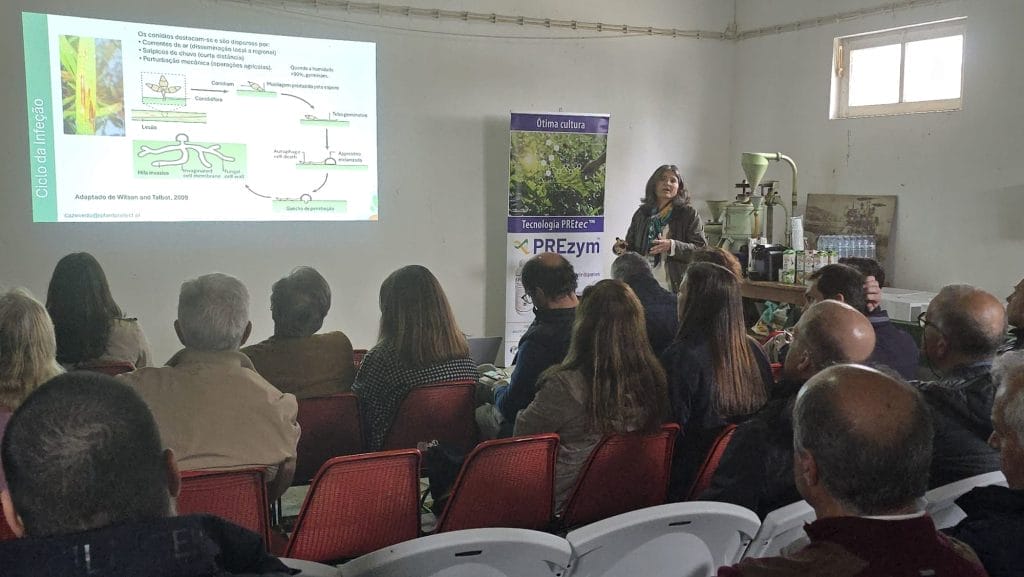
A Diretora de Biosoluções do InPP, Cristina Azevedo, integrou o painel de oradores convidados, tendo apresentado a comunicação intitulada “A problemática da Pyricularia na cultura do arroz”. A apresentação incidiu sobre os principais desafios fitossanitários associados a esta doença, que continua a constituir uma das maiores ameaças à produção de arroz a nível mundial e também em Portugal.
O encontro reuniu produtores, técnicos e especialistas da fileira do arroz, proporcionando um espaço de partilha de conhecimento e debate sobre soluções atuais e em desenvolvimento para o controlo da piriculariose. Foram igualmente abordados outros temas relevantes para a sustentabilidade e produtividade da cultura, nomeadamente a gestão da fertilização.
A participação do InPP neste tipo de iniciativas reforça o compromisso da instituição com a inovação, a transferência de conhecimento e o desenvolvimento de soluções sustentáveis para a agricultura nacional.
O InPP agradece à EDAF e ao COTArroz o convite e a organização deste importante encontro, esperando que esta colaboração continue a fortalecer-se no futuro.
InnovPlantProtect (InPP) is taking part in a European project, coordinated by the University of Minho (UMinho), which aims to create nanobiopesticides and nanobiofertilizers to combat pests in viticulture, protecting the environment, increasing production, reducing costs and tackling climate change. The project is called VINNY, brings together 19 partners from ten countries and will receive 8.3 million euros over the next four years from the Horizon Europe program. The European Union is the world's largest wine producer and is therefore looking to invest in ecological and economically sustainable production based on Portuguese know-how.
The VINNY kick-off meeting took place on July 25 and 26 in Porto and the Douro wine region, in an experimental field at Quinta do Pôpa, and was attended by InPP, represented by the directors of the New Biopesticides and Specific Crop Protection departments Cristina Azevedo and Sandra Correia. Moving from intensive to sustainable viticulture on a global scale and cutting agrochemicals in the sector by 50% are the main objectives of the consortium led by Margarida Fernandes, from the Center for Microelectromechanical Systems (CMEMS) at UMinho's School of Engineering.
The kick-off meeting of the VINNY project brought together all the partners in Porto and the Douro wine region
“We're going to study the microbiomes of vineyards in Portugal, Spain, Austria and Denmark to create potent cocktails with antifungal and plant protection profiles which, through nanoencapsulation and stimulation, will be more stable and effective. We're also going to create biofertilizers with nitrogen, phosphorus and potassium based on by-products from the meat industry and wastewater treatment,” he explains. The project will also propose agrotextiles impregnated with these nanobiofertilizers, as well as testing their efficiency, efficacy and safety in the laboratory, in pilot areas and in the field.
VINNY is expected to give rise to several projects in co-promotion with companies and associations. The project also has a social aspect, establishing the “European Vineyard Network” made up of three Living Labs and a Lighthouse to disseminate sustainable practices to farmers and organizations in the area, thus boosting innovation and sustainability in the primary sector.
At a national level, in addition to InPP, the consortium includes CMEMS (which is joined by the Center for Biological Engineering, as part of the associated laboratory LABBELS), the Center for Molecular and Environmental Biology, all from UMinho, as well as ADVID - Cluster da Vinha e do Vinho, and the communication agency LKCOM. At European level, it brings together five universities, eleven companies and three associations from ten countries. VINNY stands for “Advanced nano encapsulation of bio-based pesticides and fertilizers for a circular and sustainable viticulture”.
On July 24th, Eixo InFrass organized a webinar as part of the New Bioindustry - The future has already begun series of sessions, on the topic of “Agronomic valorization of organic insect fertilizer”.
The Secretary General of the Agenda, António Campos, opened the session and presented the InsectERA Mobilizing Agenda, followed by Sandra Correia, representing InnovPlantProtect as the leader of this WP, who presented the objectives of this axis.
This was followed by Ivã Lopes, from the Swedish University of Agricultural Sciences, who spoke about “The Potential and Advantages of Using Organic Insect Fertilizer”, resulting from the research he is carrying out. This included evaluating the chitin of three insects (black soldier fly, crickets and mealworms).
He concluded his speech by outlining the prospects for using frass:
Frass is an organic fertilizer with similar characteristics to conventional organic compounds... but there are differences!
The concentration of biostimulants in frass seems to be higher than other organics, which results in superior growth and metabolic effects
Frass contains a large amount of chitin, a natural stimulant of plant immunity
Can we consider applying frass alone? Yes. However, combining it with other raw materials results in more significant effects
We need to unravel the mechanisms behind how frass works! To do this: tests and more tests, with partnerships between industry and academia
Frass stimulates microorganisms that affect communication between plants. How can this synergistic effect be optimized?
Clarice Sousa (EntoGreen), Marisa Santos (Thunder Foods) and José Gonçalves (The Cricket) addressed the topic “Innovative Production of Organic Fertilizers: Insect Companies Present Sustainable Solutions”, which focused on the technical aspects of producing black soldier fly, tenebrio and cricket (Acheta domesticus), including the physical and chemical composition of the frass.
Sara Campos, from INEGI, presented “Challenges and Solutions in Frass Processing: Efficiency and Regulation”, addressing the issue of experimental analyses of frass quality, with variations in time and temperature and the technologies/processes used by partners for heat treatment, recalling that the work underway is for the development and application of new methods for processing insect excrement (frass) that comply with European standards and increase the efficiency of the process in terms of time and energy, without jeopardizing the quality obtained.
Ana Rita Caranova, from the DGAV, spoke about the “Legal Framework for Farmed Insect Excrement, its Treatment and Use”. She began by presenting the DGAV, its Mission and Vision. He then outlined the Agenda, in particular the legal issues, such as technical clarifications, meetings with partners, clarifications and the preparation of material to support the interpretation of the legislation in force. He referred to the definition of frass, as well as the legal requirements for placing frass on the market, as FOCOS (Organic Fertilizer and Organic Soil amendment), supported by Regulation (EU) 142/2011, points a), b), d) and e) of section 2, Chapter I, Annex XI.
He finished by referring to labeling, transport and placing on the market, which are covered by specific regulations.
Regina Menino and António Cordeiro, from INIAV, developed “Frass as an Organic Fertilizer”. Regina Menino began the presentation by saying that frass is being used in various greenhouse and field trials, with the aim of assessing its agronomic potential (both in soils and in different crops). She also mentioned the trials in pots, which are being carried out using ryegrass as a model crop, and whose aim is the agronomic enhancement of frass from different origins.
António Cordeiro presented information on the work being carried out in the olive grove field trials - hedged and intensive, and in partnership with Nutrifarms. There are many expectations in terms of monitoring and analyzing the results.
Ricardo Ramiro and Leonor Martins, from InnovPlantProtect, presented “The Impact of Frass on Plant and Soil Health”. Trials are being carried out which include assessing the effect of different frass: on vegetables (physiological parameters and crop productivity), on corn (physiological parameters and growth assessment), and on the susceptibility of different crops to diseases, by carrying out controlled infection trials. The effect of different frass on the microbiome of different crops will also be tested.
The intervention culminated in a very important question: Frass: a new tool for manipulating the microbiome? Since frass is rich in organic matter, macro- and micronutrients, with chitin being a key component, the properties of frass vary according to several factors:
insects' diet
application of treatments (e.g. temperature)
incorporation of other products
==> such versatility could allow for customized applications
The application of frass to the soil leads to an increase in the abundance of organisms capable of degrading chitin (e.g. Actinobacteria; Bacillus; Mortierellomycetes), with multiple benefits for the plant.
Diogo Cardoso, from the University of Aveiro, closed the presentations with the topic “Analysis of Soil Functionality and Ecosystem Services with the Use of Insect Frass: Sustainability and Impact Assessment”. He began by highlighting the problem of food sustainability for the global population and the need to adopt more sustainable agricultural practices. This is where organic fertilizer (Insect frass) can come in, boosting enzymatic activity, benefiting soil health, making it biologically active, with high microbial activity and good nutrient recycling. It is in this context that laboratory work is being carried out to assess the impact of frass on soil and plants, and on soil leaching. Tests are also being carried out in greenhouses and in the field.




 Português
  English