News & Events

white plant

NEWS

In viticulture, every little decision has an impact: on the soil, on the health of the plants and on the quality of the grapes that form the basis of the wine that reaches our table. The future of viticulture may depend on a single biosolution. Or a hundred. In VINNY, an ambitious European project of which InPP is a part, researchers from ten countries are looking for bioactives capable of curbing vine diseases - and, at the same time, reducing dependence on synthetic agrochemicals. What's at stake is not just science: it's the sustainability of this industry.

The aim of the VINNY project is simple but transformative: develop and implement effective, sustainable solutions and adaptable to the needs of winegrowers in various European countries, creating environmentally friendly biopesticides and biofertilizers, and advanced nano-encapsulation technologies, to reduce dependence on conventional chemicals and promote a healthier ecosystem and a better environment and a circular viticulture.

And at the heart of this mission is an essential cog in the wheel: the daily work of the researchers who search for answers invisible to the human eye - as is the case with Tiago Amaro, a researcher at InPP.

Image credits: VINNY Project

Searching for the Guardians of the Vine

The road to these new biosolutions begins in the field, with the vine. The initial work of Tiago Amaro, started in September 2024 and focuses on identifying and isolating microorganisms naturally present in the vines themselves, in samples received from partners in Portugal, Spain, Austria and Denmark.

From grapes, sticks or woody fragments, small microscopic worlds arrive in the laboratory that may contain the natural weapons needed to fighting three major threats to the vineyard, with a direct impact on farm profitability:
- A gray mold (Botrytis cinerea) and blue mold (Penicillium expansum): Fungi that cause post-harvest diseases, In the case of wine grapes, this affects the quality of the wine and makes it completely impossible to sell table grapes.
- The vine tumors: Caused by bacteria Allorhizobium vitis, This disease affects the plant in the field, causing leaf fall and reduced grape production.

Tiago Amaro, InnovPlantProtect researcher, identifying and isolating bacteria as part of the VINNY project. Image credits: InnovPlantProtect - Inês Ferreira

After isolating the microorganisms, Tiago dedicated himself to creating libraries of bacteria. What is a ‘Bacteria Library’? In the context of the investigation, a bacteria library is an organized and catalogued collection of bacteria isolated from different sources. It allows scientists to test each strain of bacteria against specific pathogens, constituting a vast catalog of potential biological ‘superheroes’ for plant protection.

This rigorous screening, which has already led to the analysis of more than 190 bacteria of this library is the first line of defense. The team selects the best candidates with the potential to be used as biological control agents against the diseases under study.

The Power of European Collaboration

What if the solution to protecting Portuguese vineyards is hidden in a Danish grape? Or in a bacterium isolated in Spain? One of the most exciting aspects of the project is its truly collaborative dimension, where researchers from ten countries are working in parallel, sharing answers, challenges and microorganisms in search of effective biosolutions for the whole of Europe.

All the solutions found will be shared, all the solutions will be tested by all the partners and it will be possible to build a ‘library of solutions’ against the various vine diseases“ emphasizes researcher Tiago Amaro.

The sharing of bacteria and extracts from different ecosystems (Portugal, Spain, Denmark and Austria) is crucial. An effective bacterium in Denmark could be the key to protecting Portuguese vineyards, and vice versa. This exchange of biological solutions, one of the innovative pillars of the project, makes it possible to exploit the microbial biodiversity beyond national borders. InPP has the fundamental role of testing, in grapes, the solutions discovered by our team as well as by other national and European partners.

This diversity of tests is a bet on the future: microorganisms that don't prove effective against vine diseases could be the solution for pathologies in other crops.

Left photo: Tiago Amaro, InPP researcher, observing a grapevine leaf, the target crop of the VINNY project, Right photo: Potted grapevine plants in the InPP greenhouse, ready to test the solutions found by the various VINNY partners. Image credits: InnovPlantProtect - Inês Ferreira

The Real Test: From the Lab to the Field

After selection in the laboratory, the next step - the formulation of the most promising bacteria - will be carried out in Portugal and Spain, at the University of Minho and the Polytechnic University of Catalonia. But it is in the field-testing phase that the greatest challenge of plant protection science lies, because even brilliant results in the laboratory can fail in the field. Formulation is the process that turns a bacterium into a product - stable, applicable and compatible with the farmer's needs.

Tiago Amaro emphasizes necessary resilience:

  • Field Uncertainty: Often, promising solutions in the laboratory or greenhouse are not as effective when applied in the field, due to environmental variables (climate, soil, etc.).
  • The Time Factor: Diseases such as Allorhizobium vitis may take a long time to develop, or the infection may not be relevant in certain years, which makes it difficult to obtain robust conclusions.
  • The Agricultural Cycle: It is necessary to test the formulation in the field during three to five consecutive years, and recording all the variations observed. With only one harvest a year, this process requires patience and persistence.

In total, from the discovery of a promising bacterium to the creation of a formulated product, proven to be effective and ready for the market, it can take around 10 years - a real test of any scientist's resilience.

Customized solutions: the new requirement of modern agriculture

The final challenge is to ensure that the tests are relevant to the producer's reality. The current trend in the agricultural sector is the search for customized solutions, adapted to the specific conditions of the farms: “There has to be a solution for every field and every farmer”, says the researcher.

This personalized approach requires more science, more rigor and more local knowledge - exactly what VINNY seeks to build.

A Europe united by science and the vine

InPP is part of this consortium, made up of 19 partners from ten countries, The project is led by the University of Minho and funded by the Horizon Europe program.

Together, they seek to answer a question that could shape the future of European viticulture: Will it be possible to find effective biosolutions for all partner countries?

The answer is still being written - in laboratories, in experimental vineyards, in fields in different climates and geographies.
And it's made up of small discoveries, many frustrations and a huge commitment to science.

Because protecting the vineyard of the future is not just a technical ambition.
It is a cultural, economic and environmental commitment.
And VINNY is helping to design that future - one microorganism at a time.

The final workshop highlighted three years of research dedicated to the early detection of pathogens in crops such as wheat and olive groves.

The project AlViGen has reached its final stretch, concluding three years of research focused on the genomic surveillance of agricultural diseases. The results now presented promise to strengthen the Alentejo agricultural sector's ability to respond to emerging phytosanitary threats.

On the day October 23rd, The final project workshop, The event brought together researchers, producers and technicians to share results and reflect on the future of genomic surveillance in Portuguese agriculture.

A pioneering genomic surveillance center

During AlViGen, the Alentejo's first genomic surveillance center, an infrastructure with capacity for early detection of diseases in strategic crops such as wheat and olive grove. This breakthrough marks a decisive step towards a more precise, sustainable and science-based agriculture.

Results and scientific contributions

Using innovative molecular tools, the project team succeeded:

  • Identify pathogenic fungi before visible symptoms appear on the plants;
  • Characterizing yellow rust strains, genetically linking them to others known at a global level;
  • Detecting resistance genes in wheat to the strains currently present in Portugal;
  • Developing diagnostic methods able to distinguish the different species of the fungus that causes gafa in olive groves.

During the workshop, the potential of the analysis of the airborne fungi community as a tool for early warning for multiple pathogens, allowing for more effective and preventive management of crop diseases.

From research to practical application

The event ended with a debate on how transform AlViGen results in a detection and warning service accessible to the agricultural sector. The initiative reflects the joint commitment between science, innovation and production, with a view to protecting national agriculture from the challenges of the future.

Partnerships and thanks

InnovPlantProtect would like to thank all the partners and funders of the project:
University of Évora, John Innes Centre, INIAV, De Prado, CERSUL, Eugénio de Almeida Foundation, Torre das Figueiras Estate, Almojanda, Malheiro Estate, Directorate-General for Food and Veterinary (DGAV), la Caixa“ Foundation”, BPI Bank e Foundation for Science and Technology (FCT).

Image credits: InnovPlantProtect - Inês Ferreira

InPP took part in the kick-off meeting for the European PROSPER project, held on October 2 and 3 in Pavia, Italy. In attendance were the director of the Monitoring and Diagnostics Department, Ilaria Marengo, and the project manager, Bruno Orrico.

PROSPER's main objective is to transform European agriculture by valorizing highly resilient “orphan” legumes - forgotten crops, but full of potential to face the climate and food challenges of the future.

The project promotes sustainable, innovative practices adapted to different agricultural realities.

Over the two days, 27 partners from 13 countries met for presentations, in-depth discussions and strategic talks about the project's next steps.

We are excited about what comes next, certain that this journey will be more than a collaboration - it will be a true cooperation within an exceptional team.

Join us and keep up to date with all the news from the PROSPER Project!

EVENTS

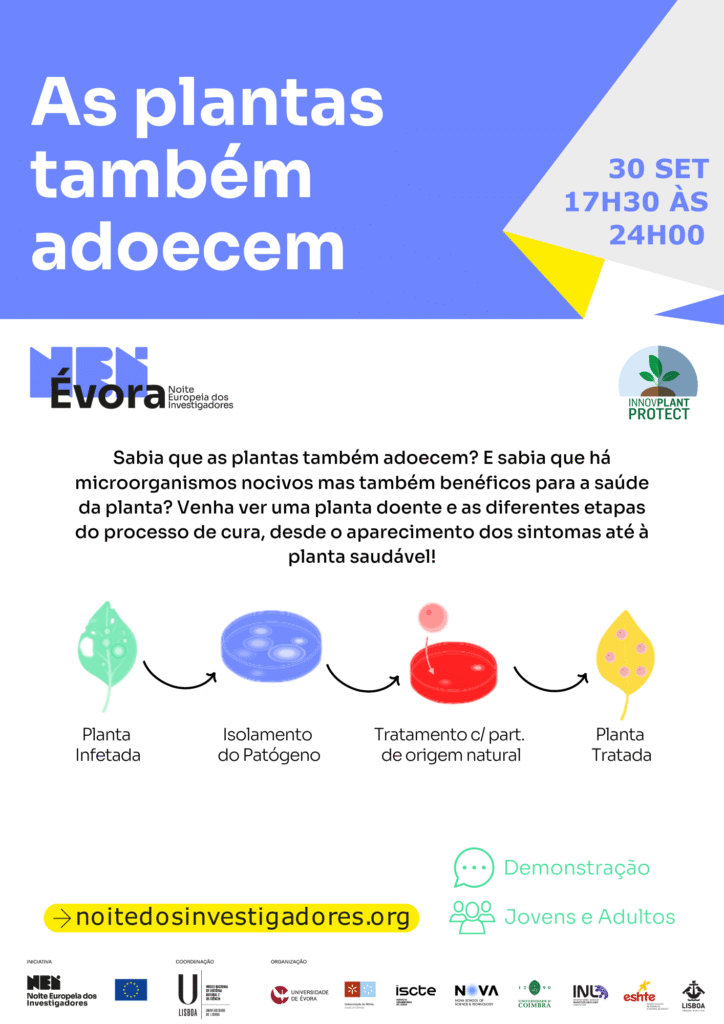
Será que os insetos também têm ciclo de vida? Já conhece o ciclo de vida da traça da colmeia? Ou sabia que as plantas também adoecem ou que existem microrganismos nocivos mas também benéficos para a saúde das plantas? Venha descobrir as respostas a todas estas questões já na próxima sexta-feira, dia 30 de setembro, na Noite Europeia dos Investigadores (NEI) 2022. Entre as 17h30 e as 00h, os investigadores e investigadoras do InPP vão marcar presença na Praça do Giraldo, em Évora.

O InPP estará no stand EU-Corner 4 e este será o ponto de encontro entre os investigadores e todos aqueles que querem descobrir a ciência que é desenvolvida no nosso laboratório colaborativo. Nesta noite vai poder participar em duas atividades científicas: na primeira vai poder descobrir o incrível ciclo de vida da traça da colmeia e na segunda vai poder ver uma planta doente e todo o processo de cura.

Entre jogos, debates, demonstrações, conversas, workshops, visitas, exposições e tertúlias, são muitas as atividades de diversas instituições científicas para explorar nesta festa da ciência.

A participação é gratuita.

Junte a família e venha ter connosco a esta festa da Ciência! Contamos com a sua visita!

Consulte a programação completa de atividades presenciais de Évora here.

A NEI ocorre todos os anos e tem o objetivo de partilhar o trabalho dos investigadores com o público em geral. O tema para o ano de 2022 é “Ciência para Todos – Sustentabilidade e Inclusão”.

Um artigo publicado recentemente pela equipa do InnovPlantProtect (InPP) revela o potencial dos métodos computacionais de machine learning para prever características fenotípicas, como é o caso do rendimento/produtividade do trigo, a partir de informações genéticas desta planta.

O machine learning (ML) é uma área da ciência de dados que tem ganho cada vez mais relevância na última década. O ML é um ramo da inteligência artificial que permite o desenvolvimento de modelos de previsão que podem ser aplicados nas mais variadas áreas. Apesar de não nos apercebermos, utilizamos ferramentas baseadas em ML no nosso dia-a-dia, como por exemplo, os resultados personalizados apresentados no feed do seu Facebook. Mas as aplicações futuras vão desde permitir a condução autonoma até à deteção de doenças através da análise de radiografias (em humanos) ou imagens de drone (em pomares).

A predição genómica (PG) é outra das áreas em que o ML tem estado a ser aplicado. Esta consiste em usar dados genómicos (que nos dão informação acerca do genótipo) para desenvolver modelos computacionais que prevêem características fenotípicas complexas dos organismos, tal como rendimento/produtividade do trigo (Ver representação esquemática).

Nesta investigação agora publicada na revista científica Agriculture, os investigadores Manisha Sirsat e Ricardo Ramiro, ambos do departamento de Gestão de Dados e Análise de Risco, em colaboração com a Paula Oblessuc do departamento de Proteção de Culturas Específicas, exploraram a utilização de vários modelos de PG baseados em diferentes métodos computacionais para além do ML, como é o caso dos métodos estatísticos ou de deep learning (DL), com o objetivo de comparar a robustez e a performance de cada um deles em prever a característica fenotípica rendimento/produtividade do trigo. A ideia foi perceber quais os métodos que permitem prever características fenotípicas com maior fiabilidade.

“Os métodos estatísticos têm sido os mais utilizados em predição genómica pelas equipas de investigação em todo o mundo. Contudo, os métodos de ML estão a revelar-se uma boa alternativa, sendo mais precisos e rápidos”, evidencia Manisha Sirsat, primeira autora do estudo.

“A PG baseada em ML pode ajudar a reduzir o tempo e o custo da avaliação extensiva do processo de fenotipagem (durante os programas de melhoramento) e a acelerar o ganho genético”, explica a investigadora. “Este estudo contribui assim para ajudar os investigadores a perceber os fatores chave no desenvolvimento de modelos que possam acelerar os programas de melhoramento do trigo, ou de outras culturas, e a aumentar a produtividade agrícola”, acrescenta.

Representação esquemática do processo de predição genómica

A equipa tem estado a trabalhar em predição genómica desde 2020, e espera que a genómica e a predição genética sejam fundamentais para permitir manter ou aumentar a produtividade das culturas, apesar das múltiplas ameaças que enfrentamos, e para responder ao aumento de 50% na procura por alimentos até 2050, quando a população mundial atingir 9,7 mil milhões.

O estudo foi cofinanciado por fundos europeus, através do Programa Alentejo2020, e pela Foundation for Science and Technology.

Investigadores Manisha Sirsat, Ricardo Ramiro e Paula Oblessuc (da esquerda para a direita)

Original article

Revista Agriculture

Genomic Prediction of Wheat Grain Yield Using Machine Learning

Manisha Sirsat e Ricardo Ramiro

DOI: https://doi.org/10.3390/agriculture12091406

No passado dia 31 de Agosto, a diretora de departamento Cristina Azevedo esteve no Dia Aberto do Arroz – “A cultura do arroz no Baixo Mondego”, organizado pelo Pólo de Inovação de Coimbra da Direção Regional de Agricultura e Pescas do Centro (DRAPCentro), e que teve lugar no Campo do Bico da Barca, em Montemor-o-Velho. A iniciativa pretendeu dar a conhecer o que de mais inovador se tem feito ao nível da cultura deste cereal. 

Durante o Dia Aberto, que contou com a colaboração de várias entidades e empresas ligadas ao setor da cultura do arroz, os participantes visitaram ensaios e campos de arroz, ficaram a conhecer um ensaio de novas variedades deste cereal, que está a avaliar o comportamento agronómico das cultivares e a determinar o seu rendimento industrial, e um novo fertilizante – CHAMAE – desenvolvido pela Lusosem, Syngenta, Bayer CropScience e DRAP Centro, que está a ser testado para esta cultura.

Os visitantes tiveram ainda a oportunidade de experienciar o incrível trabalho que tem sido realizado pelo INIAV, IP na conservação e melhoramento desta cultura, bem como um sistema em modo de produção biológico, no qual a Lusosem e a Associação de Beneficiários da Obra de Fomento Hidroagrícola do Baixo Mondego (Abofhbm) estão a testar novas tecnologias inovadoras e sustentáveis de sementeira e controlo de infestantes.

No âmbito da cultura do arroz, o departamento de Novos Biopesticidas, liderado por Cristina Azevedo, tem estado a trabalhar no desenvolvimento de biopesticidas para o controlo da piriculariose, uma das doenças que mais afeta este cereal, e, no passado mês de Agosto já recolheu duas amostras de arroz infetado na bacia do Mondego (em Montemor-o-Velho) e do Tejo/Sorraia (em Coruche e Porto Alto, em Samora Correia). A equipa planeia amostrar ainda este ano na zona do Sado.