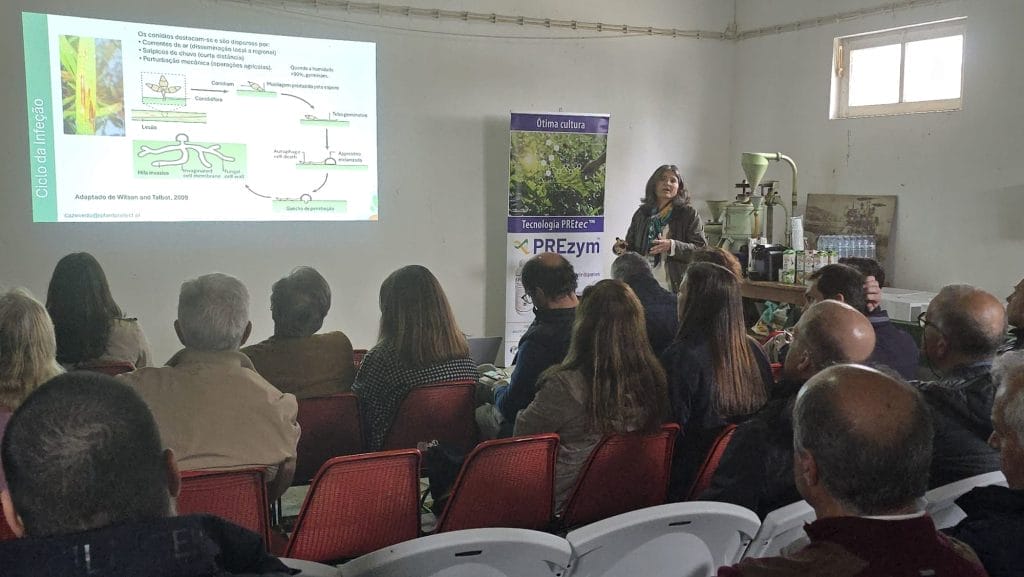
O InPP marcou presença no Encontro com orizicultores e técnicos(as) em Portugal, promovido pela EDAF, que decorreu no dia 5 de março, no Pólo de Inovação de Salvaterra de Magos, em Santarém.
A Diretora de Biosoluções do InPP, Cristina Azevedo, integrou o painel de oradores convidados, tendo apresentado a comunicação intitulada “A problemática da Pyricularia na cultura do arroz”. A apresentação incidiu sobre os principais desafios fitossanitários associados a esta doença, que continua a constituir uma das maiores ameaças à produção de arroz a nível mundial e também em Portugal.
O encontro reuniu produtores, técnicos e especialistas da fileira do arroz, proporcionando um espaço de partilha de conhecimento e debate sobre soluções atuais e em desenvolvimento para o controlo da piriculariose. Foram igualmente abordados outros temas relevantes para a sustentabilidade e produtividade da cultura, nomeadamente a gestão da fertilização.
A participação do InPP neste tipo de iniciativas reforça o compromisso da instituição com a inovação, a transferência de conhecimento e o desenvolvimento de soluções sustentáveis para a agricultura nacional.
O InPP agradece à EDAF e ao COTArroz o convite e a organização deste importante encontro, esperando que esta colaboração continue a fortalecer-se no futuro.
The project TomaBioTec started in January with the aim of developing and validating innovative solutions that contribute to a more sustainable and efficient production of tomatoes in the industry, in line with the current challenges of the agri-food sector, by integrating biotechnology and digital technologies.
The initiative aims to evaluate, under real field conditions, the effectiveness and efficiency of a biosolution with bioprotective and/or biostimulant properties, developed by InnovPlantProtect (InPP), This could help improve the quality and productivity of industrial tomato crops.
The rehearsals take place at Alentejo and Spanish Extremadura and combine traditional agronomic methods with advanced technologies, such as drones, multispectral sensors and artificial intelligence models. This approach allows detailed monitoring of the health of the crop, the presence of pests and diseases and the impact of the bioproduct throughout the production cycle.
The project “TomaBioTec: New biological and digital solutions for tomato crop protection and fertilization” is led by the InPP, in collaboration with the Centro Tecnológico Nacional Agroalimentario Extremadura (CTAEX) and Cordeiro Group, and was selected as one of the winners of the 7th edition of the Promove Program, The prize was awarded by the “la Caixa” Foundation, in partnership with Banco BPI and the Foundation for Science and Technology (FCT), in the category of innovative pilot projects.
This project reinforces the commitment to biological and digital solutions as drivers of more sustainable, competitive agriculture based on scientific evidence, with a direct impact on producers and industry.
InnovPlantProtect (InPP) was present at the XVI National Maize Congress, which also included the 2nd Meeting of Cereal Crops, organized by ANPROMIS, in collaboration with ANPOC and AOP. The event took place on February 11 and 12 at CNEMA in Santarém, bringing together national and international experts to discuss the sector's main challenges.
António Saraiva, Executive Director of InPP, took part in the panel “Cereal Production: What technical challenges are we facing?”, where he highlighted the decisive role of research in responding to the emerging challenges of cereal production, in a context of growing demographic, environmental and economic pressure.
“I'm proud that today, after seven years, we have 28 researchers working full-time on this topic, 12 of whom have PhDs, with experience in crops such as rice, which has been central to our work,” he said, emphasizing the multifunctional and international nature of InPP's teams.
He also pointed out that the work being done extends beyond rice to include maize, through ongoing projects and new operational groups focused on emerging crop problems. Among the initiatives in the spotlight is an application to Horizon Europe focused on developing improved and more resilient varieties.
For António Saraiva, anticipation is the key to success: “These challenges can't wait too long to be discussed or resolved. The sooner we anticipate the issues, the easier, more effective and more economical the solutions will be.”
In a debate that also marked the 40th anniversary of Portugal's integration into Europe and the role of the Common Agricultural Policy in the cohesion of the European Union, one message was clear across the board: “Climate change is the biggest threat we have.”
InPP thus reaffirms its commitment to innovation, science and the development of sustainable solutions for the future of cereal crops.
InPP and CEPAAL formalized a partnership protocol with the aim of supporting the members of the Center for the Study and Promotion of Olive Oil in Alentejo in the protection of their olive groves.
The two entities will collaborate in developing strategies to solve the challenges posed by pests and diseases to the Center's member agricultural companies. The partnership also includes the provision of laboratory and digital services by InPP to CEPAAL producers, under specific contracts.
InPP has joined the observer group of the European Technology Platform (ETP) ‘Plants for the Future’, which represents the innovation channel in the area of plant science and agriculture. The Plant ETP aims to stimulate research and innovation by promoting dialogue between industry, academia and the agricultural community, in order to benefit producers and end consumers.
The ETPs are public-private partnerships recognized by the European Commission and are considered instrumental in the transfer of knowledge, driving innovation and promoting competitiveness at European level.
“All the new technologies applied to [plant] breeding are the result of the development of scientific knowledge and its application to a practice that goes back 10,000 years,” defended InPP's executive director, during the event. webinar “Debates on Biotechnology: from Agriculture to the Bioeconomy”. “The ability we have to improve plants so that they produce what we need is not something that suddenly appears,” recalled Pedro Fevereiro, in the session entitled “Biotechnology in agriculture and agro-industry”.
The event, organized on June 7 by the Portuguese Farmers' Confederation (CAP) and the Portuguese Bioindustry Association (P-BIO), as part of the National Agriculture Fair 2021 and BIOMEET Sessions 2021, “We are now able to intervene at specific points in order to make changes in a similar way to what happens in nature,” explains Pedro Fevereiro. The InPP CEO recalls that these NTGs derive from our current ability to sequence the genomes of all organisms, particularly plants - which allows us to know at what point we need to act in order to alter plant characteristics so that they behave as we want them to, be it with an increase in productivity, an increase in tolerance to environmental factors, etc.
NTG also allows for a much more regional adaptation to the needs of producers and consumers. “One of the big differences is that we don't introduce new DNA sequences into plants, or we introduce very small sequences.” For Pedro Fevereiro, the concern about biodiversity is really a false question, since we've always been looking for more adaptable plants and “what can affect biodiversity are bad agricultural practices”. For a CoLab like InPP, which is dedicated to developing bio-inspired technologies for crop protection, NTG is the most advanced way of managing the genome of plants so that they resist pests and diseases, particularly emerging ones, in the context of reducing the use of traditional phytopharmaceuticals.
One of the aspects enshrined in the GMO directive, which dates back to 2001, is that the legislation should be adjusted in line with the evolution and practice of these techniques, recalls the director of the InPP, concluding that “we should have started ten years ago”. Not least because only NTGs will make it possible to respond to consumer requests in good time.
The three speakers on this panel, moderated by CAP's secretary-general Luís Mira, were unanimous: communication about NTGs needs to be more effective than that regarding genetically modified organisms (GMOs) in the 1990s, and it needs to reach the general population, agreed the deputy director-general of the Directorate-General for Food and Veterinary (DGAV), and Pedro Queiroz, director-general of the Federation of Portuguese Agri-Food Industries (FIPA). Paula Carvalho, who mentioned the case of wheat in Germany and France, which has already reached stagnation in terms of production capacity, even hopes that “European legislative adaptation won't take too long”.





 Português
  English