O InPP participou na reunião final do projeto Algae Vertical, realizada no Instituto Superior de Agronomia, onde foram apresentados os principais resultados e foi feito um balanço daquela que foi a maior iniciativa dedicada às algas integrada no Pacto da Bioeconomia Azul.
Na qualidade de líder do subprojeto SP6 – Agricultura, o InPP apresentou os principais resultados alcançados no desenvolvimento de soluções inovadoras para o setor agrícola baseadas em biomassa de algas, em colaboração com diversos parceiros do consórcio. A apresentação esteve a cargo de Cristina Azevedo, diretora da área de Biosoluções do InPP.
Cinco soluções inovadoras para a agricultura
Ao longo de quatro anos de trabalho colaborativo, o SP6 – Agricultura permitiu o desenvolvimento de cinco soluções baseadas em algas, destinadas a responder a desafios concretos do setor agrícola:
Dois bioestimulantes
Dois bioprotectores para o controlo de doenças das plantas
Um modulador da microbiota do solo para promoção da saúde do solo
Estas soluções foram concebidas para aplicação em várias culturas agrícolas relevantes para o setor, contribuindo para práticas de produção mais sustentáveis, eficientes e resilientes.
Um marco para o InPP e para o setor das algas
A participação na sessão final do Algae Vertical representa um momento particularmente significativo para o InPP, enquanto entidade líder do SP6 – Agricultura e parceira ativa numa iniciativa que reuniu 37 entidades e mobilizou um investimento de 44 milhões de euros.
O projeto demonstrou o potencial das algas como recurso estratégico para o desenvolvimento de novas biosoluções agrícolas, reforçando a ligação entre investigação, inovação e aplicação industrial.
“Mais do que o encerramento de um projeto, este momento representa um reconhecimento da capacidade de coordenação científica e tecnológica do nosso CoLAB em projetos de grande escala, bem como do nosso compromisso com o desenvolvimento de biosoluções inovadoras para a agricultura.”, sublinha António Saraiva, diretor executivo do InPP.
O diretor executivo assinala ainda o resultado de quatro anos de colaboração intensa entre parceiros científicos e empresariais, que criaram “bases sólidas para futuras oportunidades de valorização das algas na agricultura.”
Portugal reforça posição no setor das algas
O projeto Algae Vertical demonstrou a capacidade nacional para desenvolver tecnologias, processos e aplicações inovadoras em torno das algas, abrangendo áreas como a alimentação humana, aquicultura, agricultura, nutracêuticos e cosmecêuticos, e posicionando Portugal como um dos países com maior capacidade de desenvolvimento tecnológico neste domínio.
O InPP felicita todos os parceiros envolvidos pelo trabalho realizado ao longo destes quatro anos e pelos resultados alcançados, que contribuem para reforçar a competitividade e a sustentabilidade da bioeconomia azul em Portugal.
No passado dia 17 de junho, a Herdade de Rui Vaz, em Avis, recebeu a sessão prática “Tree Talkers: Sensores IoT que permitem compreender a fisiologia das árvores”, uma iniciativa promovida pelo InnovPlantProtect, no âmbito do projeto BioLivingLABs.
A ação reuniu produtores, académicos, técnicos e representantes de diferentes entidades interessados em conhecer uma tecnologia inovadora de monitorização florestal capaz de recolher e transmitir, em tempo real, informação detalhada sobre o estado fisiológico das árvores e as condições ambientais envolventes.
A sessão teve início com um conjunto de apresentações técnicas dedicadas à gestão sustentável do montado e da floresta mediterrânica, ao funcionamento dos sensores Tree Talkers e à interpretação dos dados recolhidos pela tecnologia.
Seguiu-se uma demonstração prática em campo, durante a qual os participantes puderam observar os sensores instalados numa área florestal, compreender os parâmetros monitorizados e visualizar exemplos de resultados obtidos em condições reais.
Os Tree Talkers permitem monitorizar indicadores como o crescimento das árvores, o fluxo de seiva, a disponibilidade hídrica e outras variáveis ambientais relevantes, contribuindo para uma melhor compreensão da resposta das árvores a diferentes fatores de stress e apoiando uma gestão florestal mais informada e sustentável.
A sessão ficou ainda marcada pela participação ativa dos presentes, que colocaram diversas questões sobre as potencialidades da tecnologia e as suas aplicações em contexto florestal.
O InnovPlantProtect agradece a todos os participantes pela sua presença e interesse, bem como à Herdade de Rui Vaz pela disponibilidade para acolher a iniciativa.
Sobre o projeto BioLivingLABs
A ação foi realizada no âmbito do projeto BioLivingLABS: Bioeconomy at the service of the sustainability of inland territories, cofinanciado pelo COMPETE 2030, que visa aproximar a ciência das empresas e dos produtores, transformando os resultados da investigação em soluções práticas e sustentáveis que tragam valor económico e ambiental aos territórios de baixa densidade das regiões Norte, Centro e Alentejo.
O consórcio integra cinco instituições de investigação e inovação – o Instituto Politécnico de Bragança, o Instituto Politécnico de Castelo Branco, o Laboratório Colaborativo Montanhas de Investigação (MORE), o Laboratório Colaborativo InnovPlantProtect e o Centro de Valorização e Transferência de Tecnologia da Água (AquaValor).
O InnovPlantProtect realizou, no passado dia 2 de junho, a ação “iCountPests em Campo: demonstração prática da app de monitorização de pragas agrícolas”, que decorreu na Herdade das Servas, em Estremoz.
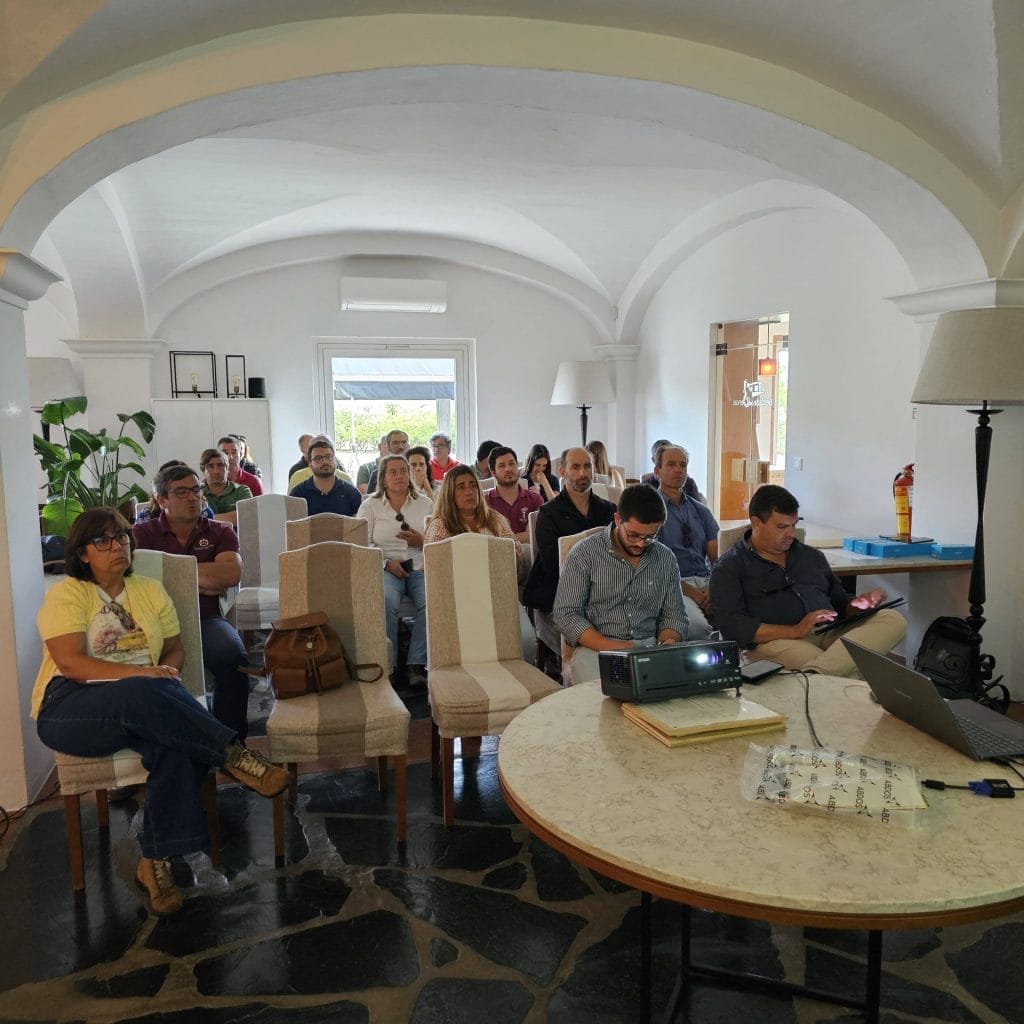
A iniciativa contou com a participação de 23 produtores, técnicos agrícolas e outros profissionais do setor interessados em conhecer o potencial da tecnologia digital e da inteligência artificial aplicada à monitorização de pragas. Ao longo da manhã, os participantes tiveram oportunidade de assistir à apresentação da iCountPests e de acompanhar uma demonstração prática da aplicação em contexto real.
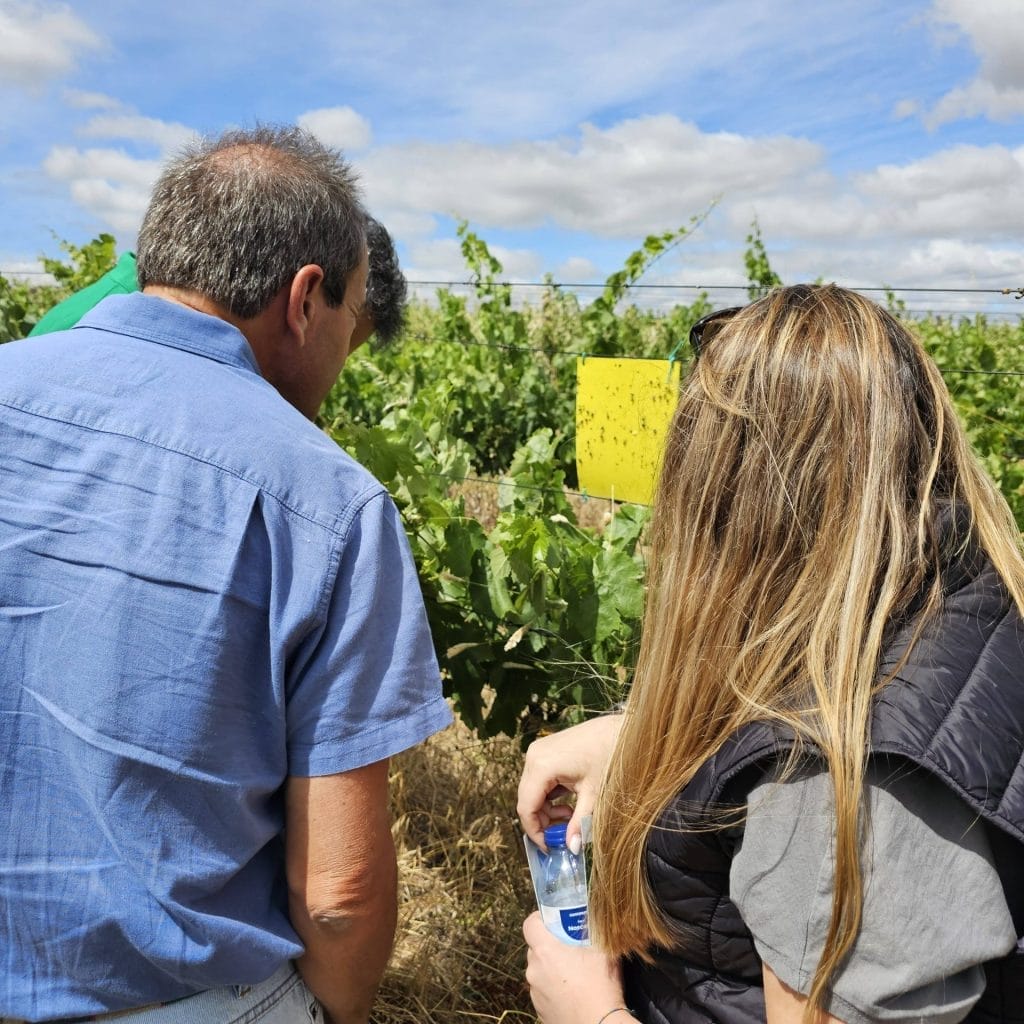
A demonstração prática permitiu mostrar o funcionamento da aplicação em contexto real, desde a captura das imagens até à obtenção dos resultados, evidenciando o potencial da tecnologia para simplificar processos de monitorização, reduzir o tempo dedicado às contagens manuais e apoiar a tomada de decisão no campo.
O momento de demonstração em vinha proporcionou ainda uma oportunidade de interação entre os participantes e a equipa de desenvolvimento, promovendo a troca de experiências e a discussão sobre os desafios atuais da monitorização de pragas e da digitalização da agricultura.
O que disseram os participantes
“A app é simples de utilizar e permite poupar tempo na monitorização.”, destacou Nuno Chegadinho, ATEVA – Associação Técnica dos Viticultores do Alentejo. Uma das funcionalidades da app que Nuno considera mais interessante é “conseguir manter um histórico das observações e acompanhar a evolução das populações ao longo do tempo.”
“É uma ferramenta com potencial para apoiar o trabalho diário dos técnicos no terreno.”, sublinhou Ricardo X, Herdade das Servas.
O InnovPlantProtect agradece a todos os participantes pela presença e interesse demonstrado nesta iniciativa.
Agradecemos igualmente à ATEVA – Associação Técnica dos Viticultores do Alentejo, pelo apoio na divulgação da ação junto dos seus associados e da comunidade vitivinícola, e à Herdade das Servas, pela disponibilidade e colaboração na realização da demonstração em contexto real.
A ação foi realizada no âmbito do projeto BioLivingLABS: Bioeconomy at the service of the sustainability of inland territories, cofinanciado pelo COMPETE 2030, que visa aproximar a ciência das empresas e dos produtores, transformando os resultados da investigação em soluções práticas e sustentáveis que tragam valor económico e ambiental aos territórios de baixa densidade das regiões Norte, Centro e Alentejo.
O consórcio integra cinco instituições de investigação e inovação – o Instituto Politécnico de Bragança, o Instituto Politécnico de Castelo Branco, o Laboratório Colaborativo Montanhas de Investigação (MORE), o Laboratório Colaborativo InnovPlantProtect e o Centro de Valorização e Transferência de Tecnologia da Água (AquaValor).
The Polytechnic Institute of Portalegre is now a member of InnovPlantProtect (InPP), joining the 12 founding members: Câmara Municipal de Elvas, Universidade NOVA de Lisboa, Instituto Nacional de Investigação Agrária e Veterinária (INIAV), Centro de Biotecnologia Agrícola e Agro-alimentar do Alentejo (CEBAL), Universidade de Évora, Syngenta Crop Protection, Bayer Crop Science, Fertiprado, Federação Nacional das Organizações de Produtores de Frutas e Hortícolas (FNOP), Associação Nacional de Produtores de Milho e Sorgo (Anpromis), Associação Nacional de Produtores de Proteaginosas, Oleaginosas e Cereais (ANPOC) and Casa do Arroz.
“Joining the InnovPlantProtect collaborative laboratory is a decisive step towards affirming the Polytechnic of Portalegre as a research and investment attraction hub for the Alentejo region, capable of boosting the creation of qualified jobs and densifying the country's interior, reinforcing the relevance of this region to the growth and development of the Portuguese agricultural sector,” says Luís Loures, president of the Polytechnic Institute of Portalegre (IPPortalegre).
In a note published on IPPortalegre's website, it can be read that this association was already expected, “considering the growing cooperation between the two entities, in particular through the Escola Superior Agrária de Elvas - IPPortalegre”. IPPortalegre now hopes to contribute to, among other things: increasing CoLAB's capabilities in the area of applied biological sciences, boosting participation in research projects with complementary lines of work; boosting internships and other practical activities in InnovPlantProtect's research areas for students from the Polytechnic; increasing and diversifying the number of partners of the laboratory, with intervention in the agricultural area, thus boosting its capacity to penetrate the regional economic fabric in its area of activity.
With 15 centers across the country and a foot in six collaborative laboratories, the president of the National Institute for Agricultural and Veterinary Research sees InnovPlantProtect, based at the Elvas Center, as a complementary arm that strengthens INIAV's link with industry. The big impact of CoLAB? It will come, guarantees Nuno Canada, when it manages to put bio-based molecules or solutions on the market for plant protection and post-harvest, which solve national problems but can be marketed on a global scale.
Text: Eva Ceia/ InnovPlantProtect Photo: Joaquim Miranda
How important is the InnovPlantProtect (InPP) collaborative laboratory for the National Institute for Agricultural and Veterinary Research (INIAV)?
INIAV is a nationwide structure with 15 centers throughout the country, with various scientific themes, and which is active in the areas of agriculture and food, forests and biodiversity, as well as territorial development, particularly in rural areas. It is the largest national research structure in these areas. INIAV is positioned at the interface between the national scientific system and companies, production organizations and the territory.
It therefore has a strong focus on the dimension of knowledge and technology transfer. From this point of view, it is very interested in the emergence of these collaborative arrangements, both competence centers and collaborative laboratories, and has supported the creation of these structures since their inception. INIAV has supported the creation of 22 competence centers and six collaborative laboratories, as these are structures that will strengthen the national research and innovation ecosystem in this area of knowledge and technology transfer.
Since plant protection is one of INIAV's core areas of activity, InnovPlantProtect complements our work and strengthens this link with companies. That's why we were so interested in supporting and being part of this collaborative laboratory when the Interface program came along.
Why was InPP set up at INIAV's Elvas Campus?
The Elvas Center is one of INIAV's 15 centers. It is one of the most important in national terms and has great regional relevance; in this area of innovation and research, it is the most important structure in the region. Its activity is strongly linked to the sector, to the various value chains - cereals, legumes, pastures. It also has a tradition, in addition to working closely with the sector, of creating collaborative arrangements. The National Competence Center for Climate Change in the Agroforestry Sector, CEREALTECH in cereals, is based in Elvas, and the InPP has come to complement the activity that is already being developed in Elvas.
As this is a sparsely populated area and one of the central objectives of the collaborative laboratories [CoLAB] is to hire highly qualified people, it is also an opportunity to bring these people to the region; and, in addition, there has been great support from the Elvas City Council throughout this installation.
What is the importance of the InPP for the Alentejo region?
The importance here has two dimensions. The fact that we are hiring more highly qualified resources, who will bring their families to the region, will create direct and indirect settlement of people and wealth in the region, which is a central aspect. The other dimension is that, although the activity of this CoLAB, being an interface laboratory with the pharmaceutical industry, has a global impact, having an activity of national and international relevance being carried out in Elvas will also, in terms of notoriety and promotion of that region, be an important aspect.
The plant protection industry will have to make a transition...
Although the central idea of this collaborative laboratory is to develop bio-based molecules for plant protection and post-harvest, and other types of alternative bio-based solutions, given the partnership with these companies that are part of CoLAB, the most relevant national problems in this field are identified and the ultimate goal is to develop solutions that are of interest to national agriculture, but that have the capacity to be marketed on a global scale. The national market is small; these solutions alone are not sustainable if they are only sold on the national market. We need to think globally and nationally in combination.
It only makes sense to have a collaborative laboratory if there is close coordination with companies.
How do you see the participation of companies in CoLAB? Do you think that the strategy followed allows InPP to develop its activity together with them?
The Interface program created the CoLABs precisely to be interface structures with companies - very industry-oriented, in particular. In the case of InPP, there are two industrial anchor partners, Bayer and Syngenta. It only makes sense to have a collaborative laboratory if there is close coordination with companies. In this case, in addition to companies, there are also production organizations, which is something that most collaborative laboratories don't have.
This set-up allows for close coordination between anchor partners, the national scientific and technological system - such as NOVA, the University of Évora [UÉvora], INIAV - and these companies, to identify the most important problems for the country and, when designing solutions, try to match them with commercialization on a global scale. This is one of the most important critical success factors for the sustainability of this collaborative laboratory.
CoLAB's sustainability will depend very much on its ability to put this into practice. The laboratory team has to be able to interact very closely with the RD&I [Research, Development & Innovation] departments of Bayer and Syngenta, in order to develop these complementary solutions to what these RD&I departments are already doing, in this field of biopesticides and biologically-based molecules for post-harvest and other types of solutions that reduce the use of phytopharmaceuticals. At a lower, pre-competitive TRL [Technology Readiness Levels] level, which can then evolve within companies to stages closer to the market.
What other factors are critical to success?
The structures of the Interface program have three funding components: state support, much of it to pay for human resources; the development of tailor-made RD&I with companies; and another dimension, which is competitive research projects.
The competitive research projects that CoLAB can develop so as not to be in competition with the anchor partners should be consortia that the partners alone would find difficult to promote. This is another critical success factor. The most successful collaborative laboratories are managing to do this, and this one will have to as well in order to be sustainable. The fact that we have companies and partners from the scientific system together, as this laboratory does, allows us to have a very strong link with companies and to have a lot of critical mass.
This combination is a great comparative advantage when it comes to competing, for example, for European projects under Horizon 2020 and now Horizon Europe. And also within the framework of major national projects: mobilizing programmes, the agendas for reindustrialization... These large consortia are a unique capacity that collaborative laboratories can have and which helps to make this third axis of competitive research sustainable.
Programs such as the Recovery and Resilience Plan...
The Recovery and Resilience Plan, the agendas for reindustrialization, which are one-off... But from a less one-off point of view, European projects under Horizon Europe are going to be an opportunity in which Portugal usually enters and in which the partners enter as ‘minor’ partners; and the CoLABs, because of their constitution, may have the critical mass to be leaders of a European consortium, or to be major partners in a European consortium.
It's a differentiating factor, where partners alone have difficulties. NOVA, UÉvora, INIAV, although they are involved in various European projects, find it more difficult to lead a European project, or be in a position of strength in a European project, than a CoLAB, due to the large critical mass it can have and, above all, its more entrepreneurial nature.
Why is the CoLAB team still not interacting closely with companies? What is missing?
Collaborative laboratories allow companies to work together pre-competitively, but the focus is on putting products or services on the market, not doing fundamental research. And it's the companies that know what needs to be put on the market. This work between the companies' R&I departments and the CoLABs is very important because, on the company side, the interlocutor is very important; if it's an interlocutor from a non-research area, they have a different perception and sensitivity than an interlocutor from the R&I department.
There is a path that is already being taken, but there is a need to strengthen this component, possibly in the strategic positioning of CoLAB. Obviously, as competing companies, they have their reservations. But there are lower, pre-competitive TRLs where it's possible to be much more efficient working in a model of this nature.
And that path...
I think this is a path that will have to be taken; it's essential for CoLAB's sustainability. If the collaborative laboratory does things that the partners are already doing, it ends up not being sustainable and the turnover is much lower. When it comes to developing tailor-made research for a large company, the amounts contracted are huge. Or if we're talking about Horizon Europe projects, the amounts are very different from an FCT [Foundation for Science and Technology] project or a regional Operational Program.
Today CoLAB is in the installation phase, but if we think about five or ten years from now, the goal is to become self-sustaining from an economic and financial point of view; to be able to pay the whole team, to expand the team, to have money to reinvest...
Although NOVA, UÉvora and INIAV are involved in various European projects, they find it more difficult to lead a European project, or to be in a position of strength in a European project, than a CoLAB, due to the large critical mass it can have and, above all, due to its more entrepreneurial nature.
What is INIAV's main role in the InPP?
INIAV is the country's main structure in this area, as it has the national reference laboratories for plant protection. There is a European network of reference laboratories, which are the first-line laboratories in each area; the European Commission only recognizes one in each member state. They then work in a network with the other member states to ensure that the technical competence, the equipment and, above all, the results that come out of a laboratory like this in Portugal are exactly the same as those that come out of Germany, Holland or anywhere else.
INIAV has all the national reference laboratories for agricultural and forestry plant diseases and pests. It also has a very important research activity, whether in the laboratory area or using digital tools for earlier detection of diseases... And then there are two more very important areas. One is genetic improvement, one of the relevant factors for Elvas; it is from Elvas that all the national plant improvement programs are coordinated and the issue of disease resistance is one of the factors. And then there's the issue of sustainability: having plant varieties that allow for more efficient use of resources and also require fewer phytopharmaceuticals.
As INIAV is the main national organization working in this area, it is very important to fit InPP into the ecosystem and give it the spin This is what makes the ecosystem stronger, more diverse, with a greater capacity to adapt and, ultimately, with a greater capacity to respond to the problems the country has in this area. These problems are very much related to climate change and globalization. More and more existing and emerging plant diseases and pests are appearing, particularly diseases transmitted by insects, or pests caused by insects themselves.
This is an area that is absolutely central to the sustainability of the country's various agricultural sectors. INIAV can help with this framework, this complementarity and this integration of CoLAB into the ecosystem and the various agricultural sectors with which INIAV is involved.
Do you think INIAV and InPP have been able to collaborate well?
I'd say it's a learning process. This issue of collaborative arrangements is new in Portugal. I was personally involved in the genesis of all the collaborative arrangements, both the collaborative laboratories and the competence centers, in this area. In 2014, we started creating the first competence centers and now, more recently, the CoLABs. And when the first competence centers were created, the researchers and the interlocutors from the companies couldn't even speak the same language.
There is a process of learning together, it's a path that is being taken. And the good interaction between the various CoLAB partners, and the activity and sustainability of CoLAB, depend a lot on the ability to do things that complement what the partners are already doing, exploiting complementarities and synergies.
O mainstream The aim of this CoLAB is to produce bio-based molecules for plant protection and post-harvest, or solutions that drastically reduce the use of synthetic molecules for these areas, which is something that the partners individually don't have the capacity to do. There is still a long way to go, which requires some learning, some reorganization on the part of everyone involved. I believe we'll get there.
What other challenges does InPP face?
Collaborative laboratories are interface structures with companies, they have to be oriented towards what can be put on the market, at times that might be interesting for companies.
We have to assume that there are legal limitations in Europe to the use of genomics and, in a context of innovation that is very close to the market, trying to work within them means losing touch with reality. This is not the position of a collaborative laboratory. I'm not saying that a university doing basic research shouldn't continue to work on these issues, because maybe in a few years' time solutions will emerge that will certainly be useful. But in the specific case of CoLAB, I think these are limitations that could take a long time to resolve and that, from the point of view of sustainability, could be a step that is not the most appropriate.
In a broad sense, the idea of working in the field of innovation in a collaborative laboratory is to take things that are already more mature and turn them into concrete solutions that can be put on the market in the short or medium term, but that are appealing to companies straight away.
What do you think will be the most important impact of the InPP?
InnovPlantProtect is working in an area that is very relevant to sustainability and can therefore have a major impact. The big impact will be when CoLAB manages to put bio-based molecules or solutions on the market for plant protection and post-harvest, which solve these serious problems we have and which are of great interest to us on this path to more sustainable food production, but which can be marketed on a global scale. We're a small country; it's not possible to put a new molecule on the market to be sold only in Portugal.
The central area of activity of this CoLAB is fundamental for the country and for Europe, not only today, but also from a prospective point of view, since it is expected that there will be more and more problems related to plant protection and more difficulty in using synthetic phytopharmaceuticals. It is also very much in line with Europe's two main goals for the next ten years - a greener Europe and a more digital Europe - and with the main objectives of the Green Deal and Farm to Fork. This is another reason for motivation and a guarantee that the laboratory has legs.
Interview published first hand by Rural Life, January 2022 issue.
InPP researchers mark the International Day of Women and Girls in Science 2022 by uniting on the Guadiana River and warning: water is life and billions of people in poor countries still don't have access to drinking water and sanitation.
“This year, the theme of International Day of Women and Girls in Science (IDWGS) is ‘Water Unites Us’. On this day, we want to give a voice to those who don't have one. We alert you to the lack of water conditions in poor countries. By 2030, billions of people will have no access to sanitary conditions. Together, let's be an agent of change!” say the InnovPlantProtect (InPP) researchers, adding: “We should care about water regardless of whether it's a dry or wet year. Water has been synonymous with life on this planet from the very beginning. This is why water unites us.”
IDWGS is celebrated annually around the world on February 11. InPP researchers captured this photo at lunchtime on February 10, 2022, next to the Guadiana River, one of the largest that runs through Portugal. InPP is a private non-profit association dedicated to developing bio-inspired solutions for crop protection against pests and diseases. It is based in Elvas, a small town in the interior of Portugal, very close to the River Guadiana and the Spanish border.
The theme of IDWGS 2022 is “Equity, Diversity and Inclusion: Water Unites Us”, in recognition of “the role of women and girls in science, not only as beneficiaries, but also as agents of change, including with a view to accelerating progress towards Sustainable Development Goal 6 (Drinking Water and Sanitation)”. According to the organization, “February 11 is celebrated globally in different ways, big and small. We hope that our humble action contributes to the collective voices on Equality in Science!






 Português
  English