News & Events

white plant

NEWS

Beyond strategy: The secret ingredient of innovation

On the path to success, organizations define strategies, plan each step, and invest in crucial resources such as the sale of services and products, project applications, the development of solid business plans, and the protection of intellectual property. However, there is an often-neglected element that is fundamental to the flourishing of innovation: serendipity. But what exactly is this mysterious force, and why is it so vital to advancing agriculture and so many other areas?

When chance opens doors: The power of unplanned discovery

Serendipity lies in the art of finding something valuable when looking for something else. It's the unintentional discoveries that arise from unexpected situations. Throughout history, some of the most transformative innovations have not been the result of a rigorous plan, but rather of a fortuitous encounter with the unknown. Although deliberate research and methodical experimentation are pillars of scientific and technological progress, openness to the unexpected proves to be a powerful catalyst. When researchers cultivate this openness, they often come across revelations that have the potential to revolutionize entire industries, transform technologies, and expand our understanding of the world around us.

A close look at the “error”: The genesis of an innovative biofungicide

Today, we unveil the surprising and inspiring story of Maria Miguel, a talented researcher from the InPP's New Biopesticides Department, whose insight transformed a fortuitous event into a discovery of inestimable value: a broad-spectrum biofungicide capable of combating Botrytis cinerea, the relentless fungus responsible for the devastating gray mold disease in tomato plants. This pathology represents one of the greatest phytosanitary challenges in tomato cultivation, especially when grown in greenhouses, causing significant losses to producers if not controlled in a timely manner.

From discard to discovery: An investigator's insight

The journey of this discovery began in a scenario familiar to any researcher: the observation of Petri dishes, used to grow cell or microorganism cultures. In Maria Miguel's Petri dishes, colonies of the fungus Botrytis cinerea were growing, intentionally introduced there for study. However, something else caught her attention: one of the plates was contaminated by mold, and curiously, a clear zone surrounded this intruder. Instead of discarding the plate and ignoring it as mere contamination, Maria Miguel decided to investigate the reason behind that clear area. Her curiosity revealed that the mold had a surprising ability to inhibit the growth of Botrytis cinerea in its vicinity.

“Sometimes we look at something and think it's a mistake. The truth is that within a failure, there can be something good,” shares the researcher. The emotion and enthusiasm of a researcher when realizing that what at first seemed like an obstacle, a negative result, can actually be an opportunity, is contagious. For Maria Miguel, this “error” transformed into a serendipitous discovery with enormous potential.

Maria Miguel, a researcher at the InPP's Department of New Biopesticides, transformed an unexpected event into a groundbreaking discovery: a broad-spectrum biofungicide to combat gray mold in tomato plants.

Beyond chance: The active ingredients of scientific discovery

As the story of this biofungicide demonstrates, the world of science is full of examples of discoveries that arose from the unexpected. One of the most famous cases is the discovery of penicillin by Alexander Fleming in 1928. While observing Petri dishes, Fleming noticed that a mold was producing a substance that eliminated Staphylococcus aureus bacteria around it. He identified the mold as Penicillium notatum and named his revolutionary antibiotic penicillin. Penicillin ended up becoming an extremely important drug for fighting infections.

However, chance is not the only protagonist of these important revelations. “Sometimes we have to follow our intuition and be able to prove that we are right or wrong,” explains Maria Miguel. In addition to intuition, a generous dose of curiosity, an open mind to accept unexpected results, a solid scientific knowledge, and the ability to see and advance to further investigations on surprising results play a crucial role in the alchemy of discovery.

The ecosystem of discovery: Fostering an environment conducive to innovation

There are other ingredients that contribute to the recipe for scientific success:

  • Creativity: The ability to generate new perspectives, concepts, questions, or solutions, and the willingness to explore existing ideas under a new light.
  • Flexibility: The courage to venture into unknown territories without fear of failure, thus increasing the odds of serendipitous encounters.

But no discovery flourishes in isolation. At InPP, the strong team spirit and culture of collaboration transcend departmental boundaries. Maria Miguel's discovery is a testament to this synergy, as she herself acknowledges: “My colleagues opened doors so that I could do my research.”

To foster innovation, organizations need to cultivate an environment that stimulates open discussions and connects people from diverse areas of knowledge and life experiences, without judgment; that encourages curiosity and receptiveness to new experiences; and that promotes a relentless pursuit of improving scientific knowledge, the fertile ground where serendipity can germinate.

Sowing the future: The impact of a discovery and the path of research

Although Maria Miguel is about to embark on a new journey, driven by a prestigious Marie Skłodowska-Curie doctoral fellowship - a program that supports the career of researchers and promotes excellence and innovation in research - her legacy at InPP is already flourishing. Her innovative discovery is opening new and promising doors for future research in the area of crop protection, demonstrating how, at times, it is in the unexpected that the potential to transform our world lies.

Beyond strategy: The secret ingredient of innovation

On the road to success, organizations define strategies, plan every step and invest in crucial resources such as selling services and products, applying for projects, drawing up solid business plans and protecting intellectual property. However, there is an element that is often overlooked, but which is fundamental to the flourishing of innovation: serendipity. But what exactly is this mysterious force and why is it so vital to the advancement of agriculture and so many other areas?

When chance opens doors: The power of unplanned discovery

Serendipity is the art of finding something valuable when you're looking for something else. It's the unintentional discoveries that arise from unexpected situations. Throughout history, some of the most transformative innovations have not been the result of a rigorous plan, but rather a chance encounter with the unknown. While deliberate research and methodical experimentation are pillars of scientific and technological progress, openness to the unexpected proves to be a powerful catalyst. When researchers cultivate this openness, they often stumble upon revelations that have the potential to revolutionize entire industries, transform technologies and expand our understanding of the world around us.

A close look at “error”: The genesis of an innovative biofungicide

Today, we unveil the surprising and inspiring story of Maria Miguel, a talented researcher from InPP's New Biopesticides Department, whose acumen turned a chance event into a priceless discovery: a broad-spectrum biofungicide capable of combating the Botrytis cinerea, the relentless fungus responsible for the devastating gray rot disease in tomato plants. This pathology represents one of the biggest phytosanitary challenges in tomato cultivation, especially when grown in greenhouses, causing significant losses to producers if it is not controlled in good time.

From discard to discovery: The insight of a researcher

The journey of this discovery began in a setting familiar to any researcher: the observation of Petri dishes, used to grow cultures of cells or microorganisms. On Maria Miguel's plates, colonies of the fungus Botrytis cinerea were growing, intentionally introduced there for study. However, something else caught her eye: one of the plates was contaminated by mold, and curiously, a clear area surrounded this intruder. Instead of discarding the plate and dismissing it as mere contamination, Maria Miguel decided to investigate the reason behind the clear area. Her curiosity revealed that the mold had a surprising ability to prevent the growth of Botrytis cinerea in its vicinity.

“Sometimes we look at something and think it's a mistake. The truth is that in a failure there can be something good,” the researcher shares. The excitement and enthusiasm of a researcher realizing that what at first glance seemed like an obstacle, a negative result, could actually be an opportunity, is contagious. For Maria Miguel, this “mistake” turned into a serendipitous discovery with enormous potential.

Maria Miguel, a researcher at InPP's New Biopesticides Department, who turned an unexpected event into a discovery that changed the course of her work: a broad-spectrum biofungicide to combat gray rot in tomato plants.

Beyond chance: The active ingredients of scientific discovery

As the history of this biofungicide shows, the world of science is full of examples of discoveries that came out of the blue. One of the most famous cases is Alexander Fleming's discovery of penicillin in 1928. While observing Petri dishes, Fleming noticed that a mold was producing a substance that eliminated bacteria Staphylococcus aureus around him. He identified the mold as Penicillium notatum and named his revolutionary antibiotic penicillin. Penicillin ended up becoming an extremely important medicine for fighting infections.

However, chance is not the only protagonist of these important revelations. “Sometimes we have to follow our intuition and be able to prove ourselves right or wrong,” explains Maria Miguel. In addition to intuition, a generous dose of curiosity, an open mind to accept unexpected results, solid scientific knowledge and the ability to see and move on to further research into surprising results play a crucial role in the alchemy of discovery.

The discovery ecosystem: Fostering an environment conducive to innovation

There are other ingredients that contribute to the recipe for scientific success:

  • Creativity: The ability to generate new perspectives, concepts, questions or solutions, and the willingness to explore existing ideas in a new light.
  • Flexibility: The courage to venture into unknown territory without the fear of failure, thus increasing the chances of serendipitous encounters.

But no discovery flourishes in isolation. At InPP, the strong team spirit and culture of collaboration transcend departmental boundaries. The case of Maria Miguel's discovery is testimony to this synergy, as she herself acknowledges: “My colleagues opened doors so that I could do my research”.

To foster innovation, organizations need to cultivate an environment that encourages open discussions and connects people from different areas of knowledge and life experiences, without judgment; that encourages curiosity and receptiveness to new experiences; and that promotes an incessant quest to improve scientific knowledge, the fertile ground where serendipity can germinate.

Sowing the future: The impact of a discovery and the path of research

Although Maria Miguel is about to embark on a new journey, boosted by a prestigious Marie Skłodowska-Curie PhD scholarship - a program that supports the careers of researchers and promotes excellence and innovation in research - her legacy at InPP is already flourishing. Her groundbreaking discovery is opening promising new doors for future research in the field of crop protection, demonstrating how sometimes it is in the unexpected that the potential to transform our world lies.

In the March issue of Fruits, vegetables and flowers you will find the opinion article entitled “The role of InnovPlantProtect in Organic Farming: Paths to sustainable and efficient solutions”, in which the executive director of InnovPlantProtect (InPP), António Saraiva, reveals how our CoLAB is contributing to the success of organic farming.

“By boosting research, collaboration and knowledge sharing, InPP is helping to solve the central challenges of this practice [organic farming], allowing it to expand and enhancing the supply of agricultural products to consumers. The solutions developed by InPP make organic farming a more viable option for producers,” says the executive director.

Read the full article and find out how we are shaping the future of agriculture.

We thank Frutas, legumes e flores magazine for its recognition and reiterate our commitment to the agriculture of the future.

EVENTS

MASSA - Knowledge Centre for Sustainable Agricultural Modernization and Food Security is one of the priority CAIS of the South Campus and is based at the Elvas CoLAB.

InnovPlantProtect (InPP) is the headquarters of one of the three priority centers for applied knowledge and innovation of the recently created South Campus, This consortium brings together the University of Évora (UÉ), NOVA University Lisbon and the University of the Algarve. NOVA and UÉ are members of the collaborative laboratory (CoLAB).

The Centers of Applied Knowledge and Innovation for Sustainability (CAIS) focus on designing “innovative solutions in specific areas of sustainable development in the South, based on existing infrastructures,” explain the consortium's leaders. The specific objective of MASS CAISES - The Knowledge Centre for Sustainable Agricultural Modernization and Food Security, based at the InPP in Elvas, aims to “promote agriculture based on a sustainable model, aligned with the principles of the circular economy and the eco-economy (...), contributing to the development and cohesion of the territories of the Iberian South and Interior”.

Innovation applied to agricultural production, the valorization of endogenous natural resources, the promotion of the Mediterranean diet and the training of human resources in the area of sustainable agriculture are the main thematic lines of action. The strategic partners of this CAIS include local authorities, CCDRs (Algarve, Alentejo, Lisbon), the Institute of Agricultural and Veterinary Research (INIAV, also an InPP associate), Bayer Crop Science, Syngenta Crop Protection (both InPP associates), the Eugénio de Almeida Foundation, the Fraunhofer Institute and the Association of Young Farmers of Portugal (AJAP), as well as other academic partners at Iberian and international level.

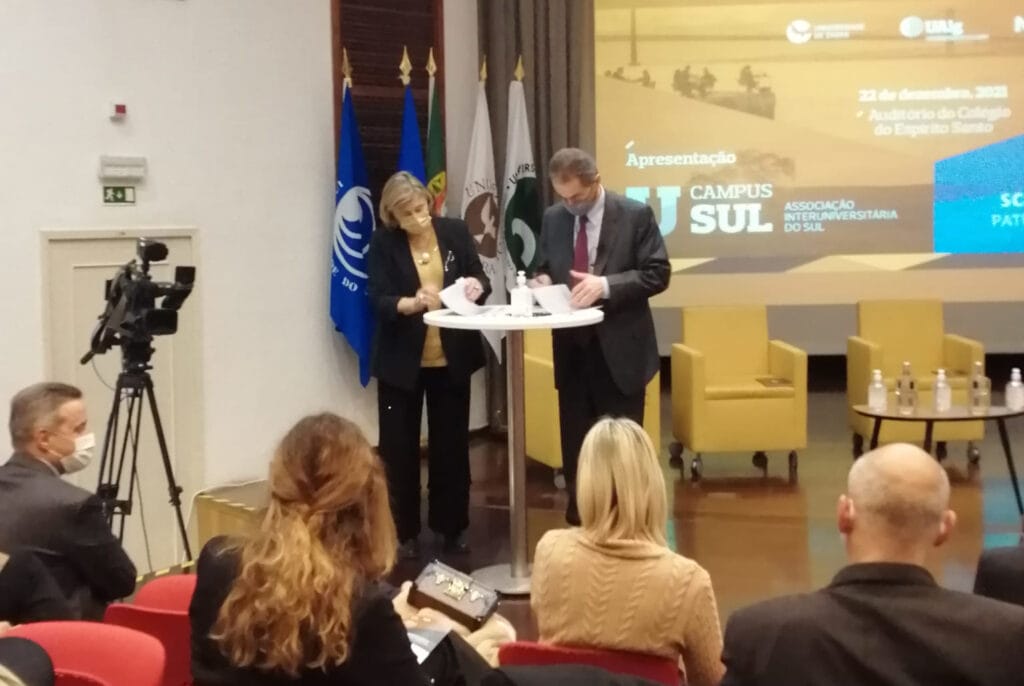
The South Campus - Interuniversity Association of the South was presented was publicly announced on December 22, 2021, in the Auditorium of the Colégio do Espírito Santo at the University of Évora. InPP's executive director was one of the speakers at the afternoon session (Science Day@South). Pedro Fevereiro spoke on the panel “Earth Research and Social Innovation”, with a presentation entitled “Innovative Bio-based Solutions for Crop Protection”.

Read more on the Innovation component of the South Campus and on the priority CAIS, including MASSA.

InnovPlantProtect (InPP) would like to wish the entire team, Associates and partners Happy Holidays by sharing the Christmas Tree set up by CoLAB's newly created sustainability team, InPP Greeners.

The maritime pine (Pinus pinaster) was purchased locally from the Elvas Volunteer Fire Brigade for a symbolic price, helping to raise funds for the organization, which collects the trees for the benefit of the Serra de São Mamede forest.

It is decorated with repurposed laboratory materials, including reused paper ribbons and recycled cardboard balls.

Follow the team on @InPPGreeners

The Elvas Volunteer Fire Brigade is selling the pine trees at a symbolic price of €5 and €10. The maritime pine is widely used in Portugal as a Christmas tree. Plastic, paper and cardboard, among other materials, were reused in the decorations.

InnovPlantProtect is participating in three ideas that applied to the Recovery and Resilience Plan (PRR) measure “Mobilizing Agendas for Business Innovation - Proposals for the Economy of the Future”, which have been selected to move on to phase two of the process: InsectERA, the Blue Bioeconomy Pact and OesteFruta 4.0.

OesteFruta 4.0 is a mobilizing agenda for fruit growing in the West. The aim is to provide the region and the sector with tools that will enable them to face current and future challenges, with a focus on the Rocha pear and the Alcobaça apple. The consortium is led by Atlantic Portuguese Apple - Clube da Maçã and the idea, presented on Friday in Leixões by Armando Torres Paulo, corresponds to a total investment of €97 million.

The public session to present the Mobilizing Agendas took place on December 2nd and 3rd at the Port of Leixões Cruise Terminal. At the day 3 Daniel Murta, CEO of Ingredient Odyssey, and Tiago Pitta e Cunha, representing Inovamar, which is leading the Blue Bioeconomy Pact. This idea, which corresponds to a total investment of €220 million, aims to reindustrialize the blue bioeconomy by creating new economic models based on the use of marine bio-resources, as well as creating the first blue bioeconomy in the world. hub european blue bioeconomy.

The InsectERA agenda, which involves a total investment of €57 million, aims to apply circular economy concepts to the insect industry. The idea is to return by-products from the agro-industry, and some agricultural and urban waste, to the value chain in the form of nutritional solutions for people, animals and plants, as well as new industrial solutions, from cosmetics to bioplastics.

The information is public and can be consulted on the from IAPMEI.