News & Events

white plant

NEWS

Beyond strategy: The secret ingredient of innovation

On the path to success, organizations define strategies, plan each step, and invest in crucial resources such as the sale of services and products, project applications, the development of solid business plans, and the protection of intellectual property. However, there is an often-neglected element that is fundamental to the flourishing of innovation: serendipity. But what exactly is this mysterious force, and why is it so vital to advancing agriculture and so many other areas?

When chance opens doors: The power of unplanned discovery

Serendipity lies in the art of finding something valuable when looking for something else. It's the unintentional discoveries that arise from unexpected situations. Throughout history, some of the most transformative innovations have not been the result of a rigorous plan, but rather of a fortuitous encounter with the unknown. Although deliberate research and methodical experimentation are pillars of scientific and technological progress, openness to the unexpected proves to be a powerful catalyst. When researchers cultivate this openness, they often come across revelations that have the potential to revolutionize entire industries, transform technologies, and expand our understanding of the world around us.

A close look at the “error”: The genesis of an innovative biofungicide

Today, we unveil the surprising and inspiring story of Maria Miguel, a talented researcher from the InPP's New Biopesticides Department, whose insight transformed a fortuitous event into a discovery of inestimable value: a broad-spectrum biofungicide capable of combating Botrytis cinerea, the relentless fungus responsible for the devastating gray mold disease in tomato plants. This pathology represents one of the greatest phytosanitary challenges in tomato cultivation, especially when grown in greenhouses, causing significant losses to producers if not controlled in a timely manner.

From discard to discovery: An investigator's insight

The journey of this discovery began in a scenario familiar to any researcher: the observation of Petri dishes, used to grow cell or microorganism cultures. In Maria Miguel's Petri dishes, colonies of the fungus Botrytis cinerea were growing, intentionally introduced there for study. However, something else caught her attention: one of the plates was contaminated by mold, and curiously, a clear zone surrounded this intruder. Instead of discarding the plate and ignoring it as mere contamination, Maria Miguel decided to investigate the reason behind that clear area. Her curiosity revealed that the mold had a surprising ability to inhibit the growth of Botrytis cinerea in its vicinity.

“Sometimes we look at something and think it's a mistake. The truth is that within a failure, there can be something good,” shares the researcher. The emotion and enthusiasm of a researcher when realizing that what at first seemed like an obstacle, a negative result, can actually be an opportunity, is contagious. For Maria Miguel, this “error” transformed into a serendipitous discovery with enormous potential.

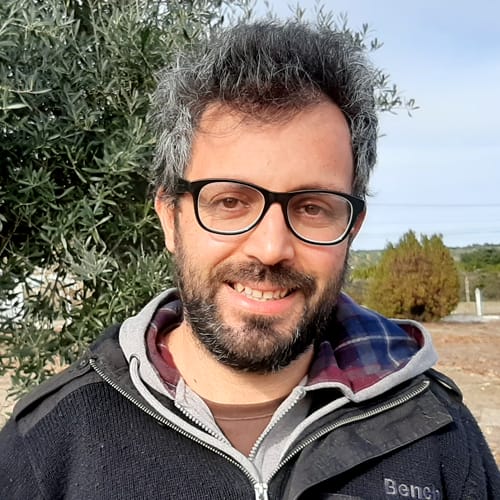
Maria Miguel, a researcher at the InPP's Department of New Biopesticides, transformed an unexpected event into a groundbreaking discovery: a broad-spectrum biofungicide to combat gray mold in tomato plants.

Beyond chance: The active ingredients of scientific discovery

As the story of this biofungicide demonstrates, the world of science is full of examples of discoveries that arose from the unexpected. One of the most famous cases is the discovery of penicillin by Alexander Fleming in 1928. While observing Petri dishes, Fleming noticed that a mold was producing a substance that eliminated Staphylococcus aureus bacteria around it. He identified the mold as Penicillium notatum and named his revolutionary antibiotic penicillin. Penicillin ended up becoming an extremely important drug for fighting infections.

However, chance is not the only protagonist of these important revelations. “Sometimes we have to follow our intuition and be able to prove that we are right or wrong,” explains Maria Miguel. In addition to intuition, a generous dose of curiosity, an open mind to accept unexpected results, a solid scientific knowledge, and the ability to see and advance to further investigations on surprising results play a crucial role in the alchemy of discovery.

The ecosystem of discovery: Fostering an environment conducive to innovation

There are other ingredients that contribute to the recipe for scientific success:

  • Creativity: The ability to generate new perspectives, concepts, questions, or solutions, and the willingness to explore existing ideas under a new light.
  • Flexibility: The courage to venture into unknown territories without fear of failure, thus increasing the odds of serendipitous encounters.

But no discovery flourishes in isolation. At InPP, the strong team spirit and culture of collaboration transcend departmental boundaries. Maria Miguel's discovery is a testament to this synergy, as she herself acknowledges: “My colleagues opened doors so that I could do my research.”

To foster innovation, organizations need to cultivate an environment that stimulates open discussions and connects people from diverse areas of knowledge and life experiences, without judgment; that encourages curiosity and receptiveness to new experiences; and that promotes a relentless pursuit of improving scientific knowledge, the fertile ground where serendipity can germinate.

Sowing the future: The impact of a discovery and the path of research

Although Maria Miguel is about to embark on a new journey, driven by a prestigious Marie Skłodowska-Curie doctoral fellowship - a program that supports the career of researchers and promotes excellence and innovation in research - her legacy at InPP is already flourishing. Her innovative discovery is opening new and promising doors for future research in the area of crop protection, demonstrating how, at times, it is in the unexpected that the potential to transform our world lies.

Beyond strategy: The secret ingredient of innovation

On the road to success, organizations define strategies, plan every step and invest in crucial resources such as selling services and products, applying for projects, drawing up solid business plans and protecting intellectual property. However, there is an element that is often overlooked, but which is fundamental to the flourishing of innovation: serendipity. But what exactly is this mysterious force and why is it so vital to the advancement of agriculture and so many other areas?

When chance opens doors: The power of unplanned discovery

Serendipity is the art of finding something valuable when you're looking for something else. It's the unintentional discoveries that arise from unexpected situations. Throughout history, some of the most transformative innovations have not been the result of a rigorous plan, but rather a chance encounter with the unknown. While deliberate research and methodical experimentation are pillars of scientific and technological progress, openness to the unexpected proves to be a powerful catalyst. When researchers cultivate this openness, they often stumble upon revelations that have the potential to revolutionize entire industries, transform technologies and expand our understanding of the world around us.

A close look at “error”: The genesis of an innovative biofungicide

Today, we unveil the surprising and inspiring story of Maria Miguel, a talented researcher from InPP's New Biopesticides Department, whose acumen turned a chance event into a priceless discovery: a broad-spectrum biofungicide capable of combating the Botrytis cinerea, the relentless fungus responsible for the devastating gray rot disease in tomato plants. This pathology represents one of the biggest phytosanitary challenges in tomato cultivation, especially when grown in greenhouses, causing significant losses to producers if it is not controlled in good time.

From discard to discovery: The insight of a researcher

The journey of this discovery began in a setting familiar to any researcher: the observation of Petri dishes, used to grow cultures of cells or microorganisms. On Maria Miguel's plates, colonies of the fungus Botrytis cinerea were growing, intentionally introduced there for study. However, something else caught her eye: one of the plates was contaminated by mold, and curiously, a clear area surrounded this intruder. Instead of discarding the plate and dismissing it as mere contamination, Maria Miguel decided to investigate the reason behind the clear area. Her curiosity revealed that the mold had a surprising ability to prevent the growth of Botrytis cinerea in its vicinity.

“Sometimes we look at something and think it's a mistake. The truth is that in a failure there can be something good,” the researcher shares. The excitement and enthusiasm of a researcher realizing that what at first glance seemed like an obstacle, a negative result, could actually be an opportunity, is contagious. For Maria Miguel, this “mistake” turned into a serendipitous discovery with enormous potential.

Maria Miguel, a researcher at InPP's New Biopesticides Department, who turned an unexpected event into a discovery that changed the course of her work: a broad-spectrum biofungicide to combat gray rot in tomato plants.

Beyond chance: The active ingredients of scientific discovery

As the history of this biofungicide shows, the world of science is full of examples of discoveries that came out of the blue. One of the most famous cases is Alexander Fleming's discovery of penicillin in 1928. While observing Petri dishes, Fleming noticed that a mold was producing a substance that eliminated bacteria Staphylococcus aureus around him. He identified the mold as Penicillium notatum and named his revolutionary antibiotic penicillin. Penicillin ended up becoming an extremely important medicine for fighting infections.

However, chance is not the only protagonist of these important revelations. “Sometimes we have to follow our intuition and be able to prove ourselves right or wrong,” explains Maria Miguel. In addition to intuition, a generous dose of curiosity, an open mind to accept unexpected results, solid scientific knowledge and the ability to see and move on to further research into surprising results play a crucial role in the alchemy of discovery.

The discovery ecosystem: Fostering an environment conducive to innovation

There are other ingredients that contribute to the recipe for scientific success:

  • Creativity: The ability to generate new perspectives, concepts, questions or solutions, and the willingness to explore existing ideas in a new light.
  • Flexibility: The courage to venture into unknown territory without the fear of failure, thus increasing the chances of serendipitous encounters.

But no discovery flourishes in isolation. At InPP, the strong team spirit and culture of collaboration transcend departmental boundaries. The case of Maria Miguel's discovery is testimony to this synergy, as she herself acknowledges: “My colleagues opened doors so that I could do my research”.

To foster innovation, organizations need to cultivate an environment that encourages open discussions and connects people from different areas of knowledge and life experiences, without judgment; that encourages curiosity and receptiveness to new experiences; and that promotes an incessant quest to improve scientific knowledge, the fertile ground where serendipity can germinate.

Sowing the future: The impact of a discovery and the path of research

Although Maria Miguel is about to embark on a new journey, boosted by a prestigious Marie Skłodowska-Curie PhD scholarship - a program that supports the careers of researchers and promotes excellence and innovation in research - her legacy at InPP is already flourishing. Her groundbreaking discovery is opening promising new doors for future research in the field of crop protection, demonstrating how sometimes it is in the unexpected that the potential to transform our world lies.

In the March issue of Fruits, vegetables and flowers you will find the opinion article entitled “The role of InnovPlantProtect in Organic Farming: Paths to sustainable and efficient solutions”, in which the executive director of InnovPlantProtect (InPP), António Saraiva, reveals how our CoLAB is contributing to the success of organic farming.

“By boosting research, collaboration and knowledge sharing, InPP is helping to solve the central challenges of this practice [organic farming], allowing it to expand and enhancing the supply of agricultural products to consumers. The solutions developed by InPP make organic farming a more viable option for producers,” says the executive director.

Read the full article and find out how we are shaping the future of agriculture.

We thank Frutas, legumes e flores magazine for its recognition and reiterate our commitment to the agriculture of the future.

EVENTS

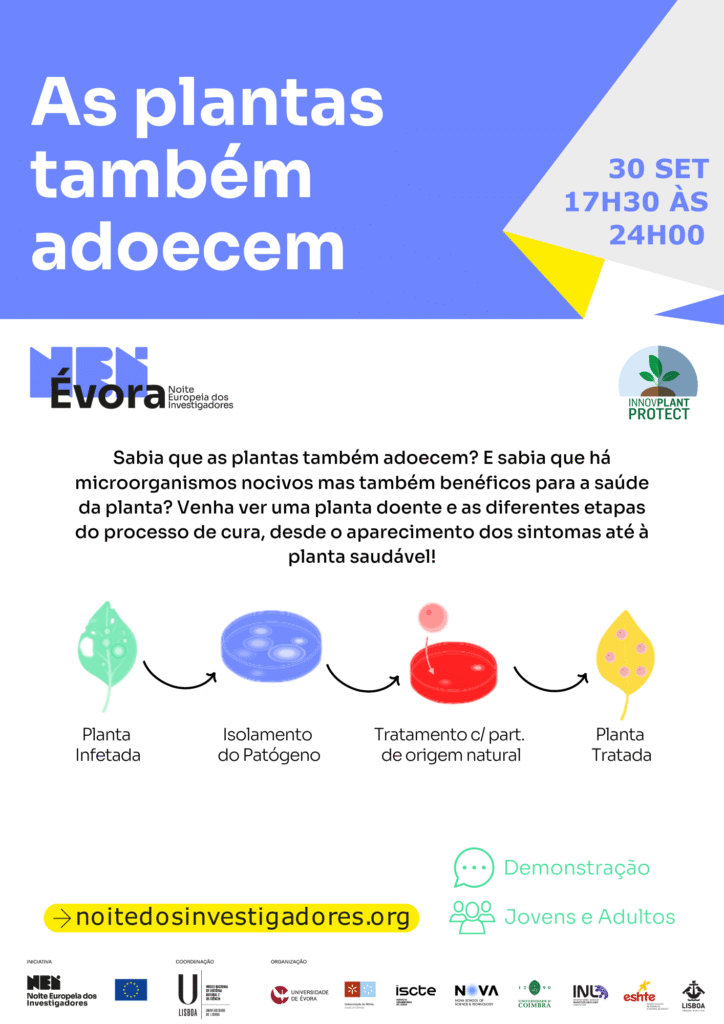
Será que os insetos também têm ciclo de vida? Já conhece o ciclo de vida da traça da colmeia? Ou sabia que as plantas também adoecem ou que existem microrganismos nocivos mas também benéficos para a saúde das plantas? Venha descobrir as respostas a todas estas questões já na próxima sexta-feira, dia 30 de setembro, na Noite Europeia dos Investigadores (NEI) 2022. Entre as 17h30 e as 00h, os investigadores e investigadoras do InPP vão marcar presença na Praça do Giraldo, em Évora.

O InPP estará no stand EU-Corner 4 e este será o ponto de encontro entre os investigadores e todos aqueles que querem descobrir a ciência que é desenvolvida no nosso laboratório colaborativo. Nesta noite vai poder participar em duas atividades científicas: na primeira vai poder descobrir o incrível ciclo de vida da traça da colmeia e na segunda vai poder ver uma planta doente e todo o processo de cura.

Entre jogos, debates, demonstrações, conversas, workshops, visitas, exposições e tertúlias, são muitas as atividades de diversas instituições científicas para explorar nesta festa da ciência.

A participação é gratuita.

Junte a família e venha ter connosco a esta festa da Ciência! Contamos com a sua visita!

Consulte a programação completa de atividades presenciais de Évora here.

A NEI ocorre todos os anos e tem o objetivo de partilhar o trabalho dos investigadores com o público em geral. O tema para o ano de 2022 é “Ciência para Todos – Sustentabilidade e Inclusão”.

Um artigo publicado recentemente pela equipa do InnovPlantProtect (InPP) revela o potencial dos métodos computacionais de machine learning para prever características fenotípicas, como é o caso do rendimento/produtividade do trigo, a partir de informações genéticas desta planta.

O machine learning (ML) é uma área da ciência de dados que tem ganho cada vez mais relevância na última década. O ML é um ramo da inteligência artificial que permite o desenvolvimento de modelos de previsão que podem ser aplicados nas mais variadas áreas. Apesar de não nos apercebermos, utilizamos ferramentas baseadas em ML no nosso dia-a-dia, como por exemplo, os resultados personalizados apresentados no feed do seu Facebook. Mas as aplicações futuras vão desde permitir a condução autonoma até à deteção de doenças através da análise de radiografias (em humanos) ou imagens de drone (em pomares).

A predição genómica (PG) é outra das áreas em que o ML tem estado a ser aplicado. Esta consiste em usar dados genómicos (que nos dão informação acerca do genótipo) para desenvolver modelos computacionais que prevêem características fenotípicas complexas dos organismos, tal como rendimento/produtividade do trigo (Ver representação esquemática).

Nesta investigação agora publicada na revista científica Agriculture, os investigadores Manisha Sirsat e Ricardo Ramiro, ambos do departamento de Gestão de Dados e Análise de Risco, em colaboração com a Paula Oblessuc do departamento de Proteção de Culturas Específicas, exploraram a utilização de vários modelos de PG baseados em diferentes métodos computacionais para além do ML, como é o caso dos métodos estatísticos ou de deep learning (DL), com o objetivo de comparar a robustez e a performance de cada um deles em prever a característica fenotípica rendimento/produtividade do trigo. A ideia foi perceber quais os métodos que permitem prever características fenotípicas com maior fiabilidade.

“Os métodos estatísticos têm sido os mais utilizados em predição genómica pelas equipas de investigação em todo o mundo. Contudo, os métodos de ML estão a revelar-se uma boa alternativa, sendo mais precisos e rápidos”, evidencia Manisha Sirsat, primeira autora do estudo.

“A PG baseada em ML pode ajudar a reduzir o tempo e o custo da avaliação extensiva do processo de fenotipagem (durante os programas de melhoramento) e a acelerar o ganho genético”, explica a investigadora. “Este estudo contribui assim para ajudar os investigadores a perceber os fatores chave no desenvolvimento de modelos que possam acelerar os programas de melhoramento do trigo, ou de outras culturas, e a aumentar a produtividade agrícola”, acrescenta.

Representação esquemática do processo de predição genómica

A equipa tem estado a trabalhar em predição genómica desde 2020, e espera que a genómica e a predição genética sejam fundamentais para permitir manter ou aumentar a produtividade das culturas, apesar das múltiplas ameaças que enfrentamos, e para responder ao aumento de 50% na procura por alimentos até 2050, quando a população mundial atingir 9,7 mil milhões.

O estudo foi cofinanciado por fundos europeus, através do Programa Alentejo2020, e pela Foundation for Science and Technology.

Investigadores Manisha Sirsat, Ricardo Ramiro e Paula Oblessuc (da esquerda para a direita)

Original article

Revista Agriculture

Genomic Prediction of Wheat Grain Yield Using Machine Learning

Manisha Sirsat e Ricardo Ramiro

DOI: https://doi.org/10.3390/agriculture12091406

No passado dia 31 de Agosto, a diretora de departamento Cristina Azevedo esteve no Dia Aberto do Arroz – “A cultura do arroz no Baixo Mondego”, organizado pelo Pólo de Inovação de Coimbra da Direção Regional de Agricultura e Pescas do Centro (DRAPCentro), e que teve lugar no Campo do Bico da Barca, em Montemor-o-Velho. A iniciativa pretendeu dar a conhecer o que de mais inovador se tem feito ao nível da cultura deste cereal. 

Durante o Dia Aberto, que contou com a colaboração de várias entidades e empresas ligadas ao setor da cultura do arroz, os participantes visitaram ensaios e campos de arroz, ficaram a conhecer um ensaio de novas variedades deste cereal, que está a avaliar o comportamento agronómico das cultivares e a determinar o seu rendimento industrial, e um novo fertilizante – CHAMAE – desenvolvido pela Lusosem, Syngenta, Bayer CropScience e DRAP Centro, que está a ser testado para esta cultura.

Os visitantes tiveram ainda a oportunidade de experienciar o incrível trabalho que tem sido realizado pelo INIAV, IP na conservação e melhoramento desta cultura, bem como um sistema em modo de produção biológico, no qual a Lusosem e a Associação de Beneficiários da Obra de Fomento Hidroagrícola do Baixo Mondego (Abofhbm) estão a testar novas tecnologias inovadoras e sustentáveis de sementeira e controlo de infestantes.

No âmbito da cultura do arroz, o departamento de Novos Biopesticidas, liderado por Cristina Azevedo, tem estado a trabalhar no desenvolvimento de biopesticidas para o controlo da piriculariose, uma das doenças que mais afeta este cereal, e, no passado mês de Agosto já recolheu duas amostras de arroz infetado na bacia do Mondego (em Montemor-o-Velho) e do Tejo/Sorraia (em Coruche e Porto Alto, em Samora Correia). A equipa planeia amostrar ainda este ano na zona do Sado.