Como podemos compreender melhor o estado de saúde das árvores e antecipar situações de stress hídrico ou ambiental?
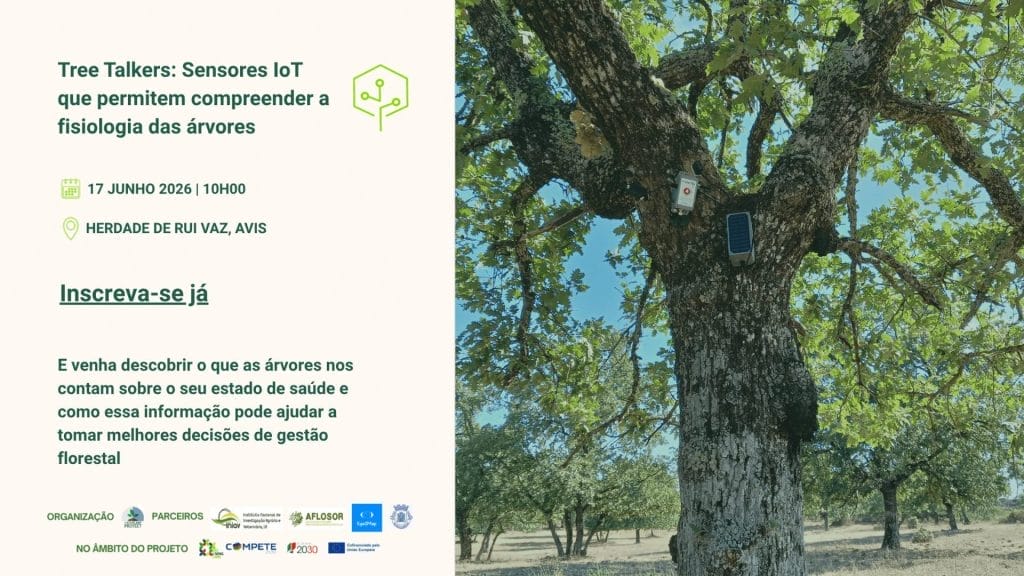
No próximo dia 17 de junho, o InnovPlantProtect promove a sessão prática “Tree Talkers: Sensores IoT que permitem compreender a fisiologia das árvores”, uma iniciativa que permitirá conhecer uma tecnologia inovadora para monitorização florestal em tempo real.
Os Tree Talkers são um sistema avançado de sensores IoT capaz de recolher continuamente diversos dados sobre a fisiologia das árvores, como crescimento radial, velocidade do fluxo da seiva, densidade da copa, estabilidade das árvores, bem como informação sobre as condições ambientais envolventes.
Esta tecnologia permite acompanhar o estado de saúde das árvores e compreender melhor o funcionamento dos ecossistemas florestais, apoiando uma gestão mais informada e sustentável.
Durante a sessão, os participantes terão oportunidade de
Conhecer a tecnologia TreeTalkers e as suas aplicações;
Visualizar exemplos de resultados obtidos através da monitorização contínua das árvores;
Compreender como os dados recolhidos podem apoiar a gestão florestal;
Assistir a uma demonstração prática em campo, numa floresta de sobreiros.
Receção dos participantes| 09H30
Presentations | 10H00
Conter a desertificação com a gestão e conservação do montado e da floresta mediterrânica caducifólia
TreeTalker Cyber: o sensor IoT que ouve as mudanças nas árvores
No interior da árvore. Compreender o stress através dos dados
O que as árvores nos dizem: dos dados à informação
Beberete e momento de networking | 11H30
Demonstração em campo | 11H45
A participação é gratuita, mas sujeita a inscrição prévia. Para se inscrever basta preencher o formulário disponível here.
Marque na sua agenda e junte-se a nós! Teremos todo o gosto em recebê-lo/a!
📅 Data: 17 de junho de 2026 🕙 Hora: 10h00 📍 Local: Herdade de Rui Vaz, Avis
Esta ação realiza-se no âmbito do projeto BioLivingLABS: Bioeconomy at the service of the sustainability of inland territories, cofinanciado pelo COMPETE 2030, que visa aproximar a ciência das empresas e dos produtores, transformando os resultados da investigação em soluções práticas e sustentáveis que tragam valor económico e ambiental aos territórios de baixa densidade das regiões Norte, Centro e Alentejo.
O consórcio integra cinco instituições de investigação e inovação – o Instituto Politécnico de Bragança (IPB), the Polytechnic Institute of Castelo Branco (IPCB), o Laboratório Colaborativo Montanhas de Investigação (MORE CoLAB), o InnovPlantProtect e o Centro de Valorização e Transferência de Tecnologia da Água (AquaValor).
Os Laboratórios Colaborativos geraram 261,6 milhões de euros de Valor Acrescentado Bruto (VAB) em Portugal. Saiba como o InnovPlantProtect e os parceiros do setor estão a transformar a ciência em valor real para o campo.
Já está disponível para consulta e download o estudo integral “Impacto Socioeconómico dos Laboratórios Colaborativos (CoLABs)”. Promovido pelo Fórum dos Laboratórios Colaborativos (FCoLAB), em parceria com a Porto Business School (PBS), o relatório quantifica e valida o contributo destas estruturas como pontes determinantes entre o conhecimento científico e as necessidades concretas do tecido empresarial.
Os Números do Impacto Nacional
Os resultados demonstram que o investimento na inovação colaborativa apresenta um retorno sólido para a economia e para a sociedade civil. Entre os principais indicadores destacados pelo estudo, destacam-se:
Criação de Valor: Os CoLABs foram responsáveis pela geração de 261,6 milhões de euros de Valor Acrescentado Bruto (VAB) in Portugal.
Sustentabilidade do Emprego: Foram sustentados 2.178 postos de trabalho diretos, indiretos e induzidos.
Retorno do Investimento Público: Entre 2021 e 2025, o investimento público de 115 milhões de euros traduziu-se numa receita pública estimada em 92,8 milhões de euros (cerca de 81% do financiamento recebido).
Capacidade de Mobilização: Só no âmbito do PRR, os CoLABs mobilizaram mais de 300 milhões de euros em inovação colaborativa e captaram mais de 28 milhões de euros em projetos Horizon Europe.
O Papel Estratégico do Setor Agroalimentar e Florestal
O estudo dedica especial atenção a áreas críticas para a resiliência do país, reconhecendo o papel dos CoLABs na valorização do conhecimento e na transferência de tecnologia no setor Agroalimentar e Florestal. Atualmente, esta área estratégica integra oito Laboratórios Colaborativos que trabalham de forma complementar para responder aos desafios da sustentabilidade, segurança alimentar e adaptação às alterações climáticas:
“Os resultados deste estudo demonstram que os CoLABs geram impacto económico real e têm um papel decisivo na ligação entre conhecimento científico e aplicação prática. No setor agroalimentar e florestal, esta missão é especialmente importante, porque os desafios ligados à sanidade vegetal, sustentabilidade dos sistemas produtivos e adaptação às alterações climáticas exigem inovação colaborativa e soluções com aplicação prática.”— António Saraiva, Diretor Executivo do InnovPlantProtect.
Como infraestruturas de interface, estas oito entidades — InnovPlantProtect (InPP), MORE CoLAB, FeedInov, Smart Farm CoLAB, Food4Sustainability, Vines & Wines, ForestWISE e Colab4Food — atuam em contextos de incerteza técnica ou falhas de mercado, capacitando o tecido empresarial com soluções que de outra forma estariam fora do alcance do mercado produtor tradicional.
Convidamos todos os nossos parceiros, produtores, investigadores e agentes do setor a analisar o documento na íntegra para compreender a evolução do ecossistema de inovação em Portugal.
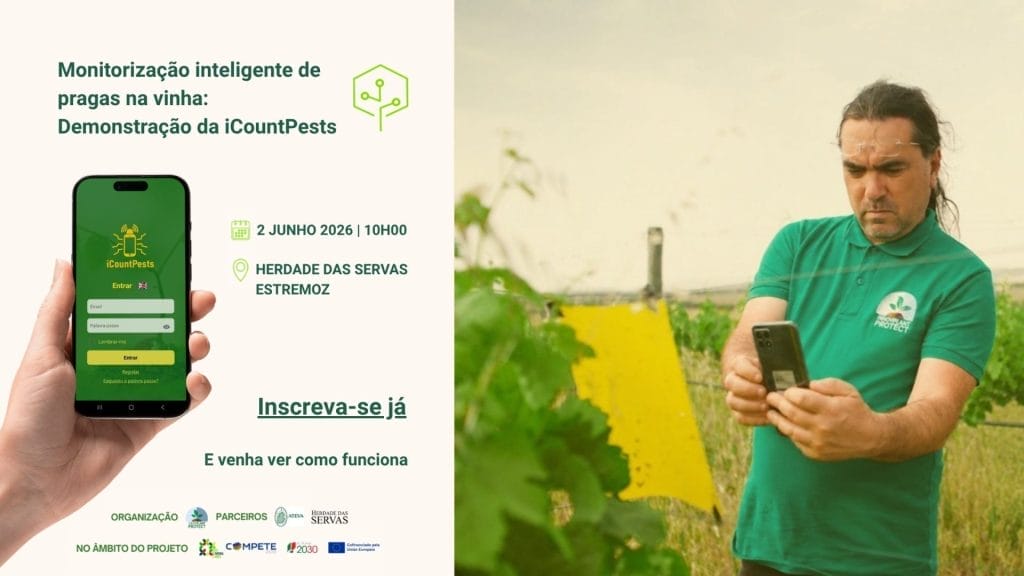
No próximo dia 2 de junho, o InnovPlantProtect (InPP), com o apoio da ATEVA, promove uma sessão de demonstração daiCountPests, uma aplicação móvel que facilita e acelera a monitorização de pragas agrícolas através da análise automática de imagens captadas no campo.
A iniciativa decorre durante a manhã na Herdade das Servas (Estremoz), e é direcionada a produtores e técnicos agrícolas, proporcionando uma oportunidade para conhecer a aplicação em contexto real e perceber o seu potencial para uma monitorização de pragas mais eficiente, rápida e informada na vinha.
Durante a sessão, os participantes poderão:
conhecer as funcionalidades da aplicação
perceber como funciona a análise automática de imagens
assistir a uma demonstração prática em campo da utilização da iCountPests
explorar o potencial da ferramenta no apoio à tomada de decisão agrícola
Lançada recentemente, a iCountPests utiliza inteligência artificial para automatizar a contagem de pragas através de imagens captadas com o telemóvel, reduzindo o tempo associado às contagens manuais e contribuindo para uma monitorização mais eficiente e informada.
Com um foco inicial na vinha, a aplicação permite monitorizar a cigarrinha-verde e a traça-dos-cachos, estando prevista a integração futura de novas pragas e culturas agrícolas.
Programa:
Receção dos participantes | 09H30
Apresentação sobre as pragas cigarrinha-verde (Jacobiasca lybica) e curl moth (Cryptoblabes gnidiella) | 10H00
Nuno Faria | Investigador da área de Monitorização Inteligente de Pragas e Doenças
Apresentação da app iCountPests | 10H20
Ricardo Ramiro | Diretor da área de Ciência dos Dados e Bioinformática
Coffee break e momento de networking | 10H45
Demonstração da app em ambiente real | 11H00
A participação é gratuita, mas sujeita a inscrição prévia. Para garantir uma experiência prática e próxima dos participantes, as vagas são limitadas a 30 participantes. Para se inscrever basta preencher o formulário disponível here.
Marque na sua agenda e junte-se a nós! Teremos todo o gosto em recebê-lo/a!
📅 Data: 2 de junho de 2026 🕙 Hora: 10h00 📍 Local:Herdade das Servas, Estremoz
Esta ação é realizada no âmbito do projeto BioLivingLABS: Bioeconomy at the service of the sustainability of inland territories, cofinanciado pelo COMPETE 2030, que visa aproximar a ciência das empresas e dos produtores, transformando os resultados da investigação em soluções práticas e sustentáveis que tragam valor económico e ambiental aos territórios de baixa densidade das regiões Norte, Centro e Alentejo.
O consórcio integra cinco instituições de investigação e inovação – o Instituto Politécnico de Bragança (IPB), the Polytechnic Institute of Castelo Branco (IPCB), o Laboratório Colaborativo Montanhas de Investigação (MORE CoLAB), o InnovPlantProtect e o Centro de Valorização e Transferência de Tecnologia da Água (AquaValor).
InnovPlantProtect (InPP) is taking part in a European project, coordinated by the University of Minho (UMinho), which aims to create nanobiopesticides and nanobiofertilizers to combat pests in viticulture, protecting the environment, increasing production, reducing costs and tackling climate change. The project is called VINNY, brings together 19 partners from ten countries and will receive 8.3 million euros over the next four years from the Horizon Europe program. The European Union is the world's largest wine producer and is therefore looking to invest in ecological and economically sustainable production based on Portuguese know-how.
The VINNY kick-off meeting took place on July 25 and 26 in Porto and the Douro wine region, in an experimental field at Quinta do Pôpa, and was attended by InPP, represented by the directors of the New Biopesticides and Specific Crop Protection departments Cristina Azevedo and Sandra Correia. Moving from intensive to sustainable viticulture on a global scale and cutting agrochemicals in the sector by 50% are the main objectives of the consortium led by Margarida Fernandes, from the Center for Microelectromechanical Systems (CMEMS) at UMinho's School of Engineering.
The kick-off meeting of the VINNY project brought together all the partners in Porto and the Douro wine region
“We're going to study the microbiomes of vineyards in Portugal, Spain, Austria and Denmark to create potent cocktails with antifungal and plant protection profiles which, through nanoencapsulation and stimulation, will be more stable and effective. We're also going to create biofertilizers with nitrogen, phosphorus and potassium based on by-products from the meat industry and wastewater treatment,” he explains. The project will also propose agrotextiles impregnated with these nanobiofertilizers, as well as testing their efficiency, efficacy and safety in the laboratory, in pilot areas and in the field.
VINNY is expected to give rise to several projects in co-promotion with companies and associations. The project also has a social aspect, establishing the “European Vineyard Network” made up of three Living Labs and a Lighthouse to disseminate sustainable practices to farmers and organizations in the area, thus boosting innovation and sustainability in the primary sector.
At a national level, in addition to InPP, the consortium includes CMEMS (which is joined by the Center for Biological Engineering, as part of the associated laboratory LABBELS), the Center for Molecular and Environmental Biology, all from UMinho, as well as ADVID - Cluster da Vinha e do Vinho, and the communication agency LKCOM. At European level, it brings together five universities, eleven companies and three associations from ten countries. VINNY stands for “Advanced nano encapsulation of bio-based pesticides and fertilizers for a circular and sustainable viticulture”.
On July 24th, Eixo InFrass organized a webinar as part of the New Bioindustry - The future has already begun series of sessions, on the topic of “Agronomic valorization of organic insect fertilizer”.
The Secretary General of the Agenda, António Campos, opened the session and presented the InsectERA Mobilizing Agenda, followed by Sandra Correia, representing InnovPlantProtect as the leader of this WP, who presented the objectives of this axis.
This was followed by Ivã Lopes, from the Swedish University of Agricultural Sciences, who spoke about “The Potential and Advantages of Using Organic Insect Fertilizer”, resulting from the research he is carrying out. This included evaluating the chitin of three insects (black soldier fly, crickets and mealworms).
He concluded his speech by outlining the prospects for using frass:
Frass is an organic fertilizer with similar characteristics to conventional organic compounds... but there are differences!
The concentration of biostimulants in frass seems to be higher than other organics, which results in superior growth and metabolic effects
Frass contains a large amount of chitin, a natural stimulant of plant immunity
Can we consider applying frass alone? Yes. However, combining it with other raw materials results in more significant effects
We need to unravel the mechanisms behind how frass works! To do this: tests and more tests, with partnerships between industry and academia
Frass stimulates microorganisms that affect communication between plants. How can this synergistic effect be optimized?
Clarice Sousa (EntoGreen), Marisa Santos (Thunder Foods) and José Gonçalves (The Cricket) addressed the topic “Innovative Production of Organic Fertilizers: Insect Companies Present Sustainable Solutions”, which focused on the technical aspects of producing black soldier fly, tenebrio and cricket (Acheta domesticus), including the physical and chemical composition of the frass.
Sara Campos, from INEGI, presented “Challenges and Solutions in Frass Processing: Efficiency and Regulation”, addressing the issue of experimental analyses of frass quality, with variations in time and temperature and the technologies/processes used by partners for heat treatment, recalling that the work underway is for the development and application of new methods for processing insect excrement (frass) that comply with European standards and increase the efficiency of the process in terms of time and energy, without jeopardizing the quality obtained.
Ana Rita Caranova, from the DGAV, spoke about the “Legal Framework for Farmed Insect Excrement, its Treatment and Use”. She began by presenting the DGAV, its Mission and Vision. He then outlined the Agenda, in particular the legal issues, such as technical clarifications, meetings with partners, clarifications and the preparation of material to support the interpretation of the legislation in force. He referred to the definition of frass, as well as the legal requirements for placing frass on the market, as FOCOS (Organic Fertilizer and Organic Soil amendment), supported by Regulation (EU) 142/2011, points a), b), d) and e) of section 2, Chapter I, Annex XI.
He finished by referring to labeling, transport and placing on the market, which are covered by specific regulations.
Regina Menino and António Cordeiro, from INIAV, developed “Frass as an Organic Fertilizer”. Regina Menino began the presentation by saying that frass is being used in various greenhouse and field trials, with the aim of assessing its agronomic potential (both in soils and in different crops). She also mentioned the trials in pots, which are being carried out using ryegrass as a model crop, and whose aim is the agronomic enhancement of frass from different origins.
António Cordeiro presented information on the work being carried out in the olive grove field trials - hedged and intensive, and in partnership with Nutrifarms. There are many expectations in terms of monitoring and analyzing the results.
Ricardo Ramiro and Leonor Martins, from InnovPlantProtect, presented “The Impact of Frass on Plant and Soil Health”. Trials are being carried out which include assessing the effect of different frass: on vegetables (physiological parameters and crop productivity), on corn (physiological parameters and growth assessment), and on the susceptibility of different crops to diseases, by carrying out controlled infection trials. The effect of different frass on the microbiome of different crops will also be tested.
The intervention culminated in a very important question: Frass: a new tool for manipulating the microbiome? Since frass is rich in organic matter, macro- and micronutrients, with chitin being a key component, the properties of frass vary according to several factors:
insects' diet
application of treatments (e.g. temperature)
incorporation of other products
==> such versatility could allow for customized applications
The application of frass to the soil leads to an increase in the abundance of organisms capable of degrading chitin (e.g. Actinobacteria; Bacillus; Mortierellomycetes), with multiple benefits for the plant.
Diogo Cardoso, from the University of Aveiro, closed the presentations with the topic “Analysis of Soil Functionality and Ecosystem Services with the Use of Insect Frass: Sustainability and Impact Assessment”. He began by highlighting the problem of food sustainability for the global population and the need to adopt more sustainable agricultural practices. This is where organic fertilizer (Insect frass) can come in, boosting enzymatic activity, benefiting soil health, making it biologically active, with high microbial activity and good nutrient recycling. It is in this context that laboratory work is being carried out to assess the impact of frass on soil and plants, and on soil leaching. Tests are also being carried out in greenhouses and in the field.





 Português
  English