On September 18, the executive director of InnovPlantProtect (InPP), António Saraiva, the director of the New Biopesticides Department, Cristina Azevedo, and researcher Luís Grilo attended the Open Day “The Cereals of Baixo Mondego”, promoted by the Centro Regional Coordination and Development Commission (CCDR Centro), at the Bico da Barca Experimental Unit in Montemor-o-Velho.
The event highlighted the latest innovations from the Coimbra Innovation Hub, from new technologies applied to maize and rice, to fertilization strategies, protection and the use of biostimulants on these key crops in the Baixo Mondego region.
Our team also monitored trials with biofungicides, including the product I21, developed with our collaborative laboratory to combat pyriculariosis in two rice varieties, which is being patented.
In an interview with Voice of the Countryside, Cristina Azevedo shared the work we have been doing in the area of biosolutions.
Maize continues to be the Portugal's most important arable crop, The sector has a significant impact on food safety and the national agri-food industry. Involving thousands of producers and generating tens of millions of euros a year, the sector is currently facing increasingly complex phytosanitary challenges.
Among already known pests and emerging diseases, there are risks ranging from cartridge caterpillar until Maize Rugose Dwarfism Virus (MRDV), The presence of this virus is increasing in Portugal. This virus, transmitted by the corn leafhopper, can seriously compromise production and is found in the climate change increasingly favorable conditions for its spread.
However, it's not just MRDV that's worrying. There are new threats that require vigilance, such as the coleopter Diabrotica virgifera or the MDMV virus (Maize Dwarf Mosaic Virus), already detected in neighboring countries, and also toxic weeds, such as the winter fig (Datura stramonium), which in addition to impacting productivity pose public health risks.
Faced with this reality, the answer is integrated and sustainable strategies, matching:
crop rotation and good agricultural practices;
careful use of insecticides to avoid resistance and environmental impacts;
resistant or tolerant varieties, where available;
research and technological innovation, including new digital tools for early detection.
As the InnovPlantProtect researcher points out, Nuno Faria, in the article entitled “The main emerging pests and diseases of the maize crop in Portugal”, available in the August edition of Voz do Campo magazine: “The phytosanitary panorama of maize in Portugal requires continuous vigilance, investment in research and the application of integrated and sustainable strategies capable of responding to an increasingly dynamic and unpredictable reality.”
To find out more about the main current risks and mitigation measures, read the full article published in the August issue of Voz do Campo magazine (pages 88-89), available on newsstands and online.
InnovPlantProtect (InPP) is pleased to announce the publication of an international patent application (PCT) for a strain of Bacillus velezensis with application as a plant biostimulant. This innovation represents a significant milestone in our research, with a direct impact on sustainable agriculture and crop resilience in the face of climate and environmental challenges.
A natural and effective solution
The biostimulant developed by our team has been carefully studied and tested on different vegetable crops, such as tomatoes and lettuce, and on cereals, such as rice. The results obtained demonstrate the potential of this technology:
Greater development in the early stages of crops, This promotes more vigorous and healthy starts.
Increased productivity, This is evidenced by greater fresh biomass in lettuce and greater fruit production in tomatoes.
Proven molecular responses, with analyses confirming the activation of genes associated with plant responses to different types of abiotic stress.
These results reinforce the effectiveness of the Bacillus velezensis as a natural biostimulation tool, capable of boosting crop performance and contributing to more sustainable agriculture.
From the lab to the field
This patent is another step in InPP's commitment to developing innovative, sustainable biotechnological solutions with industrial applicability. The aim is clear: to support farmers and companies in the sector in meeting the challenges of crop productivity, quality and resilience, in an era when agriculture needs sustainable, high-impact responses.
We are looking for strategic partnerships
We are currently looking for new partnerships with companies and entities in the agricultural sector to take this technology from the laboratory to the field. We believe that collaboration is the key to turning scientific innovation into practical solutions that benefit the entire agricultural value chain.
If you're interested in learning more about this technology or exploring opportunities for collaboration, talk to us. Together we can drive a more productive, resilient and sustainable agriculture.
Innovate together. Protect better.
Image credits: InnovPlantProtect - Inês Ferreira (Photos from left to right: Sandra Caeiro and Rui Figueiras, researchers from the Specific Crop Protection Department and Inês Mexia, researcher from the Formulations and Process Development Department.
Beyond strategy: The secret ingredient of innovation
On the road to success, organizations define strategies, plan every step and invest in crucial resources such as selling services and products, applying for projects, drawing up solid business plans and protecting intellectual property. However, there is an element that is often overlooked, but which is fundamental to the flourishing of innovation: serendipity. But what exactly is this mysterious force and why is it so vital to the advancement of agriculture and so many other areas?
When chance opens doors: The power of unplanned discovery
Serendipity is the art of finding something valuable when you're looking for something else. It's the unintentional discoveries that arise from unexpected situations. Throughout history, some of the most transformative innovations have not been the result of a rigorous plan, but rather a chance encounter with the unknown. While deliberate research and methodical experimentation are pillars of scientific and technological progress, openness to the unexpected proves to be a powerful catalyst. When researchers cultivate this openness, they often stumble upon revelations that have the potential to revolutionize entire industries, transform technologies and expand our understanding of the world around us.
A close look at “error”: The genesis of an innovative biofungicide
Today, we unveil the surprising and inspiring story of Maria Miguel, a talented researcher from InPP's New Biopesticides Department, whose acumen turned a chance event into a priceless discovery: a broad-spectrum biofungicide capable of combating the Botrytis cinerea, the relentless fungus responsible for the devastating gray rot disease in tomato plants. This pathology represents one of the biggest phytosanitary challenges in tomato cultivation, especially when grown in greenhouses, causing significant losses to producers if it is not controlled in good time.
From discard to discovery: The insight of a researcher
The journey of this discovery began in a setting familiar to any researcher: the observation of Petri dishes, used to grow cultures of cells or microorganisms. On Maria Miguel's plates, colonies of the fungus Botrytis cinerea were growing, intentionally introduced there for study. However, something else caught her eye: one of the plates was contaminated by mold, and curiously, a clear area surrounded this intruder. Instead of discarding the plate and dismissing it as mere contamination, Maria Miguel decided to investigate the reason behind the clear area. Her curiosity revealed that the mold had a surprising ability to prevent the growth of Botrytis cinerea in its vicinity.
“Sometimes we look at something and think it's a mistake. The truth is that in a failure there can be something good,” the researcher shares. The excitement and enthusiasm of a researcher realizing that what at first glance seemed like an obstacle, a negative result, could actually be an opportunity, is contagious. For Maria Miguel, this “mistake” turned into a serendipitous discovery with enormous potential.
Maria Miguel, a researcher at InPP's New Biopesticides Department, who turned an unexpected event into a discovery that changed the course of her work: a broad-spectrum biofungicide to combat gray rot in tomato plants.
Beyond chance: The active ingredients of scientific discovery
As the history of this biofungicide shows, the world of science is full of examples of discoveries that came out of the blue. One of the most famous cases is Alexander Fleming's discovery of penicillin in 1928. While observing Petri dishes, Fleming noticed that a mold was producing a substance that eliminated bacteria Staphylococcus aureus around him. He identified the mold as Penicillium notatum and named his revolutionary antibiotic penicillin. Penicillin ended up becoming an extremely important medicine for fighting infections.
However, chance is not the only protagonist of these important revelations. “Sometimes we have to follow our intuition and be able to prove ourselves right or wrong,” explains Maria Miguel. In addition to intuition, a generous dose of curiosity, an open mind to accept unexpected results, solid scientific knowledge and the ability to see and move on to further research into surprising results play a crucial role in the alchemy of discovery.
The discovery ecosystem: Fostering an environment conducive to innovation
There are other ingredients that contribute to the recipe for scientific success:
Creativity: The ability to generate new perspectives, concepts, questions or solutions, and the willingness to explore existing ideas in a new light.
Flexibility: The courage to venture into unknown territory without the fear of failure, thus increasing the chances of serendipitous encounters.
But no discovery flourishes in isolation. At InPP, the strong team spirit and culture of collaboration transcend departmental boundaries. The case of Maria Miguel's discovery is testimony to this synergy, as she herself acknowledges: “My colleagues opened doors so that I could do my research”.
To foster innovation, organizations need to cultivate an environment that encourages open discussions and connects people from different areas of knowledge and life experiences, without judgment; that encourages curiosity and receptiveness to new experiences; and that promotes an incessant quest to improve scientific knowledge, the fertile ground where serendipity can germinate.
Sowing the future: The impact of a discovery and the path of research
Although Maria Miguel is about to embark on a new journey, boosted by a prestigious Marie Skłodowska-Curie PhD scholarship - a program that supports the careers of researchers and promotes excellence and innovation in research - her legacy at InPP is already flourishing. Her groundbreaking discovery is opening promising new doors for future research in the field of crop protection, demonstrating how sometimes it is in the unexpected that the potential to transform our world lies.
In the March issue of Fruits, vegetables and flowers you will find the opinion article entitled “The role of InnovPlantProtect in Organic Farming: Paths to sustainable and efficient solutions”, in which the executive director of InnovPlantProtect (InPP), António Saraiva, reveals how our CoLAB is contributing to the success of organic farming.
“By boosting research, collaboration and knowledge sharing, InPP is helping to solve the central challenges of this practice [organic farming], allowing it to expand and enhancing the supply of agricultural products to consumers. The solutions developed by InPP make organic farming a more viable option for producers,” says the executive director.
Read the full article and find out how we are shaping the future of agriculture.
We thank Frutas, legumes e flores magazine for its recognition and reiterate our commitment to the agriculture of the future.
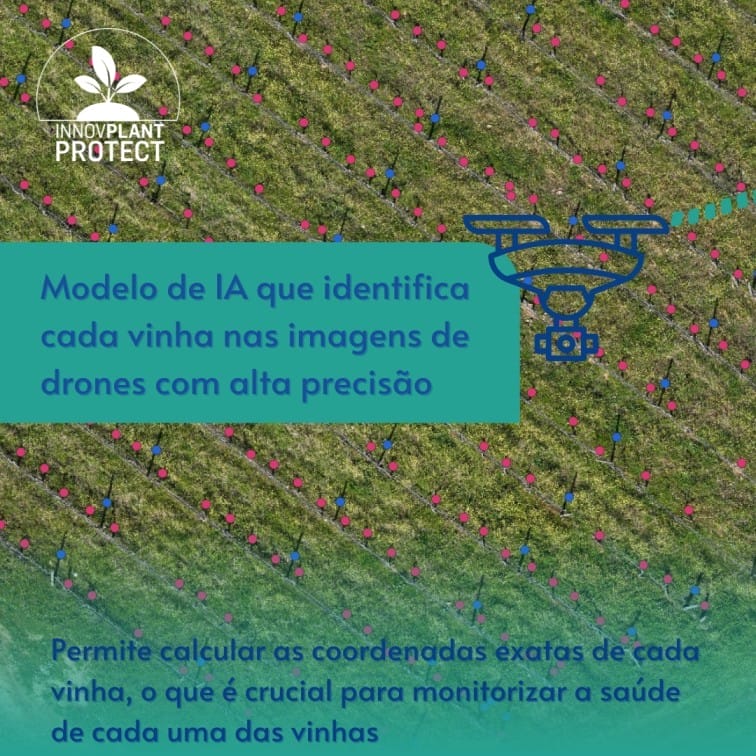
Imagine a future where drones and artificial intelligence work together to protect your vineyards. That's what the AI4Leafhopper project is making a reality!
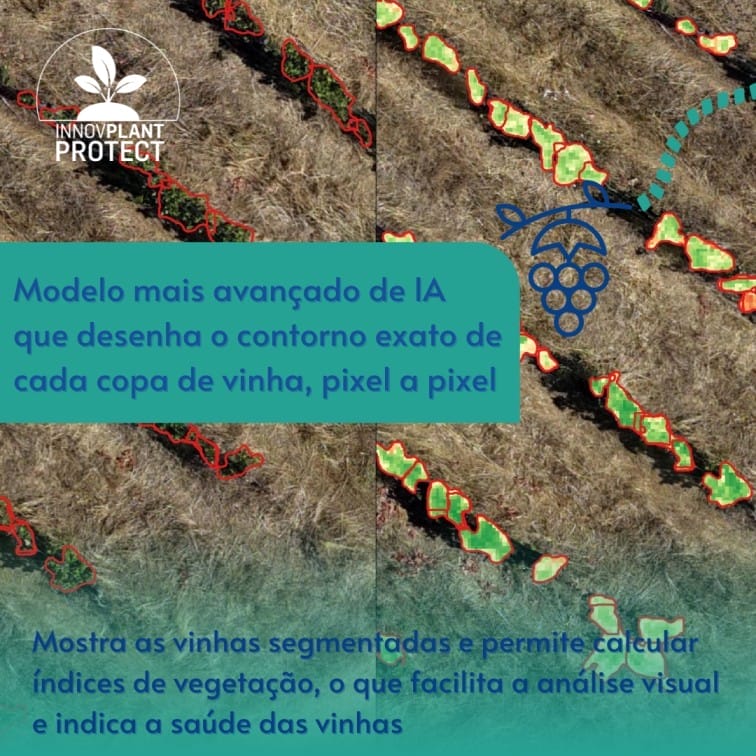
Manisha Sirsat, a researcher on the AI4Leafhopper team, has developed two artificial intelligence models that analyze the aerial images captured by our latest generation drone... and these models make it possible:
geolocation of each vine
to know if there are vine failures
quickly identify “sick” vines”
optimize the application of treatments
The result? Growers can have a detailed view of the health of their vineyards, detect problems early and make more informed decisions.
AI4Leafhopper is a project led by InPP and funded by the ICAERUS Horizon Europe program, which began in April 2024 and ended on April 30 with a final meeting involving the six European projects approved in the 1st edition of the ICAERUS program's PULL applications. The project team presented the AI-based models for detecting and monitoring the impact of the green leafhopper on vineyards.


 Português
  English