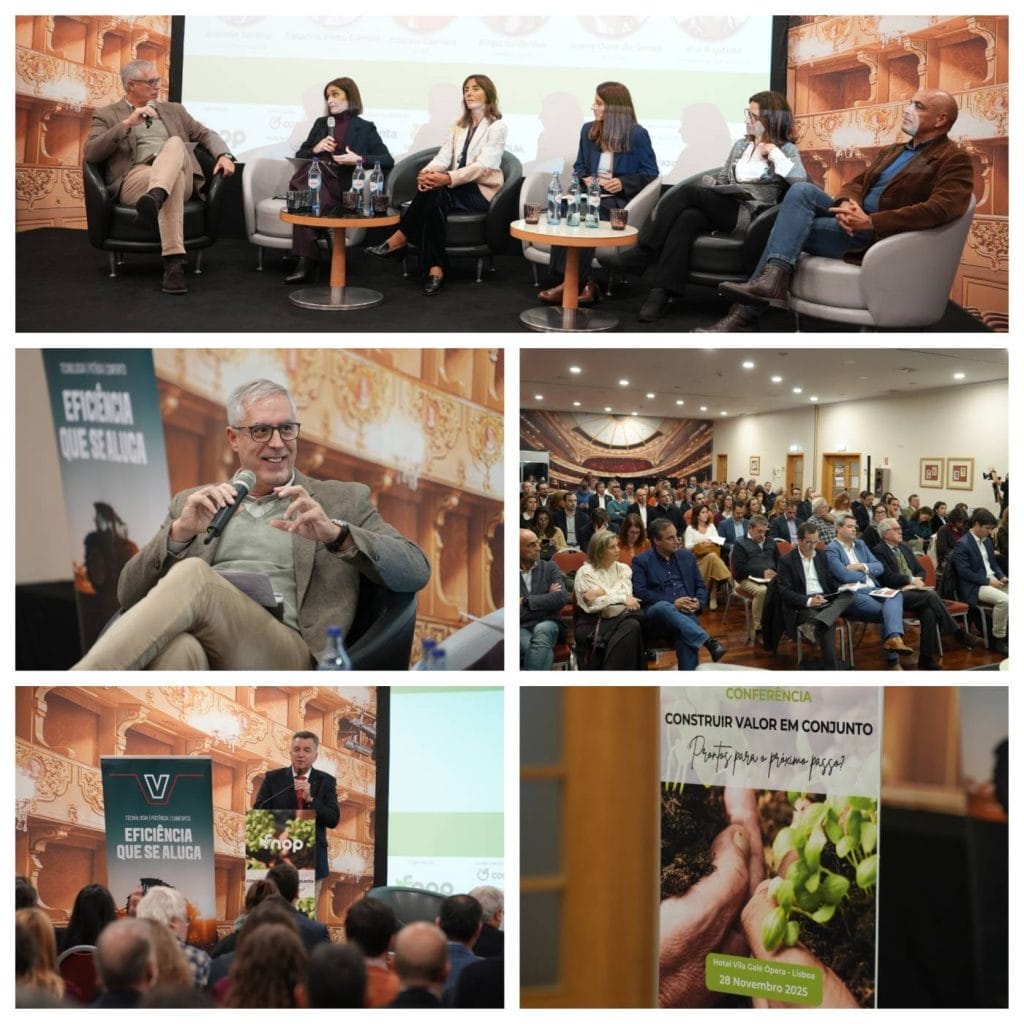
InnovPlantProtect (InPP) was present at the conference “Building value together”, organized by our associate FNOP - National Association of Fruit and Vegetable Producers' Organizations.
InPP's executive director, António Saraiva, moderated the panel “Sustainability that generates value: The role of ESG in the future of the sector”, which included interventions from Catarina Pinto Correia (VdA), Cristina Câmara (APED), Filipa Saldanha (Crédito Agrícola), Joana Oom de Sousa (Sovena) and Rui Veríssimo Baptista (Companhia das Lezírias).
The opening session was given by Domingos dos Santos, president of FNOP and a member of CoLAB's Board of Directors of our CoLAB.
The meeting brought together producer organizations, farmers, companies, experts and political decision-makers to discuss the current challenges and look to the future of the national fruit and vegetable sector.
With the participation of national and international experts, the conference was a privileged space for sharing experiences and strategic reflection, focusing on the organization of production and the role of public policies in promoting sustainable growth.
Congratulations to FNOP for the initiative and the ability to bring together a panel of excellent speakers, making this conference a relevant and topical milestone for the sector.
In viticulture, every little decision has an impact: on the soil, on the health of the plants and on the quality of the grapes that form the basis of the wine that reaches our table. The future of viticulture may depend on a single biosolution. Or a hundred. In VINNY, an ambitious European project of which InPP is a part, researchers from ten countries are looking for bioactives capable of curbing vine diseases - and, at the same time, reducing dependence on synthetic agrochemicals. What's at stake is not just science: it's the sustainability of this industry.
The aim of the VINNY project is simple but transformative: develop and implement effective, sustainable solutions and adaptable to the needs of winegrowers in various European countries, creating environmentally friendly biopesticides and biofertilizers, and advanced nano-encapsulation technologies, to reduce dependence on conventional chemicals and promote a healthier ecosystem and a better environment and a circular viticulture.
And at the heart of this mission is an essential cog in the wheel: the daily work of the researchers who search for answers invisible to the human eye - as is the case with Tiago Amaro, a researcher at InPP.
Image credits: VINNY Project
Searching for the Guardians of the Vine
The road to these new biosolutions begins in the field, with the vine. The initial work of Tiago Amaro, started in September 2024 and focuses on identifying and isolating microorganisms naturally present in the vines themselves, in samples received from partners in Portugal, Spain, Austria and Denmark.
From grapes, sticks or woody fragments, small microscopic worlds arrive in the laboratory that may contain the natural weapons needed to fighting three major threats to the vineyard, with a direct impact on farm profitability: - A gray mold (Botrytis cinerea) and blue mold (Penicillium expansum): Fungi that cause post-harvest diseases, In the case of wine grapes, this affects the quality of the wine and makes it completely impossible to sell table grapes. - The vine tumors: Caused by bacteria Allorhizobium vitis, This disease affects the plant in the field, causing leaf fall and reduced grape production.
Tiago Amaro, InnovPlantProtect researcher, identifying and isolating bacteria as part of the VINNY project. Image credits: InnovPlantProtect - Inês Ferreira
After isolating the microorganisms, Tiago dedicated himself to creating libraries of bacteria. What is a ‘Bacteria Library’? In the context of the investigation, a bacteria library is an organized and catalogued collection of bacteria isolated from different sources. It allows scientists to test each strain of bacteria against specific pathogens, constituting a vast catalog of potential biological ‘superheroes’ for plant protection.
This rigorous screening, which has already led to the analysis of more than 190 bacteria of this library is the first line of defense. The team selects the best candidates with the potential to be used as biological control agents against the diseases under study.
The Power of European Collaboration
What if the solution to protecting Portuguese vineyards is hidden in a Danish grape? Or in a bacterium isolated in Spain? One of the most exciting aspects of the project is its truly collaborative dimension, where researchers from ten countries are working in parallel, sharing answers, challenges and microorganisms in search of effective biosolutions for the whole of Europe.
“All the solutions found will be shared, all the solutions will be tested by all the partners and it will be possible to build a ‘library of solutions’ against the various vine diseases“ emphasizes researcher Tiago Amaro.
The sharing of bacteria and extracts from different ecosystems (Portugal, Spain, Denmark and Austria) is crucial. An effective bacterium in Denmark could be the key to protecting Portuguese vineyards, and vice versa. This exchange of biological solutions, one of the innovative pillars of the project, makes it possible to exploit the microbial biodiversity beyond national borders. InPP has the fundamental role of testing, in grapes, the solutions discovered by our team as well as by other national and European partners.
This diversity of tests is a bet on the future: microorganisms that don't prove effective against vine diseases could be the solution for pathologies in other crops.
Left photo: Tiago Amaro, InPP researcher, observing a grapevine leaf, the target crop of the VINNY project, Right photo: Potted grapevine plants in the InPP greenhouse, ready to test the solutions found by the various VINNY partners. Image credits: InnovPlantProtect - Inês Ferreira
The Real Test: From the Lab to the Field
After selection in the laboratory, the next step - the formulation of the most promising bacteria - will be carried out in Portugal and Spain, at the University of Minho and the Polytechnic University of Catalonia. But it is in the field-testing phase that the greatest challenge of plant protection science lies, because even brilliant results in the laboratory can fail in the field. Formulation is the process that turns a bacterium into a product - stable, applicable and compatible with the farmer's needs.
Tiago Amaro emphasizes necessary resilience:
Field Uncertainty: Often, promising solutions in the laboratory or greenhouse are not as effective when applied in the field, due to environmental variables (climate, soil, etc.).
The Time Factor: Diseases such as Allorhizobium vitis may take a long time to develop, or the infection may not be relevant in certain years, which makes it difficult to obtain robust conclusions.
The Agricultural Cycle: It is necessary to test the formulation in the field during three to five consecutive years, and recording all the variations observed. With only one harvest a year, this process requires patience and persistence.
In total, from the discovery of a promising bacterium to the creation of a formulated product, proven to be effective and ready for the market, it can take around 10 years - a real test of any scientist's resilience.
Customized solutions: the new requirement of modern agriculture
The final challenge is to ensure that the tests are relevant to the producer's reality. The current trend in the agricultural sector is the search for customized solutions, adapted to the specific conditions of the farms: “There has to be a solution for every field and every farmer”, says the researcher.
This personalized approach requires more science, more rigor and more local knowledge - exactly what VINNY seeks to build.
A Europe united by science and the vine
InPP is part of this consortium, made up of 19 partners from ten countries, The project is led by the University of Minho and funded by the Horizon Europe program.
Together, they seek to answer a question that could shape the future of European viticulture: Will it be possible to find effective biosolutions for all partner countries?
The answer is still being written - in laboratories, in experimental vineyards, in fields in different climates and geographies. And it's made up of small discoveries, many frustrations and a huge commitment to science.
Because protecting the vineyard of the future is not just a technical ambition. It is a cultural, economic and environmental commitment. And VINNY is helping to design that future - one microorganism at a time.
The final workshop highlighted three years of research dedicated to the early detection of pathogens in crops such as wheat and olive groves.
The project AlViGen has reached its final stretch, concluding three years of research focused on the genomic surveillance of agricultural diseases. The results now presented promise to strengthen the Alentejo agricultural sector's ability to respond to emerging phytosanitary threats.
On the day October 23rd, The final project workshop, The event brought together researchers, producers and technicians to share results and reflect on the future of genomic surveillance in Portuguese agriculture.
A pioneering genomic surveillance center
During AlViGen, the Alentejo's first genomic surveillance center, an infrastructure with capacity for early detection of diseases in strategic crops such as wheat and olive grove. This breakthrough marks a decisive step towards a more precise, sustainable and science-based agriculture.
Results and scientific contributions
Using innovative molecular tools, the project team succeeded:
Identify pathogenic fungi before visible symptoms appear on the plants;
Characterizing yellow rust strains, genetically linking them to others known at a global level;
Detecting resistance genes in wheat to the strains currently present in Portugal;
Developing diagnostic methods able to distinguish the different species of the fungus that causes gafa in olive groves.
During the workshop, the potential of the analysis of the airborne fungi community as a tool for early warning for multiple pathogens, allowing for more effective and preventive management of crop diseases.
From research to practical application
The event ended with a debate on how transform AlViGen results in a detection and warning service accessible to the agricultural sector. The initiative reflects the joint commitment between science, innovation and production, with a view to protecting national agriculture from the challenges of the future.
Partnerships and thanks
InnovPlantProtect would like to thank all the partners and funders of the project: University of Évora, John Innes Centre, INIAV, De Prado, CERSUL, Eugénio de Almeida Foundation, Torre das Figueiras Estate, Almojanda, Malheiro Estate, Directorate-General for Food and Veterinary (DGAV), la Caixa“ Foundation”, BPI Bank e Foundation for Science and Technology (FCT).
O InnovPlantProtect (InPP) and D. Sancho II Secondary School, from Agrupamento de Escolas n.º 3 de Elvas, are going to organize a pedipaper at the Elvas Municipal Garden for 10th graders to explore, identify and marvel at the different trees in the garden and their differentiating characteristics. The initiative is part of and will take place on Fascination of Plants Day.
The event, to which Elvas City Council (CME) joins, will be held on the morning of May 18, 2021, Fascination of Plants Day. The Municipal Garden of Elvas is the largest green space in this Alentejo city, where the InPP is based. There you'll find specimens of olaias, linden trees, olive trees, cedars, orange trees, horse chestnut trees, mulberry trees, casuarinas, ash trees and carob trees, among many others.
Among olaias, linden and olive trees, you can find orange trees, horse chestnuts and casuarinas, among many other trees, in the Elvas Municipal Garden.
The activity starts at 8:30 a.m. and will be divided into three sessions of 90 minutes each, for three 10th grade classes at Escola Secundária D. Sancho II: from 8:30 a.m. to 10 a.m., from 10 a.m. to 11:30 a.m., and from 11:30 a.m. to 1 p.m.. InPP researchers and teachers from the school will be on site to assist the participants. Another class, from the multimedia technical course, is due to take part, reporting on the event. At a later date, a similar activity will be offered to the class from the technical-vocational agricultural course.
The topic of Biodiversity is covered by the 10th grade. As a result of this activity, InPP, Escola Secundária D. Sancho II and CME will continue to collaborate on the development of a physical identification system for the Garden's trees, based on a QR (Quick Response) code.
This QR code, once scanned by a visitor's smartphone, will give access to a database on the trees in the Elvas Municipal Garden, including their identification, description, curiosities, history and mythology. This database/digital brochure will be created by InPP researchers and the school's students and teachers, and made available to the CME and all the secondary schools in the municipality of Elvas, in a project that should run until 2022.
The Municipal Garden is located on Avenida António Sardinha in Elvas.
Fascination of Plants Day is an initiative of the European Plant Science Organization (EPSO) and seeks to arouse enthusiasm and draw attention to the importance of plant science in various areas, from agriculture and sustainable food production, to forestry and the production of non-food goods, as well as culture and leisure.
In Portugal, the initiative is coordinated by ITQB NOVA and Portuguese Society of Plant Biology, The aim is for Portuguese institutions and companies to join hundreds of organizations from more than 40 countries in celebrating the wonderful world of plants. Portugal is considered a success story and is traditionally one of the countries that brings the most institutions together to celebrate this day.
InnovPlantProtect (InPP) is organizing a paper chase game (peddy-paper, in Portuguese) with D. Sancho II Secondary School for 10th graders to explore, identify and marvel at Elvas Municipal Garden’s diverse trees and their differentiating characteristics, as a celebration of Fascination of Plants Day.
This event, with which the Municipality of Elvas associates itself, will take place in the morning of May 18, 2021 - Fascination of Plants Day. The Municipal Garden is the biggest green space in this small city of the Alentejo region where InPP is based. It holds specimens of Judas trees, lime trees, olive trees, cedars, orange trees, horse chestnut trees, mulberry trees, Casuarina, ash trees and carob trees, among many others, which are yet to be catalogued and mapped.
In Elvas Municipal Garden there are Judas trees, lime trees, olive trees, cedars, orange trees, horse chestnut trees... among many, many others.
The activity will start at 8:30 AM and will be divided into 3 (three) 90-minutes time slots, for three different 10th grade classes from D. Sancho II School: 8:30 - 10 AM / 10 - 11:30 AM / 11:30 AM - 1 PM. InPP researchers and teachers from the school will be on site to assist the participants. A different class, from the multimedia technical course, shall also participate, reporting on the event. At a later date, a similar activity shall be proposed to the class from the professional technical course in mixed farming.
The theme of Biodiversity is taught in the 10th grade in Portugal. As a result of this activity, InPP and D. Sancho II Secondary School will continue collaborating to develop a physical signing system for the trees, based on a QR code. The code, once read by a visitor's smartphone, will give access to a complete data base about the trees of the Municipal Garden, including their identification, description, curiosities, history and local mythology. This data base/ digital brochure is to be built by InPP researchers and the school's students and teachers, and made available to the Municipality and all its secondary schools, in a project that should last until 2022.
The Municipal Garden is located in Avenida António Sardinha, in Elvas.
Fascination of Plants Day is promoted internationally by the European Plant Science Organization (EPSO) with the aim of awakening enthusiasm and calling attention to the importance of plant science in different areas, from agriculture and sustainable food production, to forestry and the production of other kinds of goods, as well as culture and leisure.
In Portugal, the initiative is coordinated by ITQB NOVA and Portuguese Society of Plant BiologyThe goal is that national institutions and companies join hundreds of organizations worldwide, from more than 40 countries, to celebrate the wonderful world of plants. Portugal is considered a success story and is traditionally one of the countires with more organizations joining the celebrations.
Artificial intelligence at the service of prediction and early detection of Phytophthora cinnamomi in assembled received funding from the Promove 2020 program.
We are delighted to share that our project “AI applied to a system for the prediction and early detection of Phytophthora cinnamomi in mounted/ dehesa” is one of the winners of the Promove 2020 Program, launched by the “la Caixa” Foundation, in partnership with the Foundation for Science and Technology (FCT).
The results of the competition were announced today. “We are sure that the conditions are in place for this to be a successful partnership,” says the message we received. Congratulations to the Pest and Disease Monitoring and Diagnosis department, and to the entire InPP. Now, let the work continue!



 Português
  English