The executive director of InnovPlantProtect (InPP), António Saraiva, took part in the conference “What are the challenges facing the national agroforestry sector over the next decade?”, which took place at the Escola Superior Agrária de Coimbra (ESAC) of the Polytechnic Institute of Coimbra last Tuesday, April 22.
The event, which brought together more than 150 participants and was organized by 17 national Competence Centres, discussed topics such as innovation, sustainability, soil conservation, monitoring cork oak forests and efficient agricultural management.
António Saraiva was part of the panel of commentators, whose speaker was Pedro Santos, Director General of CONSULAI, and moderated by Maria Custódia Correia, Coordinator of the AKIS Portugal Network. The opening session was attended by the Minister for Agriculture and Fisheries, José Manuel Fernandes, who announced the publication of the Ordinance of April 21 to open the Grant for Initiatives for the creation of Operational Groups (OG).
This initiative provides a total of 11 million euros for new GOs, with a maximum of 350,000 euros per project and eligible funding of 100%.
The GOs are considered crucial structures for transferring knowledge and strengthening the AKIS (Agricultural Knowledge and Innovation System).
Special thanks to the 17 Competence Centers for the opportunity to participate in this productive meeting!
Beyond strategy: The secret ingredient of innovation
On the path to success, organizations define strategies, plan each step, and invest in crucial resources such as the sale of services and products, project applications, the development of solid business plans, and the protection of intellectual property. However, there is an often-neglected element that is fundamental to the flourishing of innovation: serendipity. But what exactly is this mysterious force, and why is it so vital to advancing agriculture and so many other areas?
When chance opens doors: The power of unplanned discovery
Serendipity lies in the art of finding something valuable when looking for something else. It's the unintentional discoveries that arise from unexpected situations. Throughout history, some of the most transformative innovations have not been the result of a rigorous plan, but rather of a fortuitous encounter with the unknown. Although deliberate research and methodical experimentation are pillars of scientific and technological progress, openness to the unexpected proves to be a powerful catalyst. When researchers cultivate this openness, they often come across revelations that have the potential to revolutionize entire industries, transform technologies, and expand our understanding of the world around us.
A close look at the “error”: The genesis of an innovative biofungicide
Today, we unveil the surprising and inspiring story of Maria Miguel, a talented researcher from the InPP's New Biopesticides Department, whose insight transformed a fortuitous event into a discovery of inestimable value: a broad-spectrum biofungicide capable of combating Botrytis cinerea, the relentless fungus responsible for the devastating gray mold disease in tomato plants. This pathology represents one of the greatest phytosanitary challenges in tomato cultivation, especially when grown in greenhouses, causing significant losses to producers if not controlled in a timely manner.
From discard to discovery: An investigator's insight
The journey of this discovery began in a scenario familiar to any researcher: the observation of Petri dishes, used to grow cell or microorganism cultures. In Maria Miguel's Petri dishes, colonies of the fungus Botrytis cinerea were growing, intentionally introduced there for study. However, something else caught her attention: one of the plates was contaminated by mold, and curiously, a clear zone surrounded this intruder. Instead of discarding the plate and ignoring it as mere contamination, Maria Miguel decided to investigate the reason behind that clear area. Her curiosity revealed that the mold had a surprising ability to inhibit the growth of Botrytis cinerea in its vicinity.
“Sometimes we look at something and think it's a mistake. The truth is that within a failure, there can be something good,” shares the researcher. The emotion and enthusiasm of a researcher when realizing that what at first seemed like an obstacle, a negative result, can actually be an opportunity, is contagious. For Maria Miguel, this “error” transformed into a serendipitous discovery with enormous potential.
Maria Miguel, a researcher at the InPP's Department of New Biopesticides, transformed an unexpected event into a groundbreaking discovery: a broad-spectrum biofungicide to combat gray mold in tomato plants.
Beyond chance: The active ingredients of scientific discovery
As the story of this biofungicide demonstrates, the world of science is full of examples of discoveries that arose from the unexpected. One of the most famous cases is the discovery of penicillin by Alexander Fleming in 1928. While observing Petri dishes, Fleming noticed that a mold was producing a substance that eliminated Staphylococcus aureus bacteria around it. He identified the mold as Penicillium notatum and named his revolutionary antibiotic penicillin. Penicillin ended up becoming an extremely important drug for fighting infections.
However, chance is not the only protagonist of these important revelations. “Sometimes we have to follow our intuition and be able to prove that we are right or wrong,” explains Maria Miguel. In addition to intuition, a generous dose of curiosity, an open mind to accept unexpected results, a solid scientific knowledge, and the ability to see and advance to further investigations on surprising results play a crucial role in the alchemy of discovery.
The ecosystem of discovery: Fostering an environment conducive to innovation
There are other ingredients that contribute to the recipe for scientific success:
Creativity: The ability to generate new perspectives, concepts, questions, or solutions, and the willingness to explore existing ideas under a new light.
Flexibility: The courage to venture into unknown territories without fear of failure, thus increasing the odds of serendipitous encounters.
But no discovery flourishes in isolation. At InPP, the strong team spirit and culture of collaboration transcend departmental boundaries. Maria Miguel's discovery is a testament to this synergy, as she herself acknowledges: “My colleagues opened doors so that I could do my research.”
To foster innovation, organizations need to cultivate an environment that stimulates open discussions and connects people from diverse areas of knowledge and life experiences, without judgment; that encourages curiosity and receptiveness to new experiences; and that promotes a relentless pursuit of improving scientific knowledge, the fertile ground where serendipity can germinate.
Sowing the future: The impact of a discovery and the path of research
Although Maria Miguel is about to embark on a new journey, driven by a prestigious Marie Skłodowska-Curie doctoral fellowship - a program that supports the career of researchers and promotes excellence and innovation in research - her legacy at InPP is already flourishing. Her innovative discovery is opening new and promising doors for future research in the area of crop protection, demonstrating how, at times, it is in the unexpected that the potential to transform our world lies.
Beyond strategy: The secret ingredient of innovation
On the road to success, organizations define strategies, plan every step and invest in crucial resources such as selling services and products, applying for projects, drawing up solid business plans and protecting intellectual property. However, there is an element that is often overlooked, but which is fundamental to the flourishing of innovation: serendipity. But what exactly is this mysterious force and why is it so vital to the advancement of agriculture and so many other areas?
When chance opens doors: The power of unplanned discovery
Serendipity is the art of finding something valuable when you're looking for something else. It's the unintentional discoveries that arise from unexpected situations. Throughout history, some of the most transformative innovations have not been the result of a rigorous plan, but rather a chance encounter with the unknown. While deliberate research and methodical experimentation are pillars of scientific and technological progress, openness to the unexpected proves to be a powerful catalyst. When researchers cultivate this openness, they often stumble upon revelations that have the potential to revolutionize entire industries, transform technologies and expand our understanding of the world around us.
A close look at “error”: The genesis of an innovative biofungicide
Today, we unveil the surprising and inspiring story of Maria Miguel, a talented researcher from InPP's New Biopesticides Department, whose acumen turned a chance event into a priceless discovery: a broad-spectrum biofungicide capable of combating the Botrytis cinerea, the relentless fungus responsible for the devastating gray rot disease in tomato plants. This pathology represents one of the biggest phytosanitary challenges in tomato cultivation, especially when grown in greenhouses, causing significant losses to producers if it is not controlled in good time.
From discard to discovery: The insight of a researcher
The journey of this discovery began in a setting familiar to any researcher: the observation of Petri dishes, used to grow cultures of cells or microorganisms. On Maria Miguel's plates, colonies of the fungus Botrytis cinerea were growing, intentionally introduced there for study. However, something else caught her eye: one of the plates was contaminated by mold, and curiously, a clear area surrounded this intruder. Instead of discarding the plate and dismissing it as mere contamination, Maria Miguel decided to investigate the reason behind the clear area. Her curiosity revealed that the mold had a surprising ability to prevent the growth of Botrytis cinerea in its vicinity.
“Sometimes we look at something and think it's a mistake. The truth is that in a failure there can be something good,” the researcher shares. The excitement and enthusiasm of a researcher realizing that what at first glance seemed like an obstacle, a negative result, could actually be an opportunity, is contagious. For Maria Miguel, this “mistake” turned into a serendipitous discovery with enormous potential.
Maria Miguel, a researcher at InPP's New Biopesticides Department, who turned an unexpected event into a discovery that changed the course of her work: a broad-spectrum biofungicide to combat gray rot in tomato plants.
Beyond chance: The active ingredients of scientific discovery
As the history of this biofungicide shows, the world of science is full of examples of discoveries that came out of the blue. One of the most famous cases is Alexander Fleming's discovery of penicillin in 1928. While observing Petri dishes, Fleming noticed that a mold was producing a substance that eliminated bacteria Staphylococcus aureus around him. He identified the mold as Penicillium notatum and named his revolutionary antibiotic penicillin. Penicillin ended up becoming an extremely important medicine for fighting infections.
However, chance is not the only protagonist of these important revelations. “Sometimes we have to follow our intuition and be able to prove ourselves right or wrong,” explains Maria Miguel. In addition to intuition, a generous dose of curiosity, an open mind to accept unexpected results, solid scientific knowledge and the ability to see and move on to further research into surprising results play a crucial role in the alchemy of discovery.
The discovery ecosystem: Fostering an environment conducive to innovation
There are other ingredients that contribute to the recipe for scientific success:
Creativity: The ability to generate new perspectives, concepts, questions or solutions, and the willingness to explore existing ideas in a new light.
Flexibility: The courage to venture into unknown territory without the fear of failure, thus increasing the chances of serendipitous encounters.
But no discovery flourishes in isolation. At InPP, the strong team spirit and culture of collaboration transcend departmental boundaries. The case of Maria Miguel's discovery is testimony to this synergy, as she herself acknowledges: “My colleagues opened doors so that I could do my research”.
To foster innovation, organizations need to cultivate an environment that encourages open discussions and connects people from different areas of knowledge and life experiences, without judgment; that encourages curiosity and receptiveness to new experiences; and that promotes an incessant quest to improve scientific knowledge, the fertile ground where serendipity can germinate.
Sowing the future: The impact of a discovery and the path of research
Although Maria Miguel is about to embark on a new journey, boosted by a prestigious Marie Skłodowska-Curie PhD scholarship - a program that supports the careers of researchers and promotes excellence and innovation in research - her legacy at InPP is already flourishing. Her groundbreaking discovery is opening promising new doors for future research in the field of crop protection, demonstrating how sometimes it is in the unexpected that the potential to transform our world lies.
Discover the latest advances in project WhYRust, regarding fungal epidemiology and population structure studies, data collection and model validation of a warning system, and identification of wheat genes involved in YR resistance.
Supporting the Portuguese wheat breeding program in the climate change scenario is the purpose of the WhYRust project. Yellow rust (YR), caused by Puccinia striiformis f. sp. tritici (Pst), is one of the most destructive diseases for wheat (Triticum ssp.), with global annual losses of US$ 979 million. Planting resistant cultivars is the most effective, economic, and environmental-friendly way to control diseases. Among other things, WhYRust aims to identify the wheat's genome areas associated with resistance or susceptibility to YR, a major threat to this cereal.
InnovPlantProtect, namely through its Department of Protection of Specific Crops - Department 2, leads this project, with the participation of INIAV Elvas and ITQB NOVA, and the collaboration of ANPOC and CERSUL.We are (1) studying the fungus epidemiology in Portugal, evaluating the fungal pathogenesis mechanisms by (2) sequencing the fungus genome, (3) investigating its transcriptome during plant interaction and (4) proteome of secreted proteins under conditions of low versus high temperature, (5) performing genome-wide association studies to identify resistance genes in the plant, and (6) developing genomic prediction models through machine learning in order to support precision breeding.
Wheat seeds germination in vitro. Two-week-old wheat plants in our growth chamber. Sampling of yellow rust fungal spores from wheat leaf showing symptoms of YR disease (by Miguel Teixeira and Cláudia Rato)
As far as fungal epidemiology and population structure studies are concerned, the quarantine enforced by COVID-19 in the first trimester of 2020 imposed some difficulties, but some wheat infected leaves were sampled in the 2019/2020 season. New sampling will be performed for the 2020/2021 season. Collected spores are being used to isolate single pustules, which will be further used to identify the specific fungus races.
Germination of YR fungus spores (called urediniospores) in vitro conditions (by Miguel Teixeira and Cláudia Rato)
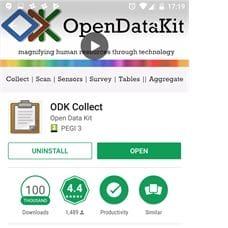
Sampling app, by iLaria Marengo
InPP's Department 2 is also collaborating with Department 4 (Monitoring and Diagnosis). Portuguese agronomists are going to be trained on data collection and model validation of a yellow rust warning system. The goal is to use Open Data Kit (ODK), an open source software for (android) mobile devices that uses a form designed by InPP (Dep. 4) to collect data in the field and offline. The submission of the data to the InPP server is made once back to the office, when Internet connectivity is available. The app not only speeds up the data collection but also improves its management and accessibility.
Regarding the identification of wheat genes involved in YR resistance, the first field trial for the evaluation of disease symptoms in a panel of 250 wheat accessions of INIAV's breeding pool has been sown in the INIAV Elvas field. The crop of common or bread wheat (Triticum aestivum) is checked by the team every week, to remove weeds and check accessions status.
Disease evaluation will begin as soon as first symptoms develop. Image analysis of infected leaves will be performed to identify the percentage of pustules per leaf. This experiment will be performed in three consecutive years, and the data will be used to access the genetic and phenotypic variability within this panel and for future genome-wide association studies.
Field work by researchers Miguel Teixeira, Asmae Jlilat, Ana Miguel Reis, Diana Acácio, Flavio Storino, Diana Sousa and Hadi Sheikhnejad
For 2021, we also expect the most prevalent YR fungus race will have its genome sequenced and potential virulent factors will be identified by in silico analysis.
Accelerating technological innovation and creating new sustainable solutions for the protection of agricultural crops against pests, diseases and weeds, while protecting ecosystems, is the aim of the new collaboration between Syngenta Crop Protection, an InnovPlantProtect (InPP) member, and Insilico Medicine, which specializes in artificial intelligence (AI) and deep learning.
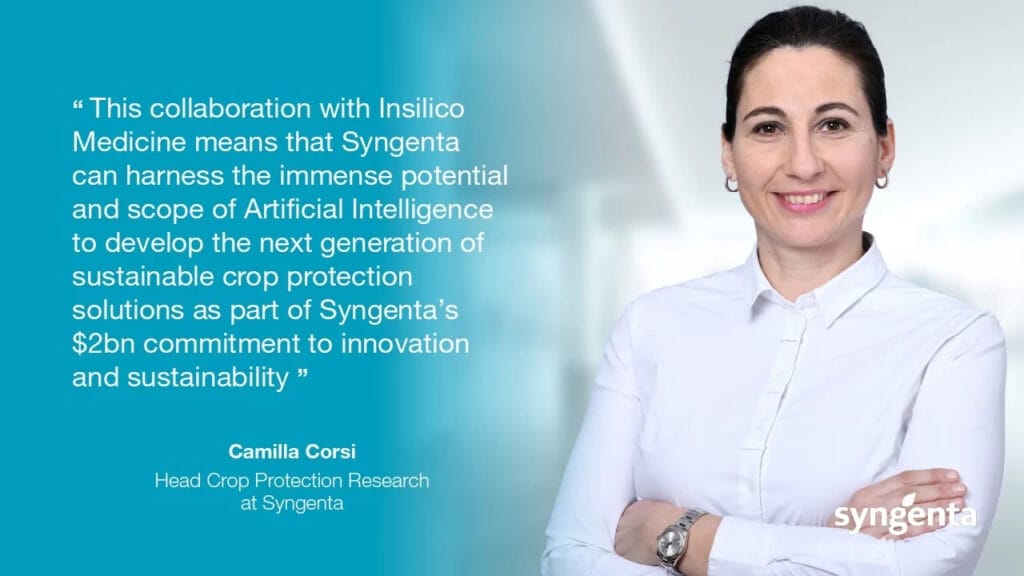
The partnership “will further transform agriculture by providing farmers around the world with the tools they need to produce healthy, nutritious, affordable and sustainably grown food in the most efficient way, while minimizing environmental impact,” Camilla Corsi said in a statement, head of Crop Protection Research at Syngenta.
Insilico Medicine's solid and proven experience in the use of AI and deep learning to develop, synthesize and validate new active substances promises to “transform the development of new solutions that help keep plants safe, from planting to harvest,” Syngenta points out. The safety of agricultural products and the protection of human health, in the short and long term, are also top priorities.
Twelve founding members, the InnovPlantProtect team and all those who contributed to giving birth to this young CoLab are to be congratulated today: two years ago, the formal constitution of InPP was registered with a notary in Elvas.
On January 24, 2019, in pre-pandemic times, the public deed was signed to establish the InnovPlantProtect - Associação collaborative laboratory in Elvas. Today, a highly qualified team is now complete, work is underway and projects are in progress, marking the second anniversary of the formal establishment of the collaborative laboratory, which has twelve founding partners.
Despite the restrictions imposed on all of us by the Covid-19 crisis, 2021 promises to be auspicious. “The conditions are beginning to be created for the careful and dedicated management to achieve the desired results,” says the mayor of Elvas (CME), an InnovPlantProtect (InPP) member. “Now it's ‘hands on’,” says Nuno Mocinha.
Admitting that “it's been a Herculean task to set up the CoLab”, the chairman of the board of Casa do Arroz has no doubt that “it's been worth it” and that InPP “will be on the map”. “It has everything it takes to succeed,” assures Pedro Monteiro. “For us, the CoLab is our insurance for the future. It's a laboratory that represents a great opportunity for the defense of rice cultivation in Portugal.”
InPP members sign the public deed of incorporation, on January 24, 2019, at the notary's office in Elvas.
The traditional “family photo”.
The great satisfaction with the quality of the technical staff is shared by CME, CEBAL and Fertiprado - and by InPP's executive director and “man at the helm”, Pedro Fevereiro. “The high level of professionalism, the dedication of all the professionals who make it up and its great organization put this institution on the map of major international organizations in the field of plant protection,” says Liliana Marum, a researcher at CEBAL. “CEBAL, as a founding partner, congratulates InnovPlantProtect on its excellent work and its mission of great importance for the sustainability of national agriculture.”.
“Although it's still in the installation phase, the excellent team already set up by Professor Pedro Fevereiro gives us high hopes for the success of the important projects already underway in the InnovPlantProtect collaborative laboratory,” says Ana Barradas, Fertiprado's R&D director. The company is already working with InPP on the Pythium project, the aim of which is to “identify the pathological organism that causes root rot and find a solution to eliminate it”.
“The CoLab is our insurance for the future.” Pedro Monteiro, Casa do Arroz
“Fertiprado is very proud to be a founding member of the InnovPlantProtect CoLab and we are very pleased to be celebrating its second anniversary,” concludes Ana Barradas. “After two years, the CoLab has a team of 38 employees, the vast majority of whom are highly educated, highly motivated and competent. It's a team that is expected to make a difference on the agricultural innovation scene and to be able to respond to the challenge of developing biopesticides and services that reduce the impact of pests and diseases on Mediterranean crops,” stresses Pedro Fevereiro.
“Our resilience lies and will lie in the fact that we have created a friendly and interactive working environment, which we want to maintain and expand,” argues InPP's CEO, who bet on this project “because it is a way of participating in the transfer of academic knowledge to real life, on the one hand, and of participating in the construction of solutions for a more productive and sustainable agriculture, on the other.”.
For Pedro Fevereiro, the second anniversary of the establishment of CoLab means above all that the institution has survived the initial installation phase, “which is not over yet, even despite the pandemic situation we are living in”. “It means that what we invested in is still in a position to progress and develop. The preliminary process of setting up was the effort of a team that knew how to put the common interest ahead of individual agendas and that knew how to find a way to make this project viable,” stresses the executive director.
“CoLab has a team of 38 highly motivated and competent employees.” Pedro Fevereiro, CEO of InPP
In the current context, the biggest challenge “is to keep the team active and working, while we wait for the possibility of having everyone working in the same place and in suitable conditions to develop the projects we already have in hand” - a goal that Pedro Fevereiro hopes to achieve within six months. “Another challenge is to create a modern institution of reference in a territory far from the major centers.” For Nuno Mocinha, InnovPlantProtect represents, in fact, “a qualitative leap in the affirmation of Elvas as a research hub in the national context and a special partnership between academia, companies and local government”.
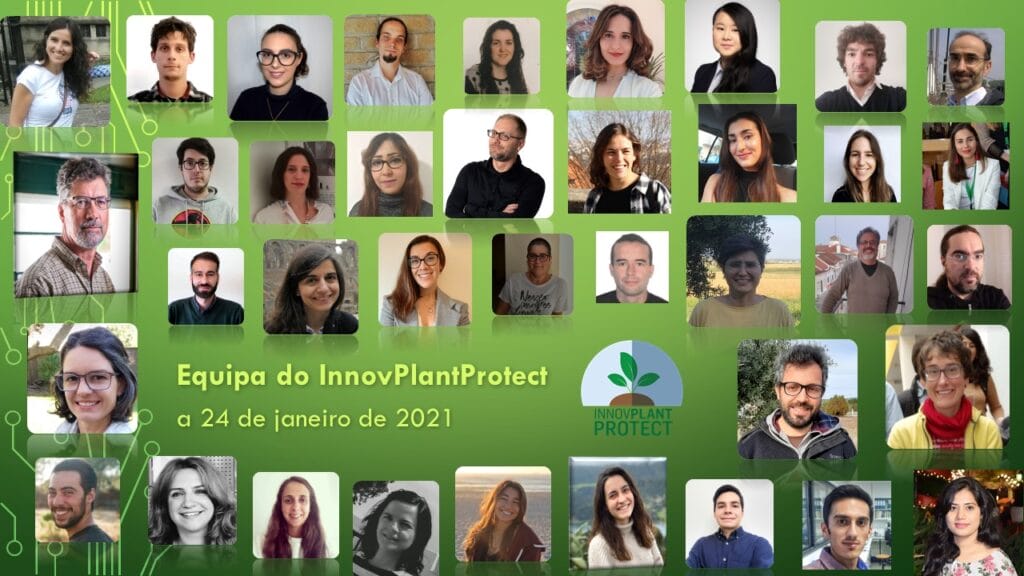
The 38 members of the InnovPlantProtect team in January 2021.
The main objective now is to “develop national and international projects in the field of crop protection that have the capacity to present solutions as soon as possible, while guaranteeing the CoLab's financial balance,” says Pedro Fevereiro. New bio-based solutions for protecting plants against pests and diseases are “a market that is expected to double in the next five years at international level and which will certainly expand enormously in the European Union in the light of the European Green Deal and the ‘Farm to Fork’ and ‘Biodiversity’ Strategies”, recalls Felisbela Torres de Campos, responsible for Regulatory and Business Sustainability at Syngenta Portugal, an InPP member.
“This collaborative laboratory is on the right track: towards the sustainability of agriculture,” says Felisbela Campos, who considers CoLab “a strategic partnership for Syngenta and also because of the company's strong commitment to R&D in biological solutions for agriculture”. In addition, “InnovPlantProtect positions Portugal as a creator of technologies to solve specific phytosanitary problems in Portuguese agriculture, which will certainly help to reduce the country's dependence on foreign technologies and ensure that the solutions found are more effective from the outset”.
“We welcome this partnership and its potential to accelerate innovationfor farmers and nature”. Felisbela Torres de Campos, Syngenta Portugal
“CEBAL, as a founding partner, congratulates InnovPlantProtect for its excellent work and its mission of great importance for the sustainability of national agriculture,” agrees Liliana Marum, a researcher at the biotechnology center based in Beja.
InPP's founding partners are the National Institute for Agricultural and Veterinary Research, Elvas City Council, the New University of Lisbon, Syngenta Crop Protection, the Alentejo Agricultural and Agri-Food Biotechnology Center, Casa do Arroz, Bayer Crop Science, the University of Évora, Fertiprado, the National Federation of Fruit and Vegetable Producers' Organizations, the National Association of Protein, Oilseed and Cereal Producers, and the National Association of Maize and Sorghum Producers.





 Português
  English