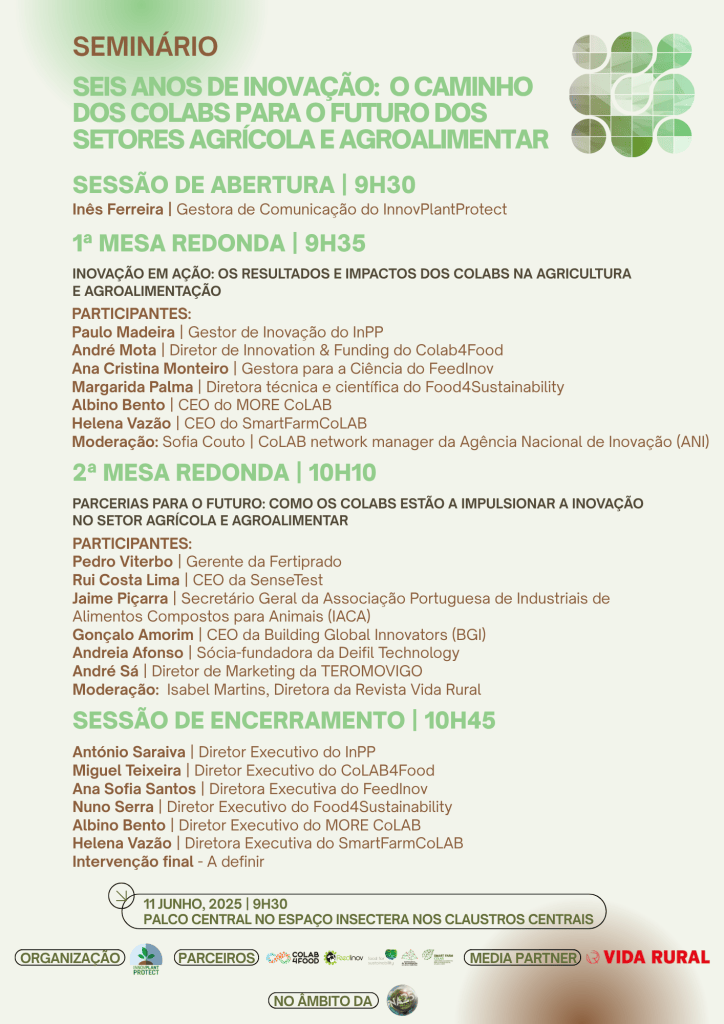
O InnovPlantProtect (InPP) promotes the seminar “Six years of innovation: The path of CoLABs for the future of the agricultural and agri-food sectors”, on the next day June 11th, from 09h30 until 11h00, in center stage at Espaço InsectERA, located in the Central Cloisters of the National Center for Agricultural Exhibitions and Markets (CNEMA) in Santarém.
The seminar aims to present the practical results and real impact of six Collaborative Laboratories (CoLABs) in Portugal - InnovPlantProtect, Colab4Food, FeedInov, Food4Sustainability, MORE and SmartFarmCoLAB. These interface infrastructures are essential pillars of the National Innovation System (SNI) and play a growing and essential role in the dynamics of innovation for agriculture and agri-food.
The event will be attended by members of the teams and partners of each of the CoLABs, who will talk about their vision of the added value of these interface and innovation entities, from the point of view of those who collaborate directly with them.
The initiative, which is part of the National Agriculture Fair (FNA) 2025, which this year has the theme “Biosolutions” and will be the stage for exploring the innovations that are shaping the future of the sector, brings together different representatives of the innovation ecosystem to show the role of CoLABs in stimulating the transfer of knowledge and making innovation available to agriculture and agri-food in Portugal, creating value and attracting highly qualified human resources to the country.
See the full program in the image below.
The registration for the event is free, but mandatory due to the limited capacity of the space. Guarantee your presence by filling in the available form here.
We look forward to welcoming you for a morning of sharing and debate on the future of innovation in the agricultural and agri-food sectors!
Estamos em contagem decrescente para a Feira Nacional de Agricultura (FNA), uma das maiores feiras agrícolas do país!
É já de 7 a 15 de junho que o InPP vai estar na 61ª edição da Feira Nacional de Agricultura, que se realiza no CNEMA – Centro Nacional de Exposições, em Santarém.
O tema da edição deste ano é “Biosoluções”e pretende destacar a importância das soluções e tecnologias inovadoras no setor agroalimentar e na promoção de práticas mais sustentáveis e eficientes.
A FNA reúne agricultores, empresários e especialistas dos setores agroalimentar, pecuário e agrícola e é um excelente espaço para aumentar a nossa rede de contactos, trocar conhecimentos e apresentar as mais recentes tendências e soluções agrícolas que a nossa equipa tem desenvolvido.
Vai poder encontrar-nos no stand nº.18, à entrada do Espaço dos claustros, dedicado à Agenda InsectERA, entre as 10h e as 20h.
InnovPlantProtect (InPP) took part in the National Olive Growing Fair (FNO 25) in Campo Maior, from May 23 to 25, presenting its latest biological and digital innovations for crop protection, including projects focused on biopesticides for olive diseases and early detection of fungi that cause gafa, and monitoring insect vectors of the bacterium Xylella fastidiosa, which attacks olive groves. The Elvas CoLAB was present with its own stand to demonstrate its strengths and the impact of its research on agricultural sustainability, inviting producers, technicians and researchers to learn about its innovative bio-based and digital solutions and to actively participate in the discussion of the sector's challenges.
The collaborative laboratory (CoLAB) welcomed visitors at the stand no. 14, located at thematic area at the Campo Maior Municipal Garden, to showcase their activity, the ongoing projects that are developing solutions to the main olive diseases, the patents already submitted, the apps for agricultural management and the bio-based and digital products and services they have to offer the agricultural sector and the market. Throughout the three days of the fair, some of InPP's researchers were at the stand to demonstrate to visitors the various features of the Elvas CoLAB, which has been developing innovation that it hopes will contribute to the sustainability of agricultural systems.
InPP announced ValorCannBio project, which is processing biomass that is not used in the medical cannabis industry to develop effective and sustainable biopesticides against gafa and tuberculosis, The project will be carried out in the municipality of Elvas, which is responsible for decimating entire harvests, leading to severe economic losses and compromising food quality. The impact of this project will be felt in the municipality of Elvas, where the project is being developed, but it is expected that it will extend to the entire olive-growing region from Trás-os-Montes to the Algarve, where production losses are increasing due to these diseases. O AlViGen project was also one of the protagonists and is using cutting-edge technology to detecting and identifying the strains of fungi that cause gafa, long before the symptoms become visible. The project team has used traps to collect spores that circulate in the air to monitor the presence of fungi, which can give farmers an important advantage in preventing infections and protecting their crops, reducing production losses.
O SNM_XylellaVt project, The SNM_XylellaVt project, led by DRAPCENTRO and in which InPP actively participates, was also highlighted at FNO. SNM_XylellaVt is monitor the insect vectors of the bacteria Xyllela fastidiosa, in particular the foam leafhopper, the insect responsible for transmitting the bacterium, which attacks various agricultural and forestry crops, and in particular olive groves. The project team is developing new tools, such as risk prediction models which, in the presence of the bacterium, whether in plants or insect vectors, will allow the National Agricultural Warning Service (SNAA) to alert, in real time, about the economic attack levels (EAL) for these insects, thus allowing prevent infection of the main crops. As part of this project, the team has also developed an online platform where citizens can report the sighting of foams, which are signs of the presence of the insect vectors of X. fastidiosa, This will help to map its temporal and spatial distribution and to plan measures to combat this bacterium.
The FNO, organized jointly by the Campo Maior City Council and the Centre for the Study and Promotion of Olive Oil in the Alentejo (CEPAAL), is an event that aims to enhance national olive growing, and in particular Portuguese olive oil, boosting the local economy and bringing together professionals from the sector - producers, technicians, or researchers - from all over the country to discuss challenges and trends in the Portuguese olive and olive oil sector.
O InnovPlantProtect (InPP) marcou presença no 3.º Encontro Anual de Laboratórios Colaborativos (CoLAB), organizado pela Agência Nacional de Inovação (ANI), que aconteceu nos dias 6 e 7 de Dezembro, na Universidade do Algarve, em Faro.
No segundo dia do encontro, Pedro Fevereiro, Diretor Executivo do InPP integrou o painel “Saving Planet A for future generations – Pitching Session & Discussion”, no qual apresentou as principais atividades desenvolvidas pelo CoLAB, bem como, os indicadores de realização, as cooperações nacionais e internacionais e os principais desafios e oportunidades para os próximos anos.
Estes encontros são fulcrais para a partilha de conhecimento, experiências e de necessidades comuns, pelo que é de extrema relevância nacional o trabalho colaborativo desenvolvidos pelos CoLABs.
De acordo com a ANI, os CoLAB permitiram a criação de 639 empregos altamente qualificados, mais 13,7% do que em 2020, dos quais 32% eram doutorados, um valor que se traduz em 107% do objetivo para 2022. Os CoLABs agregam atualmente 295 entidades associadas, nomeadamente 173 empresas e 122 entidades não empresariais, sendo que, desde a sua criação, representam 72,4 milhões de euros de investimento.
Vídeo da intervenção do Diretor executivo do InPP na 3ª edição do Encontro de CoLABs.
O encontro teve transmissão via streaming. Pode (re)ver o encontro na íntegra no canal de YouTube da ANI here.
Saiba mais sobre os dois dias do evento na página da ANI here.
Na Revista SÁBADO, um artigo intitulado “Tomate contra o cancro” conta com uma entrevista, realizada pela jornalista Susana Lúcio, ao diretor executivo do InnovPlantProtect (InPP) Pedro February.
Pedro Fevereiro aborda o tema das culturas geneticamente modificadas, e fala sobre a sua evolução e segurança, das restrições europeias aos organismos geneticamente modificados (OGM), bem como do movimento antitransgénicos, a pretexto da aprovação de cultivo do tomate roxo nos Estados Unidos.
O diretor executivo explica que a maior parte dos alimentos que ingerimos e que existem no mercado não existem na Natureza: “O tomate era um fruto pequeno, esverdeado, que produzia toxinas para se defender dos predadores. Alterámos o tamanho e reduzimos a toxicidade”.
E será que há razão para duvidarmos dos alimentos OGM? A resposta é clara: “Há 20 anos, desde que saíram para o mercado, que não há um relato de incidentes de saúde pública com OGM”, salienta Pedro Fevereiro.
O CEO do InPP deixa ainda um alerta: “Sem a biotecnologia (…) e sem as técnicas de melhoramento das plantas, que inclui os OGM, não vamos conseguir alimentar a população mundial.”
Pedro February, diretor executivo do InnovPlantProtect (InPP), visitou o centro de investigação Agrotecnio, localizado em Lleida, na Catalunha, em Espanha, nos dias 1 e 2 de dezembro. A visita ao centro de excelência nas áreas da agricultura, produção animal e tecnologia alimentar, teve como objetivo discutir propostas de cooperação entre as duas instituições, em particular, em relação ao combate à doença do arroz: a piriculariose.
Pedro Fevereiro, diretor executivo do InPP, apresenta o CoLAB no centro de investigação Agrotecnio, em Lleida, na Catalunha.
Durante a visita, que decorreu a convite de Paul Christou, membro do Conselho Consultivo da Unidade de Investigação GREEN-IT of ITQB NOVA, e de Teresa Capell, docente na Universidade de Lleida, o diretor executivo deu a conhecer o InPP e as diferentes áreas de investigação que estão a ser exploradas pelos cinco departamentos do laboratório colaborativo.
A equipa do InPP tem trabalhado no desenvolvimento de biopesticidas contra a piriculariose do arroz, uma das doenças que mais afeta este cereal em todo o mundo e também em Portugal, e que é causada pelo fungo Magnaporthe oryzae. No âmbito do projeto BlaSTOP – Desenvolver soluções integradas para combater a piriculariose do arroz têm sido recolhidas amostras nas bacias do Mondego, Tejo/Sorraia e Sado, com o objetivo de isolar e de caracterizar do ponto de vista genético as culturas de microrganismos presentes, de modo a conhecer a atual diversidade genética de Magnaporthe oryzae in Portugal.



 Português
  English