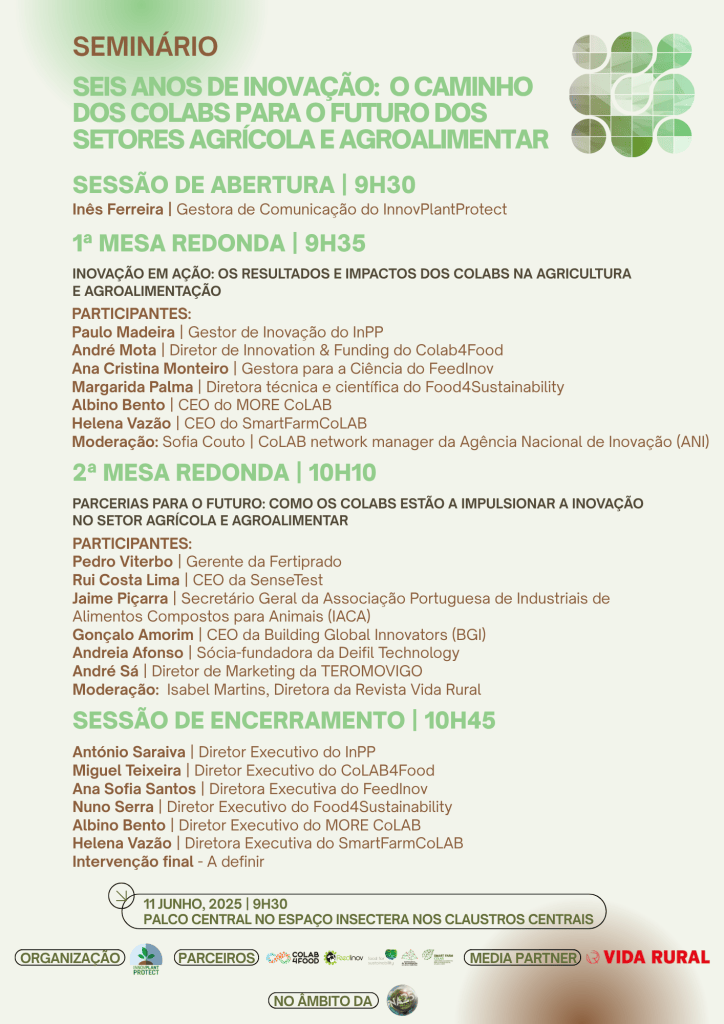
O InnovPlantProtect (InPP) promotes the seminar “Six years of innovation: The path of CoLABs for the future of the agricultural and agri-food sectors”, on the next day June 11th, from 09h30 until 11h00, in center stage at Espaço InsectERA, located in the Central Cloisters of the National Center for Agricultural Exhibitions and Markets (CNEMA) in Santarém.
The seminar aims to present the practical results and real impact of six Collaborative Laboratories (CoLABs) in Portugal - InnovPlantProtect, Colab4Food, FeedInov, Food4Sustainability, MORE and SmartFarmCoLAB. These interface infrastructures are essential pillars of the National Innovation System (SNI) and play a growing and essential role in the dynamics of innovation for agriculture and agri-food.
The event will be attended by members of the teams and partners of each of the CoLABs, who will talk about their vision of the added value of these interface and innovation entities, from the point of view of those who collaborate directly with them.
The initiative, which is part of the National Agriculture Fair (FNA) 2025, which this year has the theme “Biosolutions” and will be the stage for exploring the innovations that are shaping the future of the sector, brings together different representatives of the innovation ecosystem to show the role of CoLABs in stimulating the transfer of knowledge and making innovation available to agriculture and agri-food in Portugal, creating value and attracting highly qualified human resources to the country.
See the full program in the image below.
The registration for the event is free, but mandatory due to the limited capacity of the space. Guarantee your presence by filling in the available form here.
We look forward to welcoming you for a morning of sharing and debate on the future of innovation in the agricultural and agri-food sectors!
Estamos em contagem decrescente para a Feira Nacional de Agricultura (FNA), uma das maiores feiras agrícolas do país!
É já de 7 a 15 de junho que o InPP vai estar na 61ª edição da Feira Nacional de Agricultura, que se realiza no CNEMA – Centro Nacional de Exposições, em Santarém.
O tema da edição deste ano é “Biosoluções”e pretende destacar a importância das soluções e tecnologias inovadoras no setor agroalimentar e na promoção de práticas mais sustentáveis e eficientes.
A FNA reúne agricultores, empresários e especialistas dos setores agroalimentar, pecuário e agrícola e é um excelente espaço para aumentar a nossa rede de contactos, trocar conhecimentos e apresentar as mais recentes tendências e soluções agrícolas que a nossa equipa tem desenvolvido.
Vai poder encontrar-nos no stand nº.18, à entrada do Espaço dos claustros, dedicado à Agenda InsectERA, entre as 10h e as 20h.
InnovPlantProtect (InPP) took part in the National Olive Growing Fair (FNO 25) in Campo Maior, from May 23 to 25, presenting its latest biological and digital innovations for crop protection, including projects focused on biopesticides for olive diseases and early detection of fungi that cause gafa, and monitoring insect vectors of the bacterium Xylella fastidiosa, which attacks olive groves. The Elvas CoLAB was present with its own stand to demonstrate its strengths and the impact of its research on agricultural sustainability, inviting producers, technicians and researchers to learn about its innovative bio-based and digital solutions and to actively participate in the discussion of the sector's challenges.
The collaborative laboratory (CoLAB) welcomed visitors at the stand no. 14, located at thematic area at the Campo Maior Municipal Garden, to showcase their activity, the ongoing projects that are developing solutions to the main olive diseases, the patents already submitted, the apps for agricultural management and the bio-based and digital products and services they have to offer the agricultural sector and the market. Throughout the three days of the fair, some of InPP's researchers were at the stand to demonstrate to visitors the various features of the Elvas CoLAB, which has been developing innovation that it hopes will contribute to the sustainability of agricultural systems.
InPP announced ValorCannBio project, which is processing biomass that is not used in the medical cannabis industry to develop effective and sustainable biopesticides against gafa and tuberculosis, The project will be carried out in the municipality of Elvas, which is responsible for decimating entire harvests, leading to severe economic losses and compromising food quality. The impact of this project will be felt in the municipality of Elvas, where the project is being developed, but it is expected that it will extend to the entire olive-growing region from Trás-os-Montes to the Algarve, where production losses are increasing due to these diseases. O AlViGen project was also one of the protagonists and is using cutting-edge technology to detecting and identifying the strains of fungi that cause gafa, long before the symptoms become visible. The project team has used traps to collect spores that circulate in the air to monitor the presence of fungi, which can give farmers an important advantage in preventing infections and protecting their crops, reducing production losses.
O SNM_XylellaVt project, The SNM_XylellaVt project, led by DRAPCENTRO and in which InPP actively participates, was also highlighted at FNO. SNM_XylellaVt is monitor the insect vectors of the bacteria Xyllela fastidiosa, in particular the foam leafhopper, the insect responsible for transmitting the bacterium, which attacks various agricultural and forestry crops, and in particular olive groves. The project team is developing new tools, such as risk prediction models which, in the presence of the bacterium, whether in plants or insect vectors, will allow the National Agricultural Warning Service (SNAA) to alert, in real time, about the economic attack levels (EAL) for these insects, thus allowing prevent infection of the main crops. As part of this project, the team has also developed an online platform where citizens can report the sighting of foams, which are signs of the presence of the insect vectors of X. fastidiosa, This will help to map its temporal and spatial distribution and to plan measures to combat this bacterium.
The FNO, organized jointly by the Campo Maior City Council and the Centre for the Study and Promotion of Olive Oil in the Alentejo (CEPAAL), is an event that aims to enhance national olive growing, and in particular Portuguese olive oil, boosting the local economy and bringing together professionals from the sector - producers, technicians, or researchers - from all over the country to discuss challenges and trends in the Portuguese olive and olive oil sector.
Today, April 29, InnovInPlantProtect (InPP) was visited by the Futuragri project team for a series of interviews linking research and innovation to agricultural production.
The interviews included members of our team, as well as two of our partners: the Portuguese Association for Soil Conservation Mobilization (APOSOLO) and the company Reynolds Wine Growers.
The main protagonists of the interviews that form part of two episodes of the series “Agriculture, Past and Present”, promoted by Futuragri, will be not only the work that has been carried out by the InPP and the new technologies that have been used to protect crops from pests and diseases, but also what has been done by our team to combat the green leafhopper, or cicadela, one of the main pests that is affecting vineyards in the Alentejo.
We'll tell you all about it in June! Stay tuned!
Futuragri is a project funded by the European Union (EU) and led by INOVA+, The aim is to inform and enlighten the national population about the Common Agricultural Policy (CAP) and to play a fundamental role in the agricultural panorama in the EU and particularly in Portugal.
The National Federation of Fruit and Vegetable Producers' Organizations (FNOP), in collaboration with InnovPlantProtect (InPP), is promoting the webinar “New technologies for sustainable crop protection”, on May 8, between 10am and 12pm.
The webinar aims to showcase the new technologies for sustainable crop protection that are being developed. The latest innovations and technological advances in the field of crop protection against pests and diseases will be explored.
From biological solutions to advanced monitoring techniques, participants will be able to discover how new technologies are transforming the way we deal with pests and diseases in a sustainable way.
The panel of speakers includes several members of the InPP team, including: Pedro Fevereiro, executive director of the collaborative laboratory, department directors Cristina Azevedo, Sandra Correia, David Learmonth and iLaria Marengo, and researcher João Colaço.
Participation in the webinar is free, but prior registration is required by filling in the form available here. here.
InnovPlantProtect (InPP) took part in two more seminars on “Technology and Information in Agriculture - Smart Farm Virtual”, promoted by CropLife Portugal, as part of the project Smart Farm Hub, These were held on April 3rd in Cantanhede and on April 11th at the Instituto Superior de Agronomia.
The director of the New Biopesticides department at InPP, Cristina Azevedo, took part in the panel on “Tools for more sustainable production systems”, in which she spoke about biopesticides.
Cristina Azevedo was also one of the speakers at the round table “Technology and Information in Agriculture”, which was attended by Gabriela Cruz, president of the Portuguese Association for Soil Conservation Mobilization (Aposolo), Cátia Pinto, executive director of Smart Farm CoLab (SFColab), Jorge Canhoto, president of the Biotechnology Information Centre (CiB), Manuel António Baptista, farmer and president of the Apibairrada Association, and Albino Costa, farmer and director of Adega Cooperativa Cantanhede. The round table was moderated by João Cardoso, executive director of CropLife Portugal.
On April 11, InPP's executive director, Pedro Fevereiro, traveled to the Instituto Superior de Agronomia in Lisbon, where he marked another step towards the most advanced technologies in the service of agriculture and food production.
The importance of biotechnology for adapting plants to the challenges posed by climate change, the need to make digital and precision agriculture accessible and the importance of research and development into biopesticides for establishing more sustainable production systems have been some of the topics discussed in these initiatives.
A big thank you to CropLife Portugal for the invitation, for the excellent moments of sharing knowledge and experiences and, above all, for allowing us to be with you on this journey!
The seminars, which CropLife Portugal has been organizing in various regions of the country (roadshows) to publicize the SmartFarmHub project and its Smart Farm Virtual platform, will continue over the coming months.



 Português
  English