News & Events

white plant

NEWS

InnovPlantProtect (InPP) recently received approval for an application submitted to COMPETE2030-2024-6 - Collective Actions - Transfer of scientific and technological knowledge - BioLivingLABS - Bioeconomy at the service of the sustainability of inland territories, led by MORE CoLAB - Laboratório Colaborativo Montanhas de Investigação, Associação, in partnership with the Polytechnic Institute of Bragança (IPB), the Polytechnic Institute of Castelo Branco (IPCB) and AQUAVALOR.

BioLivingLABS aims to promote the economic valorization of research and development (R&D) results obtained by various institutions in the North, Center and Alentejo. To this end, it will create an experimental demonstration network, the so-called Living Labs, The project will be held in the innovation hubs of Mirandela, Douro, Covilhã and Elvas. In addition, demonstration actions, workshops, an inland innovation catalog and training on intellectual property protection will be developed with the aim of encouraging the incorporation of innovative solutions in the business sectors of these regions.

Scheduled to begin in October and lasting 24 months, the project has a total eligible investment of over 740,000 euros, financed by COMPETE2030 - Thematic Program for Innovation and Digital Transition. For InPP, this project is a strategic opportunity to strengthen its mission as a center for technology development and transfer, boosting the practical application of scientific knowledge to promote sustainable development.

This initiative confirms InPP's commitment to open and sustainable innovation, integrating science, technology and regional development to respond to the challenges and potential of the interior of the country.

On September 18, the executive director of InnovPlantProtect (InPP), António Saraiva, the director of the New Biopesticides Department, Cristina Azevedo, and researcher Luís Grilo attended the Open Day “The Cereals of Baixo Mondego”, promoted by the Centro Regional Coordination and Development Commission (CCDR Centro), at the Bico da Barca Experimental Unit in Montemor-o-Velho.

The event highlighted the latest innovations from the Coimbra Innovation Hub, from new technologies applied to maize and rice, to fertilization strategies, protection and the use of biostimulants on these key crops in the Baixo Mondego region.

Our team also monitored trials with biofungicides, including the product I21, developed with our collaborative laboratory to combat pyriculariosis in two rice varieties, which is being patented.

In an interview with Voice of the Countryside, Cristina Azevedo shared the work we have been doing in the area of biosolutions.

(Re)watch the interview here.

Image credits: InnovPlantProtect and Voz do Campo magazine

Maize continues to be the Portugal's most important arable crop, The sector has a significant impact on food safety and the national agri-food industry. Involving thousands of producers and generating tens of millions of euros a year, the sector is currently facing increasingly complex phytosanitary challenges.

Among already known pests and emerging diseases, there are risks ranging from cartridge caterpillar until Maize Rugose Dwarfism Virus (MRDV), The presence of this virus is increasing in Portugal. This virus, transmitted by the corn leafhopper, can seriously compromise production and is found in the climate change increasingly favorable conditions for its spread.

However, it's not just MRDV that's worrying. There are new threats that require vigilance, such as the coleopter Diabrotica virgifera or the MDMV virus (Maize Dwarf Mosaic Virus), already detected in neighboring countries, and also toxic weeds, such as the winter fig (Datura stramonium), which in addition to impacting productivity pose public health risks.

Faced with this reality, the answer is integrated and sustainable strategies, matching:

  • crop rotation and good agricultural practices;
  • careful use of insecticides to avoid resistance and environmental impacts;
  • resistant or tolerant varieties, where available;
  • research and technological innovation, including new digital tools for early detection.

As the InnovPlantProtect researcher points out, Nuno Faria, in the article entitled “The main emerging pests and diseases of the maize crop in Portugal”, available in the August edition of Voz do Campo magazine: “The phytosanitary panorama of maize in Portugal requires continuous vigilance, investment in research and the application of integrated and sustainable strategies capable of responding to an increasingly dynamic and unpredictable reality.”

To find out more about the main current risks and mitigation measures, read the full article published in the August issue of Voz do Campo magazine (pages 88-89), available on newsstands and online.

EVENTS

InnovPlantProtect (InPP) will be present at the 2nd edition of the Microbiome PT Summit, organized by BioData.co.uk, Portugal's national bioinformatics and biological data platform, by the national node of the European biological data program, ELIXIR EN, and the European research network on host-microbe symbiosis SymbNET, which began yesterday, October 26, and is still going on today, at the Institute of Molecular Medicine (IMM), in Lisbon.

The Microbiome PT Summit brings together the scientific community in Portugal that is working with microbiomes to discuss the latest advances in this area, share experiences and knowledge and network.

The director of the Data Management and Risk Analysis department, Ricardo Ramiro, was one of the guest speakers at session IV dedicated to Industry, with a presentation entitled “Microbiome analysis as a service in agriculture: challenges and opportunities”.

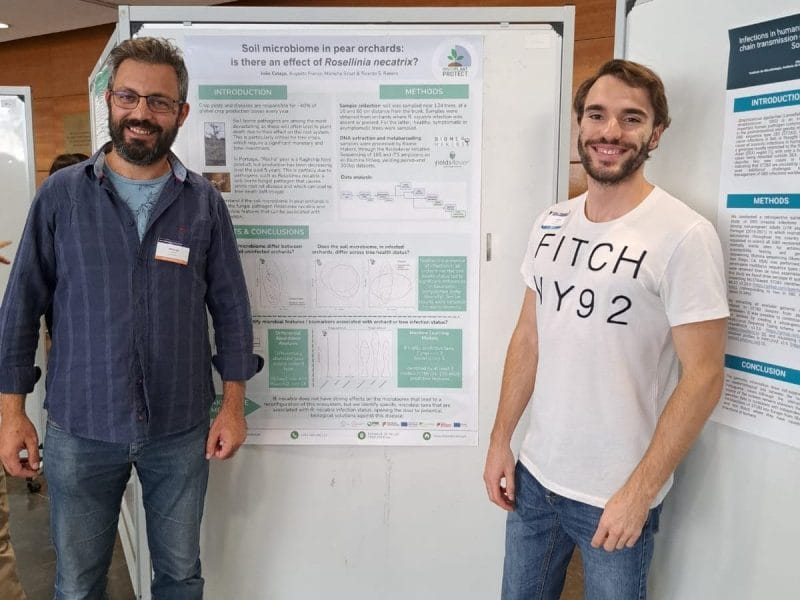
InPP researcher João Colaço was also present at the event to present the poster “Soil microbiome in pear orchards: is there an effect of Rosellinia necatrix?.

Today marks the end of another edition of the Microbiome PT Summit! In 2024 it's back in Lisbon!

More information can be found on the event page here.

InnovPlantProtect (InPP) will take part in the 12th National Meeting on Integrated Protection (ENPI), promoted by the Escola Superior Agrária de Elvas (ESAE) of the Polytechnic Institute of Portalegre (IPP), which will take place on October 30 and 31, 2023.

With the motto “Integrated Protection's Contribution to the SDGs”, the meeting aims to bring together experts from research, teaching and production, as well as young students interested in the protection of plants and plant products, to analyze, share knowledge, propose and debate innovative ideas and techniques for protecting crops and agricultural products.

ENPI will address four main thematic areas such as “Crop protection in the context of climate change and globalization”, “Recovering the concepts of “Risk estimation” and “Decision making” in the context of emerging problems”, “Plant defence mechanisms” and “Alternative means of protection”.

The director of the New Biopesticides department, Cristina Azevedo, will be one of the guest speakers at session 4 entitled “Towards new bio-based solutions to control plant diseases”.

Registration for ENPI is still open until October 29, 2023 using the form available here ahere.

More information on the event website here.

Don't miss the chance to be part of the 12th edition of ENPI!

On October 23rd, InnovPlantProtect (InPP) was present at the conference “Cereals in Portugal: From Volatility to Valorization” promoted by the Association of Protein, Oilseed and Cereal Producers (ANPOC) and which took place at NEW IMS - Campolide Campus, in Lisbon, and addressed fundamental issues related to cereal production in Portugal and the international market.

The main objectives of this meeting were to discuss how national cereal production is facing the challenges posed by the volatility of the international market. In addition, it sought to draw the attention of Portuguese public opinion to the critical issues in the international cereal market and to find ways of enhancing national production while guaranteeing minimum security stocks.

The colloquium was attended by experts and opinion leaders from the agricultural sector, including Rogério Ferreira, Director General of the Directorate General for Agriculture and Rural Development, Miguel de Castro Neto, Director of NOVA IMS, and Arnaud Petit, Executive Director of the International Grains Council.

One of the highlights of the event was the presentation of the project developed by ANPOC, in partnership with NOVA University and the National Rural Network. This project demonstrates how the agricultural sector in Portugal is evolving in a sustained and integrated way.