O InPP marcou presença no Encontro com orizicultores e técnicos(as) em Portugal, promovido pela EDAF, que decorreu no dia 5 de março, no Pólo de Inovação de Salvaterra de Magos, em Santarém.
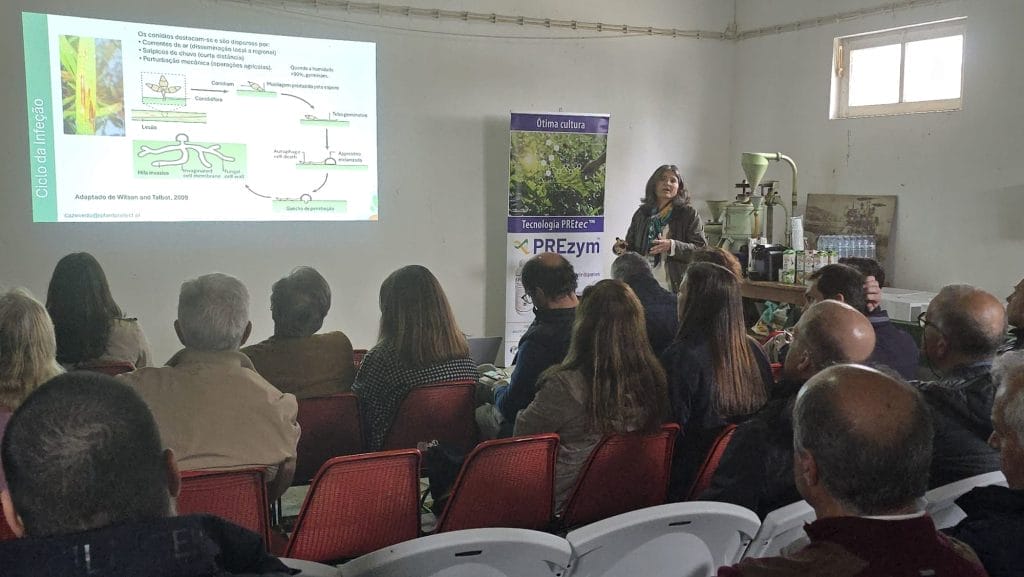
A Diretora de Biosoluções do InPP, Cristina Azevedo, integrou o painel de oradores convidados, tendo apresentado a comunicação intitulada “A problemática da Pyricularia na cultura do arroz”. A apresentação incidiu sobre os principais desafios fitossanitários associados a esta doença, que continua a constituir uma das maiores ameaças à produção de arroz a nível mundial e também em Portugal.
O encontro reuniu produtores, técnicos e especialistas da fileira do arroz, proporcionando um espaço de partilha de conhecimento e debate sobre soluções atuais e em desenvolvimento para o controlo da piriculariose. Foram igualmente abordados outros temas relevantes para a sustentabilidade e produtividade da cultura, nomeadamente a gestão da fertilização.
A participação do InPP neste tipo de iniciativas reforça o compromisso da instituição com a inovação, a transferência de conhecimento e o desenvolvimento de soluções sustentáveis para a agricultura nacional.
O InPP agradece à EDAF e ao COTArroz o convite e a organização deste importante encontro, esperando que esta colaboração continue a fortalecer-se no futuro.
The project TomaBioTec started in January with the aim of developing and validating innovative solutions that contribute to a more sustainable and efficient production of tomatoes in the industry, in line with the current challenges of the agri-food sector, by integrating biotechnology and digital technologies.
The initiative aims to evaluate, under real field conditions, the effectiveness and efficiency of a biosolution with bioprotective and/or biostimulant properties, developed by InnovPlantProtect (InPP), This could help improve the quality and productivity of industrial tomato crops.
The rehearsals take place at Alentejo and Spanish Extremadura and combine traditional agronomic methods with advanced technologies, such as drones, multispectral sensors and artificial intelligence models. This approach allows detailed monitoring of the health of the crop, the presence of pests and diseases and the impact of the bioproduct throughout the production cycle.
The project “TomaBioTec: New biological and digital solutions for tomato crop protection and fertilization” is led by the InPP, in collaboration with the Centro Tecnológico Nacional Agroalimentario Extremadura (CTAEX) and Cordeiro Group, and was selected as one of the winners of the 7th edition of the Promove Program, The prize was awarded by the “la Caixa” Foundation, in partnership with Banco BPI and the Foundation for Science and Technology (FCT), in the category of innovative pilot projects.
This project reinforces the commitment to biological and digital solutions as drivers of more sustainable, competitive agriculture based on scientific evidence, with a direct impact on producers and industry.
InnovPlantProtect (InPP) was present at the XVI National Maize Congress, which also included the 2nd Meeting of Cereal Crops, organized by ANPROMIS, in collaboration with ANPOC and AOP. The event took place on February 11 and 12 at CNEMA in Santarém, bringing together national and international experts to discuss the sector's main challenges.
António Saraiva, Executive Director of InPP, took part in the panel “Cereal Production: What technical challenges are we facing?”, where he highlighted the decisive role of research in responding to the emerging challenges of cereal production, in a context of growing demographic, environmental and economic pressure.
“I'm proud that today, after seven years, we have 28 researchers working full-time on this topic, 12 of whom have PhDs, with experience in crops such as rice, which has been central to our work,” he said, emphasizing the multifunctional and international nature of InPP's teams.
He also pointed out that the work being done extends beyond rice to include maize, through ongoing projects and new operational groups focused on emerging crop problems. Among the initiatives in the spotlight is an application to Horizon Europe focused on developing improved and more resilient varieties.
For António Saraiva, anticipation is the key to success: “These challenges can't wait too long to be discussed or resolved. The sooner we anticipate the issues, the easier, more effective and more economical the solutions will be.”
In a debate that also marked the 40th anniversary of Portugal's integration into Europe and the role of the Common Agricultural Policy in the cohesion of the European Union, one message was clear across the board: “Climate change is the biggest threat we have.”
InPP thus reaffirms its commitment to innovation, science and the development of sustainable solutions for the future of cereal crops.
InnovPlantProtect (InPP) is participating for the first time in the 56th edition of AGRO - International Agricultural, Livestock and Food Fair, which takes place from March 21st to 24th, no Altice Forum Braga. The professional agricultural fair brings together the main players in the agricultural and agri-food sectors, with the aim of promoting debate and sharing knowledge about the circular economy, natural resource management and innovation in agricultural and food production. InPP will be present with its own stand which aims to be a networking space that will showcase the innovative bio-based and digital solutions available for protecting crops against pests and diseases.
Image credits: Altice Forum Braga
The collaborative laboratory (CoLAB) will welcome visitors at the stand no. F88, among the 10 a.m. and 8 p.m., At the fair, InPP's researchers will be on hand to showcase their activities, the specific bio-based and digital products and services they have to offer the agricultural sector and the market, and the various projects underway. Throughout the four days of the fair, some of InPP's researchers will be at the stand to show visitors the various features of the Elvas CoLAB, which has developed innovation that it hopes will contribute to the sustainability of agricultural systems.
Other topics and services in the spotlight will be microbiome analysis, the development of strategies to obtain plants that are more resistant to pests and diseases and risk models, molecular identification and diagnosis services, in vitro plant establishment and maintenance services, plant variety genotyping services, the application of artificial intelligence and drone image analysis to develop early detection tools for various fungi, the monitoring and diagnosis of pests in various crops, as well as the Xyllela fastidiosa bacterium, GIS-based decision support systems, among many others.
AGRO, one of the largest fairs in the agricultural sector, the most important in the north of the country, and the only Portuguese fair to be part of Eurasco - European Federation of Agricultural Exhibitions and Show Organizers, is promoted annually. In 2023, the fair, organized by InvestBraga - Agência para a Dinamização Económica and the Municipality of Braga, had more than 200 exhibitors and was visited by more than 45,000 visitors.
Ricardo Pinheiro and the other Socialist Party (PS) candidates for the Portalegre constituency in the Portuguese Parliament visited InnovPlantProtect (InPP) in Elvas on Wednesday, March 6, with the aim not only of getting to know the collaborative laboratory's facilities and technological equipment, but also of sharing information and exchanging ideas on how the work of the InsectERA Mobilizing Agenda is progressing.
The delegation was welcomed by InPP's executive director, Pedro Fevereiro, and Daniel Murta, EntoGreen's managing director and chairman of the board.
The visit began with an informal and relaxed conversation between all those involved. Daniel Murta opened the visit by giving a brief presentation of the mobilizing agenda, identifying the objectives, as well as the commitment between the 42 entities involved, with the main aim of creating a new bioindustrial sector in Portugal using insects as a tool for developing new services and products in areas such as animal and human food, the cosmetics industry, or bioplastics and as bioremediation tools, by creating solutions for recovering organic waste.
The Chairman of the Board of EntoGreen, the leader of the agenda, also emphasized the funding of 43 million euros and the importance it will have for the district of Portalegre, the Alentejo region and the country, highlighting the 50 new jobs that have been created in the region as part of the agenda.
EntoGreen's CEO said that the InsetERA agenda “has the ambition to foster the circular economy, leverage the development of innovative insect-based technological solutions for the market and build new factories that will convert olive pomace into fertilizers, proteins and oils through the use of insects”.
It's worth remembering that olive pomace is a polluting by-product and a concern for olive oil producers, which can be transformed into nutritional solutions for plants and animals. Daniel Murta goes on to describe the process: “Best of all, part of this pomace can even be returned to the soil that generated the olives, in the form of organic fertilizers that enrich the soil, closing the cycle of nutrients that would otherwise be wasted.”
EntoGreen's CEO took the opportunity to call for continued joint work with the government to implement the agenda and also warned against “rethinking the extension of the completion date” of the agenda, since the date stipulated when the project application was accepted “could jeopardize the success of the Agenda”.
The executive director of InPP began by emphasizing the team of more than 40 researchers, from various nationalities, who work in the Elvense collaborative laboratory and presented the innovation around plant protection and the challenges facing agriculture to reduce the use of insecticides in national and European agriculture, as required by the European Green Deal. Green Deal, in English).
The delegation proceeded to the greenhouse, which was restored at the end of last year, where they were welcomed by Leonor Martins, a researcher from InPP's Specific Crop Protection department, who explained the work being carried out by the team to assess how these end products, which are derived from insects, produce high-value products, including those for plant and soil protection.
InPP leads the InFrass axis, one of the Agenda's nine axes, which aims to use insects as a tool for creating new, sustainable, high-quality organic fertilizers adapted to the agricultural challenges of the future.
The visit ended with a tour of the CoLAB laboratories, where it was possible to meet Hamza Chammem, a researcher from the Formulations and Process Development department, of Tunisian origin, who moved with his family to Elvas to start working at InPP. Hamza is developing to “proof of concept” or prototype level, formulations to deliver biological protection agents, designed to protect crops against pests and diseases.
Ricardo Pinheiro was enthusiastic about the facilities and the work carried out by the InPP team as part of InsectERA. The candidate considered it “very important” for the PS campaign to visit CoLAB and assured that this is a project with “added value for the local economy”. He also said he was “very pleased” to realize that it is possible, from Alto Alentejo and Elvas in this case, to “design projects on this scale”.
The director of InnovPlantProtect's New Biopesticides department, Cristina Azevedo, will take part in the next “MED às 4as” (MED on Wednesdays), on March 6, a round table organized by the MED - Mediterranean Institute for Agriculture, Environment and Development, on “From research to application: the path of knowledge from R&D institutions to Industry”.
The round table aims to deepen understanding of the ways in which technological innovation developed in public and private institutions is implemented so that in the future we can optimize the processes associated with applications for protection and maintenance of intellectual and industrial property rights. The idea is to help researchers explore the commercial potential of their ideas and results, make contacts with industry, and expand the impact of research by promoting the transition of their discoveries and inventions from the laboratory and the field to the benefits of real life.
In addition to Cristina Azevedo, the round table will also bring together Vanda Rebelo, head of the Scientific Activities Management Division at the University of Évora, Bruno Medronho, MED researcher at the University of the Algarve, and Susana Filipe, executive director of the CHANGE Associated Laboratory, specialists in the various areas of technology, from research to the production and licensing of patents, to explore the strategy of building an effective link between innovation and utility, which reinvigorates the transfer of knowledge between the university, industry and society. The moderator will be Patrick Materatski, researcher at MED.
The session will take place in person in the Conference Room of the Mitra Pole, at the University of Évora, between 2pm and 3pm, but it is also possible to watch it via Zoom.





 Português
  English