In the March issue of Fruits, vegetables and flowers you will find the opinion article entitled “The role of InnovPlantProtect in Organic Farming: Paths to sustainable and efficient solutions”, in which the executive director of InnovPlantProtect (InPP), António Saraiva, reveals how our CoLAB is contributing to the success of organic farming.
“By boosting research, collaboration and knowledge sharing, InPP is helping to solve the central challenges of this practice [organic farming], allowing it to expand and enhancing the supply of agricultural products to consumers. The solutions developed by InPP make organic farming a more viable option for producers,” says the executive director.
Read the full article and find out how we are shaping the future of agriculture.
We thank Frutas, legumes e flores magazine for its recognition and reiterate our commitment to the agriculture of the future.
Imagine a future where drones and artificial intelligence work together to protect your vineyards. That's what the AI4Leafhopper project is making a reality!
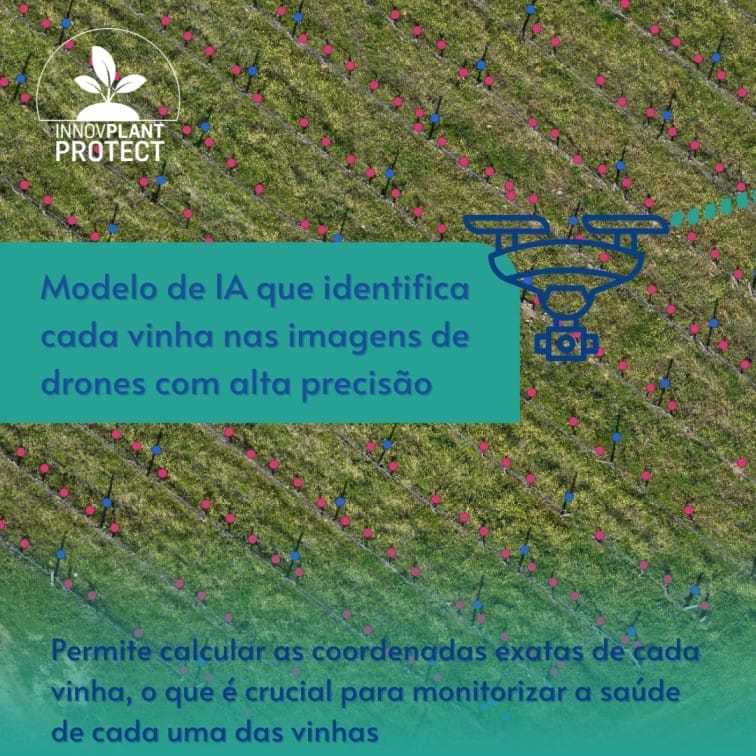
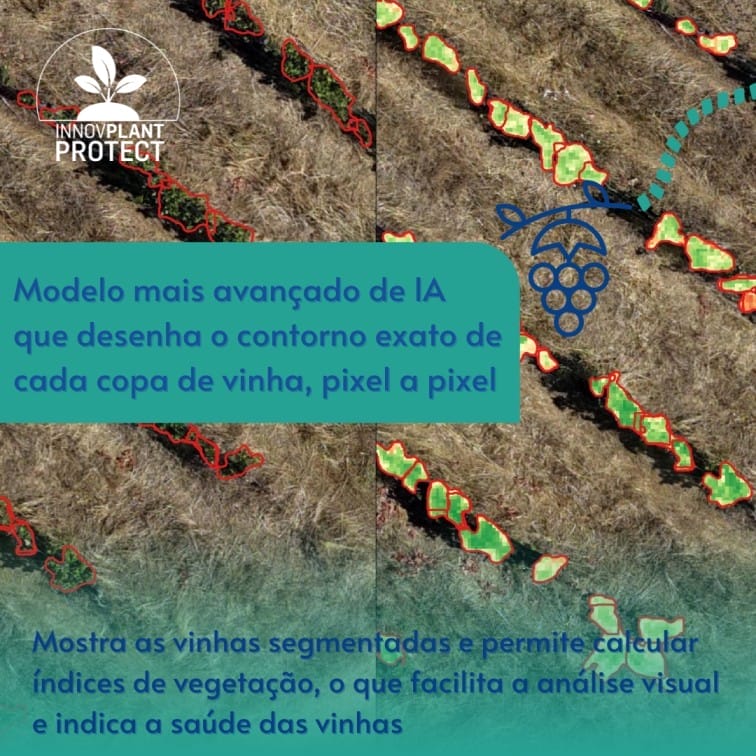
Manisha Sirsat, a researcher on the AI4Leafhopper team, has developed two artificial intelligence models that analyze the aerial images captured by our latest generation drone... and these models make it possible:
geolocation of each vine
to know if there are vine failures
quickly identify “sick” vines”
optimize the application of treatments
The result? Growers can have a detailed view of the health of their vineyards, detect problems early and make more informed decisions.
AI4Leafhopper is a project led by InPP and funded by the ICAERUS Horizon Europe program, which began in April 2024 and ended on April 30 with a final meeting involving the six European projects approved in the 1st edition of the ICAERUS program's PULL applications. The project team presented the AI-based models for detecting and monitoring the impact of the green leafhopper on vineyards.
The AI4Leafhopper project, InnovPlantProtect used a state-of-the-art drone to monitor the impact of the green leafhopper in the vineyards of our partners Reynolds Wine Growers and João Portugal Ramos. Although the results show that this advanced technology is more effective at detecting attacks at advanced stages, we are excited about the potential of this tool to provide valuable data for the management of this harmful insect.
We believe that with more research, we can refine our solution to detect early attacks and prevent significant damage to vineyards. Transforming the monitoring of this pest is where we want to go, always with the aim of protecting vineyards and guaranteeing the quality of production for winegrowers.
Over the next few days we'll be revealing everything that the AI4Leafhopper project is making a reality and how drones and artificial intelligence are working together to create a more sustainable future for viticulture. Stay tuned!
AI4Leafhopper, funded by the ICAERUS Horizon Europe program, which began in April 2024, is now in its final stages. The development phase of the project, which took place in the field, is now over and the final stage is to present the solutions developed by our team on Portuguese soil to the market.
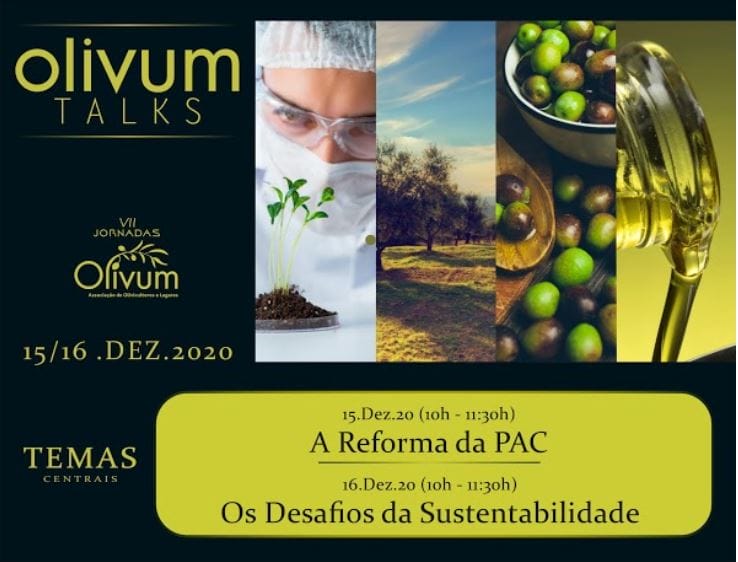
The 7th Olivum Conference will be held on December 15 and 16, this time in digital format. The first day of the event will be dedicated to the “Reform of the CAP” and the second to the “Challenges of sustainability”.
The “Reform of the CAP” will be discussed on the first day of the seventh edition of the Olivum Days, which will be held online on December 15 and 16. The session on the 15th will feature the Minister of Agriculture, Maria do Céu Antunes, MEP Isabel Carvalhais, from the Agriculture Committee, João Pacheco, Senior Fellow at think-tank Farm Europe, Paulo Gouveia, Chief Policy Adviser at COPA-COGECA, and, as moderator, the director of Diário de Notícias Rosália Amorim.
The “Challenges of Sustainability” will be the subject of analysis on the second day of the event, moderated by Isabel Martins, director of Revista Sustentável, and with speeches by Jorge Moreira da Silva, Director of Development and Cooperation at the Organization for Economic Cooperation and Development, João Wengorovius Menezes, Secretary General of the Business Council for Sustainable Development, José Pedro Salema, Chairman of the Board of Directors of Empresa de Desenvolvimento e Infra-Estruturas do Alqueva and João Luís Barroso, Director of Sustainability at the Alentejo Regional Wine Commission.
On both days, the sessions take place between 10:00 and 11:30. Participation is free, but requires registration previous.
Can Europe help feed a growing population while reducing the impact of agriculture on climate and biodiversity? Can farmers produce enough food without pesticides? Can pesticides be part of intelligent pest control, using new and innovative technologies? Find out more later in the webinar “Pesticides and a Resilient Food System”.
The debate on pesticide use is becoming increasingly contentious in Europe. As part of the Green Deal initiative launched in December last year, the European Commission is reviewing the Sustainable Use of Pesticides Directive. But this is an effort that only leads to a more fundamental discussion about the sustainable use of pesticides.
In this fundamental discussion, questions arise such as: can Europe help feed a growing population and keep farmers in business, while reducing the impact of agriculture on the climate and biodiversity? Can farmers produce enough food without pesticides? Can pesticides be part of smart pest management, which uses new and innovative technologies?
On the first anniversary of the Green Deal, Bayer is promoting an Oxford-style webinar on resilience, where two teams will ‘face off’, with the motion for the debate being “Pesticides are not necessary for a resilient food system in the European Union”.
Register to watch. The debate starts today at 16:45 (Portuguese time).
The iPlanta conferences returned this year in a different format to usual, with three webinars on RNA intervention technology (RNAi) and a panel of speakers made up of international researchers.
After the theme “Development of RNAi-based pesticides: new opportunities” on December 1, the 4th edition of the iPlanta conferences starts again today at 5pm, this time dedicated to the environmental biosafety of RNAi-based pesticides. The third and final day of the event will be on December 14, also at 5pm, where regulatory issues will be discussed.
Participation is free but requires registration. Watch the videos of the first session here e here.
iPlanta is a COST action, a European organization that promotes and funds the networking in research and technology. Chaired by Bruno Mezzetti, it aims to review existing and future applications of RNAi, create a bioinformatics database, develop specific biosafety protocols, define post-market monitoring requirements and methods for RNAi plants, and encourage, promote and disseminate research reports by scientists involved in RNAi-related studies.
The importance of the iPlanta Conferences lies in the urgent need to find more effective solutions, through the application of RNAi, one of the new breeding techniques, to combat the pathogenic interactions faced by crops, which are responsible for the loss of substantial amounts of agricultural production worldwide, including in Portugal, where around 40 % of crops are lost every year. In global terms, the figures are similar: according to estimates by the Food and Agriculture Organization of the United Nations (FAO), between 20% and 40% of crops are destroyed every year due to pests and diseases.
With the estimated increase in population, modern agriculture is facing one of its greatest challenges: guaranteeing food supplies for 10 billion people in just 30 years' time. The application of RNAi technology promises to respond effectively to this challenge.





 Português
  English